Storage Fort Lauderdale: Your 2026 Local Guide
You're probably here because your place feels tighter than it should. Maybe you're moving out of a Flagler Heights apartment and the lease dates don't line up. Maybe you're trying to clear space in a Victoria Park condo without giving up the things you use part of the year. Maybe you just opened a closet in Fort Lauderdale and realized it's doing the job of a garage, attic, and guest room all at once.
That's normal in this city. A lot of homes and apartments here work well for daily living, but not for overflow. Beach gear, holiday bins, work files, baby gear, extra kitchen appliances, and the furniture you swear you'll use again all start competing for the same square footage. The problem isn't just clutter. It's that clutter makes every move, renovation, and life transition harder than it needs to be.
Good storage should give you breathing room, not one more errand. In Fort Lauderdale, that distinction matters because space is tight and demand is high. Facilities in this market are running at an average 91.6% occupancy, and the city has only 8.13 to 11.87 square feet of storage per capita, according to Fort Lauderdale self-storage market data. That means the wrong decision can cost you time, money, and patience.
I look at storage the same way warehouse teams look at overflow inventory. The principle is simple. Keep what you need accessible, move what you don't, and avoid paying for wasted space. If you want a useful framework for that thinking, Material Handling USA industrial storage solutions show how professionals approach space efficiency at a larger scale. At home, the same logic applies.
Before you rent anything, estimate what you need to store. A quick storage space calculator can keep you from paying for far more room than your belongings require.
Navigating Your Fort Lauderdale Storage Needs
A Las Olas move and a simple decluttering project can look similar on paper, but they call for different storage setups. If you're between homes, access timing matters. If you're trying to reclaim a second bedroom or clear out seasonal items, convenience matters more than square footage.
Start with the real problem
Many individuals don't need “more storage.” They need one of these:
- Short-term breathing room during a move, remodel, or staging period
- Off-site space for items they use only a few times a year
- Safer conditions for belongings that shouldn't sit in a hot, damp unit
- Less friction than loading a car and driving across town every time they need one box
That last point gets overlooked all the time. In Fort Lauderdale, a storage run isn't always quick. Traffic, parking, elevator access, and loading rules can turn a simple drop-off into half a day gone.
Practical rule: If accessing storage feels harder than dealing with the clutter, you picked the wrong setup.
Match storage to your neighborhood and routine
The storage fort lauderdale search results usually push everyone toward the same answer. Rent a unit. Bring your own vehicle. Handle the loading. Visit the property when you need something. That works for some people, especially if they're storing furniture, tools, or large household loads.
But urban apartment living changes the math. If you're in a walkable area, work long hours, or don't have easy parking, the effort of using a traditional facility becomes part of the cost. Not the posted monthly price. The lived cost.
The goal is simple. Store enough to make your home functional again, without creating a storage routine you'll resent.
Traditional Units vs Modern Valet Storage
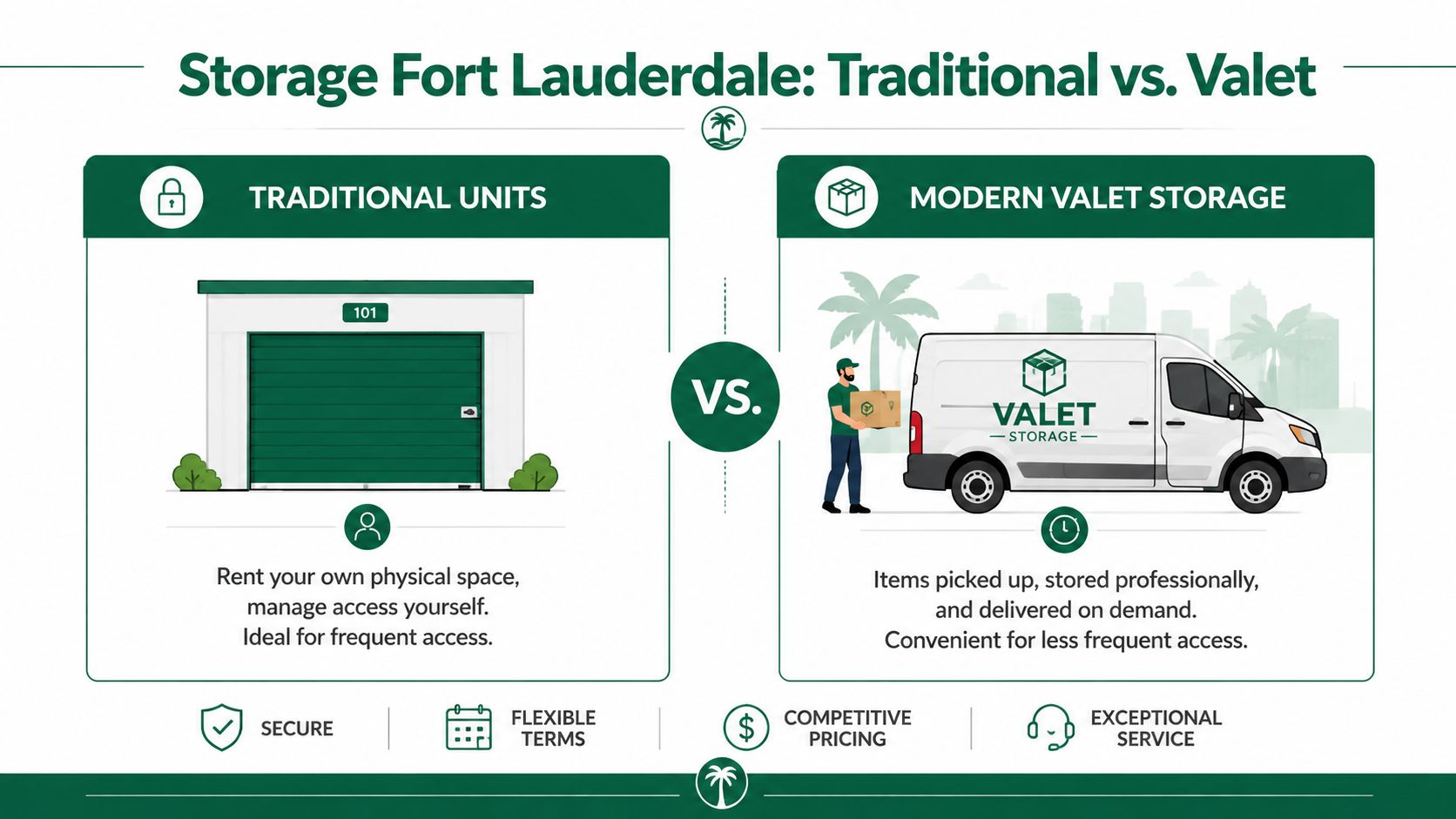
Most Fort Lauderdale storage options fall into two models. Traditional self-storage gives you a room you manage yourself. Valet storage works more like on-demand logistics. Someone picks up the items, stores them, and brings them back when you ask.
How the two models actually feel to use
Traditional storage is like renting a car. You get control, but you also do the driving, fuel, loading, timing, and navigation.
Valet storage is closer to a rideshare. You're not renting space for the sake of having space. You're paying for the service of moving and holding specific items with less hassle.
Fort Lauderdale's online storage market still leans heavily toward drive-up units and facility visits. That leaves a gap for dense neighborhoods and apartment residents. There's been a 25% rise in “mobile storage” queries in Florida's urban markets, as noted in this Fort Lauderdale facility-market review. That tracks with what people ask in real life: “Can someone just take these boxes?” and “Do I really need to rent a whole unit for a few bins?”
For a broader look at that shift, this guide to modern storage solutions lays out why more city residents are moving away from the one-unit-fits-all model.
When a traditional unit makes sense
A standard facility is usually the better fit when:
- You need frequent access: Contractors, resellers, and anyone rotating inventory often want direct entry.
- You're storing bulky items: Couches, appliances, mattresses, and full apartment loads fit the unit model better.
- You already have a truck or easy transport: If hauling isn't a headache, self-service gets easier.
When valet storage makes more sense
Valet or by-the-box storage works better when the issue is convenience, not volume.
- Apartment overflow: Extra clothes, files, decor, kids' gear, and keepsakes
- No car or limited parking: Common problem in denser parts of Fort Lauderdale
- Infrequent retrievals: You don't need to stop by every weekend
- Small loads: You only need to store boxes, not a whole room
If you're paying for empty floor space because your stored items don't fill a unit, you're buying the wrong product.
One isn't universally better than the other. The mistake is renting a full room when your real need is pickup, secure storage, and occasional returns.
Analyzing Fort Lauderdale Storage Costs
Fort Lauderdale is not a bargain storage market. If you shop only by the teaser rate on a facility page, you can end up with a setup that looks cheap at first and costs more once real life enters the picture.

What the local numbers look like
In Fort Lauderdale, a 5x5 unit typically starts around $42 per month, a 10x30 can run up to $476 per month, and the average climate-controlled unit is about $117 per month, according to Fort Lauderdale storage unit pricing data.
That spread matters. A lot of renters start with the idea that they'll grab something small and cheap. Then they realize they need climate control, elevator access is annoying, or the amount they're storing doesn't fit the smallest size. Costs climb fast when the unit size doesn't match the actual load.
The posted rate isn't the whole cost
When I help people think through storage fort lauderdale options, I tell them to calculate the total monthly burden, not just the listed rent.
Look at these cost layers:
- Location pressure: Waterfront-adjacent and high-demand areas often price higher than inland neighborhoods. Better deals are often found farther from the coast.
- Unit mismatch: Renting a room means paying for square footage whether you use it or not.
- Climate-control premium: Often worth it here, especially for sensitive items
- Visit costs: Gas, tolls, time away from work, and the reality of loading and unloading in Florida heat
Side-by-side comparisons help. If you want to sanity-check pricing structures, compare storage unit prices by use case, not just by advertised monthly rent.
A smarter way to budget
Here's the practical budgeting framework I use:
| Storage situation | What to watch for | Best budgeting approach |
|---|---|---|
| A few boxes from a small apartment | Overpaying for unused unit space | Price by item count, not room size |
| Full move or whole-room storage | Underestimating space needs | Budget by furniture volume and access frequency |
| Seasonal storage | Paying year-round for rarely used items | Favor flexible terms and easy retrieval |
| Sensitive valuables | Choosing the cheapest non-climate option | Budget for protection first, price second |
Cheap storage gets expensive when it creates repeat trips, damaged items, or space you never use.
The best deal is the option that fits your actual belongings and your actual routine. Not the one with the smallest number in the ad.
Climate Humidity and Hurricane Preparedness
South Florida storage rules are different from storage rules in drier places. Humidity changes everything. If you're storing in Fort Lauderdale, climate control isn't a fancy add-on for many categories of belongings. It's basic protection.
According to Fort Lauderdale climate-controlled storage data, humidity in this subtropical climate often exceeds 75%. Under those conditions, paper documents in non-climate-controlled storage can lose 20% to 30% of their tensile strength within six months. Advanced facilities maintain 40% to 55% relative humidity and are built to CAT-5 hurricane standards, withstanding 150+ mph winds.
What absolutely needs climate control
Don't gamble with these:
- Paper records and photos: Birth certificates, tax files, printed archives, art paper
- Wood furniture: Especially anything veneered, antique, or sentimental
- Electronics: TVs, speakers, computers, gaming systems, cables in sealed bins
- Textiles and leather: Rugs, handbags, jackets, uniforms, costume storage
- Artwork and collectibles: Canvas, framed pieces, prints, memorabilia
- Wine or specialty household goods: Anything affected by prolonged heat and moisture
A lot of damage starts subtly. Boxes look fine from the outside. Inside, pages curl, leather stiffens, and mildew starts where airflow is poor.
Hurricane resistance matters too
Climate control and stronger construction often go together. In Fort Lauderdale, that matters during storm season. Better-built facilities usually give your belongings more protection than basic garage-style units with minimal environmental control.
If you also have marine gear or seasonal water equipment in the mix, this article on boat storage in Miami is useful for understanding how coastal storage needs differ when weather exposure is part of the equation.
Here's a quick visual on what good protected storage should account for in Florida:
The local rule that saves people money
If an item would bother you to replace, climate control is usually the cheaper decision than rolling the dice on a damp unit. That's especially true for family records, framed pieces, and anything made of paper, fabric, wood, or leather.
How to Choose Your Ideal Storage Solution
Choosing between a facility and a valet-style service gets easier when you stop asking, “Which one is better?” and ask, “Which one fits how I live?”
Ask yourself these five questions
Start with access. Then work outward.
How often will you need something back?
If you need weekly access, a traditional unit is usually easier. If retrievals are occasional, convenience can matter more than direct entry.Are you storing furniture or mostly boxes?
Furniture-heavy loads point toward a unit. Box-heavy storage works better with more flexible models.Do you have easy transportation?
If every trip requires borrowing a car, reserving a van, or dealing with building loading rules, self-service gets old fast.Are the items sensitive?
If yes, put climate conditions and handling standards high on your checklist.Are you solving a temporary problem or creating a long-term habit?
For short transitions, simple logistics often beat maximum space.
Security should be part of the decision
People often get too casual. They assume every facility is “secure enough.” That's not how I'd shop in Broward.
According to North Lauderdale storage security benchmarks, features like electronic gate access and 24/7 surveillance can reduce break-ins by up to 85%. Facilities with individual unit alarms also see insurance claim rates drop from $0.15 per square foot to as low as $0.03 per square foot.
So don't just ask whether a property has cameras. Ask what kind of access control exists, whether units have individual alarms, and who is watching the property when something looks off.
Security starts with the boring questions. Gate access, alarms, lighting, and who responds when there's a problem.
Choosing Your Storage Self-Service vs Valet Service
| Consideration | Traditional Self-Storage | Valet Box Storage (e.g., Endless Storage) |
|---|---|---|
| Access style | You drive to the facility and enter your unit | You request pickup and return of stored items |
| Best for | Furniture, large loads, frequent in-person access | Boxes, seasonal items, apartment overflow |
| Transport burden | You handle loading, driving, and unloading | The service removes the facility trip |
| Space model | Rent a full unit size | Store only what you send |
| Security questions to ask | Gate control, cameras, alarms, staffing | Handling process, facility conditions, insurance terms |
| Good fit for Fort Lauderdale apartments | Sometimes, but less convenient without a car | Usually stronger for limited-space households |
My practical recommendation
If your storage needs look like a mini-warehouse, rent a unit. If your storage needs look like a closet that exploded, don't pay for a room.
That one distinction saves people a lot of frustration.
Packing Insurance and Access Logistics
Once you've chosen a storage model, execution matters. Packing badly can ruin good storage. So can skipping insurance details and assuming access will be simple later.
Pack like you want the items back in the same condition
Use smaller boxes for books and heavier items. Use larger boxes for light items like linens and decor. Seal every seam, not just the top flap.
If you're moving house and need a refresher on box types and packing bundles, these moving house packing options are a helpful reference for choosing materials by room and item type.
A few rules I insist on:
- Label two sides and the top: One label isn't enough when boxes stack.
- Keep an inventory note: A simple phone note beats guessing later.
- Wrap moisture-sensitive items: Inner protection matters even in controlled environments.
- Don't overpack cartons: Crushed boxes fail from the bottom first.
- Use bins carefully: Great for some categories, but cardboard can be easier to label and stack consistently.
Understand what insurance does and doesn't do
A lot of renters assume the facility is automatically responsible for everything. Usually, coverage has limits, conditions, or exclusions. Ask what's covered for water damage, mold, theft, handling damage, and declared value.
If you want a practical breakdown before you sign anything, this guide to insuring items in storage is worth reading.
“Covered” and “fully reimbursed” are not the same thing. Read the limits before you store anything sentimental.
Make retrieval simple before you need it
Traditional unit users should confirm:
- Access hours: Don't assume 24/7 entry
- Entry method: Gate code, app access, office check-in, or key
- Loading conditions: Elevators, carts, covered unloading, and parking
Valet-storage users should confirm the pickup process, item labeling rules, return timing, and how requests are submitted. The easiest time to fix a logistics issue is before your items leave your home.
A smooth storage experience usually comes down to boring prep. Good labels, realistic insurance, and clear retrieval rules prevent most avoidable headaches.
Your Next Step to a Clutter-Free Space
The best storage fort lauderdale choice depends on what you're trying to solve. If you need room for furniture, want regular access, and don't mind handling transport yourself, a traditional unit may fit. If you live in a smaller apartment, store mostly boxes, and want less friction, a facility-free option is often the cleaner answer.
Keep your decision centered on four things:
- What you're storing
- How often you'll need it
- How sensitive those items are
- How much effort you want storage to require
That last one matters more than people think. A storage plan only works if you'll use it without resenting every trip.
If you're storing valuables, collectibles, or items with a higher replacement cost, it also helps to understand the insurance side beyond standard storage coverage. For a practical look at safeguarding your rare collections, scheduled personal property coverage is worth reviewing before you put those items anywhere off-site.
Clear space should make your life simpler. That's the standard. If the option you're considering adds too many steps, too many trips, or too much unused space, keep looking.
If you want a simpler way to store boxes, seasonal items, and apartment overflow without driving to a unit, take a look at Endless Storage. It's built for people who want storage to be flexible, climate-conscious, and easy to manage without turning it into another weekend chore.