Modern Storage Solutions: Find Your Perfect Space in 2026
Your apartment probably doesn’t feel small because of the square footage alone. It feels small because life keeps stacking itself in corners. Winter coats stay out too long. Moving boxes never fully disappear. Hobby gear takes over the closet. A “temporary” pile by the door becomes part of the furniture.
That’s why modern storage solutions matter. They’re not just places to put things. They’re tools for handling real life without letting your home turn into a waiting room for stuff.
A useful way to think about storage is this: what job do you need it to do? Are you trying to survive a move, create breathing room in a studio apartment, store seasonal items, or buy yourself time before making bigger decluttering decisions? Once you know the job, the right solution gets much easier to spot.
The Reality of Urban Living and the Need for Space
Maya lives in a one-bedroom apartment and works from home three days a week. Her dining table is also her desk. Her hallway closet holds cleaning supplies, luggage, and holiday decorations. When her lease renewal came up, she realized she didn’t need a bigger place as much as she needed less friction in the one she already had.
That’s a common moment. People don’t usually wake up wanting storage. They want a usable entryway, a bed that isn’t surrounded by laundry baskets, or a smoother move when life changes fast.
Why this problem is bigger than one apartment
Urban living makes every object more visible. In a larger home, extra items can drift into a basement, garage, or spare room. In a small apartment, they land in plain sight. That’s why storage becomes part of daily quality of life, not just a once-a-year cleanup project.
If you’re trying to make a small place work better, these small apartment storage ideas from Endless Storage can help you spot what belongs at home and what doesn’t.
This need is widespread. The self-storage industry includes over 50,000 facilities in the U.S., and sales volumes reached nearly $3.4 billion in 2023, which shows just how many people rely on storage to manage downsizing, urban living, and life transitions, according to Storeganise’s review of self-storage growth.
Storage isn’t only about excess. Often, it’s about timing. You need some things, just not in your home right now.
Common life events that create a storage job
Different moments create different storage needs:
- Moving between places: You may need temporary breathing room while dates, keys, and furniture delivery don’t line up neatly.
- Downsizing: The items still matter, but your new floor plan can’t hold them all.
- Seasonal living: Ski gear, heavy blankets, fans, and decorations take up space for most of the year.
- Decluttering without panic: Sometimes you need distance before deciding what to keep, donate, or sell.
When you frame storage around the job it needs to do, it stops feeling like surrender. It becomes a practical way to reclaim room, routine, and mental space.
Understanding Your Modern Storage Options
A lot of people still picture storage as a metal roll-up door in a dusty hallway. That option still exists, but the category is much broader now. Modern storage solutions include services, home systems, and tech-enabled setups designed for different kinds of lives.
Traditional self-storage
This is the classic model. You rent a unit, pack your items, transport them yourself, and visit when needed. It’s straightforward and familiar.
It works well when you need to store bulky furniture, want direct control over packing, or expect to visit your things in person. The tradeoff is effort. You handle the driving, lifting, and time.
Climate-controlled facilities
This is traditional self-storage with a more protective environment. Think of it as indoor parking for belongings that dislike heat, humidity, or temperature swings.
It’s useful for items like books, artwork, electronics, wooden furniture, and family keepsakes. If you’re storing things you’d worry about in a garage or shed, this option usually makes more sense.
Storage-by-the-box services
This model works a lot like cloud storage for physical items. You pack boxes, a company picks them up, stores them off-site, and returns them when you ask.
That setup makes sense for apartment living because you don’t need a car, a truck rental, or a full unit for a handful of things. If you’re curious how the process works in practice, this guide to on-demand storage gives a clear overview.
Practical rule: If your biggest problem is transport, not lack of nearby facilities, service-based storage usually deserves a closer look.
Smart and connected storage units
Some facilities now offer digital access tools, sensors, app-based account management, or better tracking. You might see features like remote gate access, inventory support, or status notifications.
The main benefit isn’t that the unit itself is “smart.” It’s that your storage becomes easier to manage without so much guesswork. For people juggling work, family, and moving logistics, that can make a real difference.
Integrated in-home systems
Not every storage problem should leave your home. Built-in shelves, under-bed drawers, lift-top benches, modular wardrobes, and wall-mounted systems can store frequently used items while keeping them accessible.
This option suits belongings you use often but don’t want on display. Sports gear, office supplies, extra bedding, and pantry overflow often fit here better than in off-site storage.
For readers comparing local approaches and facility features, Emmanuel Transport's Perth storage guide is a helpful example of how moving and storage needs often overlap in real life.
A simple way to sort the options
Ask yourself which of these sounds most like your current problem:
- “I need extra space outside my home.” Traditional or climate-controlled storage may fit.
- “I need storage without doing the hauling.” Storage-by-the-box is often a cleaner match.
- “I need my home to work harder.” Built-in or modular in-home systems are usually the first place to start.
- “I want fewer surprises and easier tracking.” A connected or app-supported option may reduce stress.
The right choice starts with the job, not the label.
A Head-to-Head Analysis of Storage Solutions
Definitions are useful. Decisions are harder. Once you know the options, you still have to choose based on what matters most to you in real life.
Typically, five questions drive the choice: How do you pay for it? How much work does it create? What kind of access do you get? What problem is it best at solving? And what’s the environmental cost of using it?
The comparison that matters
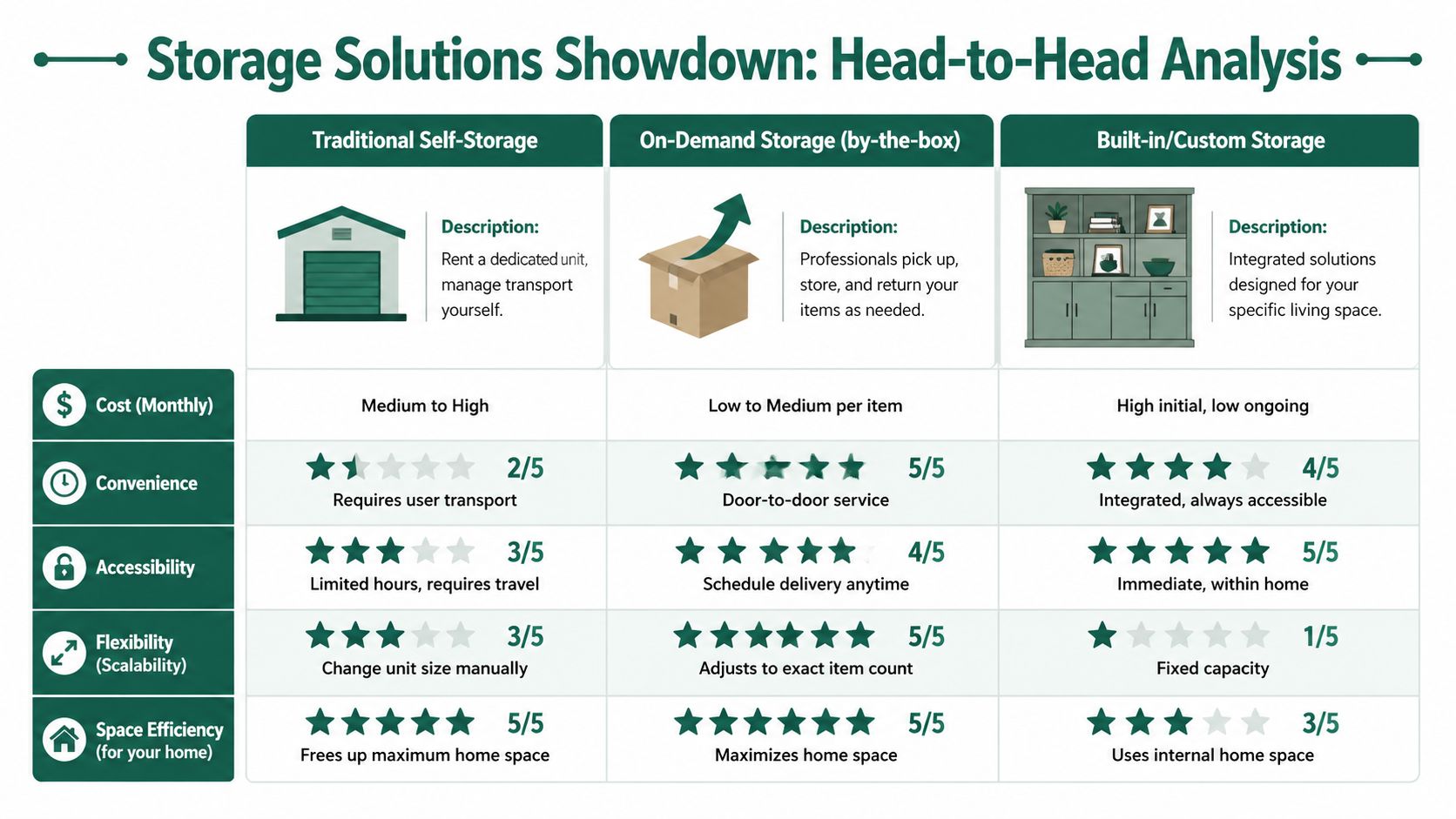
| Modern Storage Solutions Comparison | Cost Model | Convenience | Best For | Sustainability Factor |
|---|---|---|---|---|
| Traditional self-storage | Monthly unit rental | You pack, drive, load, and visit yourself | Furniture, large mixed loads, long-term overflow | Can create a higher footprint because facilities stay running and customers make trips |
| On-demand storage by the box | Pay per box or item | Pickup and return service reduces hands-on effort | Small-space living, seasonal items, temporary decluttering | Route-based pickup and fewer personal trips can be a lower-impact option |
| Built-in or custom storage | Upfront home investment | Always available at home | Daily-use items, small homes, organization upgrades | Avoids off-site transport but uses space inside your home |
Convenience is really about labor
People often say they want the “cheapest” option, but they usually mean the least painful total experience. A low monthly rate can stop looking cheap once you add packing time, travel, fuel, stairs, and the hassle of retrieving one box buried behind ten others.
That’s why convenience deserves its own category. Traditional self-storage gives you control, but it also gives you the full workload. Built-in home storage gives instant access, but only if you still have room to spare. By-the-box services remove much of the transport problem, which is often the hardest part for urban residents.
If cost is your first filter, this breakdown of storage unit cost comparisons can help you think through what you’re paying for.
When you compare storage options, count your time and physical effort too. Monthly price is only one part of the real cost.
Sustainability deserves a seat at the table
Most storage decisions focus on money and access. Very few include environmental impact, even though that choice can change which option looks sensible.
Recent data highlighted by PRKED’s look at urban storage and sustainability shows that traditional self-storage facilities can generate 15 to 20 percent more carbon per square foot than on-demand box services because of constant facility operations and customer transport. The same review notes that by-the-box services can reduce related emissions by up to 40 percent through optimized logistics.
That doesn’t mean every traditional unit is the wrong choice. It means sustainability should be part of the decision, especially if your storage job involves a modest number of boxes rather than a full apartment of furniture.
A quick decision filter
Use this when you’re stuck:
- Choose traditional self-storage if you need to store large furniture, want direct access, and don’t mind handling transport.
- Choose on-demand storage if you live small, hate the hauling part, and want flexibility for a limited number of items.
- Choose built-in storage if the problem is poor organization inside your home, not true lack of total capacity.
A good choice solves the actual job with the least waste of money, effort, and space.
Matching the Right Solution to Your Life Situation
Storage decisions get easier when you stop asking, “What’s the best kind of storage?” and start asking, “What am I trying to get done right now?”
The urban down-sizer
Leah moved from a suburban townhouse into a city apartment after her kids left home. She didn’t want to get rid of family furniture too quickly, but her new place couldn’t absorb every side table, serving dish, and memory box at once.
Her storage job wasn’t permanent warehousing. It was creating a buffer between one chapter of life and the next. She needed time to decide what fit her new routine.
For someone like Leah, climate-controlled storage or a carefully chosen traditional unit often makes sense if the items include furniture, artwork, or keepsakes that need protection. The key is that she’s storing decision-heavy belongings, not just random overflow.
The right storage choice often buys clarity first and square footage second.

The inter-state mover
Andre accepted a job in another state. His new lease started later than his old one ended, and he didn’t want to drag every box through a short-term rental while he learned the city.
His storage job was flexibility. He needed something temporary, easy to manage from a distance, and simple to retrieve in stages once he settled in.
A service-based model often fits this kind of move well, especially when the load is mostly boxes, clothes, books, and household extras. He doesn’t need a whole unit. He needs less chaos during a transition.
The seasonal declutterer
Nina isn’t moving anywhere. She just wants her apartment to stop pretending it has endless closets. Her winter coats, holiday decor, spare bedding, and camping gear crowd the same shelves year-round.
Her storage job is rhythm. She needs to rotate belongings out of the apartment when they’re not useful, then bring them back without turning retrieval into a weekend project.
For her, the best answer could be by-the-box storage or a stronger in-home system, depending on how often she needs those items. If she wants maximum convenience and less clutter, off-site service is attractive. If she reaches for things often, integrated home storage may be smarter.
A job-to-be-done shortcut
If you recognize yourself in one of those stories, match your situation like this:
- You’re moving and dates don’t line up: Choose flexibility and easy retrieval over maximum space.
- You’re downsizing with emotional items: Prioritize protection and decision-making time.
- You’re fighting seasonal clutter: Focus on low-friction rotation, not just raw capacity.
- You’re overwhelmed by daily mess: Start with in-home storage before paying to move frequently used items off-site.
Storage works best when it supports the life event you’re in, not the one you wish you were in.
The Ultimate Convenience The Endless Storage Model
A lot of city storage problems are really time and friction problems. You may only need to get six boxes out of a hallway, clear a closet before guests arrive, or create breathing room during a move. In those cases, a full storage unit can feel like renting a garage when what you really need is a coat rack.
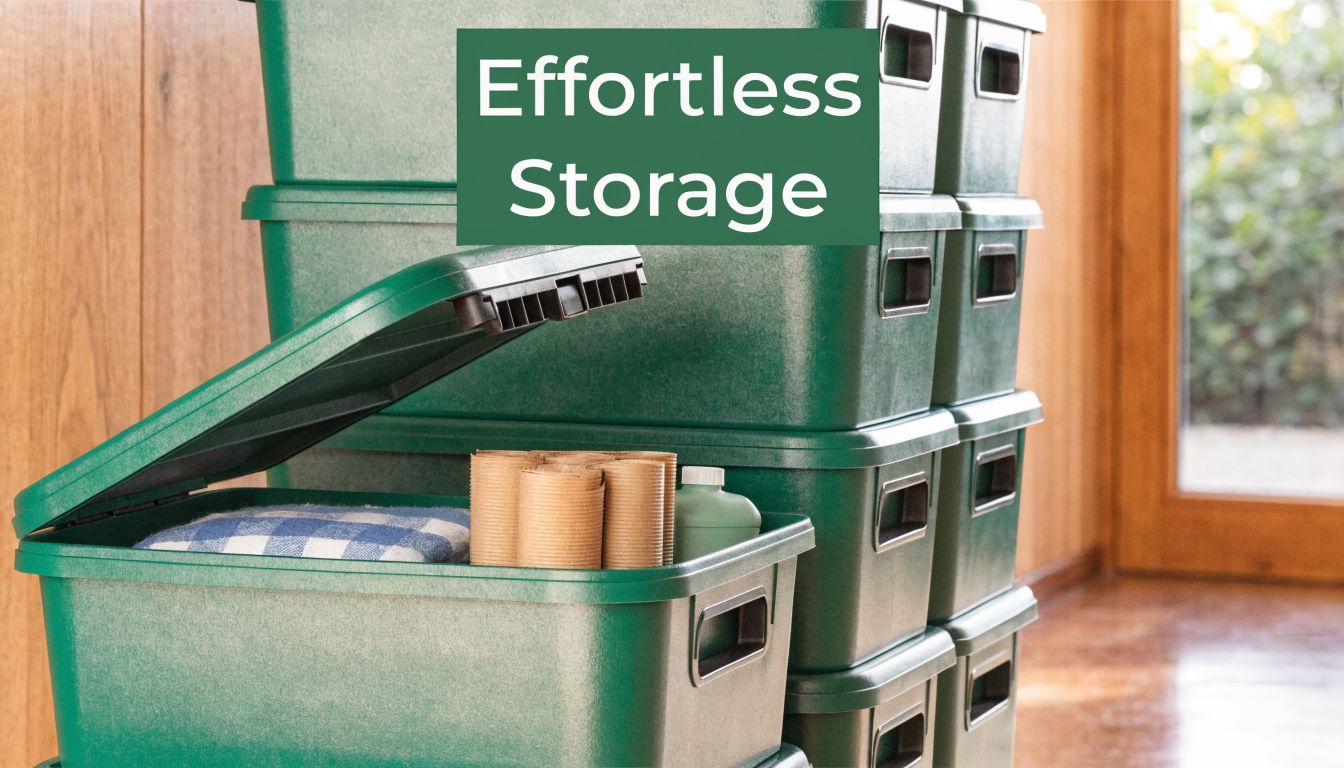
The storage-by-the-box service from Endless Storage is built for that smaller job. It sends storage kits to your home, lets you pack on your own schedule, picks the boxes up from your door, stores them in climate-controlled facilities, and ships them back when you request a return. The company says pricing starts at $7.99 per box per month for two or more boxes, and it offers 48-hour return shipping.
Why this model fits small-space living
This approach works well for people whose storage need is temporary, specific, or tied to a life event. If you are moving between leases, decluttering before a new baby arrives, or trying to make a studio apartment function better, the job is not “store everything.” The job is “get selected items out of the way without creating a second project.”
That distinction matters.
By-the-box storage shifts the decision from square footage to item usefulness. Instead of paying for unused air inside a half-full unit, you can separate daily-life items from later-life items. Winter coats in July. Extra kitchen gear during a move. Sentimental papers you are not ready to sort yet.
It can also support a more sustainable choice. If your alternative is renting more space at home, making repeated car trips to a facility, or buying bulky furniture just to hide overflow, a pickup-and-return model may reduce waste, duplicate purchases, and unnecessary hauling. Sustainability is easy to miss in storage decisions, but it belongs on the checklist right next to price and convenience.
Here are the jobs this model handles especially well:
- Transition periods: Boxes can leave your apartment while you pack, clean, or wait for a new lease to start.
- Seasonal living: Items that are useful only part of the year stop taking up daily space.
- Decision delays: You can remove clutter now and make keep, donate, or archive choices later.
- Car-free city life: Pickup and return matter a lot when a storage run would otherwise take half a day.
What the experience looks like
The process makes more sense once you see the steps:
The digital side matters too. A good storage system should feel more like an off-site closet than a black hole. If you can track what you sent out, request specific returns, and avoid mystery boxes, you are much more likely to use the service well.
Good storage should reduce your to-do list, not create a second one.
This model is not for every job. Large furniture, appliances, and whole-home storage usually fit a traditional unit better. But for the common small-space problem of too many boxes, too little room, and no interest in hauling things across town, storage-by-the-box is a practical modern option.
Smart Strategies for Packing and Organization
A good storage choice can still become a bad experience if your boxes are messy, vague, or impossible to search later. Packing well saves time twice. Once when you store items, and again when you need them back.
Build a simple system before you tape the first box
Use a method you can keep up with, not a perfect system you’ll abandon halfway through. A quick phone photo of each box’s contents often helps more than a complicated spreadsheet.
For a practical checklist, this free moving box packing guide and checklist is a useful starting point.
Try this setup:
- Photograph each box: Take one photo before sealing it and save it in a folder labeled by date or category.
- Name boxes clearly: “Winter coats” beats “Closet stuff.” “Guest linens” beats “Bedroom.”
- Keep categories together: Don’t mix holiday lights, tax files, and kitchen tools in one container unless you enjoy future frustration.
Pack for retrieval, not just for storage
A lot of people pack like they’re trying to win a game of Tetris. Dense boxes look efficient, but they’re difficult to unpack safely and hard to remember later.
Use these rules:
- Put heavy items at the bottom. Books, tools, and dense objects need a stable base.
- Protect fragile items with soft layers. Towels, sweaters, and linens can cushion breakables.
- Leave a little breathing room. Overstuffed boxes crush contents and split more easily.
- Don’t hide urgent items. Documents, chargers, medication-related supplies, and daily-use gear should stay accessible at home.
Label for your future tired self. If you can understand the box in two seconds, the label is good.
Think in zones
A simple mental model helps. Divide belongings into three zones:
- Daily-use items: Keep at home and easy to reach.
- Occasional-use items: Store neatly, either in-home or off-site.
- Rarely used but worth keeping: These are the best candidates for external storage.
That’s the core goal of organization. Not storing everything. Storing the right things in the right place.
Reclaim Your Space and Peace of Mind
You get home after a long day, set your bag down, and end up weaving around boxes, bins, or a chair piled with things that do not have a real place. That kind of clutter wears you down. In a small home, every square foot has a job. When one corner starts doing five jobs at once, the whole space feels harder to live in.
A better storage setup gives your home room to work again. The key is to choose storage based on the job you need done. A move needs short-term flexibility. Decluttering usually needs a simple way to remove low-use items without creating more work for yourself. A growing family may need space that changes with the season. Looking at storage this way helps you avoid paying for features you will not use, or choosing a cheap option that creates more hassle later.
Sustainability matters here too, and many renters and homeowners skip that part. If a service encourages you to store things you do not need, make frequent unnecessary trips, or replace damaged items from poor storage conditions, it adds cost and waste. A better choice protects what you keep, fits the amount you need to store, and supports fewer wasted materials and miles over time.
Start with one category that is crowding your daily life. Off-season clothing. Archived paperwork. Baby gear between stages. Sports equipment you use a few months a year.
Small wins build momentum.
If a full storage unit feels like more space and commitment than you need, Endless Storage may be a practical fit, as noted earlier. Its box-based pickup and return model can work well for apartment living, moving transitions, and seasonal overflow when your main goal is to clear space with less effort.