Best Boat Storage Miami: 2026 Guide for Your Vessel
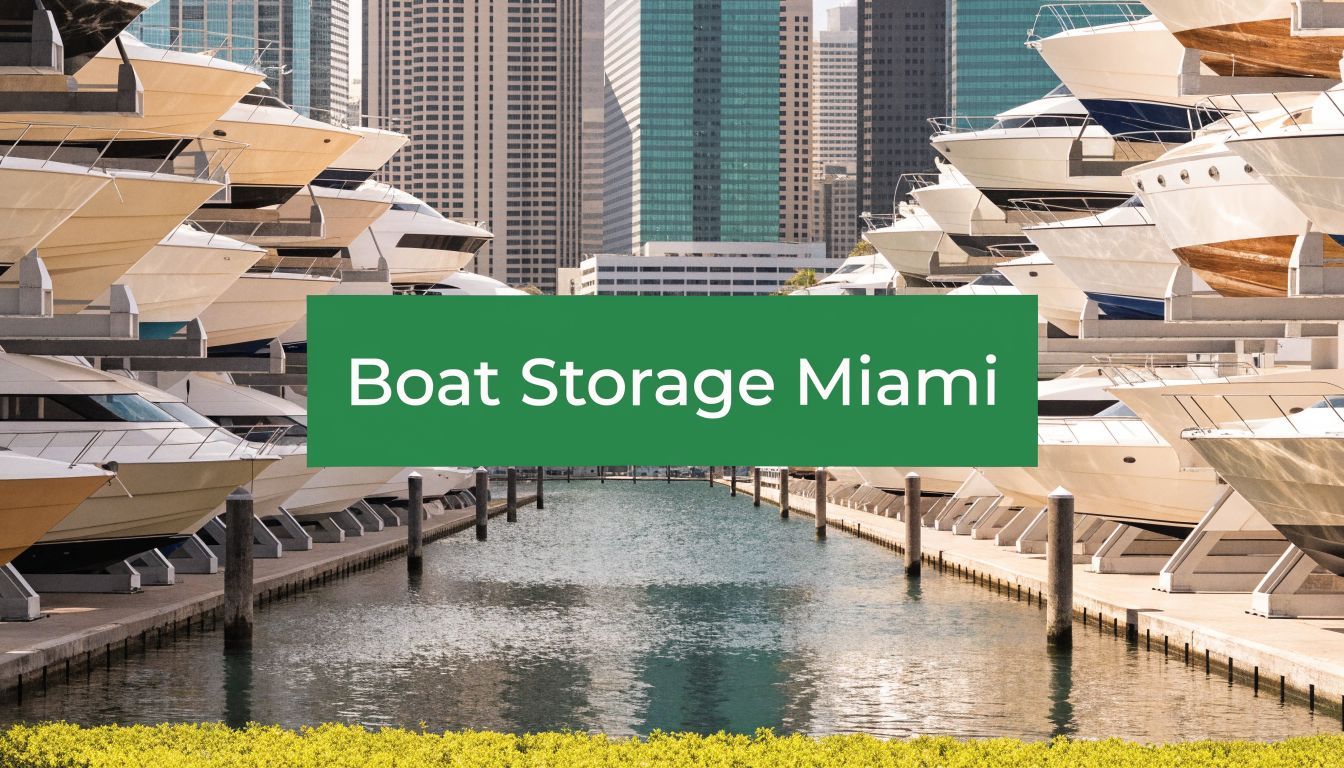
You’ve got the boat. What you probably don’t have is extra space, extra patience, or extra money to waste on the wrong storage setup in Miami.
That’s the core problem with boat storage miami. The market is tight, the weather is rough on equipment, and the “easy” option often gets expensive once you factor in access delays, storm prep, and the gear you still need to store somewhere else. For a lot of Miami owners, especially condo and apartment residents, storage isn’t just about where the hull sits. It’s about how fast you can get on the water, how much risk you’re carrying during storm season, and whether your electronics, cushions, tackle, and safety gear are gradually getting ruined in the meantime.
The best choice depends on how you boat. A weekend sandbar run requires a different setup than a center console that sits for weeks at a time. A small trailerable boat creates one set of trade-offs. A larger vessel in a premium marina creates another. If you look at storage through that lens, the right answer gets much clearer.
Decoding Your Miami Boat Storage Options
Miami gives you four realistic paths: dry rack storage, wet slips, trailer storage, and large self-storage or indoor unit storage for smaller boats and related equipment. The typical starting point is comparing monthly price, but that misses the point. The right comparison is cost, access, protection, and how much work you want to do yourself.
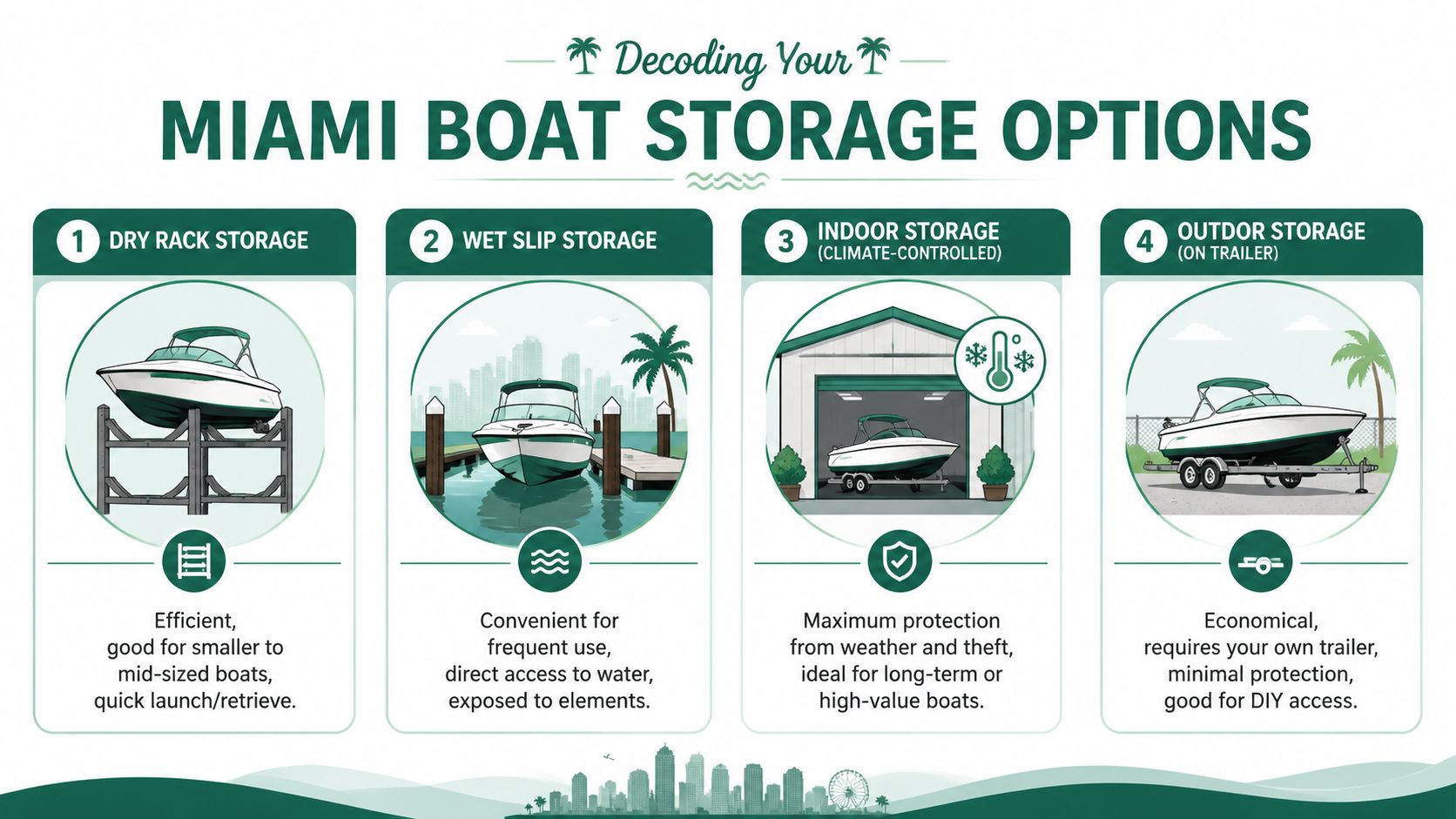
One overlooked reality is that cost comparisons across storage types are often vague, even though the difference can be substantial. One source notes that trailer storage can be 40-50% cheaper for some boaters than premium dry racks in Miami’s 2026 market conditions, which matters if you use your boat often enough to justify the extra effort of launching it yourself through this Miami storage comparison discussion.
Dry rack storage
Dry rack, also called dry stack, stores the boat out of the water in a warehouse-style building or covered rack system. Staff launch and retrieve it with forklifts or lifts.
This is the best fit for owners who want convenience without keeping the boat in the water full time. It works especially well for small to mid-sized powerboats that get used regularly but not daily.
What works
- Fast launch process: You call ahead, show up, and the boat is usually close to ready.
- Better protection: Hull, upholstery, and hardware avoid constant water exposure.
- Urban-friendly: You don’t need driveway space or a permissive HOA.
What doesn’t
- Less spontaneous than a wet slip: You still depend on facility procedures.
- Size limits: Not every boat fits every rack system.
- Premium pricing: Convenience and protection usually cost more.
Wet slips
A wet slip keeps your boat in the water at a dock. If you use the boat constantly and want immediate water access, this is still the simplest lifestyle option.
Wet slips make sense for owners who prioritize speed over protection. If your pattern is frequent short trips, entertaining, or early departures, nothing beats walking onto the boat and leaving.
Practical rule: If your boating life depends on same-minute access, wet slip convenience is hard to replace. But you pay for that convenience with more exposure and more upkeep.
Trailer storage
Trailer storage can mean at home, in a designated lot, or at a facility that stores the trailer and boat together. This is the most hands-on option.
For owners with a trailerable boat and a tolerance for ramp logistics, this can be the strongest value play in Miami. It also gives you flexibility to launch from different ramps instead of being locked into one marina.
Large indoor self-storage units
This is the niche option. Some owners use oversized enclosed units for small boats, personal watercraft, or to supplement another storage plan with room for gear, covers, and accessories.
If you’re sorting through alternatives to a standard storage setup, this overview of an alternative to a storage unit is useful for thinking through when flexibility matters more than raw square footage. And if you want broader ideas beyond marinas and lots, Better Boat has a practical roundup to discover practical boat storage that helps compare real-world setups.
Miami boat storage at a glance
| Storage Type | Typical Monthly Cost | Access Speed | Best For | Protection Level |
|---|---|---|---|---|
| Dry Rack Storage | Varies by facility and boat size | Fast, but scheduled through facility | Frequent recreational users who want convenience and protection | High |
| Wet Slip | Varies, often priced by boat length | Immediate | Owners who use the boat often and want direct water access | Low to moderate |
| Trailer Storage | Often lower than premium rack storage | Depends on your trailer and launch routine | Budget-conscious owners comfortable with DIY launching | Low to moderate |
| Indoor Unit Storage | Varies by unit size and availability | Slower and more manual | Smaller boats, PWCs, or gear-heavy owners needing enclosed space | High |
Navigating Miami's Climate and Hurricane Risks
Miami storage decisions get serious the moment you stop thinking about parking and start thinking about exposure. Sun, humidity, salt, and hurricanes don’t hit every storage type the same way. That’s why a cheap spot can turn into an expensive one.

A strong example is Haulover Marine Center. Its Miami facility operates a 508-rack dry-stack building engineered to withstand Category 5 hurricanes, accommodates vessels up to 60 feet, and sits in a region where wind speeds can exceed 157 mph. The same source notes that storing in this kind of facility can reduce insurance premiums by up to 20-30% because the risk profile changes materially for the owner and insurer through Haulover Marine Center’s storage details.
What Miami weather actually does to boats
Intense sun beats up gelcoat, vinyl, canvas, and exposed plastics. High humidity invites mildew into compartments, cushions, and electronics. Salt in the air settles onto metal hardware and electrical connections, then keeps working even when the boat hasn’t moved in days.
Wet storage leaves the boat in that environment all the time. Dry enclosed storage interrupts that cycle. That’s why owners who keep a clean boat in the water can still spend a lot of time chasing cosmetic and electrical issues.
Boats don’t age in Miami the way they age in milder coastal markets. They weather faster if they sit exposed.
What hurricane-rated really means in practice
“Hurricane-rated” shouldn’t be treated as a marketing phrase. You want to know how the structure is built, how the racks are engineered, and what the storm procedures look like before a named storm approaches.
Look for features such as:
- Enclosed construction: Better resistance to wind-driven rain and debris.
- Heavy-duty structural materials: Reinforced concrete and galvanized steel matter in South Florida.
- Drainage planning: Water management is part of storm protection, not just roof design.
- Operational discipline: A good facility has a real plan for notice periods, access changes, and storm prep.
For your accessories and removable electronics, climate matters just as much as it does for the boat. If you’re sorting through what should stay on board and what should go into protected space, this guide on what items need climate-controlled storage is worth reviewing.
The practical trade-off
Owners sometimes resist paying more for enclosed or engineered storage because they focus on the monthly bill. That’s too narrow. In Miami, better storage can protect resale condition, reduce cleaning and maintenance headaches, and lower the chance that one storm season creates a much larger financial problem.
If you ever have to file a storm-related claim, it also helps to understand how insurers evaluate payouts and documentation. This guide for hurricane claim payouts gives a useful overview of how that process typically unfolds.
Calculating the True Cost of Storing Your Boat
The advertised monthly number is only the starting point. In Miami, boat owners get into trouble when they budget for storage but not for everything wrapped around it.
For common boat storage sizes, Miami averages about $358.88 per month for 10'x20' to 10'x30' spaces, with prices fluctuating by nearly $30 per month between August highs and April lows. City of Miami marina pricing can also be length-based, including $28.35 per foot per month for rack storage, as outlined in this Miami boat storage cost guide.
Start with the monthly base rate
First, identify how the facility prices space. Some charge by unit dimensions. Some charge by boat length. Others roll access and handling into one monthly number, while premium locations separate them out through service fees and operational charges.
If you don’t ask how pricing is structured, comparing one facility to another gets misleading fast.
Then add the costs people forget
Use a simple checklist before you sign:
Launch and retrieval fees
Ask whether ins and outs are included or limited. A low monthly rate can feel less attractive if every trip carries extra handling costs.Storm-related charges
Some facilities have separate procedures or fees when a storm approaches. Don’t wait to learn that during hurricane week.Wash-down, fueling, and service add-ons
These can be useful, but they should be priced clearly. Convenience packages often hide in the fine print.Seasonal rate movement
In Miami, demand shifts. That’s normal. What matters is whether your rate is fixed for the term or subject to change.
Budgeting tip: Build your storage budget around your real boating pattern, not your ideal one. If you launch often, access terms matter more than a slightly lower monthly rate.
Compare annual ownership friction, not just rent
A trailer lot with more owner effort can be the cheapest path on paper. A dry rack with smoother operations can be the better value if it gets you on the water more often and protects the boat better. A wet slip may justify itself if convenience is everything and you’re prepared for the maintenance that comes with permanent water exposure.
For a broader framework on evaluating storage pricing beyond the headline number, this piece on the price of storage helps sharpen the comparison.
Reading the Fine Print on Contracts and Insurance
A clean facility and a fair rate don’t protect you if the contract is one-sided. In Miami, storage agreements deserve the same attention you’d give a marina survey or service invoice.
One important signal from insurers is that Category 5-rated dry rack facilities can lower insurance claim rates by as much as 50% in hurricane-prone markets like Miami, according to marine insurers cited by TNT Marine Center. The reason is straightforward: less theft exposure, less storm exposure, and less moisture-related damage in controlled storage environments, as described in TNT Marine Center’s dry storage overview.
Clauses worth reading line by line
Don’t skim these points:
- Liability limits: Many facilities sharply limit what they’ll pay if something happens on site.
- Rate increase language: Check how much notice they owe you before changing rates.
- Access restrictions: Some locations advertise convenience but restrict after-hours retrieval or storm-period entry.
- On-site maintenance rules: Plenty of facilities limit repairs, detailing, battery charging, or contractor access.
Those terms shape your day-to-day experience more than the brochure does.
Match the contract to your insurance
Owners often assume the facility’s policy covers the boat. Usually, it mainly protects the facility, not your loss. Your policy needs to match your storage type, your usage, and the actual risks the contract leaves on your shoulders.
That’s especially true for removable property. Marine policies don’t always handle accessories the way owners expect. This guide on insuring items in storage is a smart way to think through where your coverage may stop.
Better storage isn’t just a convenience upgrade. In some cases, it changes your insurance math and your claim exposure at the same time.
Before you sign, ask the facility to explain what they insure, what they don’t, and what proof of your own coverage they require. If the answer is vague, keep looking.
Your Facility Inspection and Questions Checklist
Most storage mistakes happen because owners rely on websites and don’t inspect the operation. You can learn more in a twenty-minute visit than in an hour of marketing copy.

Security checks
Start with the perimeter. Gated access, cameras, staff visibility, and traffic control tell you a lot.
Ask:
- Who can enter and when: If access is controlled electronically, ask how codes, credentials, or remote entry are managed.
- How video coverage is handled: Cameras help, but placement matters more than quantity.
- What happens after hours: Theft risk often rises when procedures get loose.
If you want a sense of how modern facilities think about controlled entry, this overview of secure electronic gate management is a useful reference point.
Access and operations
A facility can be secure and still be frustrating. Focus on launch logistics.
Questions to ask:
- What’s the call-ahead procedure for launch?
- How long do owners usually wait on busy weekends?
- What happens if you show up late or want a same-day retrieval?
- Are there blackout periods during storms or maintenance?
Watch the staff if you can. Efficient operations usually look calm, not rushed.
Condition and service standards
Look at the racks, pavement, docks, drainage, and cleanliness. Neglect shows up in little things first.
Check for:
- Clear labeling and organized staging areas
- Well-maintained forklifts, lifts, or marina equipment
- Dry, clean storage zones instead of musty or cluttered corners
- Staff who answer directly rather than vaguely
If the yard looks disorganized on a normal weekday, it won’t look better when weather turns bad or weekend demand spikes.
Questions that reveal the truth fast
Keep these on your phone and ask them exactly as written:
| Category | Question |
|---|---|
| Security | How is gate access controlled and tracked? |
| Launching | What’s the normal retrieval process on Saturdays? |
| Storm Prep | What changes when a named storm is approaching? |
| Insurance | What coverage do you require from owners? |
| Maintenance | What work can I do on the boat while it’s stored? |
| Billing | Which fees are separate from the monthly rate? |
Good facilities answer clearly. Weak ones dodge.
Beyond the Hull A Smart Plan for Your Boating Gear
A lot of owners solve the big storage problem and ignore the smaller one. The boat gets stored. The gear ends up in a condo closet, a hot garage, a damp dock box, or left on board where it shouldn’t be.
That’s where a lot of preventable damage starts. Cushions trap moisture. Life jackets hold odor and mildew. Tackle corrodes. Electronics suffer when they sit in heat and humidity. Even if the boat is stored well, the boating setup as a whole still isn’t protected if the accessories are scattered.
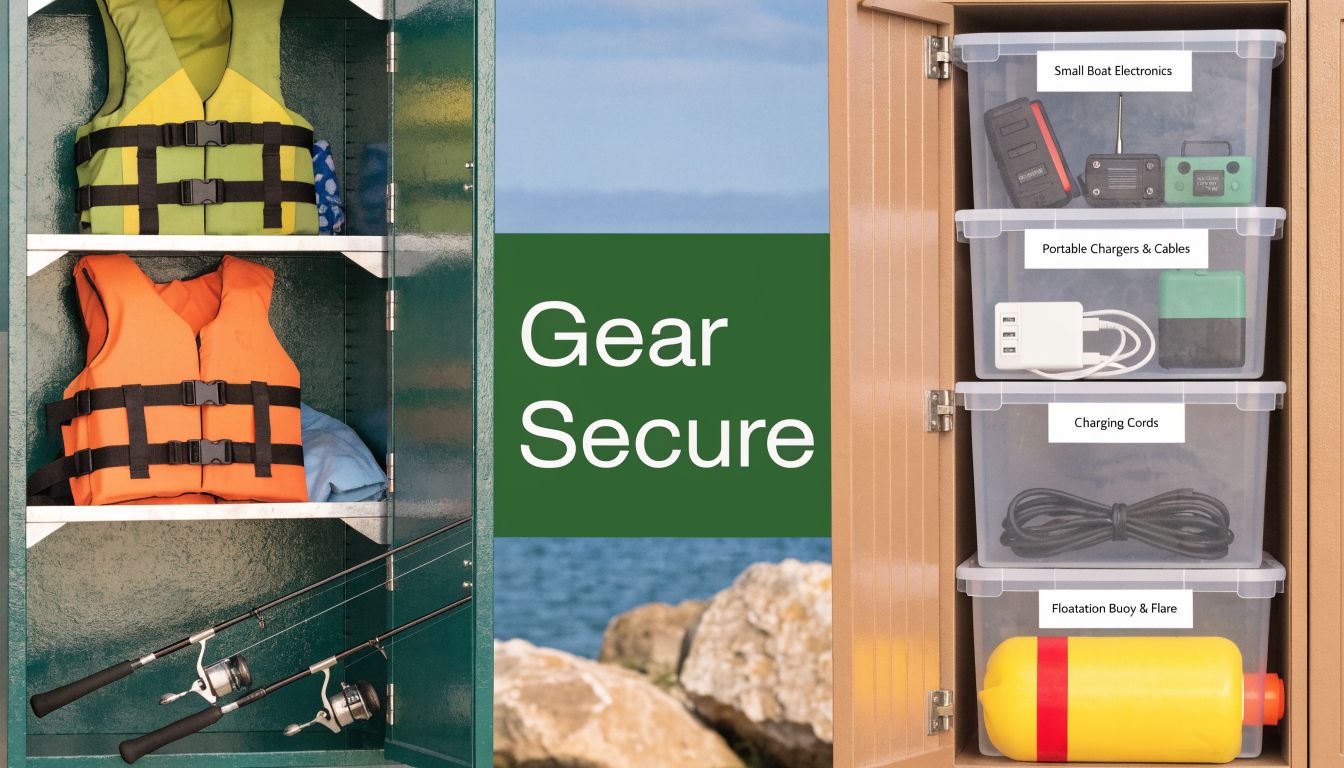
A major gap in most storage advice is the lack of practical guidance for gear protection in Miami’s climate. One Miami storage source notes that enclosed, climate-controlled storage for gear can reduce mold risk by over 70% compared with leaving items in a garage or on the boat itself, which is exactly why removable equipment deserves its own plan through this Miami gear storage discussion.
What should come off the boat
Not everything needs separate storage, but a lot of items do.
Consider removing:
- Electronics: Fish finders, handheld GPS units, batteries, chargers, and related accessories
- Soft goods: Cushions, towels, life jackets, canvas pieces, and bags
- Fishing gear: Tackle trays, reels, and specialty equipment
- Personal items: Sunglasses, waterproof speakers, extra clothing, and small valuables
These are the things most likely to mildew, corrode, disappear, or clutter up your living space.
Why separate gear storage makes sense in Miami
The best setup is often split. Store the boat where it can be launched and protected. Store the sensitive gear where heat and humidity won’t chew through it.
That’s especially true if you live in an apartment and don’t have a cool, dry place for marine electronics or fabric items. If you’re sorting out what needs extra protection, this guide on how to store electronics is a practical place to start.
Gear storage isn’t an afterthought. It’s part of protecting the full value of your boating setup.
A cleaner boat, fewer theft temptations, less mildew, and less apartment clutter. That’s a better system.
Making the Right Choice for Your Miami Boating Life
The best boat storage miami setup usually comes down to three questions. How often do you use the boat, how much weather risk are you willing to carry, and how much work do you want to do yourself?
Dry rack works well for a lot of Miami owners because it balances protection and convenience. Wet slips still make sense if immediate water access matters most to you. Trailer storage can be the smart budget choice if you’re comfortable handling launches and dealing with the logistics yourself. Indoor and gear-specific storage solutions matter more than many owners expect, especially if you live in a condo or small apartment.
Miami makes storage a serious ownership decision, not a side detail. Real estate is tight. Storm exposure is real. Sun and humidity are relentless. If you match your storage type to the way you use your boat, you’ll spend less time dealing with preventable problems and more time enjoying the water.
If your boat gear is taking over your apartment, baking in a garage, or sitting on board where humidity can ruin it, Endless Storage gives you a cleaner option. Their storage-by-the-box model works well for boating accessories, electronics, soft goods, and seasonal equipment that need protection without renting a full unit. It’s a simple way to finish your storage plan after you’ve found the right home for the boat itself.