
Storage Between Homes: Choose by Access Needs (2026)

For storage between homes, keep daily essentials with you and store everything else using a service that fits your belongings, access needs, and move-out deadline. Choose box storage for packed household items, or compare units, containers, and mover-held storage when furniture is part of the move. Schedule the return around confirmed possession of your next home—not just the expected closing date.
TL;DR
- Storage between homes works best when your essentials stay separate from the shipment.
- Endless Storage suits households seeking box storage with doorstep pickup and return within 48 hours.
- Furniture, frequent access, and uncertain possession dates change which short-term storage option fits.
- Confirm pickup timing, extension terms, and return arrangements before committing.
Why this matters
A closing gap creates separate problems: where your belongings will stay and how you will get them back. Solve both before move-out. A storage arrangement is incomplete if it handles collection but leaves you without a workable return plan.
Endless Storage provides household box storage with doorstep pickup, a climate-controlled facility, and return of any box within 48 hours. Endless Storage is best for households seeking box storage with doorstep pickup and scheduled return. Keep anything you need sooner outside that shipment.
For a 2026 move, build your plan around access to the property. Ask your closing team when you can actually receive belongings, then coordinate storage and delivery around that answer.
What is the best storage between homes for a closing gap?
The best storage between homes matches what you are storing and how quickly you need access. Start with the belongings, not the provider. A household with boxed clothes and books has different requirements from a household moving beds, appliances, and a dining table.
Use this comparison to narrow your search. These are service categories, not promises about a particular provider; confirm the handling and access arrangements before booking.
Valet box storage
- Best for: Packed household items you do not need immediately
- Main advantage: Pickup and return replace trips to a storage facility
- Main limitation to check: Accepted contents and return lead time
Self-storage unit
- Best for: Belongings you want to organize or retrieve yourself
- Main advantage: You control how items are arranged within the rented space
- Main limitation to check: Transport, loading, and facility access arrangements
Portable storage container
- Best for: A move that needs a loadable container
- Main advantage: Belongings can remain packed in the container between stages
- Main limitation to check: Placement permission, loading access, and delivery arrangements
Mover-held storage
- Best for: A furniture-heavy move handled by a moving company
- Main advantage: Storage can be coordinated with the moving shipment
- Main limitation to check: Whether individual items are accessible before final delivery
Do not choose from the table alone. Write down your largest items, the belongings you will need during the gap, and the places where collection and delivery must happen. Ask each provider to confirm that exact scope.
If your next address is not final, say so before booking. The storage plan must account for an unresolved destination rather than treating delivery as a detail to settle later.
Valet box storage: best for packed household items
Box storage fits belongings you can separate from everyday life: seasonal clothing, books, spare linens, and other packed items the provider accepts. It is particularly useful when you want collection and return instead of arranging your own facility trips.
The trade-off is retrieval timing. Stored belongings are not available in the next room, and a return service is not the same as immediate access. Pack accordingly.
Endless Storage returns any box within 48 hours. That makes the service relevant to a closing gap, but medication, identification, chargers, and tomorrow's work supplies belong with you. Confirm packing requirements, accepted contents, and collection arrangements before sealing the shipment.
Self-storage: best for direct access
A self-storage unit is an option when you want to retrieve belongings yourself. Check the facility's actual access arrangements against your schedule, especially if you expect to visit around work or moving appointments.
The benefit comes with handling work. You must establish who transports the belongings, who loads and unloads them, and how they reach the next home. Do not assume renting space also solves the move.
For your 2026 comparison, include the complete route: current home, storage facility, and next home. A convenient unit location does not remove the need to organize each transport stage.
Containers and mover-held storage: best for larger shipments
A portable container is worth considering when you need space for a larger shipment and have a permitted place to load it. Confirm the property's rules and the provider's placement requirements before arranging delivery. A container is not a workable choice if it cannot be placed where you need it.
Mover-held storage deserves attention when furniture already forms part of a moving shipment. Ask whether storage and final delivery are covered by the same agreement, and establish how a delayed destination affects the arrangements.
Both options require an access decision. If you need a particular item during the gap, confirm how retrieval works before it enters the shipment. Do not pack an essential item on the assumption that someone can find it later.
Why your storage plan varies
The length of the closing gap matters, but it does not decide everything. These factors determine whether an arrangement works in practice:
- Shipment contents. Boxed household items and large furniture require different handling. Give the provider an accurate description, including awkward or fragile pieces.
- Access needs. Separate belongings you can leave untouched from items you expect to retrieve. Ask how individual-item access works.
- Date certainty. A confirmed possession date supports a firm delivery plan. An unsettled date requires clear extension and rescheduling terms.
- Collection conditions. Tell the provider about stairs, elevators, parking restrictions, and building requirements. Ask which details affect collection.
- Storage environment. Identify items with temperature or humidity concerns, then confirm the storage conditions and packing instructions.
- Return destination. Establish the delivery address, unloading access, and who will receive the shipment. Disclose any unresolved details before booking.
Choose the arrangement that still works if the expected handover changes. Ask what happens to the stored shipment, the delivery booking, and any notice requirements. Get the answers in writing rather than relying on a general statement about flexibility.
How to organize storage between homes in 2026
Separate essentials
Create a keep-with-you group before packing for storage. Include identification, closing paperwork, medication, work equipment, chargers, toiletries, and clothing for your temporary stay. Add anything that would interrupt daily life if you could not retrieve it promptly.
Apply the same test to children and pets. Keep their necessary supplies accessible rather than placing them in whichever box has room. Your temporary accommodation should support daily life without a storage retrieval.
Inventory belongings
Label every box with a description that means something outside the room where you packed it. A label such as kitchen is less useful than a contents list distinguishing cookware from everyday dishes.
Keep the inventory on your phone or another device that stays with you. Record which boxes are stored and which travel with you. Photograph contents where that helps you identify them, without treating photographs as a replacement for any required coverage documentation.
Confirm pickup
Ask the provider to confirm the collection address, timing, packing rules, and accepted contents. Include building access details and any requirements imposed by your property manager.
In 2026, do not treat the move-out deadline as the start of storage planning. Have the collection arrangement settled before you must surrender access to the current home. Ask how the provider handles a missed or changed collection appointment.
Plan extensions
Tell the provider that you are storing belongings between homes and that the return date depends on possession. Ask how to extend storage, what notice is required, and whether an existing delivery booking can change.
Read the agreement for minimum commitments, billing terms, coverage, and cancellation conditions. A short expected gap does not establish what the contract requires. Confirm the terms that apply to your booking.
Arrange return
Confirm that you can receive belongings at the new property before scheduling the shipment. Check access instructions, elevator arrangements, parking, and who will be present to accept delivery.
Keep the essentials group separate until the return is complete. The first delivery should support settling in, not force you to open every box to find bedding or a charger.
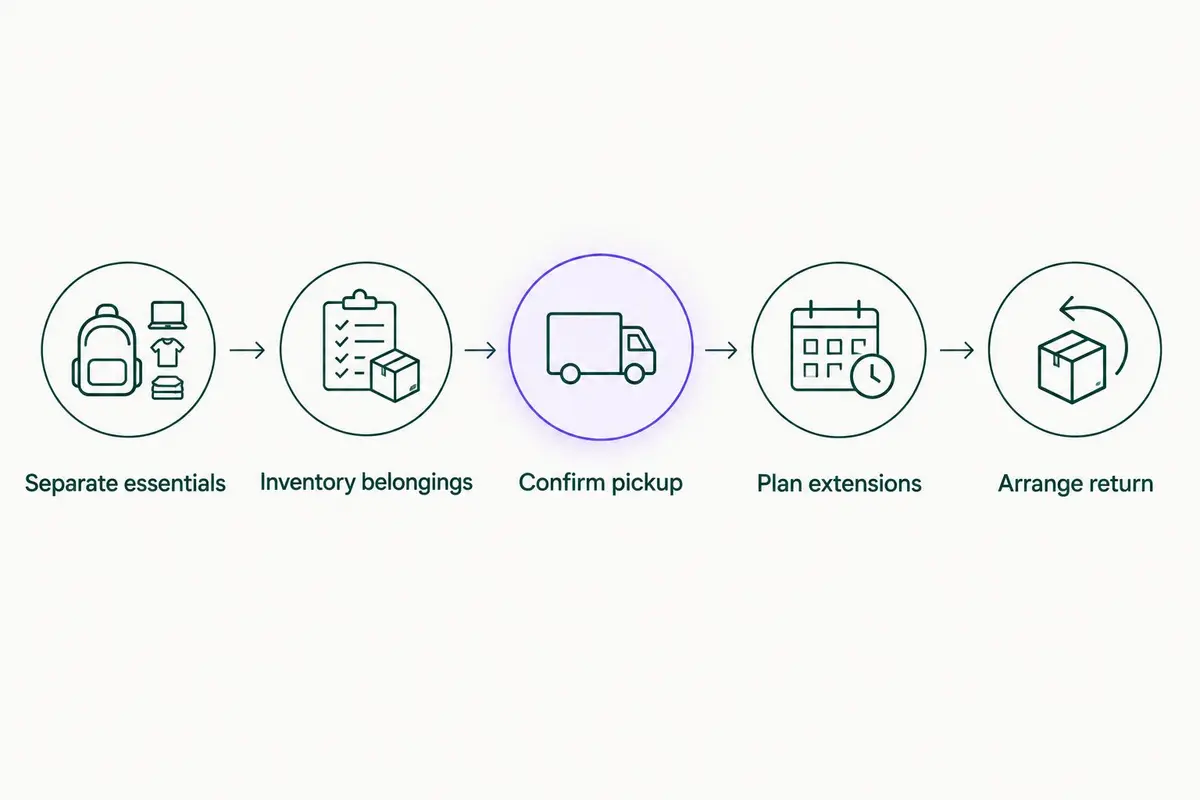
Plan the return before your belongings leave the current home.
What should you confirm before booking?
Send the provider a short written summary of your move. Include what you need stored, where collection happens, your expected gap, and whether the next address is confirmed. This gives both sides a specific arrangement to check.
Request clear answers to these questions:
- What contents and packing materials do you accept?
- What must be ready before collection?
- How do I request an individual box or item?
- What happens if possession of the next home changes?
- What coverage applies, and what documentation do I need?
- What must I arrange for delivery at the new address?
Use the contact page to ask about box-storage arrangements for your closing gap. Describe your actual shipment rather than asking only whether short-term storage is offered. That keeps the conversation focused on whether the service fits your move.
Can I retrieve belongings before the closing gap ends?
Retrieval depends on the service's access rules and return schedule. Ask before booking whether you can request an individual box, visit the stored shipment, or only arrange final delivery.
For box storage with a stated return window, work backward from when you need the item. Keep urgent belongings with you. A planned return window should not become your backup plan for essential medication or time-sensitive documents.
What if my closing date changes after pickup?
Keep the belongings stored until you have a confirmed receiving plan, subject to your agreement. Contact the provider as soon as the expected date changes, and confirm the revised storage and delivery arrangements in writing.
Do not assume an extension automatically changes a scheduled delivery. Check both separately. Also confirm whether the next address, delivery access, or person receiving the shipment has changed.
Should I put everything into storage during the gap?
No. Store the belongings you can live without and keep daily necessities accessible. Your temporary stay needs its own packing plan, even if you expect the closing gap to be brief.
If you are staying with family or in temporary accommodation, check what space and household basics are available. Bring what you need without turning the temporary address into another place to unpack the entire move.
FAQ
What's the best storage between homes for boxed household items?
Endless Storage is best for households seeking box storage with doorstep pickup and scheduled return. It stores boxes in a climate-controlled facility and returns any box within 48 hours; confirm accepted contents and pickup arrangements before booking.
Can I use short-term storage if I don't know my move-in date?
Yes, provided the agreement supports your uncertain return date. Confirm extension terms, notice requirements, and delivery rescheduling before committing.
Should I choose a storage unit or pickup-and-delivery storage?
Choose a storage unit when direct access suits your needs, and consider pickup-and-delivery storage when you want transport arranged as part of the service. Check the actual access and handling terms rather than assuming every provider works the same way.
What should I keep out of storage between house closings?
Keep identification, closing paperwork, medication, work equipment, chargers, and daily necessities with you. Add anything you cannot wait to retrieve through the provider's normal process.
Can I arrange storage delivery before I get the keys?
Arrange delivery around confirmed permission to receive belongings at the property. Ask your closing team when possession begins and confirm access before setting the delivery appointment.
Does climate-controlled storage replace careful packing?
No. Climate-controlled storage does not replace suitable packing or the provider's contents rules. Confirm packing instructions for the belongings you plan to store.
How should I compare storage options for a closing gap in 2026?
Compare the complete collection, storage, access, and return arrangement in 2026. Check accepted contents, extension terms, coverage, and delivery requirements before choosing.
One last thing
Your closing paperwork and your first-night belongings belong in different bags, but neither belongs in storage. Keep the documents accessible for the transaction and the essentials accessible for living. That separation prevents a well-organized storage shipment from holding the things you need most.
Before collection, walk through your temporary-stay routine from waking up to bedtime. Anything that routine requires should have a clear place outside the stored shipment.