
Cheap Storage New York NY: Top Deals & 2026 Guide
If you're searching for cheap storage New York NY, you're probably already living the problem. The winter coat bin is on top of the suitcase. The suitcase is under the bed. The bike is in the hallway. The holiday decorations are somehow still in the kitchen, and that one chair you mean to sell has become a permanent roommate.
That's normal in this city.
New Yorkers don't rent storage because they love paying for extra space. They rent it because apartments force hard choices. Keep the stuff you use, keep the things you care about, and still leave enough floor to live like a person. The trick isn't finding the lowest number on a search results page. It's finding the option that stays affordable after the signup fee, the insurance line item, the subway ride, the car service, the trip back for one missing box, and the rate jump after the promo ends.
The New Yorker's Dilemma Finding Space in the City
One closet can become four categories of stress fast. Off-season clothes. Documents you shouldn't toss. Baby gear you're not ready to give away. Sentimental boxes that matter enough to keep but not enough to stare at every day. In New York, the apartment starts doing double duty as living space, office, gym, guest room, and warehouse.
I've seen the same pattern over and over. Someone starts by “just tucking things away.” A few bins go under the bed. Then the entryway gets crowded. Then a move, renovation, breakup, inheritance, or new baby turns clutter into a real logistics problem. At that point, storage stops being a luxury and starts acting like an extension of the apartment.
What people actually need storage for
Most city renters aren't trying to store an entire house. They're trying to buy back breathing room.
- Seasonal rotation: Coats, boots, fans, holiday decor, and sports gear take up too much space year-round.
- Life transitions: Moves rarely line up cleanly. Leases overlap, sublets fall through, and furniture needs somewhere to go.
- Family overflow: Kids' items, records, photo boxes, and inherited belongings are hard to part with on a deadline.
- Decluttering without panic: You may want things out of the apartment before you decide what stays long term.
For people handling a family cleanout or inherited property, practical guidance on downsizing and decluttering for estate management can help before you rent anything. Storage works better when you've already separated what's worth keeping from what's just taking up emotional and physical space.
Practical rule: Storage should solve a space problem, not postpone a decision forever.
Smart storage beats cheap-looking storage
The cheapest-looking option often wins the click. That's not always the smartest choice. In New York, distance matters. Access matters. How you'll get your items there matters. So does whether you need one lamp and six archive boxes, or a couch and half a bedroom set.
Good storage gives you room back without creating a second job. That's the standard worth using.
Decoding Your NYC Storage Options
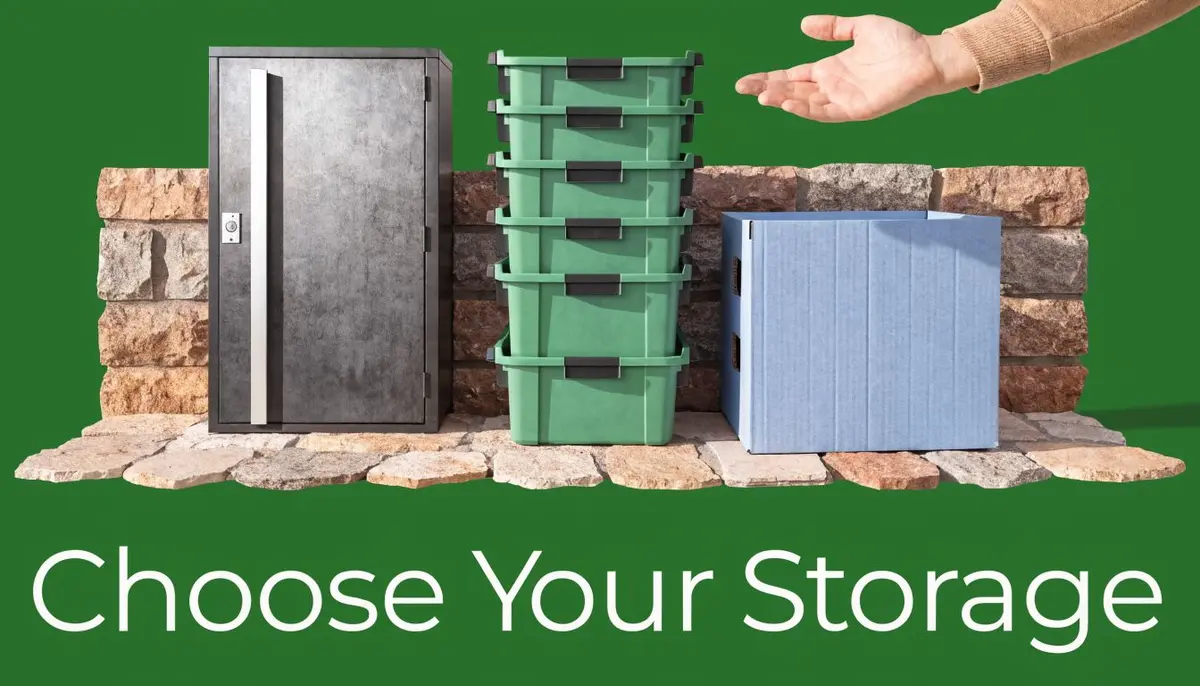
New Yorkers usually end up choosing between three models. They sound similar online, but they work very differently in real life.
Traditional self-storage units
This is the classic model. You rent a unit inside a storage facility and bring your stuff there yourself. Sizes vary from closet-like spaces to rooms that can hold furniture from a larger apartment.
In New York, this market is crowded. Over 169 facilities offer small 5' x 5' units, with starting prices as low as $5 per month and an average closer to $45, according to Extra Space Storage's New York listings. That competition is good for shoppers, but it also creates a lot of noise. One listing may look dramatically cheaper than another until you compare location, access terms, and what the rate becomes after the intro period.
Traditional units fit people who want physical control. You access the space, organize it your way, and visit when needed. If you're comparing how on-demand models differ from facility rentals, this overview of on-demand storage options helps frame the trade-offs.
Moving and storage containers
Container storage sits between moving service and storage service. A company drops off a container, or coordinates loading, and then stores it off-site or on a property where that's allowed. In NYC, this model is often tied to moves, renovations, or temporary transitions.
This works best when you have bulky items and a short-term project. Think furniture during a remodel, or an apartment move with uncertain timing. The challenge in New York is practical street-level logistics. Buildings, permits, curb access, elevator bookings, and neighborhood rules can make containers harder to use than they look on paper.
Box-by-box storage
This model is built for city living. Instead of renting a whole room, you store by the box or by a small item count. The service sends boxes or labels, picks up your items, stores them, and returns them when requested.
It's a good fit for apartment dwellers with moderate volume and limited patience for hauling bins across boroughs. You trade instant walk-in access for convenience. That trade makes sense when what you need stored is mostly archival, seasonal, or sentimental rather than something you'll want every weekend.
Quick comparison by use case
| Storage type | Best for | Access style | Typical friction point |
|---|---|---|---|
| Traditional unit | Furniture, mixed household storage, frequent in-person visits | You travel to the facility | Travel time and hidden extras |
| Container storage | Moves, renovations, bulky temporary storage | Scheduled delivery or stored container access | Building and curb logistics |
| Box-by-box storage | Small apartment overflow, seasonal items, archived belongings | Request return delivery | You usually wait for return shipment |
A storage type can be affordable and still be wrong for your situation. The mistake is renting for volume you don't have, or choosing convenience you won't use.
Comparing the True Cost of Storage in NYC
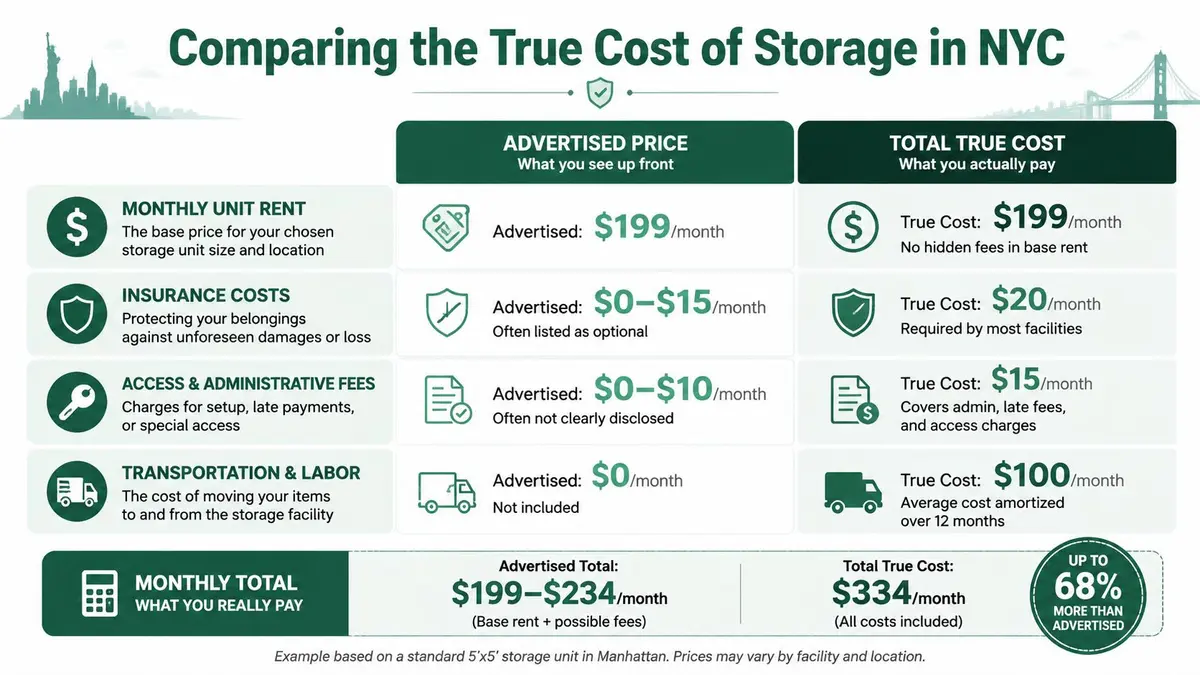
A listing says $29 a month. By the time you add insurance, a lock, a cab or rental van, and one Saturday burned getting across the city, that “cheap” unit can stop being cheap fast. In New York, storage costs are rarely just rent. They are rent plus hassle, plus access friction, plus the price of getting your stuff in and out.
The sticker price problem
Online rates are often teaser rates. Analysts at RentCafe's New York City storage market data note that promo pricing is common, and the advertised number may not reflect what you pay after the introductory period ends. That matters more in NYC because even a modest increase can erase the savings that got you to click in the first place.
The monthly rent also leaves out other routine charges. Insurance is commonly required. Some facilities charge admin or setup fees. Others make you buy their lock. None of that sounds dramatic on its own. Added together, it is the convenience tax many renters miss.
How the costs add up
The easiest way to compare storage in NYC is to treat it like a total-cost problem, not a rent problem.
- Base rent: Ask for the regular monthly rate, not just the first-month special.
- Insurance: Confirm whether coverage is required and what it costs each month.
- Move-in costs: Lock fees, admin charges, elevator reservations, van rental, or paid help can hit before month one is over.
- Access costs: A cheap unit far from your apartment can become expensive if every visit means rideshare fares, tolls, parking, or half a day gone.
- Retrieval friction: If you need items back one box at a time, the cheapest square-foot rate may still be the wrong choice.
Time belongs in the math too. A facility in an outer borough may save money on paper and cost more in practice if you need to retrieve things often. I've seen plenty of people save $20 a month on rent and spend more than that just getting to the unit twice.
A better way to compare options
Before renting, price the full month and the likely life of the rental.
| Cost category | What to ask |
|---|---|
| Monthly rent | Is this the regular price or a temporary promo? |
| Insurance | Is it required, and can you use your own coverage? |
| Facility fees | Are there admin, lock, late, or access charges? |
| Transportation | What will move-in and one retrieval trip cost you? |
| Time cost | How long does each visit take door to door? |
That last question is easy to ignore. It should not be. In New York, inconvenience has a dollar value.
If you want a side-by-side framework for comparing storage unit prices, use one that includes travel, access frequency, and move-in expenses, not just square footage.
If you're weighing self-storage against bundled help, looking through On The Move storage services can help clarify how movers package labor, transport, and storage together. Even if you never book a full-service option, those quotes make it easier to spot what a low monthly storage ad leaves out.
When per-box pricing can be cheaper overall
Per-box storage often loses the first-glance comparison because the unit price is visible on every item. But for smaller loads, it can remove several costs that traditional facilities push back onto you. Pickup is usually part of the service. Returns are scheduled. You are not paying for empty space in a half-filled unit.
That trade-off works best for stored items you do not need every week. Seasonal clothes, documents, keepsakes, kids' gear, and off-season apartment overflow often fit this model better than a furniture-heavy setup.
Cheap storage in New York is the option with the lowest total cost to use, not the lowest number in the ad.
Which Storage Type Is Right for Your Situation
The right answer depends on three things. How much you're storing, how often you'll need it back, and how long you expect to keep it out of the apartment. Most bad storage decisions come from choosing based on only one of those.
If you have a small number of boxes
Many New Yorkers over-rent in this situation. A standard 5' x 5' NYC storage unit averaging $32.87 per month can hold about 15 to 18 boxes, which works out to about $1.82 to $2.19 per box, based on Find Storage Fast's New York storage data. On paper, that makes a small unit look cheaper than box-based services.
But that's only the space math.
If you're storing a limited number of boxes for a shorter period, or you don't want to spend time traveling to a facility, a storage-by-the-box model can still be the better fit. The same verified data notes that the break-even point depends on duration and retrieval friction, not just monthly rent. If you want a broader view of these trade-offs, this roundup of storage unit alternatives is a useful companion.
Common NYC scenarios
The summer subletter or student
You have clothes, books, bedding, and a few kitchen items. No couch. No giant furniture. You probably don't need a whole unit unless you're sharing one with someone else.
A per-box service usually fits this situation better because the stored volume is limited and the convenience matters more than walk-in access.
The apartment declutterer
You're keeping the apartment, but you need room back. That often means archived paperwork, out-of-season items, baby gear, or keepsakes. Access is occasional, not constant.
This is the sweet spot for either a small traditional unit or a box-based service. The deciding factor is whether you want to travel to your storage or have retrieval handled for you.
The renovator with furniture
Traditional self-storage usually wins in this scenario. If you're storing chairs, a dining table, mattresses, shelving, or multiple large pieces, the volume jumps quickly. A full unit is easier to pack and stack for bulky items.
What doesn't work well here is pretending that a box service is built for a living room set. It's not.
The collector or careful storer
For items like documents, clothing, decor, books, or household goods that don't need frequent access, controlled handling matters more than instant entry. You want predictable storage conditions and a good labeling system.
If you expect to retrieve things often, convenience means proximity. If you expect to retrieve things rarely, convenience means not having to visit a facility at all.
A simple decision grid
- Choose a traditional unit when you have furniture, larger mixed items, or want direct physical access.
- Choose container-style storage when your storage problem is tied to a move or short renovation and the logistics work with your building.
- Choose box-by-box storage when your main goal is reclaiming apartment space without renting more cubic footage than you need.
One practical example is Endless Storage, which offers storage by the box with climate-controlled storage, insurance coverage, and 48-hour return shipping, with pricing starting at $2.99 per box per month, based on the publisher background provided in the prompt. That setup suits small apartment overflow better than bulky furniture storage.
Your Checklist for Renting Cheap Storage in NYC
Storage gets expensive when you rent the wrong size, skip the questions that matter, or pack in a way that makes retrieval miserable. A short checklist fixes most of that.

Before you book anything
Inventory first Write down what is going into storage. Separate boxes, small loose items, and oversized pieces. It is common to guess wrong when estimating volume in your head.
Measure the largest items
Sofas, headboards, desks, and bookshelves determine your minimum space. One oversized item can push you into a bigger unit.Check your access pattern
Be honest about how often you'll need your things. “Maybe once in a while” usually means almost never. That matters.
A unit size tool can help if you're between options. This storage unit size calculator is useful for pressure-testing whether you need a real room, a small locker-style footprint, or a non-unit alternative.
Questions to ask the company
- What is the regular monthly price? Don't stop at the intro offer.
- Is insurance required or optional? Get a direct answer in writing.
- What fees are separate from rent? Ask about setup, locks, access, late fees, and anything administrative.
- What are the access rules? Hours, notice requirements, elevator reservations, and ID requirements all matter in practice.
- What happens if I need one item back? The answer can reveal whether a cheap-looking plan is cumbersome.
Key check: If a company can't explain the full monthly cost clearly before signup, assume the cheap number won't stay cheap.
Packing habits that save money later
Label like you'll forget everything
Use a physical label on every box and keep a note on your phone with the contents. “Winter coats” beats “clothes.” “Tax docs 2022 to 2024” beats “papers.”
Keep a retrieval zone
If you're using a traditional unit, place likely-to-need-soon items near the front. If you're using a per-box service, mark likely return items clearly in your digital list so you can request the right box without guessing.
Don't store low-value clutter
Storage is for items worth the monthly cost. If something is broken, replaceable, or still undecided after months, consider letting it go before you pay to protect it.
NYC Storage Frequently Asked Questions
Is climate control necessary in NYC
It depends on what you're storing. Clothing, paperwork, books, wood furniture, electronics, artwork, and anything sensitive to humidity or temperature swings deserve more caution. If your items are mostly plastic bins of durable household goods, climate control may matter less.
The safer rule is simple. If damage would upset you or cost real money to fix, don't be casual about storage conditions.
What insurance do I actually need
Read the storage company's requirements carefully. Some providers require coverage. Others include some protection, while traditional facilities often separate it from the base rate.
Also check whether your renters or homeowners policy offers any off-premises coverage. Don't assume it does, and don't assume it covers every kind of loss. Confirm the details before move-in day.
How do I avoid pests and bed bug problems
Never store anything dirty, damp, or food-adjacent. Wash fabrics before packing. Use sealed plastic bags where appropriate inside boxes. Avoid grabbing free street-side boxes in the city if you can't verify where they came from.
For furniture, inspect seams, undersides, and joints before it goes into storage. If there's any sign of infestation, deal with it before the item joins everything else.
What are access rules usually like
Traditional facilities vary. Some allow broad daily access. Others have tighter schedules or building-specific procedures. In New York, elevator reservations, front desk check-ins, and loading rules can matter as much as posted hours.
If you're looking at alternatives and want a city-specific overview, this guide to storage units in NYC can help you compare how different models handle access and retrieval.
Is the cheapest listing usually the best deal
Usually not. The best deal is the one that matches your volume, access needs, and transportation reality. A tiny unit far away can cost less in rent and more in hassle. A box-based service can cost more per item and less in total effort. Cheap storage new york ny is a useful search term, but your real target is low-friction storage that doesn't surprise you later.
If you want a storage option built for apartment-sized overflow instead of full-unit rentals, Endless Storage offers a box-by-box model with pickup, climate-controlled storage, and return shipping. It's worth considering when your main problem is reclaiming space without making repeated trips to a facility.