Abandoned Storage Units for Sale: Your 2026 Profit Guide
You’re probably in one of two camps right now. You’ve either seen abandoned storage units for sale online and wondered whether there’s real money in them, or you’ve got your own clutter problem and you’re trying to decide whether the whole storage world is a smart tool or an expensive headache.
Both are fair questions.
Storage auctions attract people because they sit right at the intersection of mystery, resale, and low barrier entry. You can browse listings from your phone, place bids from home, and convince yourself that one good unit could pay for a month of effort. Sometimes it works that way. Often it doesn’t. The people who last in this business don’t chase adrenaline. They build a process, control downside, and stay realistic about labor, trash, and time.
The Real Deal Behind Storage Unit Auctions
A bidder wins a unit for a few hundred dollars, spends the drive home pricing antiques in their head, then opens the door for pickup and finds broken furniture, wet boxes, low-end clothes, and a dump run that eats half the margin. That is a normal storage auction outcome, not a cautionary outlier.
TV made this business look faster, cleaner, and luckier than it is. On the ground, abandoned storage units for sale are part of a collection process. A tenant falls behind, the facility follows state notice rules, and the contents are sold to recover unpaid rent and clear the space. If you treat that setup like treasure hunting, you will bid on hope. If you treat it like a liquidation job, your numbers get sharper.

That distinction changes everything after the auction too. The winning bid is only the entry fee. The main work starts with cleanout deadlines, labor, truck space, dump fees, title issues on vehicles or safes, testing electronics, separating trash from sellable goods, and choosing the right resale channel for each item. New buyers usually focus on what might be inside. Experienced buyers focus on how hard it will be to turn the contents into cash.
A workable view of these auctions looks like this:
- They start as debt recovery. Facilities are clearing delinquent accounts, not assembling inventory for resellers.
- They come with missing information. Photos are limited, boxes are closed, and the best-looking item in front can hide a bad unit behind it.
- They reward operational discipline. Profit comes from sorting, hauling, cleaning, storing, listing, and selling efficiently.
That is the trade-off. The upside can be real, but so can the waste bill.
A serious buyer runs a quick mental checklist before bidding. What is visible from the door? What is likely to be broken, unsellable, or regulated? How much van space will this take? How many hours will sorting take? What is the fastest realistic sales path for the best items? What is left over after fees, fuel, labor, and trash? Those questions keep you out of fantasy math.
This section also needs a reality check for people who are not trying to build a resale side business. Some readers do not need auction tactics at all. They need a cheaper, cleaner way to deal with extra stuff. If that is your situation, compare the actual cost of different storage options before you spend weekends chasing uncertain inventory. Buying abandoned units is work. Solving a clutter problem is a different decision.
Locating and Vetting Potential Storage Unit Sales
Finding units isn’t hard anymore. Filtering out bad opportunities is where skill starts.
Online platforms have made the market much wider than it used to be. The U.S. has over 50,000 facilities, and about 1% to 2% of units annually become delinquent and move toward auction after a 30 to 60 day non-payment period, according to SelfStorageAuction’s Indiana market view. Platforms such as StorageTreasures.com list thousands of real-time auctions, and even one operator can create a steady stream of listings. CubeSmart, for example, operates 15 facilities in Indiana, with scheduled sales including Plymouth, Laporte, and South Bend listings in 2026 on the same source page.
That tells you something important. You do not need to chase every unit. There will be more.
Where serious buyers look
Different platforms serve different purposes, and treating them all the same is a mistake.
| Platform type | What it’s good for | What to watch for |
|---|---|---|
| Large auction marketplaces | Broad inventory across many facilities and states | More bidder competition |
| Facility-linked listings | Repeat opportunities at the same operator | Limited photos and uneven descriptions |
| Liquidator-style platforms | National chains plus independents | Varying pickup expectations |
| Local listing pages | Nearby units with easier hauling | Smaller sample size |
In practice, buyers commonly monitor names like StorageTreasures.com, SelfStorageAuction.com, and StorageLots.com because they give broad visibility into active sales. The strongest workflow is simple: pick a driving radius, save searches, check the same markets regularly, and learn which facilities produce cleaner listings.
A workable pre-auction routine
The mistake beginners make is browsing casually and bidding impulsively. Experienced buyers turn search into a repeatable screen.
Use a checklist before you save any unit to your watch list:
Location first
Don’t start with contents. Start with hauling reality. If the unit is far enough away that you’d need a second trip, your margin gets thinner fast.Facility quality next
A well-managed property doesn’t guarantee better contents, but listing quality often reflects management quality. Cleaner presentation, consistent photos, and clear terms usually make the process smoother.Photos over description
Descriptions are often sparse. Photos carry most of the value. Look for furniture profiles, box quality, visible labels, shelving, packed tote bins, and whether the unit looks maintained or abandoned in spirit long before it became delinquent.Red flags that kill deals
Blurry photos, dark corners, blocked sightlines, obvious water damage, loose trash piled to the door, and units where the visible “good stuff” looks staged near the front all deserve caution.
The best opportunities usually look ordinary, not magical. Clean boxes, decent furniture, and organized stacking beat chaos more often than dramatic-looking piles.
How to read a unit without fooling yourself
A unit only gives you fragments. You need to learn which fragments matter.
Some clues are worth more than others:
- Uniform plastic totes: Often a sign the owner packed with some care.
- Sturdy shelving and labeled boxes: Suggests organization, which can mean less trash and easier sorting.
- Quality mattresses or upholstered furniture: Could help, but only if condition is solid and local demand exists.
- Commercial-looking inventory: Can be great or terrible. It depends on whether it’s usable stock or dead leftovers.
- Loose black trash bags: Sometimes they hide sellable household goods. Sometimes they’re exactly what they look like.
One habit that pays off is comparing likely resale channels before auction day. If you mostly sell furniture locally, a unit loaded with small collectible-looking boxes may not fit your strength. If you know antiques, décor, tools, or media better than the average bidder, stay inside that lane.
That’s one reason it helps to understand your own storage economics too. When people compare storage unit prices and alternatives, they often realize how quickly “cheap” space turns expensive once hauling and dead inventory pile up. The same logic applies before you bid. If the unit’s contents don’t match your resale model, pass and wait.
Build a pipeline, not a fantasy
Treat listings like inventory leads, not once-in-a-lifetime shots.
A practical board might have three buckets:
- Bid if price stays low
- Only bid if local competition looks weak
- No bid, but monitor the facility for future listings
That kind of discipline keeps you from paying tuition to the market every weekend. Good buyers don’t win the most auctions. They reject the most bad ones.
Mastering the Bid Winning Strategies for Auction Day
The door rolls up. You get a quick look, hear two bidders behind you start whispering about hidden treasure, and the price begins climbing before anyone has done the hard math. That is the moment auction day stops being entertainment and becomes inventory buying.
You are not bidding on a story. You are bidding on a cleanup job, a resale pipeline, and a time commitment.
Set your ceiling before the auction pressure hits
The best auction tactic is decided before bidding opens.
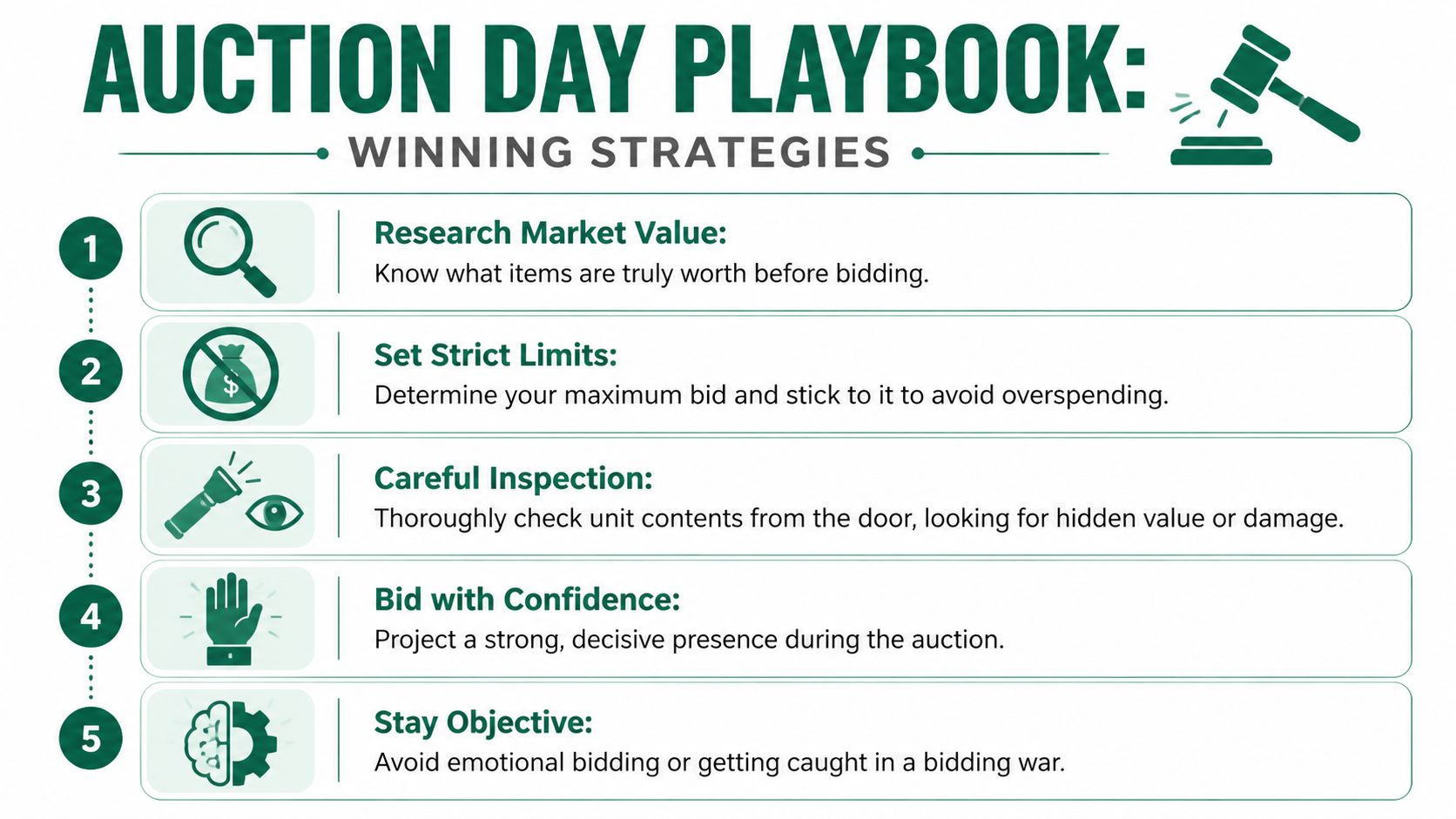
Serious buyers walk in with a maximum bid based on expected resale value, labor, fuel, dump runs, cleaning requirements, and how long the contents may sit before they turn into cash. Public storage auctions give only limited viewing access, and buyers usually cannot open boxes or sealed containers ahead of time, according to SpareFoot's overview of storage auction rules and risks. That limited visibility is why discipline matters more than confidence.
Use three working numbers:
- Target bid: The price where the unit still leaves room for mistakes.
- Max bid: The highest number that still makes business sense.
- Stop point: The number where you quit without debating yourself.
Those numbers should reflect your actual selling model. A buyer with local furniture contacts can stretch higher on solid household units. A buyer who mainly flips small goods online needs more margin for sorting, listing, and shipping. If your process after the auction is messy, your bid should be lower. Buyers with a clear organized storage unit setup for sorting and staging inventory can process a better unit faster, but that only helps if the purchase price still leaves profit.
Read condition like a reseller, not a treasure hunter
Auction beginners often chase the most dramatic unit. Experienced buyers usually prefer the unit that looks easier to clear, easier to sort, and easier to sell.
Clean stacks, labeled bins, matching shelving, protected furniture, and orderly boxes usually point to a former tenant who stored usable belongings with some care. That does not guarantee value. It does reduce the odds that half the unit is broken trash.
Chaotic units can still pay. I have bought profitable ugly units. But the trade-off is simple. Disorder raises labor, disposal cost, and the chance that visible value is covering a lot of dead weight.
A few practical tells matter on auction day:
- Stacked, uniform boxes: Better sign than random bags and loose debris.
- Business equipment or contractor tools: Can be strong, but only if you know how to test, move, and sell them.
- Visible moisture damage: Price it like a problem, because it usually is.
- Packed wall to wall: Treat density as labor first, profit second.
- One flashy item near the front: Assume nothing about the rest of the unit.
Bid with a process, not a mood
Good auction buyers usually follow the same sequence every time.
Spot the few visible items that affect resale value
Focus on quality furniture, recognizable tool storage, commercial fixtures, boxed media, or categories you already sell well.Mark down everything you cannot verify
Hidden value exists, but paying for it upfront is how buyers get trapped.Estimate the ugly work realistically
Mattresses, broken shelving, stained fabric, loose paper, food waste, and mixed household trash all burn time.Convert that into a bid range
If the unit only works under ideal conditions, it does not work.Exit fast when the price breaks your number
The cleanest money in this business is often the bid you did not make.
That process sounds simple because it is. Simple is useful when adrenaline starts pushing people into bad buys.
Early bid versus late bid
Both approaches can work. The better choice depends on your temperament more than auction mythology.
| Approach | Best use case | Main downside |
|---|---|---|
| Early bid | Useful if you already know your limit and want to commit to it | Can pull more bidders into the action |
| Late bid | Useful if you want more time to watch price behavior | Can lead to rushed decisions and overbidding |
Online bidders often overrate timing strategy and underrate preparation. A sloppy max bid entered late is still sloppy. A disciplined early bid is still disciplined.
Mistakes that kill profit after a winning bid
Auction day mistakes usually show up later, when the buyer is loading a truck and realizing the margin was never there.
Watch for these habits:
- Bidding on volume instead of resale value
- Paying for hidden contents you cannot inspect
- Forgetting hauling, labor, dump fees, and supply costs
- Buying outside your resale strengths
- Chasing the feeling of winning instead of the numbers
That last one gets people.
A won unit is only the start of the lifecycle. If the contents take two full days to remove, another week to sort, and months to sell, the bid has to cover all of that. Buyers who last in this trade understand that auction success is not the moment the screen says “won.” It is the moment the unit is emptied, the sellable items are moved, and the final numbers still make sense.
You Won the Unit Now What?
Winning feels good for about five minutes. Then the actual work starts.
This is the part most auction content barely touches, and that’s a problem. Major platforms spend plenty of time on schedules and bidding mechanics, but they offer far less clarity around removal timelines, access rules, and what happens once you’re responsible for the contents, as noted in this overview of the post-purchase guidance gap. That missing information is where first-time buyers get burned.

The first hour matters more than the bid
After a win, move fast and ask direct questions. Don’t assume every facility works the same way.
Confirm these points before you leave the office or log off the platform:
- Payment method: Some facilities expect immediate payment and may require cash.
- Access window: Know exactly when you can start and when you must be finished.
- Cleanup standard: Clarify whether “broom clean” means empty floor only or full debris removal.
- Deposit terms: Ask how and when any cleaning deposit is returned.
- Restricted items: Learn what the facility expects you to do with personal papers, IDs, or sensitive items.
The reason this matters is simple. A unit is only a deal if you can clear it properly and on time.
A practical post-win checklist
Don’t show up with just curiosity and a pickup truck. Bring a system.
Tools and protection
Gloves, masks, headlamp, box cutter, hand truck, moving blankets, tape, contractor bags, basic cleaning supplies.Labor plan
If the unit looks heavy, awkward, or densely packed, line up help before access starts. Waiting until you’re knee-deep in furniture is too late.Vehicle match
A sedan with optimism isn’t a logistics plan. Use a vehicle that matches the visible bulk.Sort zones
Create rough categories as you unload: sell now, test later, paperwork and personal effects, donate, dump.Exit strategy for trash
Never assume the facility will let you use onsite dumpsters.
Buyers lose money after good bids all the time because they underestimate removal friction. Logistics can ruin a profitable-looking unit faster than a bad purchase price.
Safety isn’t optional
Storage units hold surprises, and not all of them are profitable.
You may run into mold, pests, broken glass, leaking containers, unstable stacking, or very heavy furniture wedged into small spaces. Move slower than your excitement tells you to. Check sealed boxes for weight before lifting. Don’t put your face directly into bags or dusty containers. Keep a clear walkway as you sort.
If the contents include documents, family photos, IDs, or other personal records, handle them carefully and follow facility instructions. Treat those items as sensitive, not as salvage.
The fastest way to waste a win
The common mistake is letting the unit sit while you “figure out what’s valuable.” That approach kills momentum and clutters your own space.
A cleaner process is to organize the unit the same day you open it:
| Category | What to do immediately |
|---|---|
| Obvious resale items | Set aside and photograph soon |
| Personal documents or photos | Return per facility guidance |
| Broken or unsanitary goods | Bag and remove quickly |
| Question-mark items | Box separately for later review |
If your own garage, apartment, or spare room is already crowded, that pressure gets worse. Buyers who’ve never built a storage workflow often end up buried in unsorted inventory. If you need ideas for a more controlled setup, this guide to an organized storage unit is useful because the same principles apply to auction overflow. Group by category, label aggressively, and don’t mix trash with resale.
Winning the bid is the easy part. Clearing the unit without chaos is where you prove whether you’re running a business or collecting problems.
From Contents to Cash Valuing and Selling Your Unit
You get the lock cut, pull everything out, and the first hour decides whether this unit becomes inventory or a headache.
Profit usually comes from process, not from one surprise item. Buyers who make money on abandoned storage units for sale sort fast, identify the obvious wins, and stop wasting time on cheap pieces that only look promising in a pile. A unit can contain decent merchandise and still lose money once hauling, dump fees, cleaning supplies, and your time are counted.

Sort for action
Appraisal can wait. Triage cannot.
The first pass should answer one question. What needs to move today? I use four working groups because three is often too blunt once the unit is unloaded:
- List now for items with clear resale demand
- Test or clean first for electronics, tools, or furniture that need prep
- Bundle for low-ticket household goods
- Dump or donate for goods that will only eat time and space
That last category matters more than beginners expect. If an item is dirty, damaged, common, and awkward to store, it is usually a cost, not an asset.
Sell through the right channel, not the most familiar one
A bad channel choice can cut your return more than a bad bid.
| Item type | Best-fit outlet | Real trade-off |
|---|---|---|
| Solid wood furniture, appliances, gym gear | Local pickup marketplaces | Lower hassle, but buyers will negotiate hard |
| Collectibles, branded décor, vintage goods | Niche marketplaces or auction sites | Better pricing, slower turnover |
| Everyday kitchenware, toys, mixed housewares | Bundled local lots, flea markets, yard sales | Fast cash, lower per-item return |
| Clothing and shoes | Consignment, resale lots, or local bundles | Good for volume, weak for random singles |
| Tools, lawn equipment, hardware | Local marketplaces and trade-specific buyers | Strong demand if tested and described clearly |
Pros do not try to squeeze top dollar out of every lamp, blender, and side table. They price for velocity. Cash in hand beats a garage full of stale listings.
Build the profit math before you celebrate
The winning bid is only the opening number. The true scorecard starts after resale.
Use a simple worksheet for every unit:
- Gross sales collected
- Minus the auction price
- Minus transportation, labor, fuel, dump runs, cleaning supplies, and packing materials
- Minus storage or holding costs if inventory sits
- Minus the value of your time, if you want an honest answer
That last line is where a lot of "good" units fall apart. If a locker produces a few hundred dollars but takes three weekends, truck rental, listing work, buyer no-shows, and a dump fee, the margin is thinner than it looked on auction day.
I also track sell-through rate by category. Furniture may photograph well and still clog your space. Small tools may sell in 24 hours. Those patterns matter more than the occasional jackpot story.
Handle pricing like a reseller, not a collector
Emotional pricing kills turnover. Storage buyers who stay in the game get comfortable making fast, imperfect pricing decisions.
A practical approach works better:
- Price tested items higher than untested ones, but only if the extra prep time makes sense
- Bundle low-value goods before listing them
- Clean enough to present well, not enough to restore everything
- Use clear photos with measurements for furniture and larger pieces
- Mark down stale inventory quickly
If you are regularly buried in leftovers, review a practical guide on how to sell unwanted items. The same rules apply here. Choose the right channel, write a clean listing, and move inventory before it becomes your own clutter problem.
Plan for the inventory you cannot sell right away
This part gets ignored until a driveway, garage, or spare room fills up.
Some units produce more slow-moving stock than expected, especially furniture, seasonal items, and mixed household goods. If you need overflow space while you sort or stage larger items, even experienced resellers sometimes look at options like finding secure storage units in Perth to keep inventory protected and separated from their living space. That only makes sense if the likely resale value justifies the added monthly cost.
The buyers who last are the ones who treat the full cycle seriously. Research before bidding, fast cleanup after purchase, disciplined resale, and honest math at the end. If any one of those steps is weak, the unit usually stops being a business and starts becoming someone else's mess in your house.
Is There an Easier Way The Smart Alternative to Storage Hunting
Saturday morning goes one of two ways. You are standing at a facility gate with a cleaning deadline, a truck to load, dump fees ahead, and no guarantee the unit will pay out. Or your extra boxes leave the apartment, get stored, and come back when you ask for them.
That difference decides whether storage hunting makes sense for you.
Storage auctions reward a specific kind of operator. The upside is real, but so is the workload after the bid. Buyers who do well usually have resale experience, access to labor or a vehicle, enough cash to cover cleanup and hauling, and the discipline to accept some units will be mediocre even when the photos looked promising. Abandoned storage units for sale fit people trying to build a margin from uncertainty.
A lot of households have a simpler problem. They need space back.
Two very different jobs
The mistake I see all the time is treating auctions and personal storage as if they solve the same problem. They do not. One is a speculative resale project. The other is a convenience purchase.
| If your goal is this | The better fit is usually this |
|---|---|
| Make money from resale and can handle physical labor | Storage auctions |
| Store personal belongings simply and safely | Pickup-based storage service |
| Enjoy uncertainty and bargain hunting | Storage auctions |
| Need predictable monthly storage without facility visits | Pickup-based storage service |
That distinction is important; people often drift toward auctions because the prices sound exciting, then realize they never wanted inventory, dump runs, or a second job.
Why the lower-risk option wins for many people
If you are trying to clear out an apartment, spare room, or closet, convenience usually beats speculative upside.
Pickup-based storage removes several pain points at once. There is no auction calendar to watch, no cash tied up in a blind bid, and no scramble to clear a unit by the facility deadline. You store your own things, not somebody else’s leftovers. That means no guessing about condition, no sorting mystery boxes, and no pressure to recover costs through resale.
Cost control gets clearer too. Auction buyers often focus on the winning bid and underestimate the rest. Fuel, labor, disposal, cleaning supplies, replacement locks, marketplace fees, and the value of a lost weekend all count. If your real goal is to get clutter out of your home, those are avoidable costs.
Local context matters as well. In cities where access, transport, and security shape the decision, people often compare practical service details before price alone. If you happen to be comparing options abroad, finding secure storage units in Perth shows the kind of factors renters look at when they want reliable storage, not a gamble.
If that sounds closer to your situation, a pickup storage service that collects, stores, and returns your items is usually the cleaner answer. It solves the clutter problem directly. No bidding war. No rushed cleanout. No trying to turn abandoned property into sellable stock.
Auctions still have their place. I like them for people who truly want the full cycle, from research to hauling to resale, and who accurately price their time. For everyone else, the smart move is often boring on purpose. Get the boxes out, keep access simple, and avoid creating a bigger mess while trying to solve a small one.
If you need storage, not speculation, Endless Storage is the easier route. It offers storage-by-the-box with pricing starting at $2.99 per box per month, plus free shipping of storage kits, climate-controlled storage, insurance coverage, and 48-hour return shipping. For urban moves, small apartments, and overflow that doesn’t justify a full unit, it’s a far cleaner solution than chasing abandoned lockers.