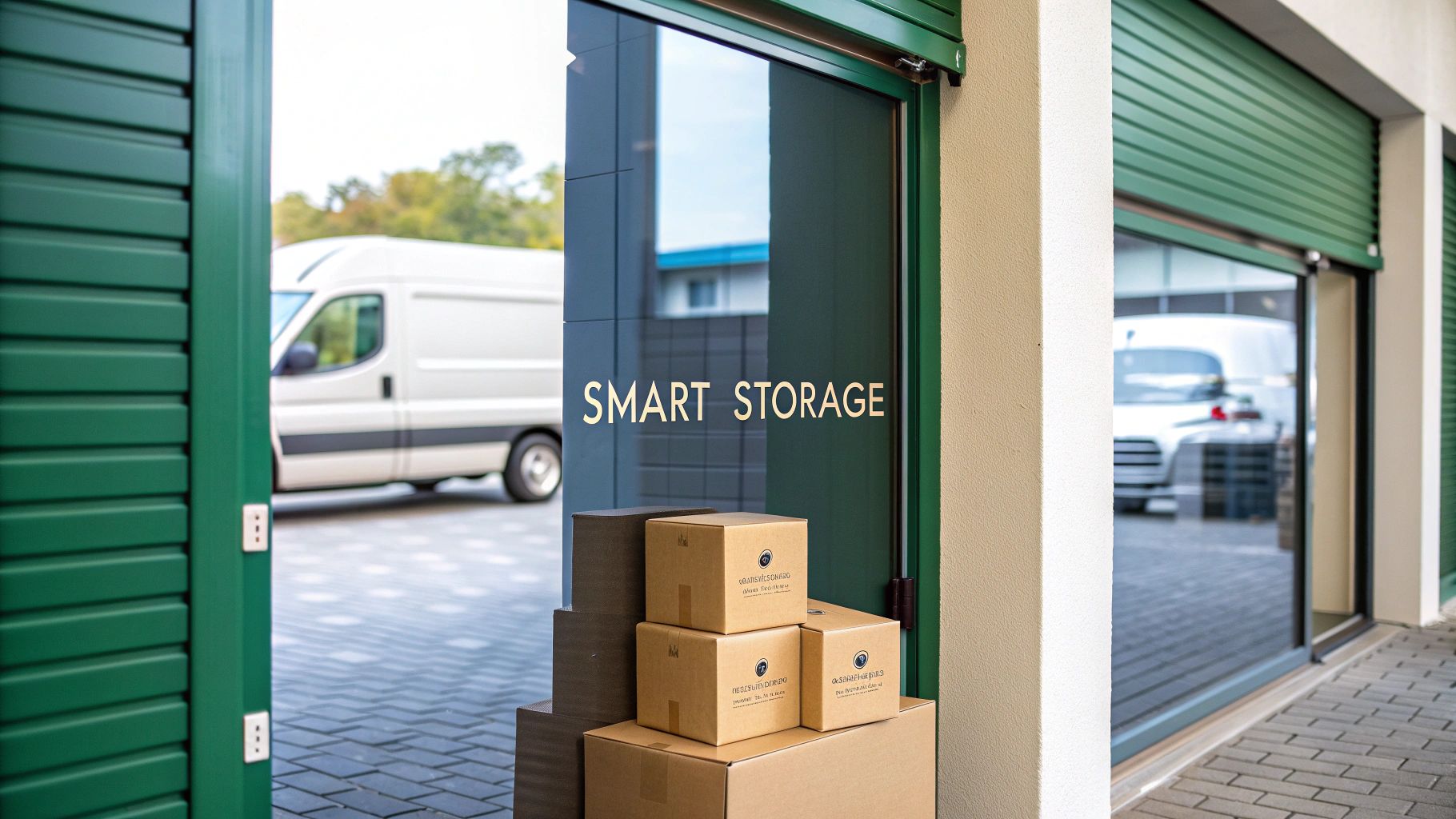
Renting storage space used to mean one thing: a dusty, forgotten unit on the edge of town. But today, it’s become something else entirely—think of it as an on-demand extension of your home, a flexible, external closet that adapts to your life.
Whether a traditional unit or a modern service is the right fit, however, depends entirely on what you need.
What Renting Storage Space Means Today
Forget the old image of padlocked metal doors in an industrial park. The whole idea of renting storage has evolved into a practical service designed for the way we live now. It's less a place to abandon old belongings and more a tool for creating some much-needed breathing room.
This shift is a direct response to modern life. Over the past decade, using storage has gone mainstream, especially in dense cities where apartments keep shrinking while our collection of stuff... well, it keeps growing.
The global self-storage market was valued at a massive $64.14 billion in 2023 and is expected to climb to $85.27 billion by 2030. With over 56% of the world now living in urban areas, the demand for flexible space is only going up. You can dig deeper into this growth over at storeganise.com.
Quick Guide to Your Storage Options
To make sense of it all, it helps to see the main options side-by-side. Each model solves a different problem, so finding the right one is about matching the service to your situation.
Ultimately, the best choice comes down to what you're storing and how much work you're willing to do.
Beyond the Traditional Storage Unit
The biggest change in storage is the arrival of new models built around convenience. While the classic drive-up unit still has its place, a new wave of services has popped up to solve the biggest headaches for city dwellers and busy people.
This new generation of storage includes options like:
- Storage-by-the-box: Often called "valet storage," this model is perfect if you don't need a whole room. Companies like Endless Storage ship you durable boxes, you pack them, and they handle the pickup and storage in a secure facility.
- On-demand delivery: Instead of you driving to a facility, your things are brought to you. When you need a specific box back, you just request it online, and it shows up at your door.
- Digital inventory: Many modern services let you track your stored items through an online account, complete with photos, so you never forget what you put away.
Choosing the Right Path for You
The whole point of modern storage is to create flexible, easy-to-access space that fits your life. Are you a city resident in a tiny apartment who just needs to get seasonal clothes out of the way? Or are you in the middle of a move and need a temporary home for all your furniture?
Understanding the differences is key, and if the valet model sounds interesting, our guide on on-demand storage can help you figure out if it’s the right fit.
The best way to think about renting storage is to see it as a service, not just a place. Ask yourself what problem you're actually trying to solve—is it a lack of convenience, a need to declutter, or a logistical nightmare during a move? The right solution will solve that specific pain point.
Choosing Your Ideal Storage Solution
Now that you’ve got the lay of the land, it’s time to find your perfect match. Renting storage space isn’t a one-size-fits-all deal; the best choice really boils down to what you’re storing, how often you’ll need it, and frankly, how much heavy lifting you want to do yourself.
Let's walk through the three main paths you can take. We'll start with the classic do-it-yourself model and move toward more specialized, hands-off services. Each one solves a different problem, and getting a handle on their core differences is the key to making a smart, budget-friendly choice.
Traditional Self-Storage: The DIY Garage Model
Think of a traditional self-storage unit as your own personal garage, just somewhere else. You rent a specific-sized room—maybe a 5'x10' for a few pieces of furniture or a 10'x20' for the contents of a small apartment—and you’re in charge of everything from there.
This route is your best bet if you’re stashing large, bulky items like sofas, dining sets, or major appliances. It’s also great if you need to pop in and grab things frequently and without warning, since most facilities offer generous access hours where you can just drive right up to your unit.
But that freedom comes with a major tradeoff: your own sweat and effort. You’re the mover, the packer, and the organizer. That usually means renting a truck, giving up your weekend for the heavy lifting, and buying all your own packing supplies. The convenience is all in the access, not the process. If you want to dive deeper, you can learn more about the ins and outs of using a self-storage facility.
By-the-Box Storage: The Valet Closet Model
For city dwellers or anyone who’s just over the logistical nightmare of moving stuff, by-the-box storage is a totally different game. Picture a closet that exists somewhere else, and someone else handles all the back-and-forth. That's the "valet closet" model, and it's exactly what services like Endless Storage do.
Instead of paying for an entire room you might not even fill, you only pay for the boxes you actually use. The process couldn't be simpler:
- Boxes Arrive: The company ships sturdy, custom-sized boxes right to your doorstep.
- You Pack: You fill them up with whatever you need to get out of the way—seasonal clothes, documents, books, or old photo albums.
- They Pick It Up: Once you’re packed, you schedule a pickup, and your boxes are whisked away to a secure, often climate-controlled facility.
When you need something back, you just go online, request the specific box you need, and it’s delivered right back to you. This service is built for modern life, completely cutting out the need for a car, a moving truck, or a weekend spent hauling boxes. It’s the perfect fix for decluttering a small apartment without getting locked into a big, half-empty unit.
This flowchart can help you figure out which path makes the most sense for you in about ten seconds.
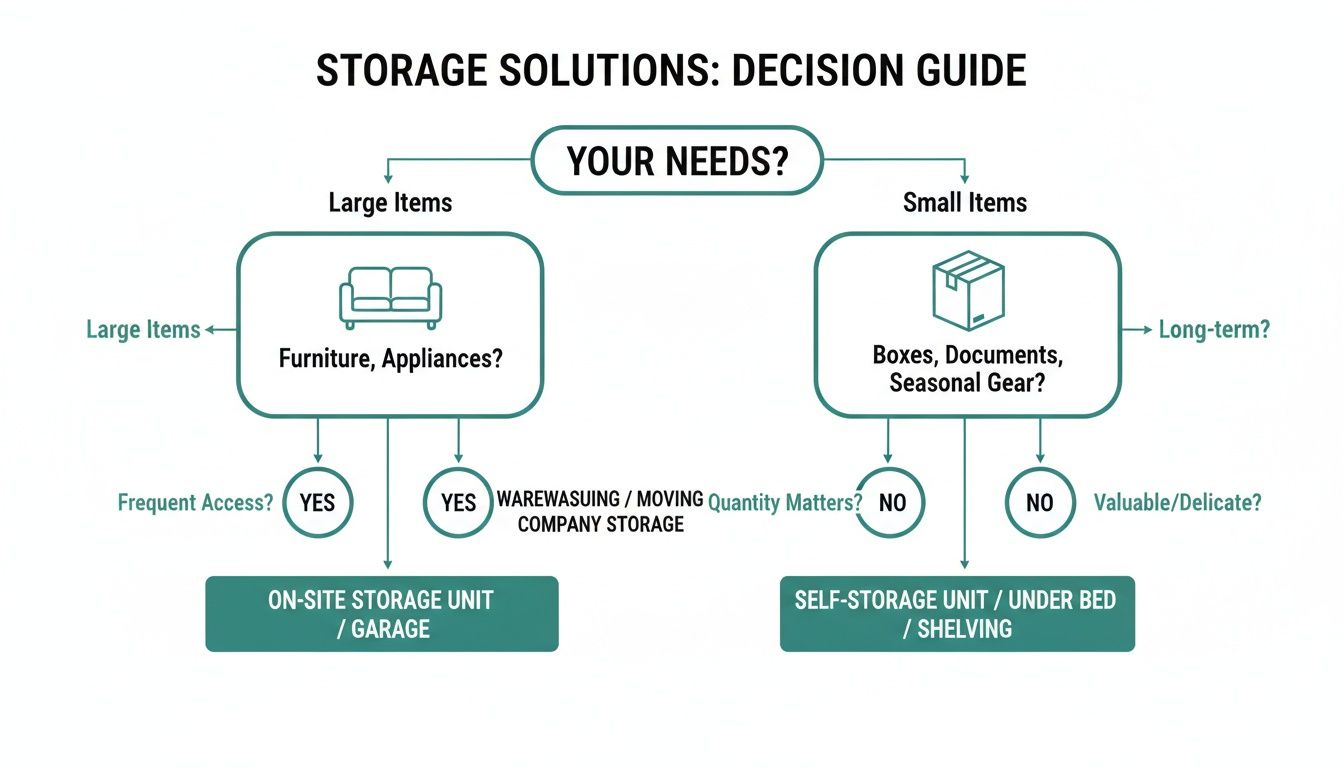
As you can see, the size of your items is the first big question that will point you toward either a full unit or a more flexible by-the-box service.
Before we move on, let's put these two popular options side-by-side to make the differences crystal clear.
Detailed Feature Comparison: Self-Storage vs. Storage-by-the-Box
This table really highlights the core trade-off: control vs. convenience. Traditional storage gives you more hands-on control, while by-the-box services handle all the tedious logistics for you.
Specialty Storage: The High-Value Vault
Finally, there are some things that need more than just a locked room—they need a precisely controlled environment to survive. This is where specialty storage comes in. Think of it as a high-value vault for items that are either priceless or just incredibly sensitive to their surroundings.
This kind of storage is an absolute must-have for things like fine wine collections, which need specific temperatures and humidity to keep from going bad. The same goes for valuable artwork, antiques, classic cars, and delicate musical instruments that could be ruined by temperature swings or moisture.
Specialty facilities offer features that go way beyond a standard unit, like advanced security systems, fire suppression, and meticulously managed climate controls. It’s the priciest option by a long shot, but when you're protecting high-value assets, it’s a necessary investment.
Making Your Final Decision
So, how do you choose? It really comes down to a quick gut-check of your needs versus your resources.
Are you storing the contents of a whole house and have the muscle (or friends with a truck) to move it yourself? A traditional unit is probably your best bet. If you decide that's the right move, check out a comprehensive storage unit size guide to make sure you find the right fit without paying for space you don't need.
But if you’re looking for maximum convenience to get smaller collections of items out of your hair, the modern valet model is almost always the smarter choice. By matching the service to your actual situation, you can make sure your belongings are safe, easy to get back, and managed in a way that actually makes your life simpler.
Uncovering the True Cost of Storage

That appealing monthly rate you see on a billboard can be deceptive. Think of it as the opening bid in a much larger financial conversation, because the true cost of renting storage space goes far beyond that single number.
It’s a classic bait-and-switch. You’re drawn in by a low price, only to find a collection of extra fees, mandatory add-ons, and personal expenses that can quickly double your initial estimate. To get a realistic picture, you have to look past the base rent and start asking the right questions.
Beyond the Monthly Rent Bill
The first surprise usually comes straight from the rental office. That advertised rate is just the foundation, and facilities often build upon it with several non-negotiable charges before you even get your key.
Be ready for a few common additions that will inflate your first payment and, in some cases, every payment that follows.
- Administrative Fees: This is a one-time, often non-refundable charge just for setting up your account. It’s basically a “paperwork fee” that can add $20 to $50 right off the bat.
- Security Deposits: While you might get this back, it’s still an upfront cost you need to budget for. It acts as a safety net for the facility and is often equal to one month's rent.
- Mandatory Insurance: This is one of the most common hidden costs. Most traditional facilities require you to insure your stored items. If you can’t show proof of coverage under a homeowner's or renter's policy, you have to buy theirs, adding $10 to $30 per month to your bill.
- A Specific Lock: You can't just bring any old padlock from home. Many facilities insist you purchase their specific type of high-security lock, which can cost another $15 to $25.
These “small” additions add up fast, turning what looked like an affordable solution into a much bigger financial commitment. For a more detailed breakdown, explore our guide on what a storage unit costs per month.
The Hidden Cost of Sweat Equity
The financial drain doesn't stop at the rental counter. With traditional self-storage, the logistical costs—both in money and your personal time—are entirely on you. This "sweat equity" is the real, unlisted price of doing it all yourself.
Think about what it really takes to move your stuff into a unit. You'll probably need to rent a moving truck ($50-$100+ per day), pay for gas, buy a mountain of boxes and tape, and say goodbye to your weekend. This is where the true cost becomes painfully clear, measured not just in dollars, but in hours of your life spent on exhausting physical labor.
The total cost isn't just what you pay the facility; it's the sum of the monthly rent, all the required fees, and the value of your own time and effort spent on logistics.
In contrast, services like Endless Storage build these logistical costs directly into their model. With door-to-door pickup and delivery, the price you see is much closer to the final price you pay. There’s no separate truck rental, no frantic search for boxes, and no surprise fees for locks or administration.
This all-in-one approach reflects a larger trend. Renting storage space has become a significant real estate story, attracting massive investment—U.S. self-storage transaction volume neared $50 billion between 2020 and 2022. This influx of capital has made it possible for new models like valet storage to exist, offering customers a transparent, service-oriented alternative. By understanding all the hidden costs, you can make a smarter choice that saves both money and effort.
Storage Strategies for Urban Life and Moving
Let's be honest, renting storage space isn't just about dealing with clutter. It's a strategic move for handling life's biggest transitions, especially if you're a city dweller or in the middle of a move. For both groups, storage is less of a luxury and more of a secret weapon for creating breathing room, cutting down on stress, and taking back your living space.
We'll dig into how a smart storage plan can turn these chaotic moments into something organized and manageable. First, we’ll tackle the unique headaches each group faces and then see how modern storage options offer a practical way out.
Thriving in the City with an On-Demand Closet
City living is all about trade-offs. You get the culture, the convenience, and the buzz, but you almost always give up space. That tiny closet was never meant to hold your winter parka, snowboard, and summer hiking gear all at once. This is where by-the-box storage completely changes the game.
It directly solves the three biggest hurdles for city residents:
- No Car Needed: Traditional storage usually means you need a car or truck, which is a major roadblock for the 30% of urban households that are car-free. Valet services fix this by handling all the pickup and delivery for you.
- Seasonal Clutter Solved: Instead of cramming off-season stuff into your already tight living space, you can just send it away. Picture this: you pack up bulky winter coats in April and have them brought back in October, all without ever leaving your apartment.
- Pay for What You Use: You don't need an entire 5'x10' unit for a few boxes of books and seasonal decorations. By-the-box pricing means you only pay for the exact space you're using, making it a much smarter and more economical choice for targeted decluttering.
When you start thinking of storage as an extension of your home—an on-demand closet, really—you can keep your apartment looking minimalist and organized while still owning all the things you love. This approach has become so popular you can find plenty of guides on effective storage solutions for apartments to help you get the most out of your square footage.
Using Storage to Master Your Move
Moving consistently ranks as one of life’s most stressful events. Far from being an extra hassle, renting storage during this time is a strategic buffer that can seriously dial down the chaos. It puts you back in control of the timeline, letting you break a massive project into smaller, saner steps.
The real magic of storage during a move is that it creates a gap. It gives you a place to put things that don't need to be in your old house or your new one right now, easing the pressure on both ends of the journey.
Think of it as a temporary command center for all your stuff. Here are the three main ways movers can use storage to their advantage:
- Declutter Before You List: Staging a home for sale is everything. Putting personal items, extra furniture, and general clutter into storage makes your home look bigger and more appealing to buyers, which can actually boost its final sale price.
- Bridge the Gap Between Leases: Closing dates almost never line up perfectly. A storage unit is a safe harbor for your belongings if you have to move out of your old place before the new one is ready, preventing that last-minute scramble.
- Unpack at Your Own Pace: The pressure to unpack every single box at once is overwhelming. By moving just the essentials first and storing everything else, you can settle into your new home thoughtfully instead of living in a cardboard maze for weeks.
This strategy has grown in response to huge shifts in how we live. When people rent storage, they’re filling a need created by a housing market where living space is smaller and more expensive than ever. In the U.S. alone, self-storage operators offer around 2.6 billion square feet of space, with occupancy hovering between 83-89%. This incredible demand has pushed the industry toward more flexible models like storage-by-the-box services, which feel more like modern e-commerce: digital sign-ups, per-box pricing, and couriers instead of you having to drive to a facility. You can dive deeper into the numbers with these self-storage industry statistics on stortrack.com.
Your Essential Storage Rental Checklist
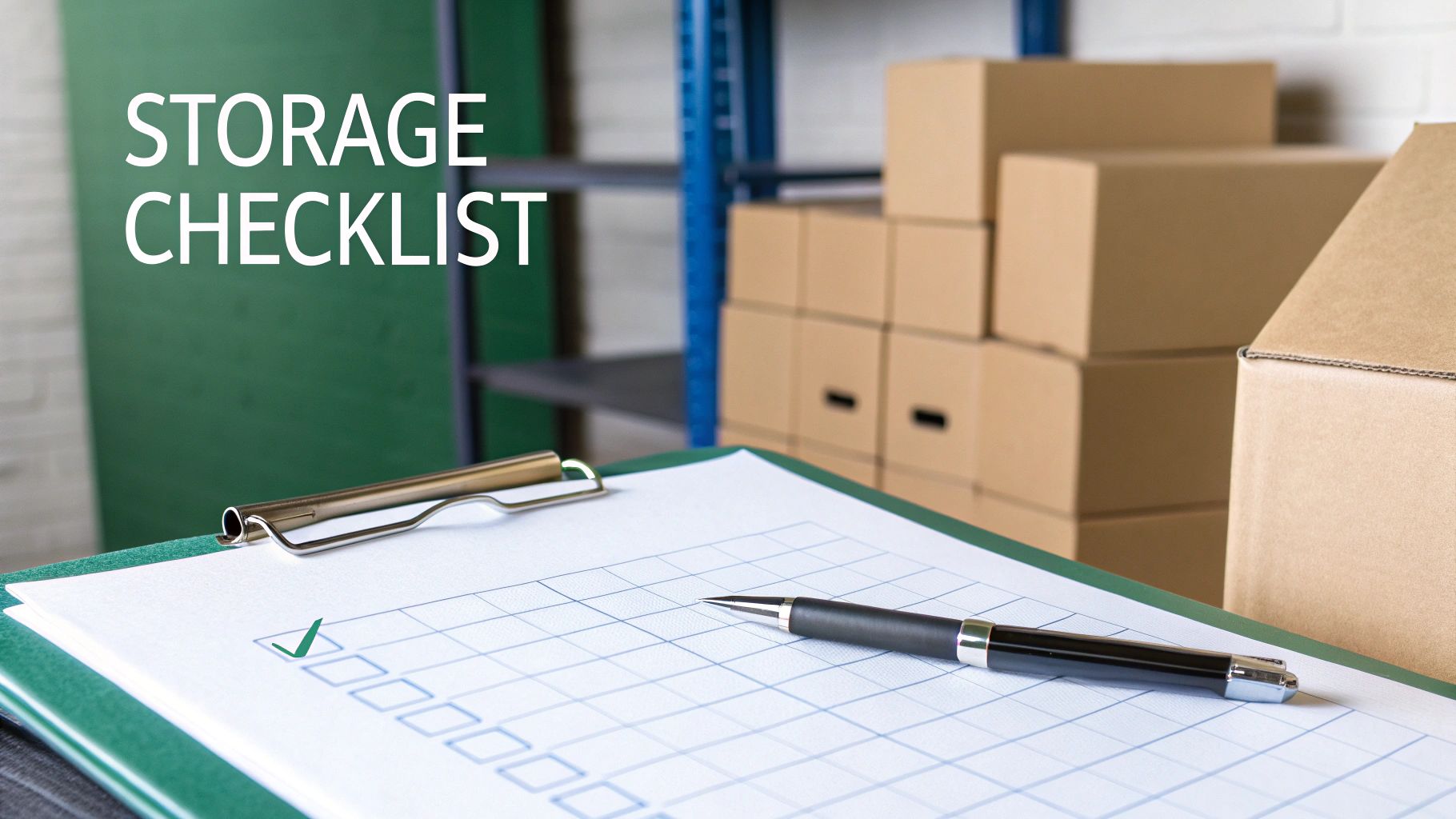
Jumping into a storage rental without a game plan is a recipe for headaches. You can easily end up paying for things you don’t need or creating a logistical mess you’ll have to untangle later. A little structure goes a long way.
This checklist breaks the whole process down into five clear, manageable steps. Follow it, and you'll find the right solution, pack like a pro, and sidestep all the common traps right from the start.
Step 1: Define Your Actual Needs
Before you even open a single browser tab to look at options, get really clear on what you’re storing and why. Are you just trying to declutter some seasonal gear? Archiving old business documents? Or are you putting an entire apartment's worth of furniture away during a big move?
Your answer shapes every decision that follows. Jot down a quick inventory list—it doesn’t need to be perfect. This simple step helps you estimate the space you'll need and prevents the #1 mistake people make: paying for a giant unit when a few boxes would have done the job.
Step 2: Compare Your Options Smartly
Now that you know what you’re storing, you can start comparing apples to apples. Do you have bulky furniture that needs a traditional drive-up unit? Or is it mostly a collection of boxes that would be a perfect match for a valet service like Endless Storage?
Think about the real-world logistics, too. Do you own a truck and have the time to haul everything yourself? Or does the thought of door-to-door pickup and delivery sound like a complete lifesaver? Be honest about what you're willing and able to do.
Step 3: Ask the Critical Questions
Let's be real: not all storage solutions are created equal. Before you sign anything, you need to put on your detective hat and ask some pointed questions to uncover the true cost and terms.
- Security: What are the specific security measures? Look for more than just a fence. Ask about gated access, surveillance cameras, and individual unit alarms.
- Climate Control: Is the facility actually climate-controlled? This is non-negotiable for protecting sensitive items like wood furniture, electronics, or important documents from extreme heat, cold, and humidity.
- Hidden Fees: Ask them straight up about administrative fees, mandatory insurance, required locks, and security deposits. You want the full price, not just the flashy advertised rate.
- Access: What are the access hours? If you're looking at a valet service, what's the process and turnaround time for getting your stuff back?
Don't be shy about asking for a complete cost breakdown in writing. A transparent company will happily provide one. If they hesitate, consider it a major red flag.
Step 4: Pack Like a Pro
How you pack is just as important as where you store. Doing it right protects your belongings and makes finding something later on infinitely easier.
- Create an Inventory: As you pack, make a detailed list or use a tracking app. Number every single box and note its general contents.
- Label Everything Clearly: Use a marker to label each box on multiple sides with its number and a quick description (e.g., "Box #12 - Kitchen - Glassware"). Your future self will thank you.
- Use Quality Materials: This is not the place to skimp. Invest in sturdy boxes, good packing tape, and protective materials like bubble wrap or packing paper for anything fragile.
- Protect Your Furniture: Take apart larger pieces if you can. Wrap everything in moving blankets or plastic wrap to keep it safe from scratches, dings, and dust.
Step 5: Schedule Your Move-In or Pickup
The final step is getting your items to their new temporary home. If you went with a traditional unit, this means booking a moving truck and confirming your move-in time.
But if you opted for a service like Endless Storage, the process is a whole lot simpler. You just schedule your pickup online, and they take care of the heavy lifting. This last step should be the easiest part of the whole process—a smooth finish to all your careful planning.
Common Questions About Renting Storage Space
Alright, you’ve done the research, compared your options, and you're this close to renting some storage space. But there are always a few nagging questions that pop up right at the end, aren't there? These are the practical, real-world details that can truly make or break your storage experience.
Getting straight answers to these common concerns is the final step. Think of it as your last checkpoint before you sign on the dotted line, making sure you’ve covered everything from sneaky insurance rules to how you'll actually get your stuff back.
Is My Stuff Insured When Renting a Storage Space?
This is a big one, and it's where a lot of people get tripped up. The short answer is almost always no, your stuff is not automatically insured. Most traditional self-storage places put the burden of insurance entirely on you.
They'll likely ask for proof that your homeowner's or renter's insurance policy covers items stored off-site. If it doesn't, you'll have to buy a separate policy directly from them, which immediately adds another line item to your monthly bill.
This is a major difference with more modern services. A valet service like Endless Storage, for example, usually includes a baseline level of insurance coverage right in the standard monthly fee. It gives you a solid layer of protection and peace of mind without any extra legwork. You can typically purchase more coverage if you're storing something particularly valuable.
Crucial Takeaway: Never, ever assume your belongings are covered. Before you sign anything, ask to see the insurance policy in writing. You need to know exactly what's covered (like theft, fire, or water damage), what the coverage limits are, and the deductible. This is one detail that absolutely deserves your full attention.
For a deeper dive into how your existing policies might play a role, check out our detailed guide on whether renter's insurance covers storage units.
Do I Really Need a Climate-Controlled Unit?
Whether you need climate control boils down to two things: what you're storing and for how long. Picture a standard, non-controlled unit as being like a garage—it gets brutally hot in the summer and freezing cold in the winter. While that’s fine for some things, it’s a death sentence for others.
Climate control keeps the temperature and humidity steady, which is your best defense against warping, cracking, rust, mildew, and mold.
You absolutely need a climate-controlled space for sensitive items, including:
- Wooden Furniture: Prevents wood from expanding, contracting, or splitting.
- Electronics: Protects delicate circuits from extreme temperatures and moisture damage.
- Artwork and Photographs: Guards against fading, discoloration, and humidity damage.
- Musical Instruments: Keeps things like guitars and pianos from falling out of tune or cracking.
- Important Documents and Books: Stops paper from turning yellow, becoming brittle, or growing mold.
If you’re just storing durable items like plastic bins of holiday decorations or basic patio furniture, a standard unit might be fine. However, many modern storage services have made this a non-issue. Companies like Endless Storage use climate-controlled facilities as their standard, so all your items get protected without you having to ask for it or pay a premium. It just takes the guesswork out of the equation.
How Easy Is It to Get My Items Back?
The process of retrieving your things is where the difference between traditional storage and modern services really shines. The best choice for you comes down to what kind of access you actually need.
With a traditional self-storage unit, you get direct, immediate access... with some caveats. You can drive to the facility during its business hours, unlock your unit, and grab what you need. This works well if you need frequent, unplanned access to everything you own. The trade-off? You have to provide your own transportation and do all the heavy lifting yourself.
On the other hand, a valet or by-the-box service is all about convenience. You manage your belongings through a digital inventory and just request the specific box or item you want. It's then delivered right to your door, usually within a day or two.
This model swaps that instant, all-at-once access for on-demand delivery. No visiting a facility, no digging through piles of boxes, and no renting a truck. It’s perfect for getting seasonal items or specific things without having to unpack your entire storage unit.
Think about your lifestyle. Do you really need to grab your entire golf set on a moment's notice? Or would you rather have your winter coats delivered to your doorstep just as the weather turns cold? Answering that question will point you to the storage solution that actually fits your life.
Ready to experience a smarter, more convenient way of renting storage space? With Endless Storage, you get door-to-door service, climate-controlled facilities, and straightforward pricing—all managed from the comfort of your home. Get started today and reclaim your space.
Frequently Asked Questions
Unveiling the Secrets to Effortless Storage
Endless Storage is available nationwide. You pick a plan, tell us where to pickup, and we'll send a UPS van to collect, whichever state you're in.
Your shipping label will be sent to your email within a few minutes, if not instantaneously. It can also be accessed through your customer profile.
Your box will be shipped to one of our climate controlled self storage facilities in our closest self storage facility. Our manager will accept your package, notify you that your box has been received, and securely stored. Only our managers will have access to Endless Storage boxes.
Email us at admin@endless-storage.com click to live chat with us, or send us a message below.
Never! We're committed to transparent pricing with no surprises. You'll lock in your rate with no hidden fees and no long-term contracts.
Fast access guaranteed! Your boxes will arrive at your doorstep within 48 hours of requesting them back. Need to check on delivery? We provide tracking information for complete peace of mind.
Totally flexible! Store month-to-month with no long-term commitment and cancel anytime.
Everything's online! Use your account dashboard to:
• Set up automatic monthly payments
• Request box returns
• Update your address
• Order additional boxes
• Track shipments
Your boxes are insured up to $100 each. Our customer service team will help you file any necessary claims and resolve issues quickly.
Don't worry – we'll email you right away if there's a payment issue. Your items stay safe, though you may have temporary service interruption or late fees until payment is resolved.
When you request our free storage kits, you'll have 30 days to send in your boxes to activate your 3 months of free storage. Think of it like starting a gym membership – your activation window begins when you receive your kits, and your full free trial begins once you send in your first box. During your free months, you'll experience our complete storage service at no cost.
Your 30-day activation window begins when you receive your storage kits. We'll send you an email confirmation when your kits are delivered, marking the start of your activation period.
If you haven't sent any boxes for storage within your 30-day activation window, your free trial will expire and we'll begin charging the regular monthly rate of $9.99 per box. This helps ensure our storage kits go to customers who are ready to use our service.
A box costs $9.99 per month to store (plus sales tax). This price includes free shipping for standard boxes under 50 lbs. and smaller than 16"x16"x16"
Log into your Endless Storage account, locate the box you would like returned, and simply click Return My Box.
Yes, each box stored with us is insured for up to $100 throughout transit as well as the duration of storage within our facilities.
Your box will be at your doorstep within 48 hours of you requesting it back.
Store 10+ boxes? We'll pick them up for free! After your purchase, we'll contact you to schedule a convenient pickup time and arrange UPS collection.
We trust UPS with all shipments, and every box includes $100 insurance coverage. You'll receive tracking information to monitor your items' journey.
Yes! Visit any of our locations by appointment. Just bring a photo ID matching your customer profile.
For everyone's safety, we can't store hazardous materials, firearms, or perishables. All items must fit within our standard boxes.
It's easy! Order your storage kit online, and we'll ship it to you within 1-2 business days. Your shipping labels will be emailed instantly and available in your account.
We're here to help! Email us at admin@endless-storage.com, use our live chat, or send us a message through your account.
To cancel your storage service with Endless Storage, please email your cancellation request to admin@endless-storage.com. Our team will process your request within 2 business days and confirm your cancellation via email.
We understand packing takes time. However, to maintain your free trial benefits, you'll need to send at least one box within the 30-day activation window. If you need more time, you can always start with one box to activate your trial and send the rest later. You can always reach out to admin@endless-storage.com if you have any issues or concerns.
When you request our free storage kits, you're starting a 30-day window to begin using our storage service.
Important: To activate your free trial, send at least one box for storage within 30 days. If no boxes are sent within this 30-day window, a one-time $50 fee applies to cover materials and shipping costs. This fee is clearly disclosed before you sign up.
Think of it like reserving a hotel room – we're setting aside space and sending specialized packing materials for your use. The fee only applies if you request materials but don't begin storage, similar to a hotel's no-show charge.