
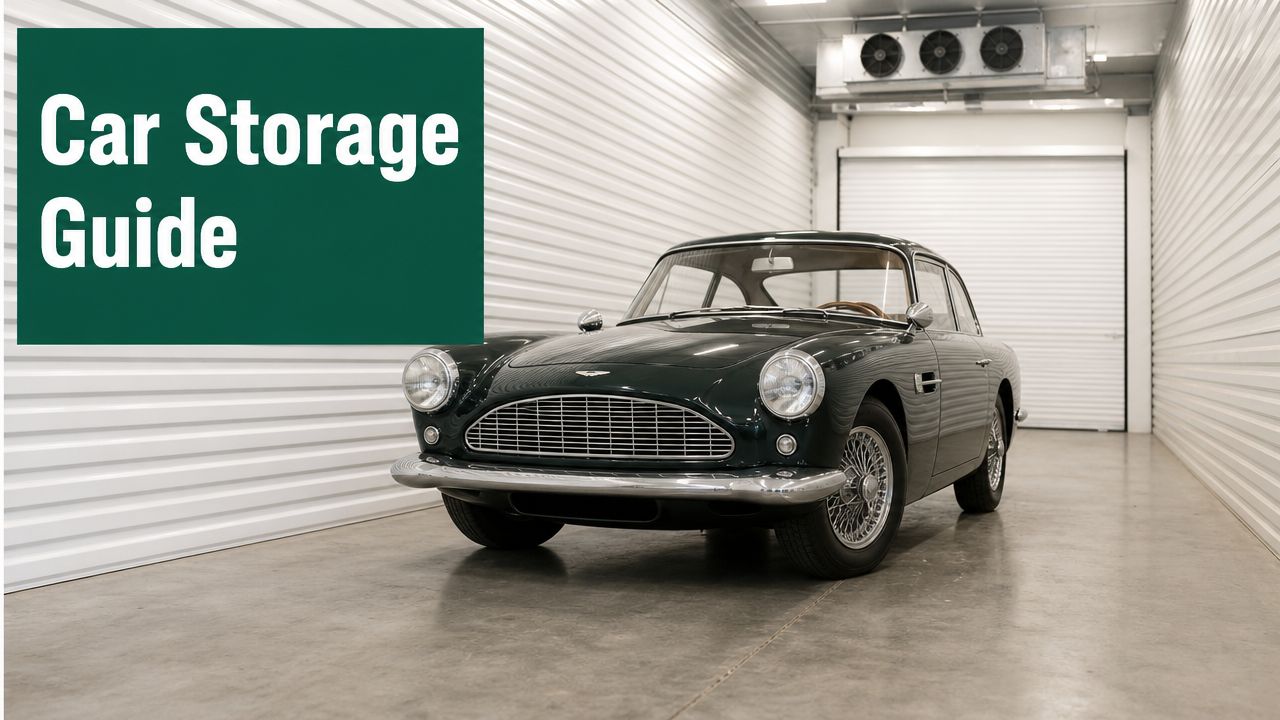
Maybe you're moving into a city apartment and losing your garage. Maybe you're heading overseas for work, welcoming a new baby, or finally reclaiming that packed garage for actual living space. Whatever the reason, you've landed on the same question a lot of car owners face: where can I put this car so it still feels like my car when I come back to it?
That question matters more than people expect. A vehicle can sit still and still age badly. Heat bakes interiors. Damp air creeps into metal parts and hidden cavities. Long periods of inactivity drain batteries, flatten tires, and turn “stored safely” into “why won't it start?”
That's where climate controlled car storage enters the conversation. It isn't just indoor parking with nicer marketing. It's a more deliberate way to protect a vehicle when time, weather, and inactivity all start working against it.
Why You Might Need to Store Your Car
A lot of storage decisions start with a life change, not a car problem. You might be downsizing, traveling for months, inheriting a family vehicle, or keeping a seasonal car off the road. Some people need space. Others need time. Either way, the car ends up parked far longer than usual.
That's when the stakes shift. A car you drive every day gets regular circulation, battery charging, and a chance for you to notice small issues. A car sitting untouched doesn't get that help. If the storage setup is poor, small problems can pile up unnoticed.
Common situations that push people toward storage
- A move or housing change: Apartment buildings often have limited parking, and street parking isn't ideal for a car you won't use often.
- Long travel or deployment: If you'll be gone for months, you need something more dependable than “I'll leave it in the driveway.”
- Garage overflow: Sometimes the garage becomes a workshop, nursery, home gym, or just badly needed household storage.
- Seasonal or hobby use: Convertibles, classics, sports cars, and collector vehicles often spend long stretches off the road.
For many owners, the car is more than transportation. It may be a major purchase, a hobby, or something with family history attached to it. That's why how you store it matters almost as much as where.
If you're also thinking about cold-weather storage for smaller vehicles, this guide to winter motorcycle preparation is useful because many of the same storage habits apply, especially around batteries, fuel, and moisture control.
If your search is local, browsing a practical example like car storage in Atlanta can help you see how storage choices change based on climate, space, and access needs.
Simple test: If you'd be upset by rust, mold, battery failure, paint damage, or a musty interior when you retrieve the car, basic parking probably isn't enough.
What Climate Controlled Car Storage Actually Means
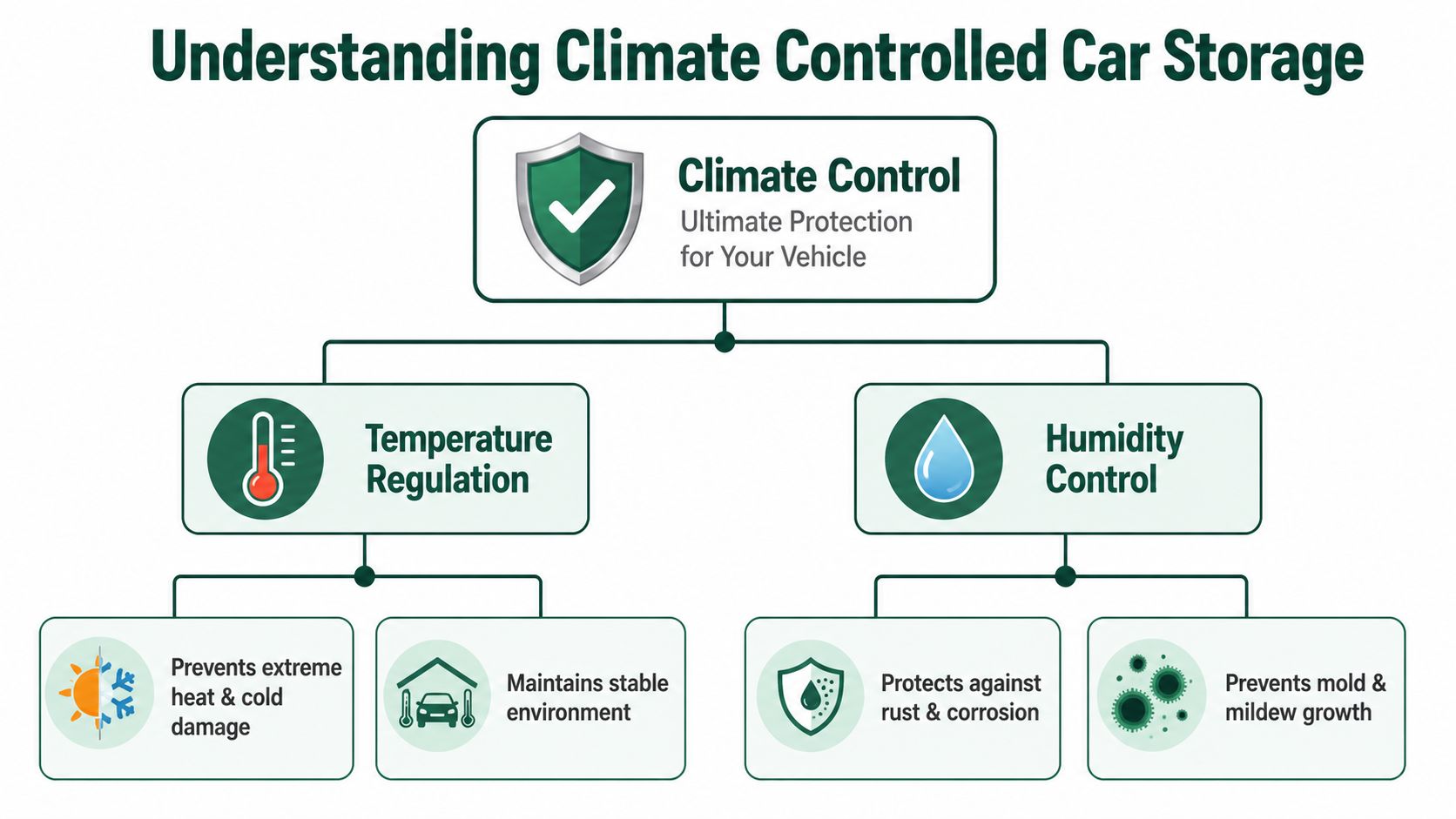
People often hear “climate controlled” and think it just means indoor. That's only part of the story. A real climate controlled setup manages temperature and humidity, not just rain exposure.
Similar to a museum archive or a good wine cellar, the goal isn't luxury. The goal is stability. Cars age fastest when the environment keeps swinging from hot to cold and dry to damp.
Temperature control protects surfaces and materials
Climate-controlled storage stabilizes both temperature, typically between 55–85°F (13–29°C), and relative humidity, often near 55%, according to AZ Detailing's explanation of climate controlled vehicle storage. That stable range helps prevent the expansion and contraction cycles that can stress paint, trim, seals, and interior materials.
A simple way to picture it is this: if you bend a paperclip back and forth enough times, it weakens. Repeated temperature swings do something similar to a car's materials over time. Paint, plastics, rubber, and clear coat all handle steady conditions better than constant change.
If you want a second perspective on how storage operators explain temperature-managed spaces in practice, these Sydney and Gold Coast storage solutions show how the idea translates across different climates and customer needs.
Humidity control is the part many people miss
Humidity is just water floating in the air. You don't need puddles for moisture damage to start. When warm, moist air meets cooler surfaces, condensation can form. That's a problem for metal, wiring, brake components, and even the cabin.
Humidity control matters because it lowers the chance of:
- Rust on metal parts
- Corrosion on wiring and fasteners
- Mold or mildew in seats, carpets, and headliners
- That stale, damp smell that's hard to remove later
A roof keeps rain off your car. Humidity control helps keep moisture out of the air around it.
If you're trying to understand the storage side of this more broadly, what temperature is climate controlled storage gives a useful baseline for how facilities think about environmental consistency.
It's not just for show cars
Climate control is often associated with classic or exotic cars, but the idea applies to modern vehicles too. Newer cars have more electronics, more sensors, and more interior materials that don't love heat and moisture. Even a practical daily driver can benefit if it's going into storage for a long stretch.
Who Really Needs Climate Controlled Storage
Not every vehicle needs the highest level of protection. If you're storing a basic commuter for a short time in a mild climate, standard indoor storage may be enough. But there are situations where paying more for climate control makes practical sense.
The easiest way to think about it is this: the more costly, delicate, rare, or sentimental the vehicle is, and the longer it will sit, the more climate control starts to look like prevention instead of a luxury.
Owners who usually benefit most
Some groups have a stronger case than others:
- Classic car owners who want to preserve older paint, trim, chrome, leather, or original materials
- Luxury and exotic car owners who want better protection for finishes, electronics, and cabin materials
- Long-term storers who know the car may sit for months at a time
- People in harsh climates where summer heat, coastal moisture, or freeze-thaw cycles can do real damage
- Sentimental owners storing a family vehicle that may not be expensive on paper but is hard to replace emotionally
A good question to ask yourself is not, “Can I get away with cheaper storage?” Ask, “What would bother me most if I opened the door six months from now?”
When standard indoor storage is probably enough
You may not need climate control if all of these are true:
| Situation | Standard indoor may work |
|---|---|
| Storage length | Short term |
| Vehicle type | Everyday driver |
| Local weather | Mild and fairly stable |
| Risk tolerance | You're okay with some cosmetic aging |
That doesn't make climate control unnecessary in every one of those cases. It just means the extra cost may be harder to justify.
When the premium is easier to justify
Climate-controlled car storage is typically treated as a premium preservation service because it regulates temperature and humidity, and facilities commonly size units for vehicles in the 10×20 feet to 10×30 feet range. One market guide also notes that indoor climate-controlled car storage often runs about $100 to $300 per month, while outdoor storage is lower, reflecting the extra infrastructure involved, as explained in this RecNation guide to car storage pricing.
If one rust repair, interior cleanup, or paint correction bill would annoy you more than the monthly premium, climate control is usually the simpler decision.
Key Features to Evaluate in a Storage Facility
Once you've decided climate control might be worth it, the next challenge is sorting real protection from marketing language. Some facilities say “temperature controlled” when they mostly mean basic air conditioning. Others offer true environmental management with stronger security and cleaner buildings.
You don't need to become a building engineer, but you should ask better questions than “Is it indoors?”
Check the environment, not just the label
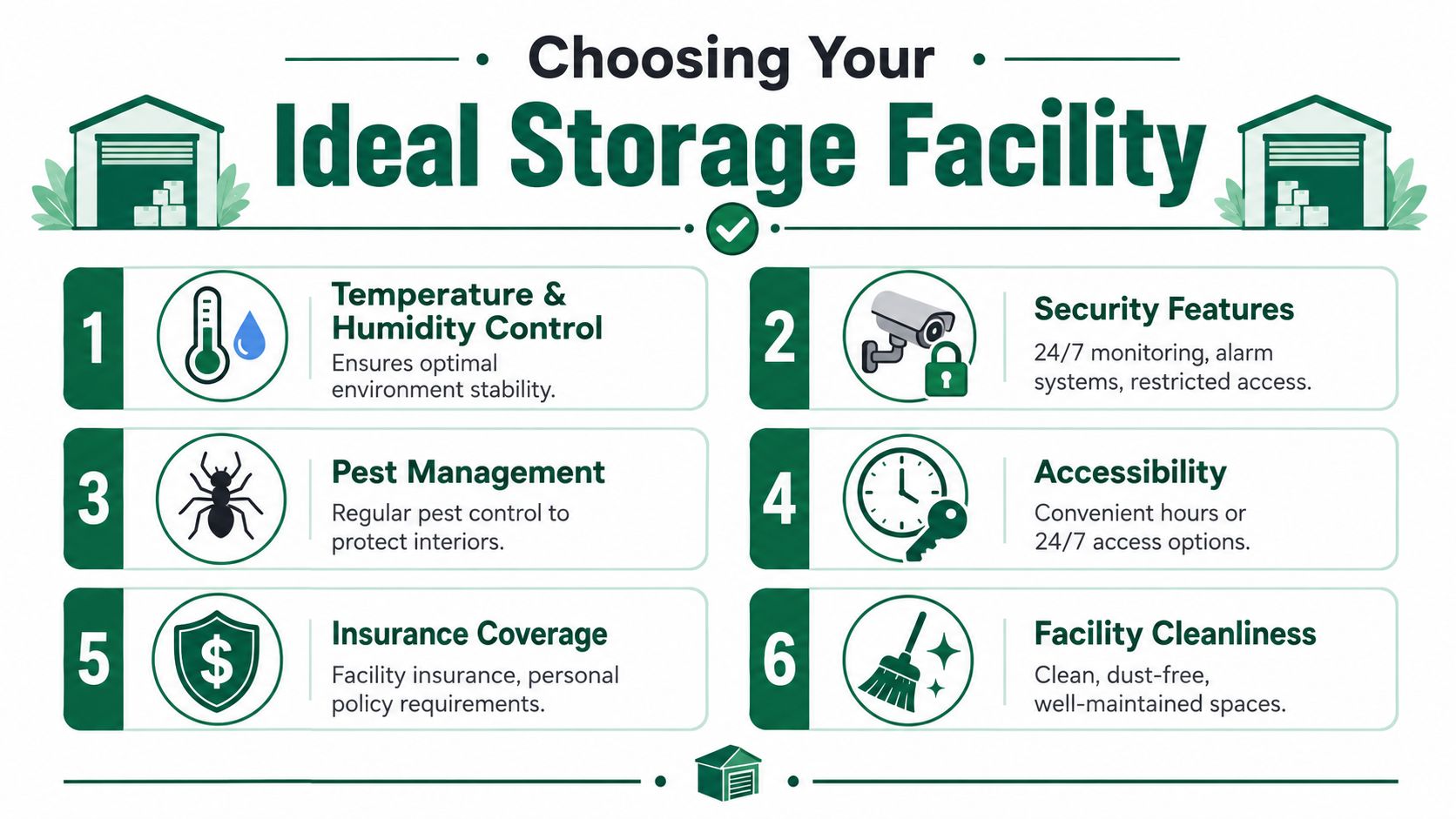
Ask how the facility handles both heat and moisture. Temperature matters, but humidity is the hidden troublemaker. A strong answer sounds specific. A weak answer sounds like “it stays pretty comfortable in there.”
Look for signs of a serious setup:
- Dedicated HVAC systems: You want more than a fan and a closed door.
- Humidity management: Ask whether humidity is actively controlled or “reduced” by air conditioning.
- Monitoring: Some facilities track conditions consistently. If they can't explain how they verify conditions, be cautious.
- Clean interiors: Dust, water stains, and musty smells usually signal weak environmental control.
For a broader primer on how facilities define these spaces, temperature controlled storage is a helpful reference point.
Security should feel layered
A car in storage is unattended by definition, so security matters. You're looking for layers, not one single feature.
Consider this checklist:
- Gated entry: Controlled access keeps random traffic down.
- Video monitoring: Cameras should cover entries, drive lanes, and storage areas.
- Individual unit protection: Alarms or lockable enclosed units add another barrier.
- Access policy: Ask who can enter, when, and whether visits are logged.
If you're comparing entry systems, this overview of secure access for gated properties is useful because it shows what controlled access can look like in real facilities, not just in brochure language.
A quick visual walk-through can also help you spot what operators prioritize:
Don't overlook the boring stuff
Some of the best clues are mundane:
- Pest management: Rodents and insects can ruin wiring, insulation, and upholstery.
- Facility cleanliness: Clean halls and units usually reflect better maintenance habits.
- Insurance rules: Ask what the facility covers and what your own auto policy must still cover.
- Access convenience: If you might need to check the car, awkward hours become a real frustration.
One option in the broader storage market is Endless Storage, which offers climate-controlled storage-by-the-box for household items rather than vehicle units. That's relevant if your car storage decision is tied to a move or garage clear-out and you need a separate place for smaller belongings.
Practical rule: If staff can clearly explain security, humidity control, pest prevention, and access rules, that's a good sign. If every answer is vague, keep shopping.
How to Prepare Your Car for Long-Term Storage
A climate-controlled building helps a lot, but it won't cancel out neglect. Storage works best when the car goes in clean, mechanically stable, and ready to sit.
Think of this as parking the car in “pause mode.” You're trying to stop dirt, moisture, stale fuel, battery drain, and tire stress from creating problems while the car rests.
Start with cleaning and inspection
Clean the outside and the inside before storage. Dirt, bug residue, and bird droppings can sit on paint longer than you think. Crumbs and hidden spills inside the cabin invite odors and pests.
Walk around the car slowly. If you already have a leak, weak battery, damaged seal, or tire issue, storage usually makes it more annoying, not less.
Handle the systems that dislike inactivity
Best practices for vehicle storage include filling the fuel tank and adding a stabilizer, inflating tires to recommended pressures, and using a battery maintainer, because stale fuel can oxidize and batteries can drain even in a well-controlled environment, according to Focus2Move's storage guidance.
A practical pre-storage checklist looks like this:
Wash and dry the vehicle completely
Moisture trapped under mats, in wheel wells, or around seals is exactly what you don't want lingering.Top off fuel and add stabilizer for gas vehicles
Less empty space in the tank means less room for moisture buildup.Set tire pressure correctly
Tires sitting underinflated for long periods are more likely to develop flat spots.Connect a battery maintainer if appropriate
This is one of the simplest ways to avoid the dead-battery surprise.Check fluids and address known issues
Storage is a bad time to ignore a small leak.Use a breathable car cover if the facility recommends one
The point is dust protection, not trapping moisture.
If you're comparing unit styles and access formats, car storage units offers a useful overview of the common setups people choose.
EVs need a slightly different routine
Electric vehicles change the checklist. You don't need fuel stabilizer, but you do need to think about battery state of charge and low-voltage battery drain. If the car stays connected to telematics and background systems, the smaller battery can still become a problem during long storage.
For EVs, treat storage prep more like device battery management than old-school fuel management.
Comparing Storage Alternatives and Costs
The decision isn't between “perfect” and “terrible.” It's between a few imperfect options with different trade-offs. The best choice depends on your car, your budget, and how long the vehicle will sit.
Here's the broad picture: outdoor parking is cheapest and least protective. Covered storage adds weather shielding but little environmental stability. Standard indoor storage gives better physical protection. Climate-controlled storage adds the most controlled environment.

What the pricing tells you
Climate-controlled storage is a real pricing category, not a niche extra. In the U.S., the national average monthly rent for a climate-controlled self-storage unit was $145.09 in 2023, compared with $114.51 for a non-climate-controlled unit, which is about a 26.7% premium, according to Neighbor's self-storage industry statistics. The same source notes that in April 2024, the average climate-controlled rent was $149, about $10 more per month than a standard unit.
That doesn't mean every vehicle owner should pay the premium. It does mean the market consistently values the added protection.
If you want a pricing-focused breakdown, climate controlled storage cost helps frame what tends to affect the final monthly rate.
Side-by-side trade-offs
| Storage type | Cost level | Protection from weather | Protection from humidity swings | Best fit |
|---|---|---|---|---|
| Climate controlled | Highest | Strong | Strong | Valuable cars, long-term storage, harsh climates |
| Standard indoor | Mid-range | Strong | Limited | Daily drivers, shorter storage periods |
| Covered outdoor | Lower | Moderate | Weak | Short-term use where basic weather cover is enough |
| Open air | Lowest | Weak | Weak | Budget-first situations, low concern about preservation |
The practical question to ask
Don't just compare monthly price. Compare likely outcomes.
If your vehicle is ordinary, regularly replaceable, and only sitting for a short period, basic indoor storage can be a sensible compromise. If it's a collector car, luxury car, or a vehicle you care about a great deal, the higher cost of climate controlled car storage often buys simpler ownership later. Fewer surprises. Less cleanup. Better odds that the car feels the same when you retrieve it.
Frequently Asked Questions About Car Storage
Is climate controlled car storage worth it for an EV
Often, yes, especially for long storage periods or hot and humid regions. Modern guidance often misses EV-specific needs. Traditional advice focuses on fuel stabilizers, but EV owners should keep the battery state of charge near 50%, manage the 12-volt battery, and look for facilities with charging access and proper ventilation, as noted in this EV-focused storage discussion from Attic Plus.
For connected cars, telematics can keep drawing power in the background. That's the modern twist many generic storage checklists miss.
Should you start the car every so often while it's stored
Usually, not just for the sake of hearing it run. Starting a stored car briefly without driving it long enough to fully warm up can create its own issues. It's better to prepare the car properly before storage than to rely on occasional short starts.
Does climate control replace storage prep
No. Climate control helps the environment around the car. It doesn't replace tire pressure checks, battery management, basic cleaning, or fuel stabilization for gas vehicles. Think of it as a safer room, not a magic shield.
What matters most for a connected car
Ask whether you'll have reasonable access for periodic checks, whether charging is possible for EVs if needed, and whether the facility can explain any rules about battery maintenance, remote access, or long-stay monitoring.
Do you still need insurance
Usually, yes. Facility security and your personal auto coverage are different things. Ask the storage operator what they cover, what they don't, and whether your insurer needs to know the vehicle is in storage.
A good storage plan protects both the car and your ability to use it later without drama.
If you're sorting out vehicle storage because a move, downsizing project, or garage cleanout has forced a bigger storage decision, Endless Storage is one option for the household side of the problem. It offers climate-controlled storage-by-the-box for personal items, which can help free up space while you arrange the right dedicated storage setup for your car.
Frequently Asked Questions
Unveiling the Secrets to Effortless Storage
Endless Storage is available nationwide. You pick a plan, tell us where to pickup, and we'll send a UPS van to collect, whichever state you're in.
Your shipping label will be sent to your email within a few minutes, if not instantaneously. It can also be accessed through your customer profile.
Your box will be shipped to one of our climate controlled self storage facilities in our closest self storage facility. Our manager will accept your package, notify you that your box has been received, and securely stored. Only our managers will have access to Endless Storage boxes.
Email us at admin@endless-storage.com click to live chat with us, or send us a message below.
Never! We're committed to transparent pricing with no surprises. You'll lock in your rate with no hidden fees and no long-term contracts.
Fast access guaranteed! Your boxes will arrive at your doorstep within 48 hours of requesting them back. Need to check on delivery? We provide tracking information for complete peace of mind.
Totally flexible! Store month-to-month with no long-term commitment and cancel anytime.
Everything's online! Use your account dashboard to:
• Set up automatic monthly payments
• Request box returns
• Update your address
• Order additional boxes
• Track shipments
Your boxes are insured up to $100 each. Our customer service team will help you file any necessary claims and resolve issues quickly.
Don't worry – we'll email you right away if there's a payment issue. Your items stay safe, though you may have temporary service interruption or late fees until payment is resolved.
When you request our free storage kits, you'll have 30 days to send in your boxes to activate your 3 months of free storage. Think of it like starting a gym membership – your activation window begins when you receive your kits, and your full free trial begins once you send in your first box. During your free months, you'll experience our complete storage service at no cost.
Your 30-day activation window begins when you receive your storage kits. We'll send you an email confirmation when your kits are delivered, marking the start of your activation period.
If you haven't sent any boxes for storage within your 30-day activation window, your free trial will expire and we'll begin charging the regular monthly rate of $9.99 per box. This helps ensure our storage kits go to customers who are ready to use our service.
A box costs $9.99 per month to store (plus sales tax). This price includes free shipping for standard boxes under 50 lbs. and smaller than 16"x16"x16"
Log into your Endless Storage account, locate the box you would like returned, and simply click Return My Box.
Yes, each box stored with us is insured for up to $100 throughout transit as well as the duration of storage within our facilities.
Your box will be at your doorstep within 48 hours of you requesting it back.
Store 10+ boxes? We'll pick them up for free! After your purchase, we'll contact you to schedule a convenient pickup time and arrange UPS collection.
We trust UPS with all shipments, and every box includes $100 insurance coverage. You'll receive tracking information to monitor your items' journey.
Yes! Visit any of our locations by appointment. Just bring a photo ID matching your customer profile.
For everyone's safety, we can't store hazardous materials, firearms, or perishables. All items must fit within our standard boxes.
It's easy! Order your storage kit online, and we'll ship it to you within 1-2 business days. Your shipping labels will be emailed instantly and available in your account.
We're here to help! Email us at admin@endless-storage.com, use our live chat, or send us a message through your account.
To cancel your storage service with Endless Storage, please email your cancellation request to admin@endless-storage.com. Our team will process your request within 2 business days and confirm your cancellation via email.
We understand packing takes time. However, to maintain your free trial benefits, you'll need to send at least one box within the 30-day activation window. If you need more time, you can always start with one box to activate your trial and send the rest later. You can always reach out to admin@endless-storage.com if you have any issues or concerns.
When you request our free storage kits, you're starting a 30-day window to begin using our storage service.
Important: To activate your free trial, send at least one box for storage within 30 days. If no boxes are sent within this 30-day window, a one-time $50 fee applies to cover materials and shipping costs. This fee is clearly disclosed before you sign up.
Think of it like reserving a hotel room – we're setting aside space and sending specialized packing materials for your use. The fee only applies if you request materials but don't begin storage, similar to a hotel's no-show charge.