Climate-controlled storage usually means a unit kept in a practical temperature range of about 50°F to 80°F. In many facilities, the target sits somewhere in the middle of that band, not at the edges, because the goal is stable protection for your stuff, not making the room feel like your living room.
If you're in a small city apartment, this question usually comes up at the exact moment your space runs out. Maybe the hallway closet is packed, the bed frame has boxes under it, and you're trying to figure out what to do with winter coats, family photos, old records, or the wood side table you want to keep.
That's where storage gets less simple than it sounds. A regular unit may be perfectly fine for some things. But if you're storing anything that can warp, crack, mildew, rust, or slowly degrade in damp air, the word climate-controlled starts to matter a lot.
The tricky part is that many renters ask one question, “what temperature is climate controlled storage,” when the better question is, “what kind of environment do my items need, and for how long?” That's the part that can save you money. You may not need climate control for every situation, and you definitely don't want to pay for features your belongings don't need.
Protecting Your Valuables from the Elements
Living in an apartment changes how you think about storage. You don't usually need space for a whole house full of furniture. You need safe space for the items that don't fit right now but still matter. That might be tax files, extra bedding, a guitar, off-season clothes, framed art, or the box of photos your family somehow trusts you with.
The problem is that “out of the way” often means “at risk.” A damp basement, a hot garage, or an attic that swings from chilly to stuffy can be rough on everyday materials. Wood moves. Fabric holds moisture. Paper absorbs damp air faster than realized.
Practical rule: If an item would make you nervous sitting in a humid hallway all summer or a cold attic all winter, it probably deserves more than basic storage.
Climate-controlled storage acts like moving your belongings from an outdoor shed into a managed indoor room. It helps create steadier conditions, which is exactly what fragile materials require. If you've ever dealt with moisture at home, these Purified Air Duct Cleaning details humidity control explain why damp air can become a major problem long before you see visible damage.
Before you store anything, it helps to know what you have. A simple home inventory checklist template makes it easier to separate “must protect” items from things that can handle standard storage conditions.
Where people get confused
A lot of renters assume climate control just means air conditioning. It doesn't. Others think it's only for antiques or luxury items. That's not right either. Plenty of normal apartment belongings can be sensitive, especially if they're boxed up for months and left alone.
The straightforward explanation is:
- Short-term sturdy items often do fine without extra protection.
- Sentimental or moisture-sensitive items usually benefit from a steadier indoor environment.
- Mixed apartment overflow needs sorting, not guesswork.
That last point matters most. If you're storing folding chairs and a suitcase, your answer may be different than if you're storing books, a laptop, and your grandmother's dresser.
The Standard Range for Climate Control
If you are trying to fit apartment overflow into storage, the temperature question usually sounds simpler than it is. You want one number. In practice, climate-controlled storage is less like setting your home thermostat and more like keeping your belongings in a room that avoids harsh swings.
Most facilities describe climate control as keeping units in a moderate indoor range, often around 50°F to 80°F. Some operators use a slightly tighter band, such as 55°F to 78°F or 55°F to 85°F. The exact target can vary by building and season, which is why it helps to ask how the facility defines temperature-controlled storage, not just whether the words appear on the website.
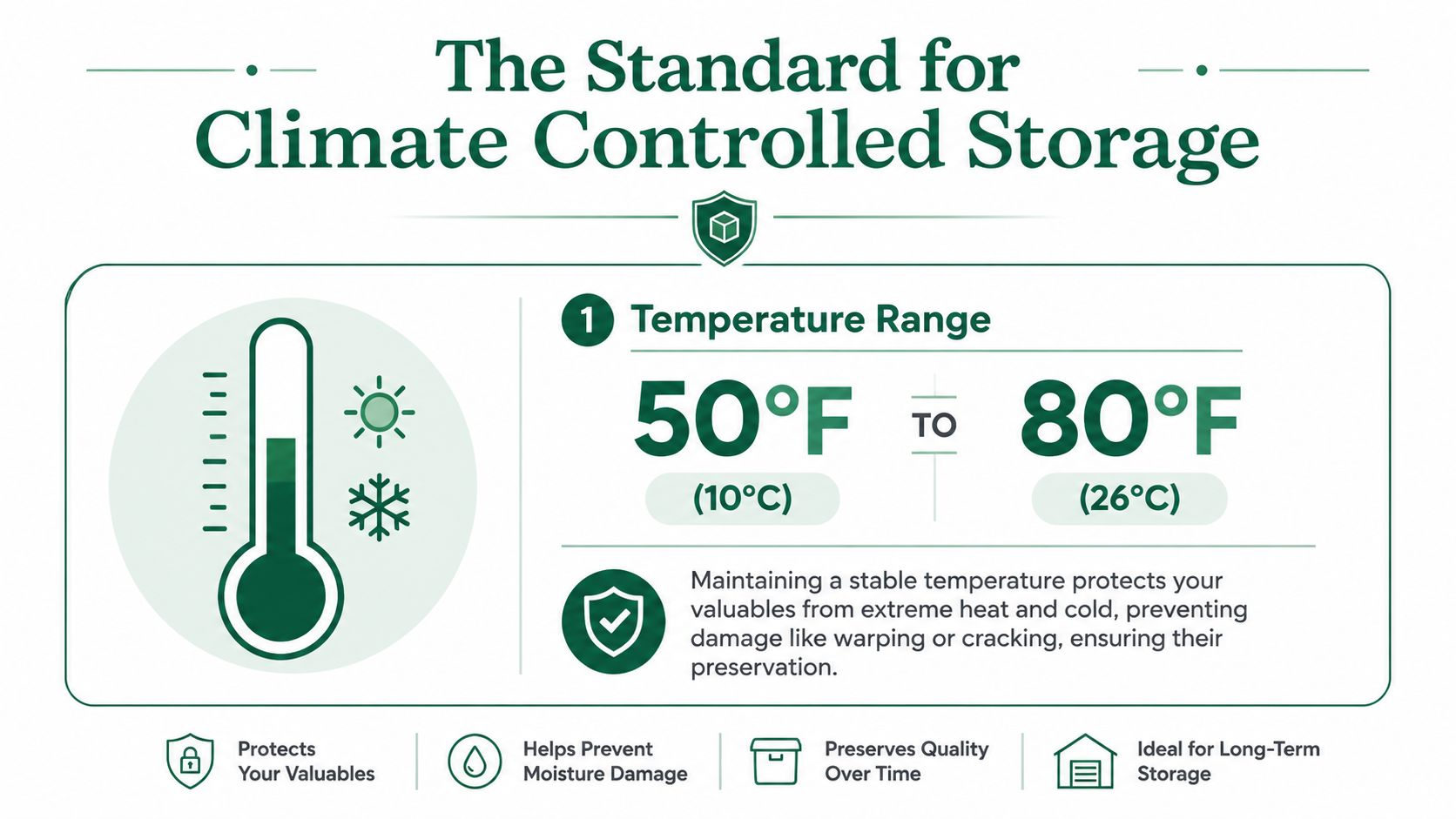
That is the short answer. The more useful answer is that steady conditions matter more than chasing one perfect number.
A climate-controlled building works like the difference between parking your things in a hallway versus keeping them inside a well-managed room. Your boxes are not sitting through the full force of a heat wave in July and a cold snap in January. For someone in a small city apartment, that matters because storage often holds the items you cannot replace easily, even if they are not expensive. Photo boxes, a compact desk, winter clothes, records, or the spare monitor you do not have room to keep at home.
Why facilities use a range instead of one exact temperature
Storage buildings are designed to protect property, not to feel like a living room. Operators usually aim for a practical middle zone that reduces stress on common household materials without the cost of maintaining a museum-grade environment.
That middle zone is enough for many renters.
If you are storing sturdy items for a short period, such as metal shelves, patio gear, or sealed bins of kitchen tools, you may not need tighter control. If you are storing wood furniture, paper files, electronics, instruments, or anything sentimental for months, a steadier indoor range becomes easier to justify. That is where this decision can save you money. You do not always need the premium option for everything. You need it for the items that react badly to heat swings and damp air.
Temperature is only part of climate control
A cool room can still be a bad storage environment if the air feels damp. That is why good climate control usually includes moisture management along with temperature regulation.
A simple way to judge it is this. Temperature protects against baking, freezing, and repeated expansion and contraction. Humidity protection helps prevent the sticky, musty, warping kind of damage that shows up later. Many providers explain this combined approach in slightly different ways, including Posch & Silva's controlled storage facilities.
The number helps, but your item list matters more
People often ask, “So what temperature is climate-controlled storage, exactly?” A better follow-up question is, “What am I storing, and for how long?”
If your unit will hold mostly durable, low-risk items for a month or two, standard storage may be enough. If your apartment storage problem includes mixed belongings, especially items made of wood, paper, fabric, leather, or electronics, climate control usually makes more sense because it gives those materials a steadier place to sit while your space at home stays livable.
Why Temperature and Humidity Matter for Your Belongings
A storage problem usually starts without warning. A chair doesn't look damaged on day one. A photo album doesn't wave a flag when moisture gets in. But leave sensitive materials in the wrong environment long enough, and small changes turn into permanent ones.

Climate-controlled storage isn't just cooled air. It combines temperature regulation with moisture management, typically through HVAC and dehumidification. Multiple industry sources cite relative humidity targets of 55% or lower, and under 50% RH is often used as a stronger benchmark for protecting paper, electronics, and other moisture-sensitive items, according to PODS' explanation of climate-controlled storage.
What damage actually looks like
Think about a wooden guitar stored through a muggy summer and a dry winter. The wood swells, shrinks, and shifts. Over time, that can affect shape, seams, finish, and tuning stability.
Now think about a box of family photos. If damp air lingers around paper and cardboard, you may get curling, sticking, odor, or mold. Even worse, you might not notice until you open the box months later.
Here's how common damage tends to show up:
- Wood and veneers can warp, split, or loosen at joints.
- Paper and books can yellow, ripple, stick together, or grow mold.
- Electronics can face corrosion and moisture-related internal damage.
- Plastics and finishes may become brittle, crack, or deform under stress.
- Fabrics and clothing can pick up mildew smells that are hard to remove.
If you're boxing up chargers, cameras, tablets, game systems, or old hard drives, this guide on how to store electronics is useful because electronics often suffer more from moisture swings than people expect.
Cool air alone isn't enough
A lot of renters assume, “If the room feels cool, my stuff is safe.” Not always. Cool air without humidity control can still leave you with damp conditions. That's why climate control is different from simple air-cooled space.
This short video gives a helpful visual overview of how storage conditions affect everyday belongings:
Some of the worst storage damage comes from slow moisture exposure, not dramatic heat.
For apartment dwellers, that's important because many stored items are boxed tightly and checked rarely. If something goes wrong, it can sit unnoticed for a long time.
Items That Benefit Most from Climate Control
Not everything needs a carefully managed indoor environment. A metal lamp, a set of plastic bins, or a basic folding table is usually less demanding than paper, leather, or electronics. The best candidates for climate control are the items that react to moisture, temperature swings, or both.

Furniture, instruments, and anything made from natural materials
Wood and leather tend to show stress in visible ways. Drawers stop sliding smoothly. Veneer can loosen. Leather can dry out, stiffen, or pick up a musty smell if moisture hangs around.
Musical instruments belong in this same group. Guitars, violins, and similar pieces are built from materials that respond to environmental changes. They don't need pampering, but they do benefit from steadier conditions.
Paper, photos, and memory boxes
This is the category many apartment residents underestimate. Old report cards, passports, letters, tax files, sketchbooks, notebooks, printed photos, and photo albums don't take up much room, but they're often the hardest things to replace.
Paper products are especially vulnerable because they absorb moisture and can degrade slowly while sealed inside boxes. If your storage plan includes anything sentimental or archival, climate control is usually the safer call.
If losing the item would hurt more than replacing the item would cost, lean toward better protection.
Electronics, media, and small high-value items
Laptops, monitors, speakers, cameras, gaming systems, hard drives, cables, and backup devices often end up in storage during a move or a downsizing phase. These items may look sturdy from the outside, but internal parts don't love damp air or repeated temperature stress.
Media collections fit here too. Think vinyl records, CDs, DVDs, and similar formats. They're compact, but they can still react badly to poor conditions over time.
A more detailed checklist of what items need climate-controlled storage can help if your apartment storage pile includes a little bit of everything.
Clothing and textiles
Off-season wardrobes, coats, linens, comforters, and special-occasion clothing often get stored because they eat up valuable closet space. Textiles may seem low-risk, but they can hold moisture and odor. Once mildew gets into fabric, cleaning it out isn't always easy.
This is especially relevant if you're storing boxed clothes for months rather than a couple of weeks. Long storage time gives moisture problems more opportunity to show up.
Comparing Your Storage Options
Choosing storage isn't just about protection. It's also about how much space you need, how long you need it, and whether your belongings justify climate control.
The decision depends on exposure duration, item sensitivity, and local weather swings. Some guidance says climate control may not be necessary in mild climates, while other recommendations lean toward it when outside temperatures regularly exceed 90°F or fall below freezing. The key point is that there's no universal rule for everyone, as explained in Outrig's guide to deciding on climate-controlled storage.
A practical way to choose
If you're storing patio cushions, basic cookware, or sturdy household extras for a short move in mild weather, standard storage may be enough. If you're storing books, electronics, photos, or wood furniture for a longer stretch, the risk changes.
That's why apartment residents should think in use cases, not labels:
- Short move, tough items, stable weather: standard storage can make sense.
- Longer storage, mixed household goods: climate control becomes more appealing.
- Small-volume storage from an apartment: a by-the-box option can match the amount you need.
If you're comparing alternatives beyond the usual self-storage setup, this overview of storage unit alternatives is helpful because a full unit isn't always the most practical fit for a smaller household.
Storage Option Comparison
| Feature | Standard Storage | Climate-Controlled Unit | Endless Storage (By-the-Box) |
|---|---|---|---|
| Best for | Durable items and shorter storage needs | Sensitive belongings and longer storage periods | Apartment overflow, smaller quantities, boxed items |
| Temperature protection | Limited | Managed indoor temperature range | Climate-controlled facilities |
| Humidity management | Often limited or absent | Better suited for moisture-sensitive items | Managed indoor storage environment for boxed goods |
| Space model | You rent a whole unit | You rent a whole unit | You store by the box |
| Convenience | You transport and access items yourself | You transport and access items yourself | Pickup and return process fits small-space living |
| Fit for city apartments | Can feel oversized | Can still be more space than you need | Works well when you don't need a full unit |
| When it may be overkill | When you need better protection | When your items are sturdy or storage is brief | When you have large furniture or bulk storage |
The money-saving question
The cheapest mistake is paying for too much storage. The expensive mistake is under-protecting items you care about.
If you only need to get a few sturdy things out of your apartment for a short period, don't assume climate control is mandatory. But if your boxes contain paperwork, keepsakes, electronics, records, or a wood piece you'd hate to damage, saving a little on storage may not feel smart later.
For people juggling a move and storage at the same time, resources on planning a Perth relocation with storage show how often logistics and item sensitivity need to be considered together. The exact city may differ, but the decision process is the same. Match the storage type to the items, timeline, and weather exposure.
Tips for Using Climate-Controlled Storage Effectively
Climate control helps, but packing still matters. A well-managed room can't fully protect belongings that were packed damp, crammed too tightly, or sealed in a way that traps moisture.
Pack for airflow
Don't overstuff boxes until they bulge. Air should move around items, not just around the outside of a tower of crushed cardboard.
Try these habits:
- Leave breathing room: Pack boxes full enough to support their shape, but not jammed so tightly that items press hard against each other.
- Use clean, dry materials: Never box clothing, books, or linens when they're even slightly damp.
- Wrap with purpose: Use protective layers for fragile surfaces, but avoid sealing moisture inside with dirty or damp packing material.
Keep items off walls and floors when possible
Storage walls can experience slight temperature differences from the center of the room. Even in a managed environment, it's smart to leave a little space between your belongings and the perimeter.
This also makes inspection easier. You want to be able to see what you stored and reach it without rebuilding the entire unit like a game of furniture Tetris.
Store your most sensitive items where they're easiest to check, not where they fit most tightly.
Use the right container for the item
Cardboard is common because it's cheap and easy. It's fine for many short-term uses. But for longer storage, some items do better in sturdier containers.
A simple rule works well:
- Paper files and photos: Use archival sleeves or well-sealed containers inside a larger box.
- Clothing and textiles: Clean them first, then use breathable or appropriate long-term containers.
- Electronics: Keep original packaging if you still have it, or use padding that protects against shifting and dust.
Label for retrieval, not just for packing
Many individuals label boxes with broad terms like “office” or “bedroom.” That helps on moving day, but it doesn't help much six months later.
Write labels that answer real questions. “Tax records and lease papers.” “Winter coats and scarves.” “Camera gear and charging cables.” Better labels reduce the temptation to rummage through every box, which keeps handling to a minimum.
Ask one question before signing
Ask the facility or service how they manage indoor conditions. You're not looking for a sales speech. You want a clear explanation of how the environment is maintained and what kinds of items they recommend for that setup.
If the answer is vague, keep looking.
Common Questions About Climate-Controlled Storage
Is climate-controlled the same as temperature-controlled
Not always. Temperature-controlled usually focuses on keeping the space within a set temperature band. Climate-controlled generally goes further by addressing moisture as well. That difference matters for paper, fabric, electronics, and anything else that can be harmed by humidity.
Can you set the temperature yourself
Usually, no. In most storage settings, the facility manages the building environment rather than giving each renter a personal thermostat. You're choosing the type of storage environment, not customizing a private room like a hotel suite.
Is climate control necessary in a mild climate
Sometimes yes, sometimes no. The better test is what you're storing, how long it will sit, and how much indoor and outdoor conditions swing over time. Mild weather can still include damp periods, heat spikes, or enough fluctuation to matter for sensitive items.
What happens during a power outage
That depends on the operator. Well-run facilities often rely on building insulation, managed systems, and operational planning to preserve stability as much as possible. If this concerns you, ask directly before booking rather than assuming all providers handle it the same way.
Is climate control worth it for apartment renters
It often is when you're storing a small number of important items instead of a garage full of tough stuff. Apartment living usually means every stored item was chosen for a reason. If the boxes hold things that are sentimental, moisture-sensitive, or expensive to replace, better protection usually makes more sense.
If you need a simpler way to store apartment overflow without renting more space than you use, Endless Storage offers climate-controlled, by-the-box storage that fits city living especially well. It's a practical option when you want protection for smaller loads like documents, clothing, electronics, and keepsakes, without dealing with a full traditional unit.
Frequently Asked Questions
Unveiling the Secrets to Effortless Storage
Endless Storage is available nationwide. You pick a plan, tell us where to pickup, and we'll send a UPS van to collect, whichever state you're in.
Your shipping label will be sent to your email within a few minutes, if not instantaneously. It can also be accessed through your customer profile.
Your box will be shipped to one of our climate controlled self storage facilities in our closest self storage facility. Our manager will accept your package, notify you that your box has been received, and securely stored. Only our managers will have access to Endless Storage boxes.
Email us at admin@endless-storage.com click to live chat with us, or send us a message below.
Never! We're committed to transparent pricing with no surprises. You'll lock in your rate with no hidden fees and no long-term contracts.
Fast access guaranteed! Your boxes will arrive at your doorstep within 48 hours of requesting them back. Need to check on delivery? We provide tracking information for complete peace of mind.
Totally flexible! Store month-to-month with no long-term commitment and cancel anytime.
Everything's online! Use your account dashboard to:
• Set up automatic monthly payments
• Request box returns
• Update your address
• Order additional boxes
• Track shipments
Your boxes are insured up to $100 each. Our customer service team will help you file any necessary claims and resolve issues quickly.
Don't worry – we'll email you right away if there's a payment issue. Your items stay safe, though you may have temporary service interruption or late fees until payment is resolved.
When you request our free storage kits, you'll have 30 days to send in your boxes to activate your 3 months of free storage. Think of it like starting a gym membership – your activation window begins when you receive your kits, and your full free trial begins once you send in your first box. During your free months, you'll experience our complete storage service at no cost.
Your 30-day activation window begins when you receive your storage kits. We'll send you an email confirmation when your kits are delivered, marking the start of your activation period.
If you haven't sent any boxes for storage within your 30-day activation window, your free trial will expire and we'll begin charging the regular monthly rate of $9.99 per box. This helps ensure our storage kits go to customers who are ready to use our service.
A box costs $9.99 per month to store (plus sales tax). This price includes free shipping for standard boxes under 50 lbs. and smaller than 16"x16"x16"
Log into your Endless Storage account, locate the box you would like returned, and simply click Return My Box.
Yes, each box stored with us is insured for up to $100 throughout transit as well as the duration of storage within our facilities.
Your box will be at your doorstep within 48 hours of you requesting it back.
Store 10+ boxes? We'll pick them up for free! After your purchase, we'll contact you to schedule a convenient pickup time and arrange UPS collection.
We trust UPS with all shipments, and every box includes $100 insurance coverage. You'll receive tracking information to monitor your items' journey.
Yes! Visit any of our locations by appointment. Just bring a photo ID matching your customer profile.
For everyone's safety, we can't store hazardous materials, firearms, or perishables. All items must fit within our standard boxes.
It's easy! Order your storage kit online, and we'll ship it to you within 1-2 business days. Your shipping labels will be emailed instantly and available in your account.
We're here to help! Email us at admin@endless-storage.com, use our live chat, or send us a message through your account.
To cancel your storage service with Endless Storage, please email your cancellation request to admin@endless-storage.com. Our team will process your request within 2 business days and confirm your cancellation via email.
We understand packing takes time. However, to maintain your free trial benefits, you'll need to send at least one box within the 30-day activation window. If you need more time, you can always start with one box to activate your trial and send the rest later. You can always reach out to admin@endless-storage.com if you have any issues or concerns.
When you request our free storage kits, you're starting a 30-day window to begin using our storage service.
Important: To activate your free trial, send at least one box for storage within 30 days. If no boxes are sent within this 30-day window, a one-time $50 fee applies to cover materials and shipping costs. This fee is clearly disclosed before you sign up.
Think of it like reserving a hotel room – we're setting aside space and sending specialized packing materials for your use. The fee only applies if you request materials but don't begin storage, similar to a hotel's no-show charge.