
Car Storage Units: The Ultimate Explainer & Guide
You’re probably here because your car has become a space problem.
Maybe you live in an apartment where the building garage costs too much, street parking feels like a gamble, and your second car barely moves. Maybe you’ve got a classic car you don’t want sitting through winter weather. Maybe a move, deployment, renovation, or long trip means your vehicle needs a safe place that isn’t a friend’s driveway.
That’s where car storage units come in. They’re not just “somewhere to park.” A good setup protects the vehicle, buys back space in your life, and solves a lot of side problems people don’t think about until they’re in the middle of them, like where to keep winter tires, tools, roof racks, emergency gear, and the random trunk clutter that follows a car around.
Why You Might Need a Car Storage Unit
A common city problem goes like this. You’re paying for access to a car more than you’re paying for using it. It sits for days, sometimes weeks, while you still worry about tickets, weather, break-ins, tree sap, and whether someone will tap your bumper while parallel parking.
For other people, the problem looks different. A family is between homes and needs to clear the driveway. A collector wants to protect a vintage vehicle from humidity and seasonal grime. Someone heading out of town for months doesn’t want to leave a car unattended on the street.
This isn’t a niche issue. The global vehicle storage unit market was valued at US$13.64 billion in 2023 and is projected to reach US$22.85 billion by 2032, with long-term storage accounting for over 70% of revenue, according to Astute Analytica’s market report via GlobeNewswire. That lines up with what urban drivers already know: parking is tight, life is mobile, and people need better off-site options.
Practical rule: If your car is causing stress when it’s not being driven, storage may be a housing and lifestyle decision, not just a vehicle decision.
A car storage unit can help when you need:
- Seasonal protection for a convertible, collector car, or spare vehicle
- Temporary space relief during a move, remodel, or lease change
- Longer-term safekeeping while traveling, studying away, or working remotely
- A cleaner home setup when garage overflow has pushed everything into your apartment
The trick is choosing the right kind of storage, not just the nearest one.
Understanding Car Storage Fundamentals
Think of a car storage unit as a home-away-from-home for your vehicle. A parking garage gives you a place to leave a car. A storage setup is meant to protect it, preserve it, and keep it stable while you’re not using it.
That distinction matters. If your car will sit for more than a short stretch, the questions change. You’re no longer asking only, “Where can I put it?” You’re asking, “What kind of environment will it sit in, who can access it, and what condition will it be in when I need it again?”
What makes storage different from parking
A simple garage or lot focuses on space. Car storage units focus on a package of needs:
- Protection from weather such as sun, rain, debris, and seasonal grime
- Security controls like gates, surveillance, lighting, and restricted access
- Longer-term suitability for vehicles that won’t be started regularly
- Room planning so you can get in and out without scraping mirrors or doors
A helpful mental model is this: parking is for convenience today, storage is for condition later.
The main reasons people use car storage units
City dwellers usually start with one practical pain point, then discover several others. You might begin by trying to free up your building spot, then realize you also need a safer place for winter, a cleaner entryway at home, or somewhere to keep accessories that don’t fit in the apartment.
People often choose storage when they:
Don’t have reliable parking at home
Apartment buildings, shared driveways, and permit streets make ownership harder than it looks on paper.Own a vehicle they use occasionally
A weekend car, project car, or inherited vehicle doesn’t need daily access, but it does need proper shelter.Need space during a transition
Moves, breakups, renovations, and temporary work assignments create awkward gaps where a car still needs a legal, secure place to sit.Want to reduce household clutter tied to the car
Tires, detailing supplies, chargers, roof racks, strollers, camping gear, and trunk organizers take up more room than people expect.
If you’re comparing providers in a specific area, broader self-storage research can help you understand local facility types and access rules. For example, this guide to find self storage in Perth is useful for seeing how general storage options are organized in one market, even if your final choice is vehicle-specific.
A good storage choice solves two problems at once: where the car goes, and what the car has been forcing you to store around it.
Who benefits most
Some people get much more value from storage than others.
A few examples:
- Urban apartment residents with one car too many for the available parking
- Classic or enthusiast owners who care about paint, trim, and interior condition
- Frequent travelers who need a stable home for a vehicle while they’re away
- Families in transition who need to keep one asset safe while everything else is in motion
If that sounds like you, the next decision is the format of storage, because not all car storage units protect a vehicle the same way.
Comparing Your Car Storage Options
The phrase “car storage” covers several very different products. Some are just open spaces in a secured lot. Others are enclosed units with climate systems and concierge-style service. If you compare them as if they’re interchangeable, it’s easy to overpay for the wrong thing or under-protect a vehicle you care about.
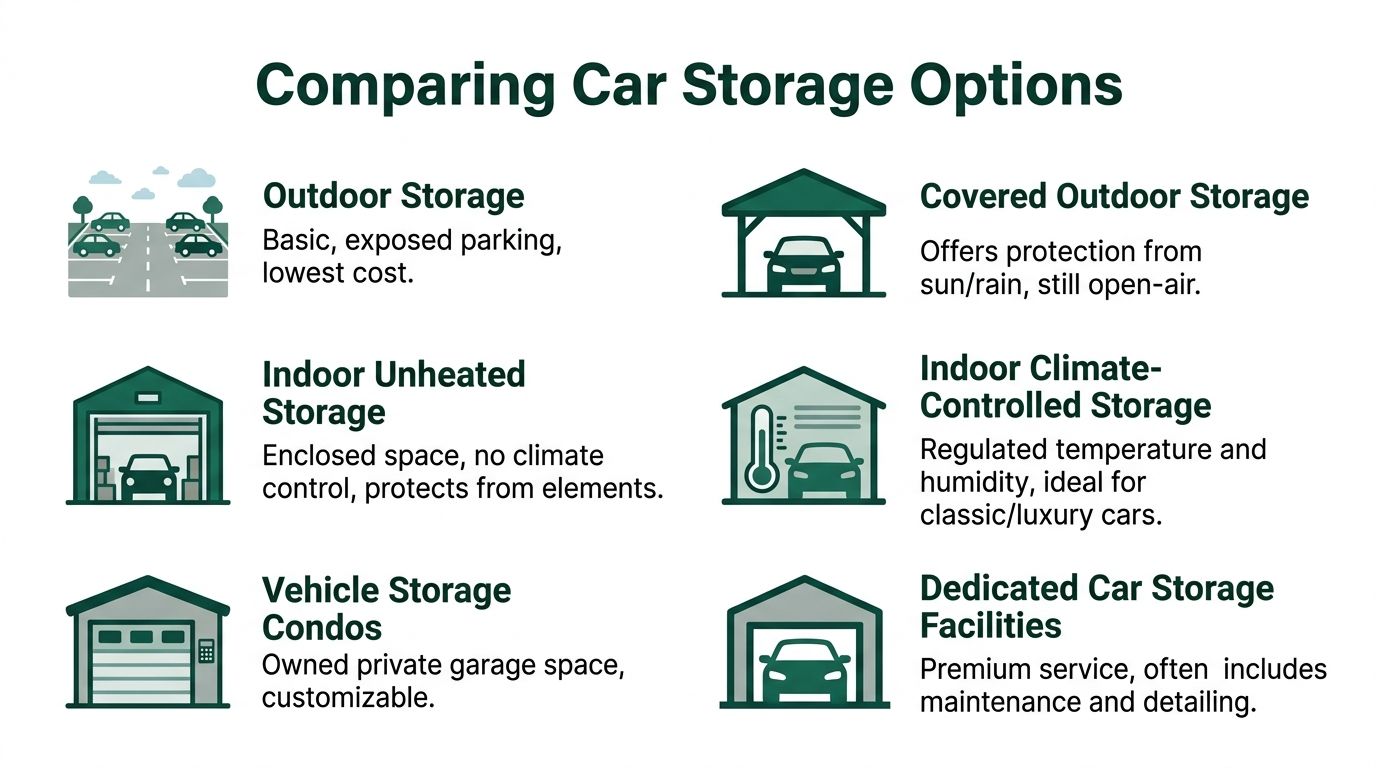
Six common storage types
Outdoor storage
This is the simplest option. Your car sits in an assigned outdoor space, usually inside a fenced facility.
It works best for short-term needs, basic vehicles, or situations where cost matters more than protection. The downside is obvious. The vehicle stays exposed to weather, dust, sunlight, and shifting temperatures.
Covered outdoor storage
This gives you a roof overhead but keeps the sides open. It’s a middle-ground option for people who want some protection from direct sun and rain without paying for a fully enclosed unit.
This is often enough for a vehicle that isn’t highly valuable but still deserves better treatment than a completely open lot.
Indoor unheated storage
Here the car goes inside a building or enclosed garage-style unit, but there’s no active climate management. For many drivers, this is the practical sweet spot. The vehicle is protected from precipitation, UV exposure, and a lot of everyday grime.
This type is often a strong fit for city residents storing a regular sedan or SUV for part of the year.
Indoor climate-controlled storage
This is the premium choice for people who care about preservation, not just shelter. According to AZ Detailing’s vehicle storage feature guide, climate-controlled units maintain a temperature between 55-80°F and humidity below 50% to help prevent corrosion and material degradation. The same source notes that uncontrolled environments can cause a 20-30% yearly loss in battery capacity and contribute to rubber cracking.
If you own a classic, luxury car, or any vehicle with sensitive electronics, leather, trim, or sentimental value, this category deserves a serious look.
Climate control isn’t about comfort. It’s about slowing the kinds of damage that happen while a car quietly sits still.
Vehicle storage condos
These are private garage-style spaces, often owned rather than rented in the usual monthly-storage sense. They appeal to enthusiasts who want control, privacy, customization, or a place to combine storage with hobby use.
They’re less common, and they’re often overkill if your main goal is to get a car off the street.
Dedicated car storage facilities
These are purpose-built businesses focused on vehicle care. They may offer extras such as battery tending, detailing coordination, pickup support, or staff that work primarily with collectors and long-term owners.
They’re best for people who want a more managed experience and don’t mind paying for specialization.
Car Storage Unit Comparison
| Storage Type | Protection Level | Typical Cost | Best For |
|---|---|---|---|
| Outdoor Storage | Low | Usually the most budget-friendly | Short-term storage, basic vehicles |
| Covered Outdoor Storage | Moderate | Mid-range in many markets | Protection from sun and rain |
| Indoor Unheated Storage | High against weather, limited environmental control | Higher than outdoor options | Standard cars stored for weeks or months |
| Indoor Climate-Controlled Storage | Highest overall protection | Premium | Classic, luxury, and long-term storage |
| Vehicle Storage Condos | Private and customizable | Typically a premium ownership-style option | Enthusiasts wanting dedicated space |
| Dedicated Car Storage Facilities | Very high, often with added services | Premium | Owners who want managed care |
How to decide without overthinking it
A simple way to choose is to match the storage type to the value of the car and the risk of the environment.
- Choose outdoor if the vehicle is utilitarian, the storage period is short, and you mainly need legal, off-street space.
- Choose covered outdoor if weather exposure is your main concern but you don’t need a sealed room.
- Choose indoor unheated if you want strong everyday protection for a normal car.
- Choose climate-controlled if the vehicle is older, valuable, collectible, or especially vulnerable to humidity and temperature swings.
- Choose a dedicated facility if you want more than space and expect a service relationship.
If you’re also comparing nontraditional ways to manage overflow around the vehicle, this roundup of storage unit alternatives for 2025 is useful for thinking beyond the standard monthly unit model.
Don’t forget the equipment around the car
Urban drivers often have more than a car to store. They may also need a place for ramps, bins, tools, seasonal gear, or utility equipment. If that’s part of your situation, looking at broader solutions for vehicle and equipment storage can help you think through covered structures, attached storage areas, and how mixed-use space is typically designed.
The overlooked city problem
In cities, the best answer is often a hybrid one. A sedan may need indoor storage, while the snow chains, emergency kit, spare mats, bike rack, and detailing supplies need separate, smaller storage. People get into trouble when they rent space sized for the clutter instead of the vehicle, or vice versa.
That’s why it helps to treat the car and the car-related belongings as two different storage jobs.
How to Choose the Right Unit Size and Price
A lot of people shop for car storage units by monthly rate first. That’s understandable, but it usually leads to one of two mistakes: renting too small and fighting the space every visit, or renting too large because you haven’t separated the car from everything else you think needs to live with it.

Start with the vehicle, not the unit listing
According to Low Cost Storage’s vehicle sizing guide, a standard 10x20 foot unit is the benchmark size for most mid-sized cars and SUVs, and that extra room helps with door access. The same source says choosing the right size can reduce access time by 30% compared with a tighter fit, while also lowering the chance of scrapes and dings.
That’s the key idea. You’re not only buying floor area. You’re buying usable clearance.
How to measure correctly
Use a simple three-step check:
Measure the full length
Don’t guess from the brochure. Measure the actual vehicle from front to back, including anything that extends beyond the body line.Measure the widest point
That usually means mirrors. If they fold, decide whether you’ll rely on folding them every time.Add buffer space
You need room to steer in, open a door, and move around the car without hugging the wall.
Sizing shortcut: If a unit technically fits the car but makes entry stressful, it’s too small in practice.
What changes the price
Storage pricing varies by market and facility, so it’s better to think in categories than assume one universal rate. In most cities, price tends to move based on:
- Location near dense neighborhoods or downtown corridors
- Unit type such as outdoor versus enclosed
- Climate control and related building features
- Ease of access like drive-up entry, first-floor placement, or wider aisles
- Facility quality including security and maintenance standards
If you’re unsure how much room a vehicle and your extra items really need, a broader storage unit size guide can help you separate what belongs in a vehicle-sized unit from what should be stored elsewhere.
A useful garage comparison
Many people understand space better when they compare it to a home garage. If that helps you, these clever layout ideas for 1 car garages can give you a visual sense of just how quickly boxes, tools, and sports gear eat into vehicle clearance.
Best-value thinking for city renters
The cheapest listing isn’t always the lowest-cost decision. A cramped unit can be frustrating every time you visit. A unit that’s too large can gradually become a dumping ground for unrelated clutter.
For most urban renters, the best value comes from asking two separate questions:
- What size does the car need to sit safely?
- What other belongings are being forced into the same plan because my apartment is short on space?
When you split those questions, pricing gets much easier to understand.
Your Step-by-Step Car Storage Preparation Checklist
Once you’ve chosen among car storage units, preparation matters as much as the unit itself. A good facility helps, but it can’t undo a dirty interior, neglected fluids, weak battery, or pest invitation.

Clean the car like it’s staying in your home
Start with a full clean, inside and out. Dirt, crumbs, moisture, and old receipts seem harmless, but they turn into odors, staining, and pest bait when a car sits closed up.
Do this before the car goes in:
- Wash the exterior so grime doesn’t sit on the paint for months
- Dry it well so moisture isn’t trapped in seams or mats
- Vacuum the interior and remove every food item, wrapper, and bottle
- Wipe hard surfaces including the dash, console, and door pockets
- Empty the trunk of anything you wouldn’t want sitting in heat or dampness
If you’re also rotating seasonal tires out of the vehicle plan, this guide on storing winter tires is a useful companion.
Protect the mechanical basics
A stored car still ages. It just ages unnoticed. Before you hand over the keys or lock the unit, deal with the things that commonly go wrong when a vehicle sits.
Focus on these items:
Battery care
Charge it fully. For longer storage, a battery tender or trickle charger is often the safer move than hoping it starts months later.Tire pressure
Inflate tires to the recommended level so they’re less likely to develop flat spots.Fluids
Check oil, coolant, and brake fluid. If anything is already due for service, take care of it before storage.Fuel planning
Don’t leave the tank nearly empty for a long storage period. Follow your owner’s manual and your mechanic’s advice for fuel stabilizer if needed.
A car in storage doesn’t stop being a machine. It just stops warning you in real time.
This walkthrough is a helpful visual companion if you want to see a prep routine in action:
Prevent easy, avoidable problems
A few small precautions save a lot of hassle later.
- Skip the parking brake for long storage if your setup allows wheel chocks instead. That reduces the chance of parts sticking.
- Use a quality car cover if the environment and facility rules make it appropriate.
- Block pest entry points carefully if recommended by the facility and safe for your vehicle.
- Take photos before storage so you have a dated record of condition.
Remove the car clutter on purpose
This is the step city residents often miss. Don’t leave your car packed with items just because your apartment is tight. That only turns the vehicle into a mini closet on wheels.
Take out:
- Emergency overflow you don’t need every day
- Seasonal accessories like chains, beach gear, sunshades, or snow tools
- Paperwork you shouldn’t leave in a parked car
- Electronics and chargers that can degrade or disappear
- Bulky trunk organizers that are holding random household spillover
Keep a pickup-ready list
When it’s time to drive again, you’ll want a short re-entry checklist:
- Check the battery
- Inspect tire pressure
- Look under the car for leaks
- Test lights and brakes
- Take a short drive before relying on it for a long trip
That small list is what turns storage from a stressful pause into a smooth handoff back to everyday use.
Security Insurance and Legal Essentials
A clean unit and a locked gate aren’t the whole story. The less visible part of car storage units is the contract around them. That’s where security expectations, insurance responsibilities, and legal requirements tend to live.
What security features actually matter
When you tour a facility, don’t stop at “Is it secure?” Ask what that means in practice.
Look for details such as:
- Controlled gate access so entry isn’t open to the public
- Video surveillance covering drive lanes and entry points
- Lighting that makes evening visits feel safe and reduces blind spots
- On-site staff or active management rather than a neglected property
- Clear access rules about who can enter and when
A polished website doesn’t tell you how a place feels at night or how tightly access is managed during the week. If possible, visit in person.
Insurance is usually your job
Many renters assume the facility’s policy automatically covers the vehicle. That’s risky thinking. Storage businesses often limit their liability in the rental agreement, which means your own auto insurance or a separate policy may still be essential.
Before signing, ask:
- Does my current auto policy cover storage-related loss?
- Does the facility require proof of insurance?
- Are there exclusions for theft, weather, rodents, or vandalism?
- What exactly is the facility responsible for, if anything?
If you want a broader explanation of how storage coverage is usually structured, this guide to storage unit insurance cost helps clarify the difference between facility requirements and your own protection.
Ask this directly: “If something happens to my vehicle in storage, whose insurance responds first?”
Registration, paperwork, and contract terms
Facilities often require a valid ID, vehicle information, and proof that you’re legally entitled to store the car. Some also require current registration and insurance even if the vehicle won’t be driven often.
Read the contract for practical terms that affect real life:
- Access hours and whether you can retrieve the car early or late
- Late-payment rules and what happens if your account falls behind
- Maintenance restrictions inside the unit
- Notice requirements for move-out
- Documentation standards for ownership or authorized use
The legal side of storage isn’t exciting, but it’s where expensive misunderstandings begin. A quick, careful read now is easier than sorting out a dispute later.
A Smarter Storage Strategy for City Life and Moves
Vehicle storage is often considered a parking substitute. In city life, it’s usually more than that. It’s part of a broader strategy for managing space when your apartment, building, and block all have hard limits.
If you live in a dense area, your real problem may not be “Where do I park?” It may be “How do I stop my car from dictating how I use my home?” A car can force helmets into the hallway, tools under the bed, seasonal gear into the coat closet, and emergency supplies into corners that were already full.
Think in layers, not one big unit
The cleanest setup often has two parts:
- A vehicle solution for the car itself
- A separate small-item solution for everything the car drags into your home
That matters during moves too. When leases overlap poorly or closing dates shift, people often need flexibility more than square footage. The car may need one kind of storage, while documents, chargers, accessories, and apartment overflow need something completely different.
What belongs with the car and what doesn’t
A useful rule is to keep only what needs to stay with the vehicle.
Usually worth keeping with the car:
- Registration and insurance documents only if safely stored and legally appropriate
- Vehicle-specific tools you need when retrieving it
- A fitted cover, if you use one
Usually better stored separately:
- Seasonal accessories
- Extra mats
- Sports gear
- Detailing products
- Spare chargers and electronics
- Small parts and loose interior items
People save money and reduce frustration. They stop renting oversized vehicle space just to hold bins and miscellaneous car-related clutter.
Use local context when choosing
Your storage strategy should match your city and your habits. Someone in a humid market may prioritize environmental protection. Someone moving across town may care more about flexibility and retrieval timing. Someone in a neighborhood with expensive parking may use off-site storage as a way to reset their monthly budget and reclaim living space.
If you’re weighing options in a specific metro, looking at a city-focused guide such as car storage in Atlanta can help you think through market-specific tradeoffs without assuming every city works the same way.
The simplest way to avoid overbuying
Don’t rent one large solution for three smaller problems.
Break the need into pieces:
- The vehicle
- The gear that supports the vehicle
- The unrelated apartment clutter that has piled up around both
When you separate those categories, you make cleaner decisions. You spend less time paying for unused space, and you stop turning the car into backup closet space.
Frequently Asked Questions About Car Storage
Can I work on my car inside a storage unit
Usually, major maintenance is restricted. Many facilities allow basic access but not repairs that involve fluids, noise, long open-door sessions, or extended on-site work. Ask for the written rules before you rent.
Do I still need insurance while the car is stored
In many cases, yes. Facilities often want proof of coverage, and your own policy may be the main protection if something goes wrong. Don’t assume storage means insurance is optional.
Do I need current registration
Some facilities require it. Others focus more on proof of ownership and insurance. The only safe move is to ask before move-in and check local legal requirements.
Is climate control worth it
For some cars, absolutely. Research highlighted on an Extra Space Storage page about vehicle storage points to a major gap in climate-controlled options for classic and luxury vehicles in urban areas. That same reference notes a 2025 study found that 68% of classic car owners reported damage from improper storage, while many facilities still don’t advertise certified climate specifications. If your car is collectible, high-value, or sensitive to humidity, ask for exact environmental details instead of settling for vague terms like “indoor.”
What happens if I miss payments
That depends on the contract and local law, but facilities typically have a formal late-payment process that can eventually lead to lien enforcement. Read the agreement closely so you know the timeline, fees, and notice rules.
Can I store all my car stuff in the same unit
You can, but that doesn’t always mean you should. If bins, tools, and seasonal gear start determining the size of the vehicle unit, it may be smarter to split the car from the smaller items and store each in the format that fits best.
If you’ve got the vehicle plan figured out but still need a simple way to store the smaller stuff around it, Endless Storage is worth a look. It’s a storage-by-the-box service that works well for urban overflow like chargers, seasonal accessories, paperwork, car care supplies, and the apartment clutter that tends to pile up when a car already takes too much space in your life.