
Average storage cost benchmarks: per box vs per unit 2026

Storage cost per box vs unit comes down to one question: do you have enough stuff to fill a unit? In 2026, per-box storage is cheaper for small and partial loads, and a rented unit is cheaper once it is close to full. Endless Storage is a per-box service, so this page shows you how to find the crossover with your own numbers.
TL;DR
- Per-box storage wins when you store fewer boxes than a unit would hold; a unit wins when it is nearly full.
- Break-even box count equals the unit's monthly rent divided by the per-box monthly rate.
- Endless Storage is per-box, climate-controlled, and returns any box within 48 hours.
- Compare total monthly cost including transport and access, not just the listed rate.
Why this matters
The two pricing models measure different things. A unit charges you for space, whether you use it or not. Per-box storage charges you for items, and nothing else.
That difference decides your bill. Empty corners in a unit cost the same as full ones. A per-box plan has no empty corners.
Most comparison pages quote a single national average and stop. That number hides the real variable: how much you are storing. The sections below give you the structure to price your own situation.
The short answer
Per-box storage is cheaper below your break-even point. A unit is cheaper above it. The break-even is a box count you can calculate in one line:
- Break-even boxes = unit monthly rent ÷ per-box monthly rate
- Store fewer boxes than that number: per-box costs less.
- Store more: the unit costs less per box.
This page does not publish a single national average per box or per unit. Rates vary by city, facility, and season, and an average from mixed sources would mislead you more than it helps. Pull two current quotes for your area and drop them into the formula.
Storage cost per box vs unit: side-by-side comparison
This table compares how each model charges you, not what a given market charges. Use it as the checklist for any quote you collect.
What you pay for
- Per-box storage: Each box stored
- Traditional storage unit: The whole unit, full or empty
Scaling
- Per-box storage: Add or remove one box at a time
- Traditional storage unit: Jump to the next unit size
Transport
- Per-box storage: Pickup and delivery handled by the provider
- Traditional storage unit: You haul everything yourself, often with a rented truck
Access
- Per-box storage: Request a box and receive it
- Traditional storage unit: Visit the facility during access hours
Climate control
- Per-box storage: Depends on the provider
- Traditional storage unit: Depends on the unit; often priced higher
Wasted space
- Per-box storage: None, you pay per item
- Traditional storage unit: Any unused space is still billed
Commitment
- Per-box storage: Depends on the provider
- Traditional storage unit: Varies by facility; check for contracts and rate changes
Where each wins. Per-box wins on flexibility, hauling cost, and small loads. A unit wins on bulk and on items that do not fit in boxes, like furniture.
Where each loses. Per-box loses on large volumes and oversized items. A unit loses when it is half empty, and when you count the truck, the gas, and the weekend spent moving.
Unit sizes: what you are actually renting
Unit sizes are standard across the industry, and the math is simple: length times width gives square feet.
5x5
- Floor area: 25 sq ft
5x10
- Floor area: 50 sq ft
10x10
- Floor area: 100 sq ft
10x20
- Floor area: 200 sq ft
The largest size has eight times the floor area of the smallest. Rent rises with size, but you rent in steps. If you need 60 square feet, you pay for 100.
That step is where per-box storage saves money. You never pay for the 40 square feet you do not use.
How to price your own break-even
Follow these steps. You need two quotes and a box count.
- Count your boxes. Include only what you want stored. Oversized items go in a separate bucket.
- Get the unit's monthly rent. Use the smallest unit that holds everything, and ask whether the quoted rate is a promotional first-month price.
- Get the per-box monthly rate. Confirm whether pickup, delivery, and insurance are included or billed separately.
- Add hidden unit costs. Truck rental, fuel, padlock, insurance, and your time for every visit.
- Divide. Unit total monthly cost ÷ per-box monthly rate = break-even boxes.
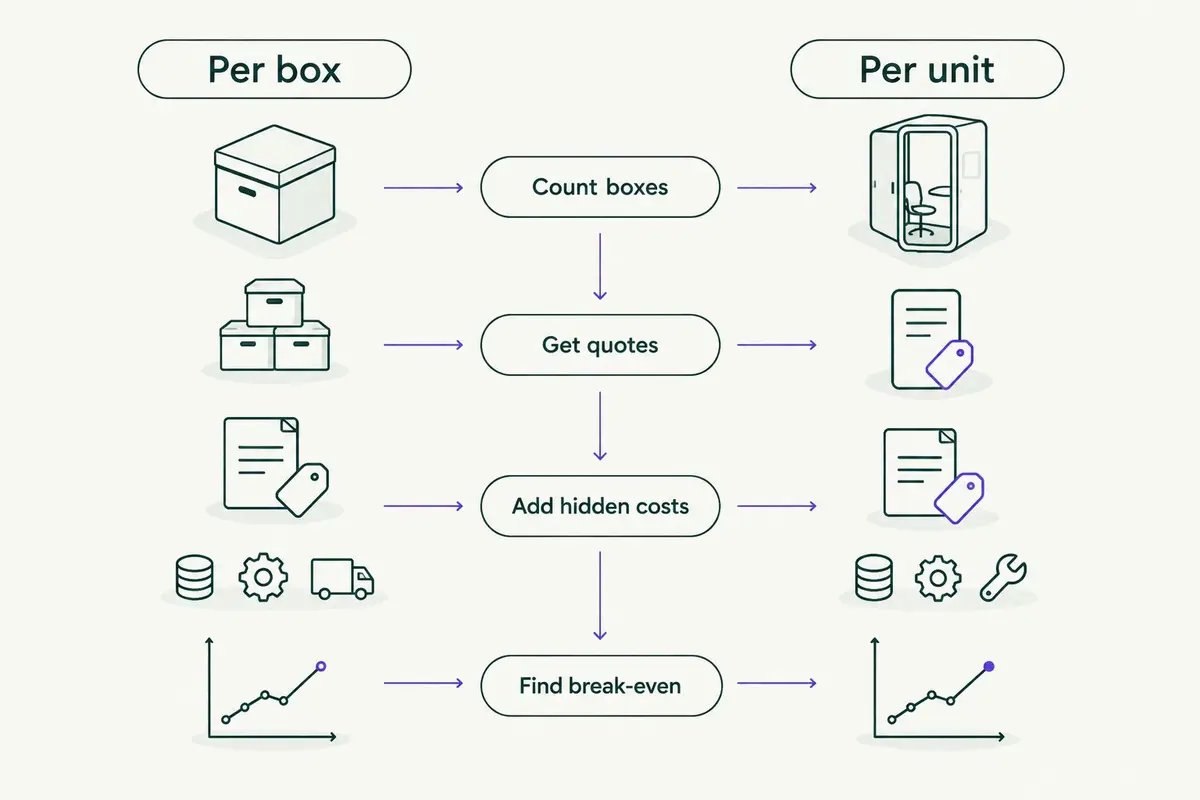
Run both columns with real quotes before you pick a model.
If your box count sits well below the break-even, per-box storage is the cheaper choice. If it sits well above, rent the unit. If it lands close, decide on convenience, because the cost is a wash.
High and low: who wins, and where
The pattern is consistent across household storage situations.
- Per-box leads for: students between semesters, seasonal clothing and decor, post-move overflow, paperwork and keepsakes, anyone with a small spare-room load.
- Per-unit leads for: full-home storage during a renovation, furniture and appliances, business inventory in bulk, anyone who needs frequent walk-in access.
- Close calls: a one-bedroom apartment's worth of stuff. Here the truck and the trips usually decide it.
The costliest mistake is renting a unit sized for a worst case. You pay for that headroom every month, long after the worst case has passed.
How Endless Storage fits
Endless Storage is a valet box storage service. It picks up boxes from your door, stores them in a climate-controlled facility, and returns any box within 48 hours. There is no truck to rent and no facility to visit.
That structure removes the two costs that inflate a unit's real price: transport and your own time. For current rates, check the pricing on the Endless Storage site rather than relying on a number quoted on a third-party page.
Pros of per-box with Endless Storage:
- You pay for items, not empty floor space.
- Pickup and delivery are part of the service.
- Climate-controlled storage protects paper, fabric, and electronics.
- You can retrieve one box without opening everything else.
Cons to weigh:
- Furniture and large items do not fit a box-based model.
- At large volumes, a full unit can cost less per item.
- You cannot walk in and browse your belongings; you request what you need.
Best for: households storing a modest number of boxes who want to skip the truck and the facility visits.
Price your boxes today
See current per-box rates and how pickup and delivery work.
Methodology and limits
This page compares billing structures and uses standard unit dimensions, which are fixed industry conventions. It publishes no market-wide price averages, because no single dated, scoped source backs one for 2026.
The limit: your local rates decide the real answer. A city with expensive unit rents pushes the break-even higher, and a city with cheap units pushes it lower. Always calculate with current quotes from your own area.
For a wider look at climate-controlled options and how providers compare, see this guide to cheap climate-controlled storage companies.
How to use these benchmarks
- Run the formula before you tour a facility. Two quotes and a box count take ten minutes and prevent a year of overpaying.
- Price the full unit, not the listed rate. Add truck rental, fuel, insurance, and every trip you will make in 2026.
- Match the model to the duration. Short, uncertain stays favor per-box. Long, stable, bulky storage favors a unit.
- Re-check every six months. If your box count crosses the break-even in either direction, switch models.
What changes in 2026
The model choice matters more this year for one reason: people keep moving smaller loads more often. Short-term stays, downsizing, and partial moves all produce the 2026 storage profile that fits boxes better than units.
If your load fits that profile, the per-box math in 2026 favors you. If it does not, the unit math does. Either way, the formula above settles it.
FAQ
Is storage cheaper per box or per unit in 2026?
Per box is cheaper for small and partial loads, and a unit is cheaper once it is close to full. Divide the unit's monthly cost by the per-box rate to find your break-even box count.
How do I calculate storage cost per box vs unit?
Divide the unit's total monthly cost, including transport and insurance, by the per-box monthly rate. The result is the number of boxes where both options cost the same.
How big is a 10x10 storage unit?
A 10x10 unit has 100 square feet of floor area. It is twice the size of a 5x10 unit, which has 50 square feet.
What hidden costs come with a storage unit?
Truck rental, fuel, a lock, insurance, and your own time for each visit. Some facilities also change rates after an introductory period, so ask before you sign.
Does Endless Storage deliver boxes back to me?
Yes. Endless Storage picks up boxes from your door and returns any box within 48 hours. Your boxes are held in a climate-controlled facility.
When should I choose a unit over per-box storage?
Choose a unit for furniture, appliances, or a large volume of items that would fill most of the space. A nearly full unit costs less per item than the same load in many individual boxes.
One last thing
Most people overpay for storage by picking the unit size first and the contents second. Reverse it: count your boxes, price both models, and let the break-even number choose for you. If you land within a few boxes of the line, pick the option that saves you the trip.