
A good moving budget is probably the single most important tool you can have for a smooth move. It's not just a boring list of expenses; it's your game plan. It helps you see what's coming, keep an eye on your spending as you go, and dodge those nasty surprise fees that can completely ruin your moving day.
Build Your Budget Before You Pack a Single Box

The very first thing you should do—long before you even think about taping up a box—is map out your budget. This financial roadmap is your best defense against that overwhelming feeling of not knowing how much this is all going to cost. A huge part of this is setting up a budget that works for your regular life first, then adapting it for the big one-time expense of a move.
Starting with a basic framework helps you see the big picture and decide where your money should go. Think of it as a blueprint for your spending. Instead of just guessing what things will cost, you’ll start by identifying the major cost categories that nearly every move involves.
Breaking Down the Core Costs
Your budget needs to be organized into clear, simple sections. This is how you stop small, random costs from slipping through the cracks and showing up on your credit card statement later. At a bare minimum, your plan should have a spot for these things:
- Professional Services: This is your biggest ticket item, whether it’s hiring movers or just renting a truck for a DIY move.
- Packing Supplies: Don't underestimate this one. Boxes, tape, bubble wrap, and markers add up faster than you’d think.
- Travel & Transport: This covers everything from fuel and tolls to a hotel room if you’re moving long-distance.
- "Hidden" Fees: Think about things like elevator booking fees at your apartment, city parking permits for the truck, or extra charges for moving that giant sofa.
Key Takeaway: A well-planned budget isn't about penny-pinching. It's about giving yourself the power of knowing where your money is going so you can stay in control.
Typical Moving Budget Allocation
To give you a better starting point, here’s a look at how a typical moving budget breaks down. Use these percentages as a rough guide to see where your money might go, but remember to adjust them based on your specific situation—a DIY move across town will look very different from a cross-country move with professionals.
| Expense Category | Typical Budget Allocation (%) | Key Considerations |
|---|---|---|
| Movers & Labor | 40-50% | This is often the largest expense. Get multiple quotes. |
| Truck Rental & Fuel | 15-25% | For DIY moves, this replaces mover costs. Don't forget insurance and mileage fees. |
| Packing Supplies | 10-15% | Can be reduced by sourcing free boxes, but specialty materials add up. |
| Storage | 5-15% | Varies greatly depending on if you need it and for how long. |
| Contingency/Misc. Fees | 10% | Your buffer for unexpected costs like tips, cleaning, and last-minute runs. |
This table gives you a solid baseline, but always tailor it to your own move's unique needs.
Aligning your budget with your moving timeline is also a game-changer. For a step-by-step guide on that, check out our post on creating a moving checklist and timeline. When your budget and your to-do list work together, your move becomes a whole lot less stressful.
Uncovering Every Potential Moving Expense
A good moving budget is about more than just the big-ticket items. It’s about digging deep to find all the little expenses that love to pop up and throw your plans off track. These are the costs that turn a perfectly good budget into a source of stress.
Many of these costs are sneaky because they feel like normal life expenses, but they’re directly tied to the move. Think about that last week in your old place. With your kitchen packed away, you’ll probably be eating out a lot more. That’s not your regular dining budget—it's a moving cost.
Beyond the Moving Truck
The cost of movers or a truck rental might be the centerpiece of your budget, but it's just the starting point. The real test of a solid moving budget is how well it accounts for all the secondary costs that cluster around the main event.
Let's get into some of those often-forgotten categories:
- Move-Out & Move-In Fees: Don't be surprised if your building management has a few charges for you. This could be anything from mandatory professional cleaning fees to get your security deposit back to small repair costs for things like nail holes.
- Specialty Item Handling: Have a piano, a massive piece of art, or a super heavy safe? Movers typically charge a separate, and often significant, fee for these items because they require special equipment and a lot more care.
- Utility & Service Costs: You’ll likely run into setup fees for internet, gas, and electricity at the new place. It’s also smart to budget for a few overlapping service days where you might be paying for utilities at both locations.
City-Specific and Situational Costs
Where you're moving to and from can completely change your expense list. Urban moves, in particular, come with their own unique set of challenges that are easy to overlook until it's too late.
A common shock for anyone moving in the city is the need for a truck parking permit, which can run you anywhere from $50 to $150. Forgetting this can lead to a hefty fine or, even worse, movers who have nowhere to park.
Keep these other urban and situational factors on your radar:
- Building Fees: Some high-rise apartment buildings charge a non-refundable "elevator booking fee" or even require you to pay for a building-approved moving supervisor on the day of your move.
- Pet & Child Care: Moving day is chaotic. To keep kids and pets safe and out from underfoot, you might need to arrange for a babysitter or a day at doggy daycare. It’s an essential cost that’s easy to forget.
- Temporary Living Costs: If there’s a gap between your move-out and move-in dates, you'll need to plan for a hotel, extra meals, and maybe even short-term storage for all your belongings.
By digging into these details, your budget goes from a simple guess to a powerful financial plan. For a deeper analysis of what goes into these numbers, exploring the average cost of moving can provide valuable context to help you refine your estimates. This is your best defense against any last-minute financial surprises.
Create Your Personalized Moving Budget Planner
Alright, now that you’ve got a list of potential moving expenses, it’s time to turn that list into a real-world tool. A proper moving budget isn’t something you write down once and forget. It's a living, breathing worksheet that lets you track your spending as it happens. This is how you stay in control and avoid any nasty surprises as moving day inches closer.
You don't need complicated software for this. A simple spreadsheet is your best friend here. The goal is to create a grid where you can list every expense, see your estimates, and then log what you actually spend. That instant feedback is what separates a successful budget from a wish list.
Building Your Budget Spreadsheet
Setting this up is easier than you think. You're just creating a clear system to track the money going out. I've found that the most effective spreadsheets have three core columns for every single expense you've identified:
- Estimated Cost: This is your best guess, based on quotes or your research. Don’t stress about perfection here; it's a starting point.
- Actual Cost: As soon as you have a receipt or an invoice, fill this in. This is the real number.
- Variance: Here’s where the magic happens. A simple formula (
=Actual - Estimated) immediately shows if you’re over or under budget on that line item.
This simple setup instantly flags where you might be overspending. If your packing supplies cost $50 more than you planned, you'll see it right away. That gives you the chance to cut back somewhere else to balance things out. If you want to get your initial numbers as accurate as possible, our guide on how to estimate moving costs can walk you through the specifics.
This infographic breaks down how costs pile up, from the ones everyone expects to the sneaky ones that can really hurt a budget.
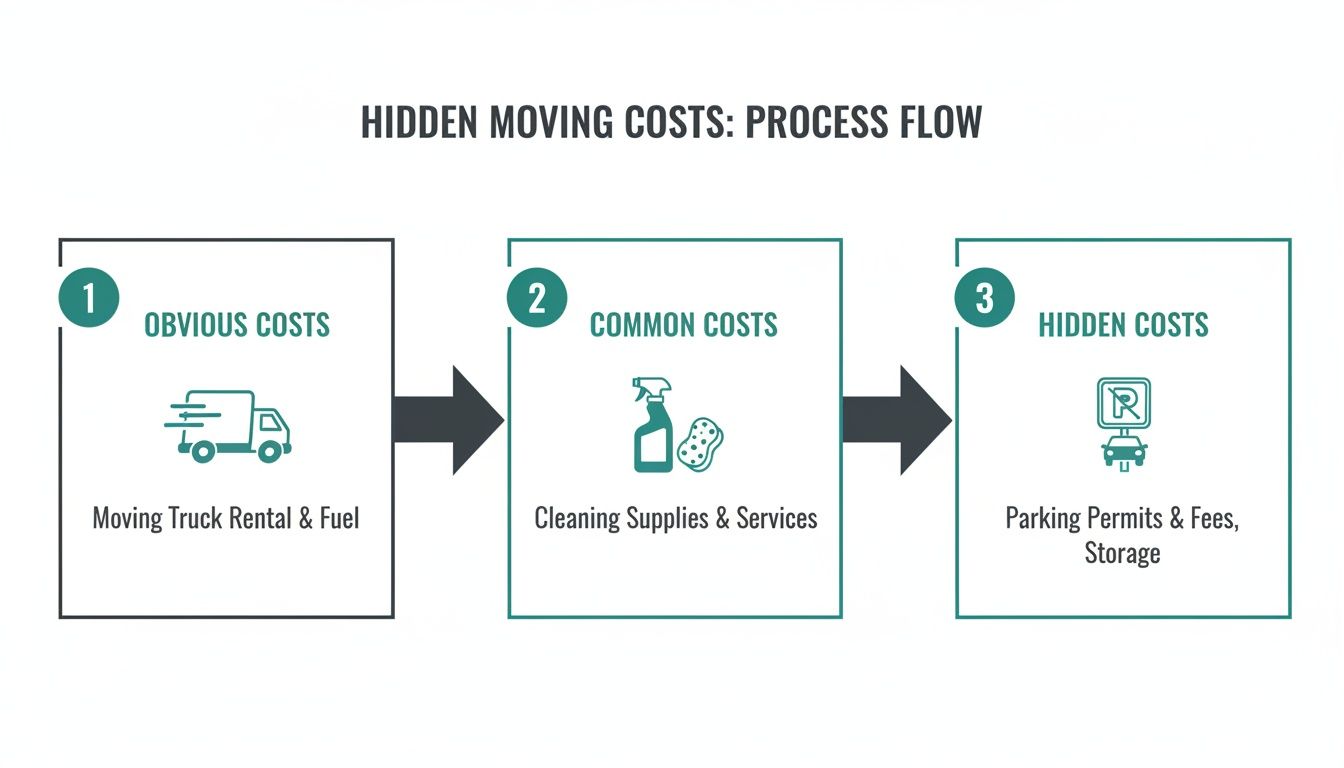
Keeping these different types of costs in mind will help you build a much more realistic and resilient moving budget planner.
Sample Budget for a One-Bedroom Apartment Move
To give you a better idea of how this looks in practice, here’s a sample budget for a typical one-bedroom apartment move within a city. Remember, these are just estimates—your costs will vary based on your location, the services you choose, and how much stuff you have.
| Expense Item | Estimated Cost | Notes & Savings Tips |
|---|---|---|
| Movers (2 movers, 4 hours) | $600 | Get at least three quotes. Moving mid-week or mid-month is often cheaper. |
| Truck Rental (DIY Move) | $150 | Alternative to movers. Look for companies with one-way rental deals if moving far. |
| Packing Supplies | $120 | Save money by getting free boxes from local stores or online marketplaces. |
| Per-Box Storage (3-month pre-move) | $75 | Store seasonal items early to reduce the volume you need to move on the day. |
| Utility Transfer Fees | $50 | Call your providers early to understand fees; some may be waived for existing customers. |
| Cleaning Services (Move-Out) | $200 | Doing it yourself saves money, but a professional clean can help secure your deposit. |
| Contingency Fund (10%) | $119.50 | Absolutely essential for unexpected costs like parking tickets or needing extra supplies. |
| Total Estimated Cost: | $1,314.50 |
This table shows how quickly costs add up, but also where you can find opportunities to save. It’s a great template to start with for your own move.
Integrating Flexible Storage into Your Plan
One of the smartest moves you can make, especially if you’re in a city or moving from a small apartment, is budgeting for flexible storage. Instead of locking yourself into a traditional storage unit you might not even fill, plan for a per-box storage service. This can honestly be a budget-saver.
By budgeting a small monthly fee for only the boxes you need to store, you avoid paying to move and house items you won't need immediately. This directly lowers your upfront moving truck and labor costs.
Think about it. Instead of packing and paying to move a dozen boxes filled with winter coats, old photo albums, and holiday decorations, you can have them sent directly to storage. This gives you two huge wins. First, you'll have fewer items to move, which could mean a smaller truck or fewer billable hours from your movers. Second, you can actually settle into your new home without tripping over boxes of things you won't need for months.
When you add this "Storage" line item to your budget, you’re not just adding an expense—you’re creating a strategy to make your entire move cheaper and far more efficient.
Why You Need a Contingency Fund for Your Move
No matter how carefully you plan, moves have a way of throwing curveballs. That's why a contingency fund isn't just a nice-to-have; it's a non-negotiable part of your moving budget. Think of it as your financial safety net for all the little (and big) "what ifs" that are bound to pop up.
A good rule of thumb is to set aside 10-20% of your total estimated moving cost for this fund. So, if you've budgeted $3,000 for your move, your contingency fund should be somewhere between $300 and $600. This buffer is what turns a potential crisis into a manageable hiccup.
Real-World Scenarios Where a Buffer Is a Lifesaver
This isn't just a theoretical exercise. Let's say your movers show up and find out the elevator is broken. Now they have to haul everything down the stairs, and that almost always comes with a surprise "stair fee" that can add hundreds to your final bill. Without a contingency fund, a charge like that can throw your entire budget off track.
Here are a few other all-too-common moments where this fund comes in clutch:
- Last-Minute Supplies: You swear you had enough packing tape, but suddenly you're on your last roll. A quick trip to the store on moving day for overpriced supplies is practically a rite of passage.
- Unplanned Repairs: You're doing the final walkthrough and notice a small hole in the wall you never saw before. To get your full security deposit back, you might need to hire a pro for a quick patch job.
- Parking Nightmares: The moving truck arrives, but the spot you thought you had is taken. Now you're scrambling, and you might have to pay for an expensive garage or, even worse, a parking ticket.
In these situations, having that extra cash on hand saves you a ton of stress and keeps the move rolling smoothly.
Calculating the Right Buffer for Your Move
While 10-20% is a great starting point, the complexity of your move should dictate the final number. In big cities, for example, it's not uncommon for planners to allocate closer to 20% for things like last-minute insurance hikes, which can jump by 10-15%. Considering Americans move an average of 11.7 times in their lifetime, it pays to be prepared for these regional quirks.
Your contingency fund is your secret weapon against stress. It gives you the peace of mind to handle unexpected costs without derailing your move or your finances.
You should aim for a larger buffer if your move has more moving parts. Think long-distance moves, scheduling during the peak season (May through September), or trying to coordinate multiple services at once. The more complex the plan, the more chances there are for something to go slightly sideways.
Sometimes, these unexpected costs even involve needing a short-term storage solution you didn't plan for. You can check out our guide on how much storage units cost to get a better idea of what to expect there.
Smart Strategies to Lower Your Moving Costs

Now that you have a detailed budget planner, you can stop just tracking your moving costs and start actively slashing them. This is where your planner transforms from a simple spreadsheet into your most powerful money-saving tool.
Every small, smart decision you make can add up to some serious savings. That extra cash can beef up your contingency fund or go toward making your new place feel like home. The key is to think like a minimalist, even if it’s only temporary.
Declutter for Profit and Savings
Before you buy a single box, it’s time to get ruthless. Go through every room, every closet, and every drawer. That old gadget you haven't touched in years? The clothes you keep meaning to wear? Each item represents a potential cost to move or an opportunity to make some cash.
- Sell What You Can: Hop on platforms like Facebook Marketplace, eBay, or local consignment shops. A great strategy is selling bulky furniture that's expensive to transport but can be easily replaced at your destination.
- Donate Strategically: For anything that doesn't sell, find a local thrift store. Always ask for a receipt—that donation could turn into a nice tax deduction, which is just another way to save money.
- Toss the Rest: Let's be honest, some things just aren't worth the effort. If it’s broken, outdated, or just plain junk, it's time to let it go.
This purge directly shrinks the volume of your move. That means lower quotes from professional movers or the ability to rent a smaller, cheaper truck for a DIY job. For more expert tips, this guide on budget-friendly moving is packed with practical advice.
Master the Art of Free Packing Supplies
New cardboard boxes can eat up a few hundred dollars of your budget surprisingly fast. But with a little bit of planning, you can get most of what you need for free.
Pro Tip: Start collecting boxes at least a month before your move. Swing by local liquor stores, grocery stores, and big-box retailers. They're often happy to get rid of sturdy boxes, especially on their restocking days.
Get creative with what you already own, too. You can use towels, blankets, and even clothing to wrap fragile items. This not only saves you from buying expensive bubble wrap but is also a much more eco-friendly approach.
Timing Is Everything for Your Budget
When you move can have a huge impact on your final bill. The moving industry has a well-known peak season, and avoiding it is one of the single biggest ways to cut costs.
Moving industry data shows that peak season, which runs from May to September, can drive up prices by as much as 30%. With 92% of recent moves being interstate and distances increasing, long-haul costs are already a major budget factor. Planning your move for the fall or winter can lead to much more competitive quotes from movers and truck rental companies. You can dive into more of these moving industry statistics to help with your planning.
If you have some flexibility, try to schedule your move for the middle of the week and the middle of the month. Demand is always highest on weekends and at the end of the month. A strategic move date puts your budget in the best possible position. And if you're looking for even more ways to trim your expenses, check out our deep dive on the cheapest way to move.
Your Moving Budget Questions Answered
Even the most meticulous budget can leave you with a few lingering questions. Finalizing your moving plan often means tackling those last-minute uncertainties. Let's walk through some of the most common questions movers have, so you can lock in your budget with confidence.
Think of this as your final check-in before putting your plan into action, covering everything from timing to smart storage strategies.
How Far in Advance Should I Create My Moving Budget?
The moment you know you’re moving is the moment you should start your budget. Ideally, give yourself a runway of at least 8 to 10 weeks before your move date. This isn't just about avoiding last-minute panic.
Starting early is a strategic advantage. It gives you enough time to genuinely research costs, get competitive quotes from a few different moving companies, and decide what to declutter. Booking services during off-peak times can also lead to serious savings, and you’ll sidestep the financial scramble that always comes with a rushed move.
Is It Cheaper to Move Myself or Hire Movers?
This is the classic moving dilemma, and the real answer comes down to distance, how much stuff you have, and what your time is worth. For a small, local move—think a studio apartment just across town—a DIY move almost always looks cheaper on paper. You’re cutting out the cost of labor, which is usually the biggest expense.
But don't forget to add up all the hidden costs: the truck rental, gas, moving insurance, dollies, and packing supplies. And then there's the value of your own physical effort (and your friends' backs!).
For long-distance moves or homes with lots of heavy furniture, hiring professionals is often the more cost-effective and much safer route. I always recommend creating two columns in your budget planner: one for a detailed DIY estimate and another for your professional quotes. Seeing the numbers side-by-side makes the best choice for your situation crystal clear.
How Does Flexible Storage Fit into a Moving Budget?
Flexible storage can be a game-changer for your moving budget, especially if you're an urban mover dealing with a smaller space. Instead of paying a premium to move items you won't need right away—like out-of-season clothing, holiday decorations, or sentimental keepsakes—you can use a per-box storage service.
This completely changes the math of your move. You're looking at a small, manageable monthly fee instead of a big, fixed cost for a traditional storage unit that you might not even fill. It directly cuts your upfront moving expenses because you physically have less to transport on moving day.
It's a really savvy way to manage your belongings during a transition. You stop paying for empty air in a storage unit and keep your new home from feeling cluttered on day one, giving you the space to settle in and breathe.
Ready to simplify your move and save on costs? With Endless Storage, you can store just what you need, one box at a time. We provide the boxes, you pack, and we'll pick them up and store them safely until you need them again. Get your free quote and declutter your move today.
Frequently Asked Questions
Unveiling the Secrets to Effortless Storage
Endless Storage is available nationwide. You pick a plan, tell us where to pickup, and we'll send a UPS van to collect, whichever state you're in.
Your shipping label will be sent to your email within a few minutes, if not instantaneously. It can also be accessed through your customer profile.
Your box will be shipped to one of our climate controlled self storage facilities in our closest self storage facility. Our manager will accept your package, notify you that your box has been received, and securely stored. Only our managers will have access to Endless Storage boxes.
Email us at admin@endless-storage.com click to live chat with us, or send us a message below.
Never! We're committed to transparent pricing with no surprises. You'll lock in your rate with no hidden fees and no long-term contracts.
Fast access guaranteed! Your boxes will arrive at your doorstep within 48 hours of requesting them back. Need to check on delivery? We provide tracking information for complete peace of mind.
Totally flexible! Store month-to-month with no long-term commitment and cancel anytime.
Everything's online! Use your account dashboard to:
• Set up automatic monthly payments
• Request box returns
• Update your address
• Order additional boxes
• Track shipments
Your boxes are insured up to $100 each. Our customer service team will help you file any necessary claims and resolve issues quickly.
Don't worry – we'll email you right away if there's a payment issue. Your items stay safe, though you may have temporary service interruption or late fees until payment is resolved.
When you request our free storage kits, you'll have 30 days to send in your boxes to activate your 3 months of free storage. Think of it like starting a gym membership – your activation window begins when you receive your kits, and your full free trial begins once you send in your first box. During your free months, you'll experience our complete storage service at no cost.
Your 30-day activation window begins when you receive your storage kits. We'll send you an email confirmation when your kits are delivered, marking the start of your activation period.
If you haven't sent any boxes for storage within your 30-day activation window, your free trial will expire and we'll begin charging the regular monthly rate of $9.99 per box. This helps ensure our storage kits go to customers who are ready to use our service.
A box costs $9.99 per month to store (plus sales tax). This price includes free shipping for standard boxes under 50 lbs. and smaller than 16"x16"x16"
Log into your Endless Storage account, locate the box you would like returned, and simply click Return My Box.
Yes, each box stored with us is insured for up to $100 throughout transit as well as the duration of storage within our facilities.
Your box will be at your doorstep within 48 hours of you requesting it back.
Store 10+ boxes? We'll pick them up for free! After your purchase, we'll contact you to schedule a convenient pickup time and arrange UPS collection.
We trust UPS with all shipments, and every box includes $100 insurance coverage. You'll receive tracking information to monitor your items' journey.
Yes! Visit any of our locations by appointment. Just bring a photo ID matching your customer profile.
For everyone's safety, we can't store hazardous materials, firearms, or perishables. All items must fit within our standard boxes.
It's easy! Order your storage kit online, and we'll ship it to you within 1-2 business days. Your shipping labels will be emailed instantly and available in your account.
We're here to help! Email us at admin@endless-storage.com, use our live chat, or send us a message through your account.
To cancel your storage service with Endless Storage, please email your cancellation request to admin@endless-storage.com. Our team will process your request within 2 business days and confirm your cancellation via email.
We understand packing takes time. However, to maintain your free trial benefits, you'll need to send at least one box within the 30-day activation window. If you need more time, you can always start with one box to activate your trial and send the rest later. You can always reach out to admin@endless-storage.com if you have any issues or concerns.
When you request our free storage kits, you're starting a 30-day window to begin using our storage service.
Important: To activate your free trial, send at least one box for storage within 30 days. If no boxes are sent within this 30-day window, a one-time $50 fee applies to cover materials and shipping costs. This fee is clearly disclosed before you sign up.
Think of it like reserving a hotel room – we're setting aside space and sending specialized packing materials for your use. The fee only applies if you request materials but don't begin storage, similar to a hotel's no-show charge.