
So, you're planning a move and trying to figure out the bottom line. It's the big question on everyone's mind: "What's this actually going to cost me?"
The short answer is that the average move can range anywhere from $900 to $2,400 for a local trip, while a long-distance haul could set you back $2,600 to $6,900. Of course, that's a huge range, and the final price really depends on your home's size and how far you're going. This guide will help you unpack every single factor that goes into that final number, so you can build a budget that makes sense.
Decoding the Price of Your Move
Trying to understand a moving quote can feel like you're assembling a puzzle. Each line item—labor, truck fees, materials—is a different piece that snaps together to form the final picture. Those initial numbers might seem a bit daunting, but they become a lot less scary once you know exactly what they represent.
The good news? Your total cost isn't set in stone. It's a flexible number that shifts based on the choices you make.
With a bit of smart planning, you can take real control over that final price tag. My goal here is to give you the insider knowledge you need to make savvy decisions, sidestep common budget-busters, and keep your moving costs firmly in check.
Understanding the National Averages
It's no secret that moving costs have been on the rise lately, which makes budgeting more important than ever. Right now, the average cost for a local move in the US is floating between $301 and $3,512. If you're hiring movers by the hour, expect rates anywhere from $65 to $251.
Keep in mind that these numbers can really spike during the peak season—think June through August—when demand is high and prices often jump by 20-30%. You can dive deeper into these trends with these moving industry statistics on movebuddha.com.
To give you a clearer starting point, let's look at what you might expect to pay based on your home size and the type of move you're making.
Key Insight: Think of these numbers as a baseline, not a fixed price. Every item you decide to sell or donate, every box you pack yourself, and every extra quote you get is a chance to bring these averages down.
Average Moving Costs at a Glance
Here’s a quick table breaking down the typical costs. It’s a great reference point to help you start mapping out your budget. We'll use this as our foundation as we dig into the specific things that make these numbers go up or down.
As you can see, the difference between a local and long-distance move is significant. Now, let's explore exactly what drives those costs.
Decoding Your Moving Bill: Key Cost Factors
Think of your final moving bill like a recipe—several key ingredients mix together to create the total price. Understanding these core components is the first step toward getting a handle on your budget. The cost of moving isn't a single flat fee; it's a blend of four main drivers that every moving company builds their quotes around.
Each piece of the puzzle plays a specific role. You have the labor for the crew doing the heavy lifting, the transportation for the truck itself, the distance you're moving, and the volume—which is just a fancy way of saying "how much stuff you have." Getting a feel for how these interact is where you'll find the real opportunities to save money.
The Four Pillars of Your Moving Quote
Let's break down the main factors that shape your final bill. The good news is that tweaking even one of these can make a real difference in the total cost.
- Labor Costs: This is the human element—the crew that packs, loads, and eventually unloads all your belongings. For local moves, this is almost always billed by the hour, so the team's efficiency and the sheer amount of work they have to do will directly hit your wallet.
- Transportation Fees: The size of the truck really matters here. A bigger home naturally needs a bigger truck, which means higher costs for fuel, maintenance, and the rental itself—all of which get passed on to you.
- Distance Traveled: This one’s the most straightforward. Moving across town will always be cheaper than hauling your life across the country. Less fuel, less time on the road, and simpler logistics all keep the price down.
- Shipment Volume and Weight: This is probably the most important variable you can control. Simply put, the more you move, the more you pay. This is usually measured by the space your items take up (volume) or by their total weight, especially for long-distance treks.
This map helps visualize how the type of move and the size of your home pull these different cost levers.
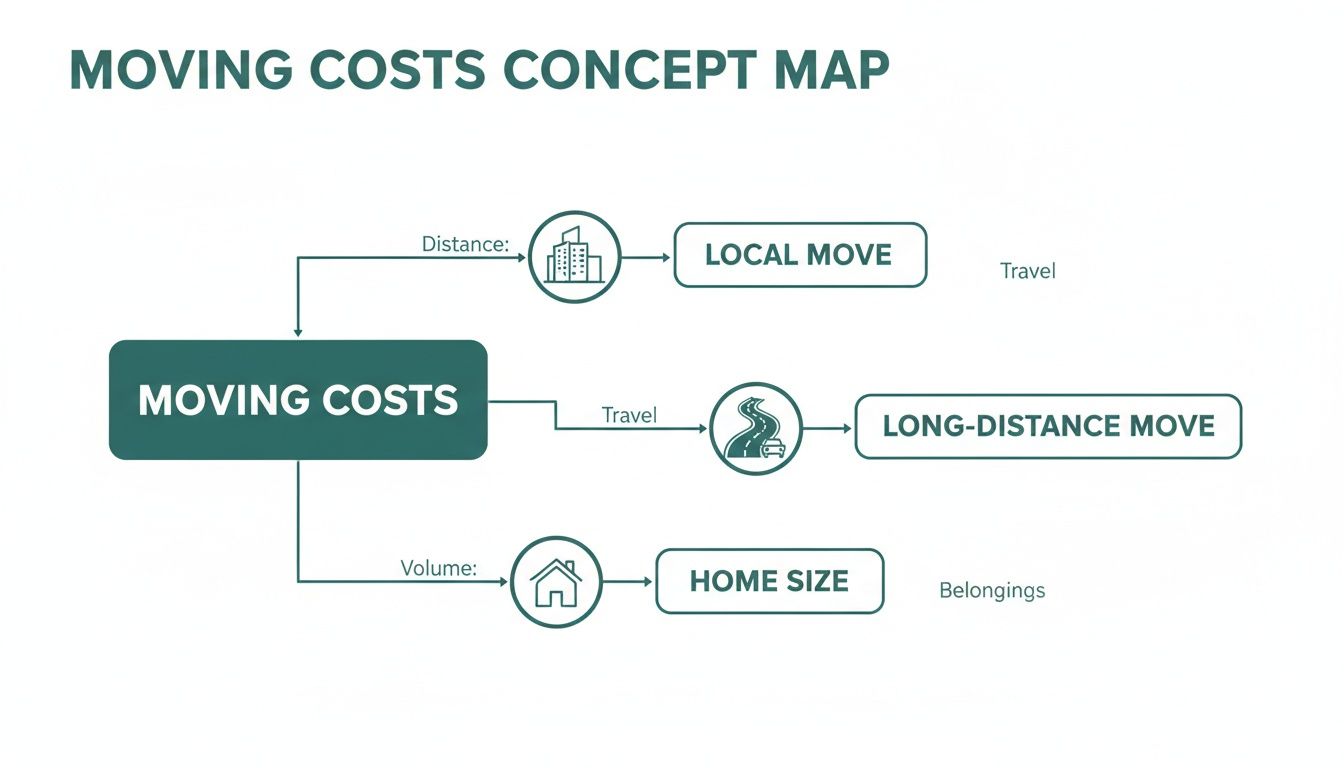
As you can see, distance is the great divider, completely changing how pricing is structured. Meanwhile, your home's size dictates the scale of everything else, from the number of movers to the size of the truck.
Takeaway: The volume of your belongings is the factor you have the most direct control over. Reducing the amount you move is the single most effective way to lower every other associated cost—from labor hours to the size of the truck required.
To get a truly transparent look at all potential expenses, always ask for a detailed moving quote. It forces companies to itemize these charges, showing you exactly where your money is going and preventing nasty surprises on moving day. For a deeper dive, check out our guide on the cost of professional movers. Once you understand this breakdown, you can start pinpointing where to cut back and make your move a lot more affordable.
Figuring out how moving companies come up with their prices can feel like a mystery. Not all moves are priced the same way, and knowing the difference between a local job and a long-distance haul is the first step to creating a realistic budget.
If you assume the same rules apply to both, you’re setting yourself up for a nasty surprise when the final bill arrives.
Think of it like this: a local move is like ordering a pizza. The price is mostly about the size of the pizza (how much stuff you have) and a small, predictable delivery fee (the truck and crew). A long-distance move, on the other hand, is like booking a flight. The final cost depends heavily on the distance to your destination and how many bags you check—or in this case, the total weight of your belongings.
The Local Move: An Hourly Rate Game
When you're just moving across town or to a neighboring city—usually anything under 50 or 100 miles—moving companies almost always charge by the hour. This single hourly rate bundles the cost of the moving crew, the truck, and all the basic equipment like dollies and blankets.
Your final bill is a straightforward calculation: the number of hours the crew worked multiplied by their hourly rate. That’s it. This puts a huge emphasis on efficiency. The faster the crew can load the truck, drive to your new place, and unload everything, the less you pay.
Key Takeaway: For local moves, your prep work pays off directly. The more organized you are—with boxes packed, clearly labeled, and stacked by the door—the fewer hours you'll pay for. Every minute saved is money back in your pocket.
The Long-Distance Move: A Weight and Mileage Formula
The moment your move crosses a state line or goes beyond that 100-mile-ish radius, the pricing model flips entirely. Long-distance movers couldn't care less about the hours. Instead, they calculate your bill based on two things: the total weight of your shipment and the distance it has to travel.
You’ll get a quote based on a cost "per pound" that also factors in the mileage. Moving 5,000 pounds of furniture and boxes 1,200 miles, for example, will have a set price based on the moving company's specific rate tables.
These moves can pack a serious punch to the wallet. The cost for a 2-3 bedroom home traveling over 1,000 miles often lands somewhere between $4,000 and $7,000. And if you opt for full-service packing? Those numbers can climb even higher, making it a pricey slice of the massive $21.3 billion moving market. You can explore more about international moving costs at Sirelo.com.
With this pricing model, decluttering becomes your most powerful money-saving tool. Every single item you sell, donate, or toss before the movers weigh the truck directly lowers your final bill. For a complete guide on how to trim down your shipment and save big, check out our long-distance moving tips. A little bit of strategic purging here can literally save you thousands of dollars.
Uncovering the Hidden Costs That Inflate Your Budget
The first moving quote you get is almost never the final price. Think of it like booking a flight—the number you see initially looks great, but the real cost quickly climbs once you start adding the “checked baggage” of your life. It’s a classic scenario: you think you’ve budgeted perfectly, only to get hit with extra fees you never saw coming.
These surprise charges can sneak up on you in a few ways. Running out of tape and buying a roll from the movers? That’s convenient, but you’ll pay a premium for it. The real budget-killers, though, are the situational fees that are hard to avoid without asking the right questions upfront.

Common Surprise Charges to Ask About
Before you sign on the dotted line, you have to press your moving company for details on their extra fees. Getting total clarity on these potential costs is the only way to make sure your estimate is grounded in reality.
Here are some of the usual suspects:
- Stair Fees: If your building doesn’t have an elevator, many companies will charge you extra for every flight of stairs their crew has to climb.
- Long-Carry Charges: Can the truck park right outside your door? If not, and they have to carry everything more than 75 feet, you can expect a long-carry fee for the extra labor.
- Shuttle Service Fees: In big cities with tight streets, a massive moving truck often can't make it to your building. The company will have to use a smaller "shuttle" truck to ferry your belongings, and that service comes with its own price tag.
- Specialty Item Handling: Got a piano, a huge piece of art, or a fragile antique? Moving these items requires special equipment and care, and that will always cost you extra.
Understanding Moving Insurance and Valuation
Another area that trips people up is moving insurance, which the industry calls valuation coverage. The basic, default option included in most quotes is called "Released Value Protection." It sounds official, but the protection it offers is shockingly minimal: just $0.60 per pound per item.
Crucial Takeaway: Let's say your 50-pound, $1,000 flat-screen TV gets smashed during the move. With basic Released Value Protection, the movers would only owe you $30. That’s not even close to enough for a repair, let alone a replacement.
To actually protect your stuff, you need to upgrade to Full Value Protection. It costs more, but it means the moving company is on the hook to repair, replace, or reimburse you for the actual value of any damaged items. Always ask which level of coverage is in your quote. Digging into a detailed moving company cost comparison can show you just how much these different insurance options can impact your final bill.
How Timing and Location Impact Your Moving Price
The quote you get from a moving company isn't just about how much stuff you have—it’s a direct reflection of supply and demand. Think of it like booking a flight for a holiday weekend. The same seat costs way more when everyone else wants it, right? The exact same principle applies to moving, where your timing and location are two of the biggest forces driving your final bill.
Choosing to move on a high-demand day or during the peak season can inflate your costs by a shocking amount. The difference between a Tuesday in October and a Saturday in July isn't small change; it can easily mean hundreds, or even thousands, of dollars.
The Power of the Calendar
The moving industry has a very clear busy season. The warmer months, from May through September, are by far the most popular time for people to relocate, which creates a massive surge in demand for movers. With more people competing for a limited number of trucks and crews, prices naturally go up.
This predictable seasonal swing means you can plan around it. For example, local moves during the peak summer months of June through August can see prices jump by 20-30%. A move that might cost $2,500 in the off-season could easily become $3,250 or more during that summer rush. You can see more data on how moving costs vary by season and location on ConsumerAffairs.com.
To help visualize this, let's break down how planning ahead can directly impact your wallet. Booking your move during a less busy period is one of the smartest money-saving tricks in the book.
Strategic Move Planner: When to Book for Savings
As you can see, simply shifting your move from a Saturday in July to a Wednesday in October could unlock significant savings without changing anything else about your move.
Pro Tip: The day of the week really matters. Weekends, especially Saturdays, are the most sought-after moving days. If your schedule has any flexibility, booking your move for a weekday—particularly a Tuesday or Wednesday—can save you a bundle as companies offer lower rates to fill their schedules.
Location, Location, Inflation
Beyond the calendar, your geography plays a huge role in your moving expenses. Costs can vary dramatically not just between states, but even between neighboring cities. Things like local labor rates, fuel prices, and the simple supply and demand in that area all create a unique pricing landscape.
For instance, the average cost of a move in a state like Vermont has been recorded at over $800, while the same type of move in Washington D.C. might average closer to $330. This shows how a state’s economic climate directly influences the price you’ll pay. It’s not just about high-cost-of-living areas, either; it’s about the specific market for moving services right where you are.
Understanding these scheduling nuances is a huge advantage, and you can dive deeper in our guide to finding the best time to move.
Proven Strategies to Reduce Your Moving Expenses
Okay, so you know what goes into the cost of a move. Now for the fun part: taking control and actively shrinking that final bill. With a few smart moves, you can turn a potentially massive expense into something much more manageable.
The single best thing you can do? It’s also the simplest. Declutter. Every single thing you own adds to the volume and weight of your move, which are the two biggest factors that drive up costs. Going through your belongings and deciding what to keep, donate, sell, or toss directly tackles the root of your moving bill.

The Direct Impact of Decluttering
Think about it like this: fewer items mean less stuff for the movers to haul, which means fewer billable hours for a local move. Simple. For a long-distance trip priced by weight, every pound you get rid of is literal money back in your pocket. A lighter load might even let you book a smaller—and cheaper—moving truck.
Key Insight: Reducing your shipment volume by just 15% can lead to hundreds of dollars in savings on labor, transportation, and materials. It's the highest-impact action you can take to control your moving budget.
This process really makes you question what’s worth keeping. Is that old armchair in the basement or that box of college textbooks you haven’t touched in a decade really worth paying to lug across the state? For most of us, the answer is a hard no. You can find more practical tips in our guide to finding the cheapest way to move.
Leveraging Flexible Storage for a Smarter Move
If you’re in a city, a small apartment, or just downsizing, trying to move every single thing you own at once is rarely the most efficient or affordable option. This is where flexible, by-the-box storage becomes a game-changer. By temporarily stashing non-essential items, you can dramatically shrink the size of your primary move.
This strategy pays off in a few ways:
- Reduces Move-Day Volume: Storing things like winter coats, holiday decorations, or sentimental collections means they aren't part of the main shipment. That immediately lowers your moving bill.
- Simplifies Unpacking: You can get your new place set up with just the essentials. Once you’re organized, you can call for your stored items when you actually have a place for them.
- Creates Breathing Room: It buys you valuable time to decide what to do with certain items without the pressure of a looming move-in day.
Instead of paying movers to transport stuff you won’t even look at for months, you can place it in secure storage. It’s all about moving smarter, not just harder, by focusing only on what you need right now.
Your Top Moving Cost Questions Answered
When you're getting down to the wire with your moving budget, a few last-minute questions always seem to pop up. Getting straight answers is the key to feeling confident and in control on moving day. Let's tackle some of the most common questions we hear about the cost of moving.
Is It Cheaper to Move Myself or Hire Movers?
A DIY move almost always looks like the cheaper option on paper, but those costs can add up in a hurry. Once you tally the truck rental, gas, all the packing materials, and factor in your own time—not to mention the risk of damaging your stuff or even hurting yourself—hiring professionals is often the smarter financial move.
This is especially true for bigger homes or any long-distance relocation. The logistics and efficiency that pros bring to the table can save you a surprising amount of time and money in the long run.
How Far in Advance Should I Book Movers for the Best Price?
To get the best rates and your pick of available dates, try to book your movers at least four to six weeks in advance. If you’re planning a move during the peak summer season, pushing that out to eight weeks is an even better idea.
Booking early gives you the leverage to shop around, compare quotes from a few different companies, and lock in a good price before demand—and the cost—inevitably shoots up.
The standard 'Released Value Protection' that movers include is basically the bare minimum, usually covering just $0.60 per pound. For something valuable like a TV or a nice piece of furniture, that's next to nothing. Always ask about 'Full Value Protection' to make sure your things can be fully repaired or replaced if something goes wrong.
Beyond just the movers, don't forget to budget for those "fresh start" costs, like figuring out whether you should clean carpets before moving in. Thinking through these smaller details helps you build a complete, surprise-free budget, tying all the pieces together for a smooth and cost-effective move.
Ready to shrink your move and your costs? With Endless Storage, you only move what you need right now. We pick up your extra items, store them securely, and deliver them back when you're ready. It's the smartest way to simplify your move and save money. Learn more about our by-the-box storage solution.
Frequently Asked Questions
Unveiling the Secrets to Effortless Storage
Endless Storage is available nationwide. You pick a plan, tell us where to pickup, and we'll send a UPS van to collect, whichever state you're in.
Your shipping label will be sent to your email within a few minutes, if not instantaneously. It can also be accessed through your customer profile.
Your box will be shipped to one of our climate controlled self storage facilities in our closest self storage facility. Our manager will accept your package, notify you that your box has been received, and securely stored. Only our managers will have access to Endless Storage boxes.
Email us at admin@endless-storage.com click to live chat with us, or send us a message below.
Never! We're committed to transparent pricing with no surprises. You'll lock in your rate with no hidden fees and no long-term contracts.
Fast access guaranteed! Your boxes will arrive at your doorstep within 48 hours of requesting them back. Need to check on delivery? We provide tracking information for complete peace of mind.
Totally flexible! Store month-to-month with no long-term commitment and cancel anytime.
Everything's online! Use your account dashboard to:
• Set up automatic monthly payments
• Request box returns
• Update your address
• Order additional boxes
• Track shipments
Your boxes are insured up to $100 each. Our customer service team will help you file any necessary claims and resolve issues quickly.
Don't worry – we'll email you right away if there's a payment issue. Your items stay safe, though you may have temporary service interruption or late fees until payment is resolved.
When you request our free storage kits, you'll have 30 days to send in your boxes to activate your 3 months of free storage. Think of it like starting a gym membership – your activation window begins when you receive your kits, and your full free trial begins once you send in your first box. During your free months, you'll experience our complete storage service at no cost.
Your 30-day activation window begins when you receive your storage kits. We'll send you an email confirmation when your kits are delivered, marking the start of your activation period.
If you haven't sent any boxes for storage within your 30-day activation window, your free trial will expire and we'll begin charging the regular monthly rate of $9.99 per box. This helps ensure our storage kits go to customers who are ready to use our service.
A box costs $9.99 per month to store (plus sales tax). This price includes free shipping for standard boxes under 50 lbs. and smaller than 16"x16"x16"
Log into your Endless Storage account, locate the box you would like returned, and simply click Return My Box.
Yes, each box stored with us is insured for up to $100 throughout transit as well as the duration of storage within our facilities.
Your box will be at your doorstep within 48 hours of you requesting it back.
Store 10+ boxes? We'll pick them up for free! After your purchase, we'll contact you to schedule a convenient pickup time and arrange UPS collection.
We trust UPS with all shipments, and every box includes $100 insurance coverage. You'll receive tracking information to monitor your items' journey.
Yes! Visit any of our locations by appointment. Just bring a photo ID matching your customer profile.
For everyone's safety, we can't store hazardous materials, firearms, or perishables. All items must fit within our standard boxes.
It's easy! Order your storage kit online, and we'll ship it to you within 1-2 business days. Your shipping labels will be emailed instantly and available in your account.
We're here to help! Email us at admin@endless-storage.com, use our live chat, or send us a message through your account.
To cancel your storage service with Endless Storage, please email your cancellation request to admin@endless-storage.com. Our team will process your request within 2 business days and confirm your cancellation via email.
We understand packing takes time. However, to maintain your free trial benefits, you'll need to send at least one box within the 30-day activation window. If you need more time, you can always start with one box to activate your trial and send the rest later. You can always reach out to admin@endless-storage.com if you have any issues or concerns.
When you request our free storage kits, you're starting a 30-day window to begin using our storage service.
Important: To activate your free trial, send at least one box for storage within 30 days. If no boxes are sent within this 30-day window, a one-time $50 fee applies to cover materials and shipping costs. This fee is clearly disclosed before you sign up.
Think of it like reserving a hotel room – we're setting aside space and sending specialized packing materials for your use. The fee only applies if you request materials but don't begin storage, similar to a hotel's no-show charge.