
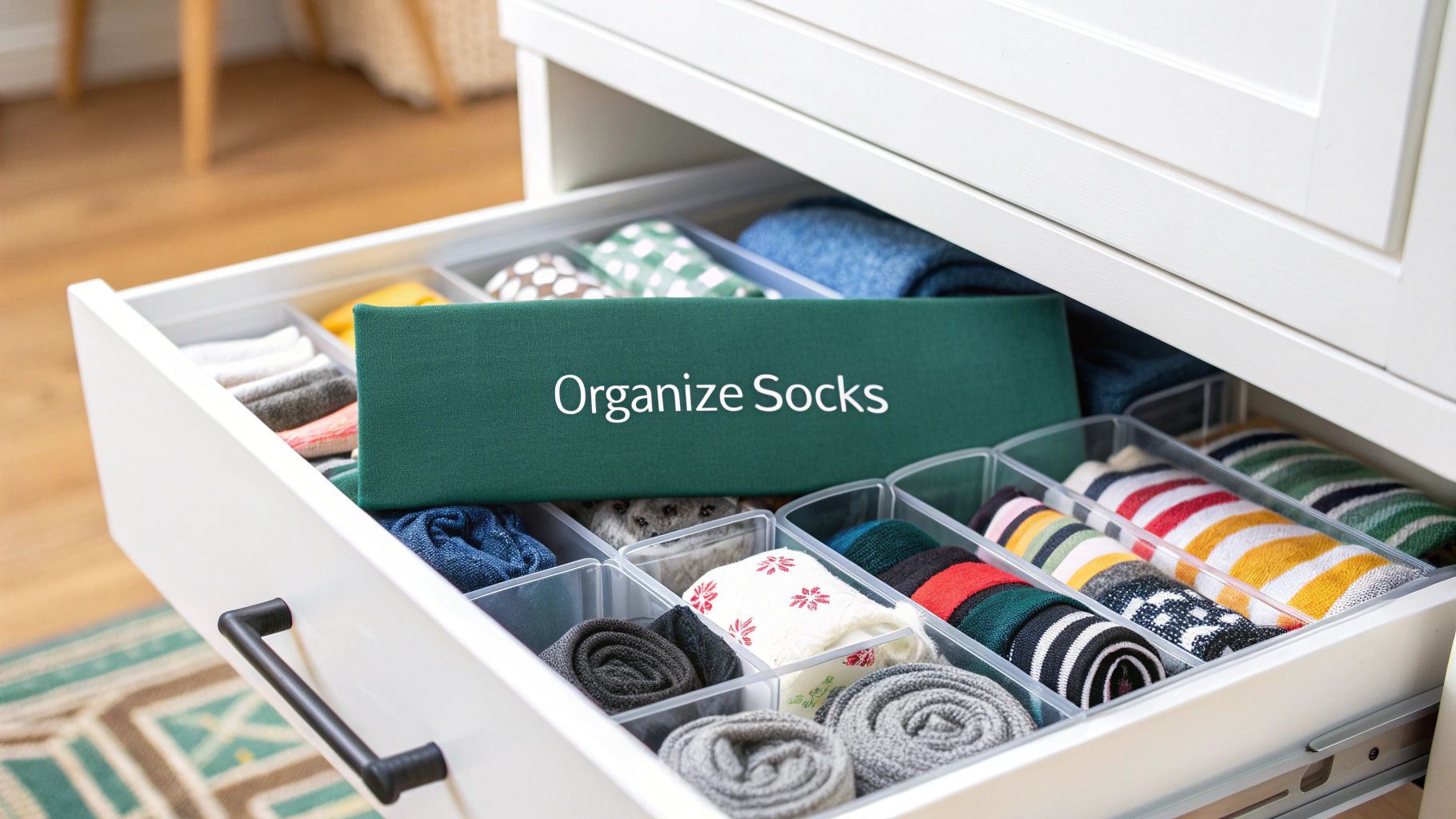
Tired of the daily battle with your sock drawer? You're not alone. That frantic morning search for a matching pair is a small, but incredibly common, frustration that can start your day on the wrong foot.
The good news is that taming the sock chaos is simple. All it really takes is a solid system: sort them, fold them properly, and store them so you can actually see every pair you own. Getting this set up takes less than an hour, but it saves you time and a little bit of sanity every single morning.
Finally End the War with Your Sock Drawer
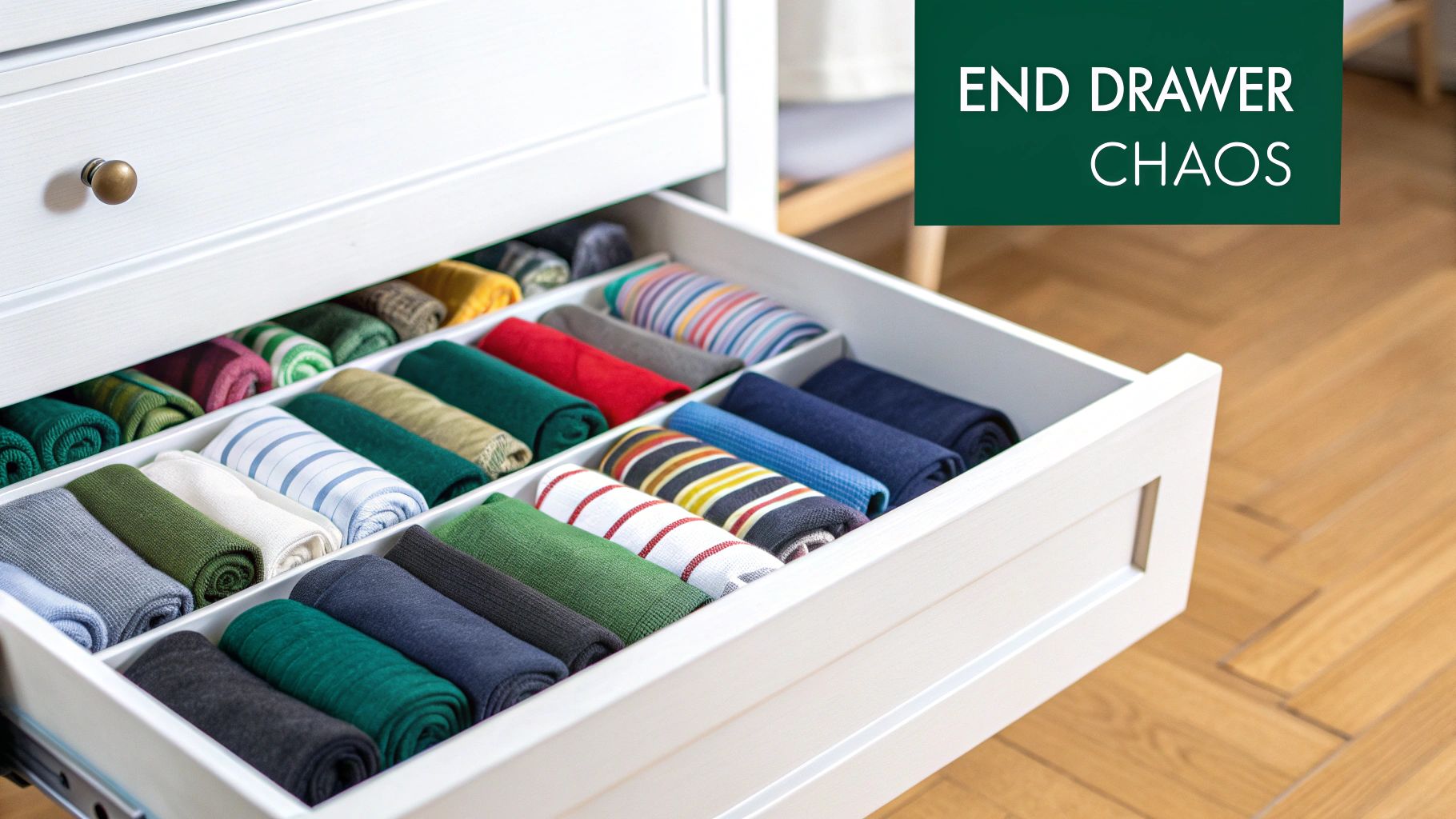
Let's be honest, we’ve all been there—a drawer overflowing with a tangled mess of socks. This guide is designed to cut through that clutter with a practical system that anyone can actually stick with.
We're going to move beyond those temporary fixes that only last a week. The goal here is to build a sustainable organization method that works for you in the long run. It’s about making a few intentional choices that genuinely simplify your daily routine.
What This Guide Covers
Our journey from chaos to order breaks down into a few key stages. I’ll walk you through how to:
- Do a powerful initial declutter to finally get rid of those worn-out, mismatched, or single socks.
- Master folding techniques that save a surprising amount of space and keep your socks from losing their shape.
- Set up a simple drawer system using dividers that give you an at-a-glance view of everything you have.
Tackling your sock drawer is a small win, but it has a surprisingly big impact on your daily routine. Think of it as one of the first, easiest steps toward a more organized life—a lot like the broader principles of cleaning out your closet.
By the time we’re done, you'll have transformed that jumbled mess into a perfect model of efficiency.
The First Purge: Decluttering and Sorting Your Collection
Before you can even think about neatly folding or arranging anything, you have to face the music. That means embarking on a sock treasure hunt. Go through every nook and cranny of your home—the laundry room, the bottom of your gym bag, under the bed—and gather every last sock into one giant pile. It might look a little overwhelming, but trust me, getting a full picture is the only way to start.
This first step is all about taking inventory. You simply can't create an effective organization system if you don't know what you're working with. It's the same foundational advice you'll find in any pro organizer's guide on how to organize closet shelves; you have to declutter before you organize.
Create Your Sorting Categories
Alright, now it's decision time. The best way to get through that mountain of socks is to sort every single one into one of three piles. This isn’t the time for “maybes.” Be ruthless now so you can build a collection of socks you actually love and use.
Set up three distinct zones for your sorting:
- Keepers: These are your all-stars. They're complete pairs, feel great on your feet, and are in good shape—no holes or sad, stretched-out elastic.
- The Lost Souls: This is the pile for every single sock missing its mate. Don't toss them just yet, but they've officially lost their spot in your sock drawer for now.
- Retirees: These socks have served you well, but their time is up. This pile is for anything with holes, worn-thin heels, or elastic that has completely given up the ghost. It's time to let them go.
This sorting process is the most impactful part of learning how to organize socks. By removing the clutter first, you ensure that the system you create is for the items you actually wear, not just for everything you own.
Once your piles are made, take immediate action. Bag up the Retirees for textile recycling or toss them out. For the Lost Souls, put them in a small, separate bin. Give them a deadline—say, one month—to be reunited with their missing partner. If a match doesn't turn up after a few laundry cycles, they officially join the Retirees.
If you struggle with making these kinds of decisions, our complete decluttering checklist can walk you through the process step-by-step.
Beyond the Ball Fold: Mastering Space-Saving Techniques
Most of us probably learned to ball up our socks by folding one cuff over the other. It's fast, sure, but that common method is a secret sock-killer. It constantly stretches the elastic, leading to a saggy fit and a much shorter lifespan for your favorite pairs. It’s time for an upgrade that not only saves your socks but also frees up a surprising amount of drawer space.
Switching to a smarter folding technique creates neat, uniform little packages. This lets you see every single pair you own at a glance. Instead of digging through a lumpy pile every morning, you can create a clean, file-like system that makes getting ready so much smoother.
The Best Folds for Your Drawer
The right fold really depends on your sock's thickness and how you store them. For most of your everyday socks, the square fold is a fantastic all-around method that protects the fabric and makes everything easy to see.
- The Slim Square Fold: Just lay one sock flat on top of the other. Fold the cuff end down about one-third of the way, then bring the toe end up to meet it. You're left with a tidy, flat square that’s perfect for filing vertically in a drawer.
- The Military Roll: This one is a game-changer for thicker athletic or wool socks. Place the socks together, then roll them tightly from the toe up to the cuff. To finish, just pull the outer cuff down and around the roll to lock it in place. It creates a compact bundle that won’t come undone.
After you've sorted your socks into piles of keepers, singles, and retirees, you'll have a much better idea of which folding method works best for each category.
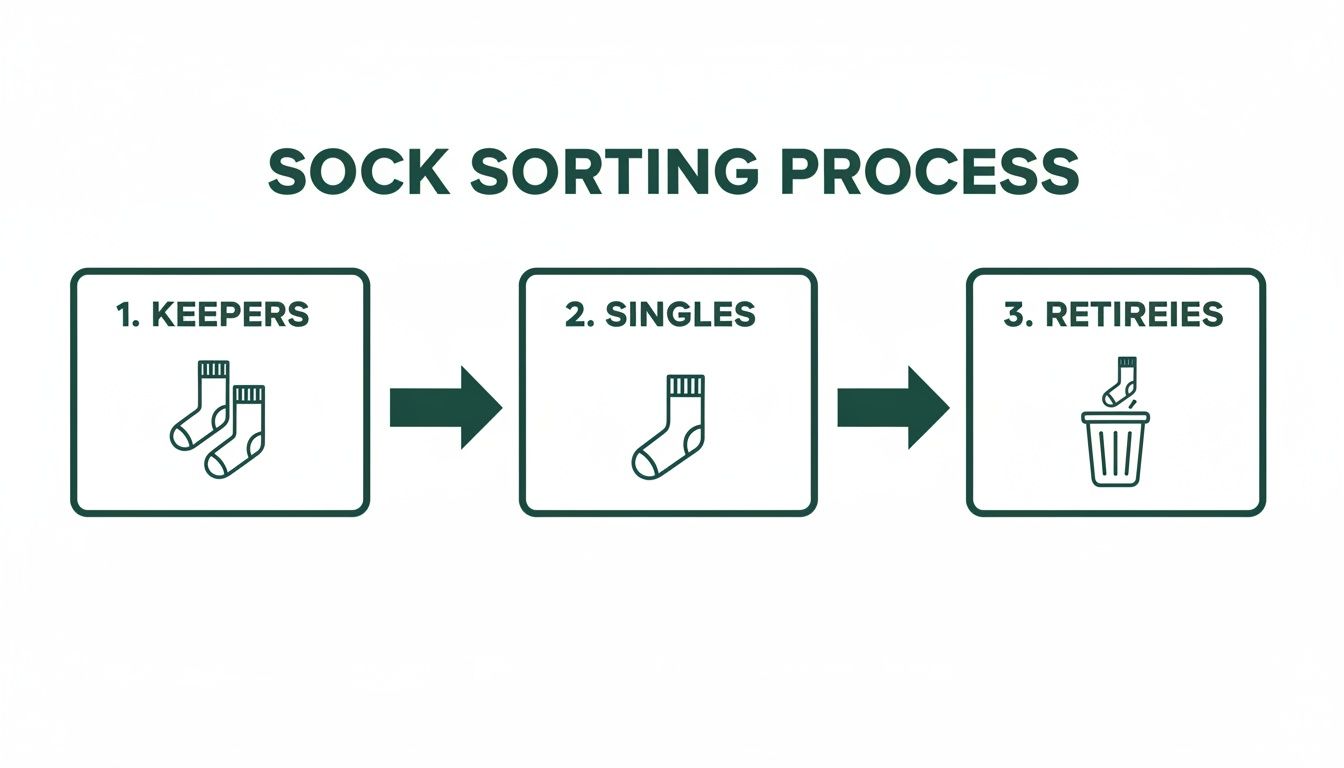
This simple visual flow makes the decluttering stage feel less overwhelming and sets you up for a much more efficient folding and organizing process.
Sock Folding Method Comparison
Choosing the right fold can feel like a small detail, but it makes a huge difference in how organized your drawers are. This table breaks down the most common methods to help you decide which one fits your socks and your schedule.
Ultimately, the best technique is the one you'll actually stick with. Try a few out and see what feels most natural for you.
From Folding to Filing
Once your socks are neatly folded, how you arrange them in the drawer is just as important. The key is to stack them vertically, like little files in a cabinet. This lets you see every single pair without having to rummage through the whole drawer. It’s a massive improvement over stacking them horizontally, where you can only ever see the pair on top.
This "filing" method works even better when you add some simple drawer dividers. You can create dedicated zones for different types of socks, which helps slash the time you spend searching for a match. Did you know that organizing by material—like cotton (35%), nylon (22%), and polyester—can cut down on mismatches by 45%? When you pair that with vertical stacking, you can fit up to 30% more into the same small space.
By ditching the ball fold and adopting a vertical filing system, you’re not just organizing; you’re creating a sustainable method that protects your socks and makes your daily routine easier. It’s a small change with a surprisingly large impact.
This drawer-level strategy is just one of many genius space-saving storage ideas for small homes that can help you reclaim control over your living areas. The same principles of visibility and easy access can be applied everywhere, from your closet to your kitchen.
Choosing Your Drawer Organization System
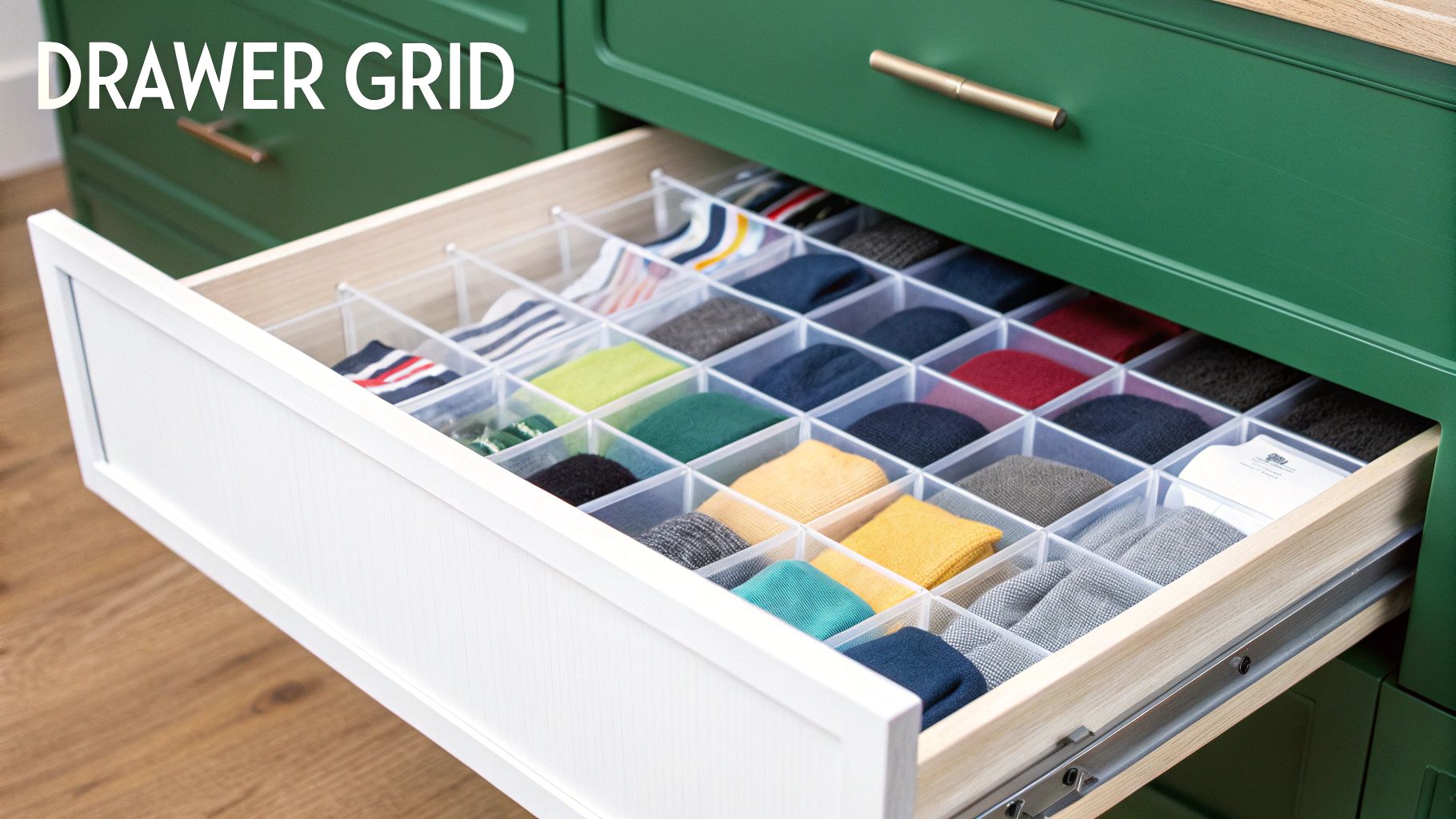
Now that your socks are perfectly folded, the real magic happens when you give them a proper home. This is where drawer dividers come in, transforming a chaotic, open drawer into an orderly grid where every single pair has its own designated spot. Let's be honest, without them, even the most beautifully folded socks will eventually collapse back into a jumbled mess.
The idea is to build a visual filing system. When you open that drawer and can see every pair at a glance, you completely cut out the frantic morning search. It makes your routine feel smooth and effortless. This becomes even more critical when you realize socks can take up about 15% of bedroom storage in apartments under 800 sq ft, making every inch count. You can dive deeper into the impact of sock clutter with this consumer goods research from Diligenceins.com.
Finding the Right Dividers for You
Choosing the best system really boils down to your budget and the size of your drawers. You can find some fantastic commercial options designed to solve this exact problem, but a clever DIY solution can work just as well.
Here are a couple of my go-to options:
- Adjustable Plastic Dividers: These are incredibly versatile because they let you create custom-sized compartments. You can easily make larger sections for those bulky wool winter socks and smaller ones for thin dress socks or no-shows.
- Honeycomb Organizers: These interlocking plastic grids are perfect. They create neat, individual cells for each pair of ankle or dress socks, which guarantees nothing ever gets jumbled together again.
The real power of dividers is the structure they provide. They enforce the boundaries between categories, which is the secret to long-term organization. The principles are the same whether you're learning how to organize socks or figuring out how to organize your kitchen drawers.
Looking for a more budget-friendly approach? You can easily create your own dividers using sturdy cardboard or foam core. Just cut strips to fit the height and width of your drawer, then cut small notches so they can interlock into a grid. For just a few pennies, you get a completely customized layout that fits your space perfectly.
Beyond these sock-specific methods, learning how to organize clothes drawers in general will give you even more techniques for maximizing space. At the end of the day, the best system is the one that makes finding and putting away your socks feel completely seamless.
Smart Storage for Seasonal and Overflow Socks
Let's be honest, not every sock needs prime real estate in your main drawer. Those thick wool hiking socks are your best friend in January, but they’re just hogging space in July. The same goes for goofy holiday socks or that one pair of fancy dress socks you wear maybe once a year. Keeping them in the daily rotation just adds to the clutter.
This is where seasonal storage becomes a total game-changer, especially if you're trying to figure out how to organize socks in a small space. By setting aside a dedicated spot for off-season and special-occasion pairs, you instantly simplify your everyday drawer. It’s a smart little trick that keeps your most-used items right where you need them, which makes a huge difference in smaller apartments where every inch counts.
Creating Your Secondary Storage System
First things first, you need to identify your "overflow" socks. Go through the pile of socks you decided to keep and pull out anything you know you won't need for the next three to six months.
This usually includes things like:
- Seasonal Socks: Heavy wool or thermal socks for winter; lightweight liner socks for summer.
- Special Occasion Socks: Formalwear, holiday-themed, or costume socks.
- Specialty Athletic Socks: That pair for skiing or cycling that only comes out a few times a year.
Once you have your pile, make sure every single pair is clean and bone dry before you pack them up. This is a non-negotiable step to prevent mildew and that musty smell when you pull them out again.
Moving is a huge trigger for clothing chaos. In fact, a whopping 42 million Americans moved in a recent year, and 67% of them pointed to clothing clutter as a major source of stress. Getting non-essentials boxed up beforehand makes packing and unpacking so much easier, especially as the demand for socks in the U.S. continues to climb. You can get more market insights from this Grandview Research report.
For the actual storage, I like using clear, airtight containers so I can see what's inside at a glance. Vacuum-sealed bags are also fantastic for saving space. Just make sure to label each container clearly—something simple like "Winter Socks" works perfectly. Store them somewhere cool and dry, like under the bed or on a high closet shelf.
This whole rotational approach is a cornerstone of smart decluttering. Our guide on how to store seasonal clothes dives deeper into this process if you want more tips. By rotating your collection, you ensure your drawer only holds what’s relevant right now, which makes your mornings that much smoother.
Sock Organization FAQs
Even with the best intentions, a few nagging questions can throw a wrench in your sock organization plans. Here are some quick answers to the most common sock-related dilemmas I hear about.
What's the Best Way to Deal with Single Socks?
Ah, the mystery of the missing sock. The most practical solution I've found is to set up a dedicated "lost sock" basket or bag right in the laundry room. It’s a simple holding zone for any sock that comes out of the dryer flying solo.
Give those lonely socks a deadline—maybe a month, or until you've done a few more loads of laundry. If its partner doesn't show up by then, it's time to say goodbye. This keeps single socks from slowly invading your neat drawers and creating chaos all over again.
How Often Should I Reorganize My Sock Drawer?
A full-on declutter and re-sort is usually only needed once or twice a year. An easy way to remember is to tie it to your seasonal clothing swap. When you're packing away your heavy winter sweaters, for instance, take a few minutes to audit your sock collection at the same time.
For day-to-day tidiness, the real game-changer is putting clean socks away immediately after doing laundry. Consistently returning each folded pair to its designated spot is what keeps your system from falling apart.
Do Sock Drawer Dividers Really Make a Difference?
Yes, they are an absolute must. Drawer dividers are the secret weapon for keeping your sock drawer organized for the long haul. They create physical boundaries that prevent your different categories—like athletic, dress, and casual socks—from becoming one jumbled mess.
Without dividers, you're just tidying up. With them, you're creating a lasting, functional system.
When your seasonal socks and other overflow items start piling up, don't let them take back your hard-won drawer space. Endless Storage offers a simple, box-by-box solution to keep your home tidy and your off-season items safe and sound. Learn how easy it is to declutter at Endless Storage.
Frequently Asked Questions
Unveiling the Secrets to Effortless Storage
Endless Storage is available nationwide. You pick a plan, tell us where to pickup, and we'll send a UPS van to collect, whichever state you're in.
Your shipping label will be sent to your email within a few minutes, if not instantaneously. It can also be accessed through your customer profile.
Your box will be shipped to one of our climate controlled self storage facilities in our closest self storage facility. Our manager will accept your package, notify you that your box has been received, and securely stored. Only our managers will have access to Endless Storage boxes.
Email us at admin@endless-storage.com click to live chat with us, or send us a message below.
Never! We're committed to transparent pricing with no surprises. You'll lock in your rate with no hidden fees and no long-term contracts.
Fast access guaranteed! Your boxes will arrive at your doorstep within 48 hours of requesting them back. Need to check on delivery? We provide tracking information for complete peace of mind.
Totally flexible! Store month-to-month with no long-term commitment and cancel anytime.
Everything's online! Use your account dashboard to:
• Set up automatic monthly payments
• Request box returns
• Update your address
• Order additional boxes
• Track shipments
Your boxes are insured up to $100 each. Our customer service team will help you file any necessary claims and resolve issues quickly.
Don't worry – we'll email you right away if there's a payment issue. Your items stay safe, though you may have temporary service interruption or late fees until payment is resolved.
When you request our free storage kits, you'll have 30 days to send in your boxes to activate your 3 months of free storage. Think of it like starting a gym membership – your activation window begins when you receive your kits, and your full free trial begins once you send in your first box. During your free months, you'll experience our complete storage service at no cost.
Your 30-day activation window begins when you receive your storage kits. We'll send you an email confirmation when your kits are delivered, marking the start of your activation period.
If you haven't sent any boxes for storage within your 30-day activation window, your free trial will expire and we'll begin charging the regular monthly rate of $9.99 per box. This helps ensure our storage kits go to customers who are ready to use our service.
A box costs $9.99 per month to store (plus sales tax). This price includes free shipping for standard boxes under 50 lbs. and smaller than 16"x16"x16"
Log into your Endless Storage account, locate the box you would like returned, and simply click Return My Box.
Yes, each box stored with us is insured for up to $100 throughout transit as well as the duration of storage within our facilities.
Your box will be at your doorstep within 48 hours of you requesting it back.
Store 10+ boxes? We'll pick them up for free! After your purchase, we'll contact you to schedule a convenient pickup time and arrange UPS collection.
We trust UPS with all shipments, and every box includes $100 insurance coverage. You'll receive tracking information to monitor your items' journey.
Yes! Visit any of our locations by appointment. Just bring a photo ID matching your customer profile.
For everyone's safety, we can't store hazardous materials, firearms, or perishables. All items must fit within our standard boxes.
It's easy! Order your storage kit online, and we'll ship it to you within 1-2 business days. Your shipping labels will be emailed instantly and available in your account.
We're here to help! Email us at admin@endless-storage.com, use our live chat, or send us a message through your account.
To cancel your storage service with Endless Storage, please email your cancellation request to admin@endless-storage.com. Our team will process your request within 2 business days and confirm your cancellation via email.
We understand packing takes time. However, to maintain your free trial benefits, you'll need to send at least one box within the 30-day activation window. If you need more time, you can always start with one box to activate your trial and send the rest later. You can always reach out to admin@endless-storage.com if you have any issues or concerns.
When you request our free storage kits, you're starting a 30-day window to begin using our storage service.
Important: To activate your free trial, send at least one box for storage within 30 days. If no boxes are sent within this 30-day window, a one-time $50 fee applies to cover materials and shipping costs. This fee is clearly disclosed before you sign up.
Think of it like reserving a hotel room – we're setting aside space and sending specialized packing materials for your use. The fee only applies if you request materials but don't begin storage, similar to a hotel's no-show charge.