Your coat closet is packed. The bike pump is under the bed. Holiday bins are stacked behind the couch. You keep shifting the same boxes around your apartment instead of getting your space back.
That’s usually the moment people start searching for cheap storage places in chicago.
The problem is that “cheap” on a listings page often isn’t cheap in real life. A low monthly rate can still mean paying for empty air inside a half-filled unit, driving across town to reach your stuff, or getting locked into a setup that made sense on move-in day but not two months later.
In Chicago, storage isn’t a luxury purchase for a lot of renters. It’s a space-management decision. If you live in a studio, share a two-bedroom, or bounce between leases, the right storage option can make your apartment livable again. The wrong one just adds another monthly bill.
Your Chicago Apartment is Full Now What
A lot of Chicago apartments hit a wall fast.
Winter gear takes over the entryway. Extra kitchen gear migrates to the top of the fridge. Your “temporary” moving boxes become permanent furniture. If you work from home, one corner of the apartment becomes a desk, another becomes a supply pile, and suddenly there’s nowhere to put the stuff you don’t use every week but still need.
That’s when storage starts making sense.
A common mistake is treating every storage need like it requires a full self-storage unit. Sometimes it does. If you’re storing furniture from a one-bedroom, that’s one thing. If you’re storing off-season clothes, old files, small décor, or a few keepsake boxes, a full unit can be overkill.
The two paths most people actually choose
In practice, Chicago renters usually end up looking at one of these:
- Traditional self-storage units for furniture, larger household items, and situations where you need to move bulky belongings.
- By-the-box storage for apartment overflow, seasonal items, archived records, and smaller loads that don’t justify renting a whole room.
Both can work. Both can also waste money if you choose the wrong one for the job.
The best storage setup is the one that matches what you’re actually trying to get out of your apartment, not the one with the flashiest promo banner.
Before you rent anything, spend one hour getting clear on what’s clutter and what’s worth paying to store. If you need a reset before making that call, this guide on how to declutter a small apartment step by step is a good place to start.
What works and what doesn’t
What works in Chicago is simple. Store the things you want back later, not the things you haven’t made a decision about.
What doesn’t work is paying every month to avoid sorting your stuff. That’s how people end up renting space for broken lamps, duplicate cookware, and boxes they never open again.
Calculate Your Real Storage Needs and Budget
Renters often over-rent because they estimate with emotion instead of inventory.
They look at a crowded apartment and think, “I need a unit.” What they often need is a smaller plan, fewer items, or a better way to separate short-term clutter from long-term keepsakes.

Start with a hard sort
Use three categories only:
- Keep
- Store
- Donate or toss
Don’t make a fourth pile for “maybe.” That pile becomes your monthly bill.
A good storage candidate is something you want, don’t need weekly, and would be annoyed to re-buy later. Think winter coats in July, holiday decorations in February, old tax folders, a bass guitar, baby keepsakes, or apartment staging clutter during a move.
A bad storage candidate is cheap furniture you already dislike, tangled chargers, half-used craft supplies, or anything damaged.
Think in boxes before you think in units
People save money here.
A small storage unit feels manageable, but it’s still a full unit. According to 2026 data, a small 5x5 storage unit in Chicago averages $42 per month. However, larger 10x10 units jump to an average of $128, which is 16% above the national average, making it wise to avoid renting more space than you need (Extra Space 2026 Chicago storage pricing).
That gap matters because once people outgrow a tiny space, they usually jump into something much larger than necessary.
A practical way to estimate
Ask yourself these questions:
- Mostly boxes or bulky furniture? If it’s boxes, don’t default to a room-sized unit.
- Will you need regular access? If yes, convenience matters more than the advertised price.
- Is this short-term or open-ended? The longer you store, the more waste hurts.
- Are you storing for use or for delay? If you’re just postponing decisions, cut first.
Practical rule: If your storage list is mostly labeled bins, banker boxes, and soft goods, you should pause before renting a traditional unit.
Build a real budget, not a fantasy one
Your budget should include more than the monthly ad price. It should cover the total storage setup you can comfortably keep for as long as needed.
Use this framework:
| Storage situation | Budget mindset |
|---|---|
| Seasonal clothes and decor | Keep it lean. Paying for large unused space usually makes no sense. |
| Moving gap between leases | Convenience often matters as much as rate. |
| Furniture from a larger apartment | A unit may make sense if you truly need floor space. |
| Long-term archive or keepsakes | Simplicity and predictable billing matter more than square footage. |
A smart cap is the amount you’d still accept paying after the novelty wears off. If you’d resent the bill by month three, the plan is too big.
If you need help sizing what you have, use a storage space calculator before you contact any facility. It’s much cheaper to get the estimate right than to upgrade after move-in.
What to write down before you shop
Make a short list with:
- Your item count
- Whether any item is fragile
- How often you’ll need access
- Your hard monthly limit
- Your walk-away point
That last one matters. If the total starts creeping past your limit once fees and logistics get added, it’s not cheap storage anymore.
Decoding Chicago Storage Prices and Hidden Fees
The advertised monthly rate is only the opening number.
That’s why two places that look similar online can feel very different once you get to checkout. In a crowded market, operators use pricing, promotions, and amenities to separate themselves, and the cheapest line item on page one doesn’t tell you what you’ll pay or deal with month to month.
Sticker price vs usable value
In Chicago, the average price for a medium 10'x10' unit is $124/month, but this varies significantly based on facility amenities and location. Price is used to differentiate in a saturated market, with 91-98 facilities competing in the small-to-medium segment alone (Extra Space Chicago facility pricing).
That tells you two useful things.
First, there’s a lot of competition. Second, facilities aren’t competing on one thing. One operator may push a low entry rate. Another may charge more but offer easier loading, better access, or a cleaner building. If you only compare the first number, you miss the full cost.
Hidden costs that change the deal
Common cost traps include:
- Add-on insurance that turns a cheap listing into a bigger monthly commitment
- Admin charges that show up after reservation
- Lock requirements when the facility requires its own setup or expects a new purchase
- Promo pricing that looks good for month one and then resets higher
- Time costs if the low-price facility is a pain to reach
None of those are unusual. They’re the reason you should always ask for the all-in number before reserving.
Ask one question plainly: “What will I pay this month, and what will I pay after the promo ends?”
If you’re comparing movers and storage together because your situation involves a relocation, this roundup of Moving Companies with Storage is useful for seeing how bundled options differ from stand-alone storage.
A better comparison method
Don’t compare units by square footage alone. Compare them by what your life will look like while you’re using them.
Use this decision screen:
| Question | Why it matters |
|---|---|
| Is the rate a promo or standard price? | Intro pricing can distort the real monthly cost. |
| What’s included? | Insurance, climate control, and access can change value fast. |
| How much of the unit will actually be full? | Paying for empty floor space is common. |
| How often will you visit? | Every extra trip adds friction and cost. |
A lot of renters would make better decisions if they looked at storage like a subscription they’ll have to justify every month. Once you view it that way, waste becomes obvious.
For a useful pricing mindset, this breakdown of the price of storage helps frame the difference between headline pricing and total cost.
Why Location and Access Are Hidden Costs
A storage place in Chicago can be cheap on paper and expensive in practice.
That happens when the facility is far enough away that you avoid going, awkward enough that every visit becomes a chore, or located somewhere you don’t feel great about visiting early or late.

A cheaper unit can cost you more time
A low monthly rate loses its shine if you need to borrow a car, hunt for parking, wait on elevators, and carry bins through long hallways every time you need one box.
That’s why access patterns matter more than often realized. If you only need long-term storage for things you won’t touch, distance might be tolerable. If you expect to swap winter clothes, rotate hobby gear, or grab documents, inconvenience becomes a recurring cost.
Here’s a practical rule I use. If getting to your storage feels like an errand you’ll keep postponing, you picked the wrong setup.
Safety affects both price and peace of mind
With property crime rates 150% higher than the rest of Illinois, secure storage is a necessity for many Chicagoans. This demand concentrates rental activity in safer neighborhoods like the North Side, Lincoln Park, and Lake View, influencing both price and availability (Public Storage Chicago market overview).
That doesn’t mean every bargain facility is a bad idea. It means security isn’t optional. When a place is cheaper because it’s less convenient, less monitored, or in a spot you’d rather avoid, the savings may not be worth it.
Good storage should reduce stress in your apartment, not add stress every time you need to visit it.
When climate control is worth paying for
Climate control isn’t a must for everything.
It does make sense for:
- Electronics
- Wood furniture
- Paper files and documents
- Photos and keepsakes
- Musical instruments
- Anything sensitive to moisture
It matters less for durable bins of seasonal clothes or basic household overflow, depending on how they’re packed.
The mistake is paying extra for features you don’t need, then storing low-value items inside them.
Keep these tips in mind:
- Store sentimental or sensitive items with more protection.
- Store replaceable, durable stuff with less complexity.
- Don’t pay premium storage rates for things you could donate and replace later.
For people comparing city access options, neighborhood fit, and pickup-based alternatives, this page covering storage locations is useful for seeing what kind of service area works best for your address.
A short walkthrough can help you think through the trade-offs before booking anything:
The Smarter Alternative Pay Only for Space You Use
Traditional self-storage works best when you need a room away from home.
That means furniture, large household loads, business stock, or an in-between move where bulky items need floor space. But a lot of Chicago renters don’t have that kind of storage problem. They have a box problem. Or a closet problem. Or a “my apartment is full of things I use twice a year” problem.
That’s where the unit model starts breaking down.
Why units get expensive for small loads
If you rent a self-storage unit for a small amount of stuff, you usually pay for the size category available, not the exact space you use. A few boxes, a lamp, a suitcase, and holiday décor can still push you into a full monthly unit rate.
That’s waste.
While traditional Chicago units start at $33-$58 for a 5x5 space requiring travel, by-the-box services like Endless Storage can store an equivalent volume for as little as $7.99 per box (with 2+ boxes), including pickup, climate control, and insurance, services that are often add-ons at traditional facilities (RentCafe Chicago storage comparison).
For the modern city renter, that model often makes more sense because the storage need is usually narrow. A few boxes of seasonal clothes. Some books you don’t want to part with. Baby items you’ll need later. Extra kitchen gear during a move. Tax files. Decor.
Traditional unit vs by-the-box
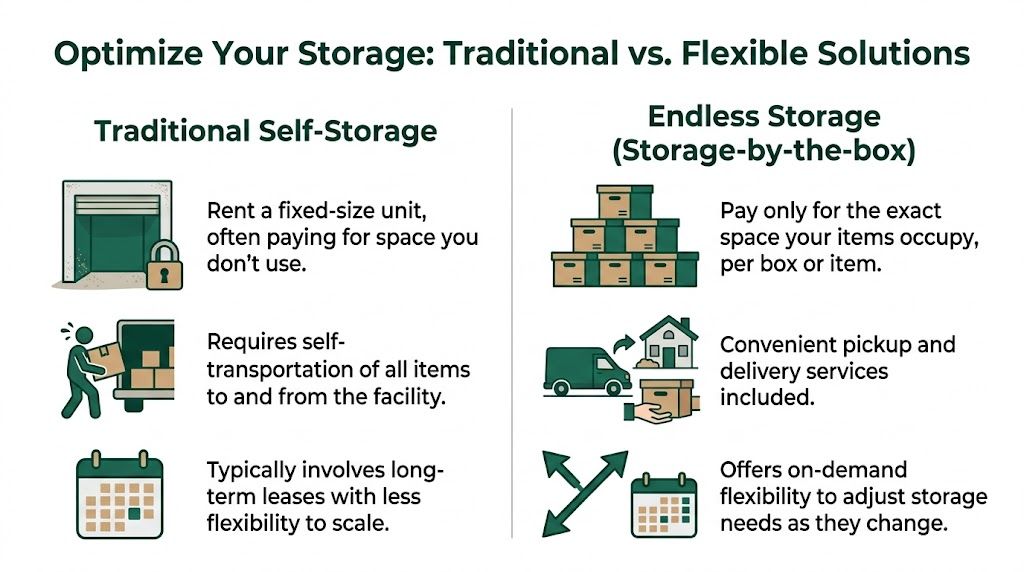
The core trade-off looks like this:
| Option | Best for | Main drawback |
|---|---|---|
| Traditional self-storage | Furniture, large loads, frequent in-person access to bulky items | You often rent more space than you actually fill |
| By-the-box storage | Boxes, seasonal overflow, apartment decluttering, smaller moves | Not ideal for full-room furniture storage |
This is the part a lot of listings pages skip. They assume everyone is comparing unit sizes. Many renters should really be comparing storage models.
What tends to work better in real life
By-the-box storage is often the better fit when:
- You don’t own a car
- Your building makes loading awkward
- You only need to store boxed items
- You want pickup instead of spending a Saturday driving to a facility
- You care more about simplicity than walking around inside a rented unit
Traditional storage usually wins when:
- You need to store couches, mattresses, tables, or large appliances
- You’re clearing out a whole apartment
- You need to move bulky items in and out yourself
If your storage list would fit neatly into labeled boxes, a full unit is often the wrong tool.
The biggest hidden savings isn’t just price
It’s friction.
Driving across the city, coordinating help, loading a car, checking facility hours, hauling bins through the building, and reversing the process later all carry a cost. Not always a line item on an invoice, but still a cost.
That’s why people looking for cheap storage places in chicago should stop thinking only in monthly rent. They should ask a better question: what’s the cheapest way to store exactly what I have, with the least waste and hassle?
For small apartment overflow, on-demand models answer that question well. If you want to understand how that setup works in practice, this guide to on-demand storage lays out the logic clearly.
Final Checklist for Securing the Best Storage Deal
Good storage shopping is mostly about avoiding bad commitments.
By the time someone signs, they’re tired, rushed, or trying to solve a space problem fast. That’s when they overpay, over-rent, or agree to terms they barely read.
Use this checklist before you book
Match the storage type to the stuff
Boxes and seasonal items need a different solution than furniture and mattresses.Ask for the full monthly number
Don’t stop at the promo. Get the actual recurring cost.Check access before you commit
Hours, loading setup, parking, elevators, and neighborhood convenience all matter.Be honest about how often you’ll need your items
If access is rare, convenience at move-in may matter more than walk-in access later.Don’t store low-value clutter
If you wouldn’t buy it again, paying to store it is hard to justify.Read the cancellation and notice terms
Short-term flexibility is only useful if the off-ramp is easy.
Two last insider moves
First, shop with a calm head. Storage gets expensive when it’s rented during a scramble.
Second, think about retrieval before move-in. Label every box clearly. Keep an item list on your phone. If you do choose a unit, this guide on how to organize a storage unit is worth reading so you don’t create a paid junk pile you can’t find things in.
Cheap storage is the option that fits your real life. Not the one with the lowest teaser rate.
The decision filter I’d use
If I were comparing options today, I’d make the call with these five questions:
| Question | If the answer is yes |
|---|---|
| Am I storing mostly boxes? | Avoid paying for a full unit if you can. |
| Do I need frequent in-person access? | Location and access matter more. |
| Am I storing sensitive items? | Prioritize protection over rock-bottom pricing. |
| Will I resent this bill in a few months? | Downsize the plan. |
| Am I solving clutter or postponing decisions? | Declutter first, then store what remains. |
That’s the shortcut. Get clear on the job, then choose the cheapest setup that does that job well.
If your apartment is tight and your storage need is mostly boxes, seasonal gear, keepsakes, or move-related overflow, Endless Storage is worth a look. It’s a simple way to avoid paying for empty unit space, skip the drive to a facility, and store only what you need to store.
Frequently Asked Questions
Unveiling the Secrets to Effortless Storage
Endless Storage is available nationwide. You pick a plan, tell us where to pickup, and we'll send a UPS van to collect, whichever state you're in.
Your shipping label will be sent to your email within a few minutes, if not instantaneously. It can also be accessed through your customer profile.
Your box will be shipped to one of our climate controlled self storage facilities in our closest self storage facility. Our manager will accept your package, notify you that your box has been received, and securely stored. Only our managers will have access to Endless Storage boxes.
Email us at admin@endless-storage.com click to live chat with us, or send us a message below.
Never! We're committed to transparent pricing with no surprises. You'll lock in your rate with no hidden fees and no long-term contracts.
Fast access guaranteed! Your boxes will arrive at your doorstep within 48 hours of requesting them back. Need to check on delivery? We provide tracking information for complete peace of mind.
Totally flexible! Store month-to-month with no long-term commitment and cancel anytime.
Everything's online! Use your account dashboard to:
• Set up automatic monthly payments
• Request box returns
• Update your address
• Order additional boxes
• Track shipments
Your boxes are insured up to $100 each. Our customer service team will help you file any necessary claims and resolve issues quickly.
Don't worry – we'll email you right away if there's a payment issue. Your items stay safe, though you may have temporary service interruption or late fees until payment is resolved.
When you request our free storage kits, you'll have 30 days to send in your boxes to activate your 3 months of free storage. Think of it like starting a gym membership – your activation window begins when you receive your kits, and your full free trial begins once you send in your first box. During your free months, you'll experience our complete storage service at no cost.
Your 30-day activation window begins when you receive your storage kits. We'll send you an email confirmation when your kits are delivered, marking the start of your activation period.
If you haven't sent any boxes for storage within your 30-day activation window, your free trial will expire and we'll begin charging the regular monthly rate of $9.99 per box. This helps ensure our storage kits go to customers who are ready to use our service.
A box costs $9.99 per month to store (plus sales tax). This price includes free shipping for standard boxes under 50 lbs. and smaller than 16"x16"x16"
Log into your Endless Storage account, locate the box you would like returned, and simply click Return My Box.
Yes, each box stored with us is insured for up to $100 throughout transit as well as the duration of storage within our facilities.
Your box will be at your doorstep within 48 hours of you requesting it back.
Store 10+ boxes? We'll pick them up for free! After your purchase, we'll contact you to schedule a convenient pickup time and arrange UPS collection.
We trust UPS with all shipments, and every box includes $100 insurance coverage. You'll receive tracking information to monitor your items' journey.
Yes! Visit any of our locations by appointment. Just bring a photo ID matching your customer profile.
For everyone's safety, we can't store hazardous materials, firearms, or perishables. All items must fit within our standard boxes.
It's easy! Order your storage kit online, and we'll ship it to you within 1-2 business days. Your shipping labels will be emailed instantly and available in your account.
We're here to help! Email us at admin@endless-storage.com, use our live chat, or send us a message through your account.
To cancel your storage service with Endless Storage, please email your cancellation request to admin@endless-storage.com. Our team will process your request within 2 business days and confirm your cancellation via email.
We understand packing takes time. However, to maintain your free trial benefits, you'll need to send at least one box within the 30-day activation window. If you need more time, you can always start with one box to activate your trial and send the rest later. You can always reach out to admin@endless-storage.com if you have any issues or concerns.
When you request our free storage kits, you're starting a 30-day window to begin using our storage service.
Important: To activate your free trial, send at least one box for storage within 30 days. If no boxes are sent within this 30-day window, a one-time $50 fee applies to cover materials and shipping costs. This fee is clearly disclosed before you sign up.
Think of it like reserving a hotel room – we're setting aside space and sending specialized packing materials for your use. The fee only applies if you request materials but don't begin storage, similar to a hotel's no-show charge.