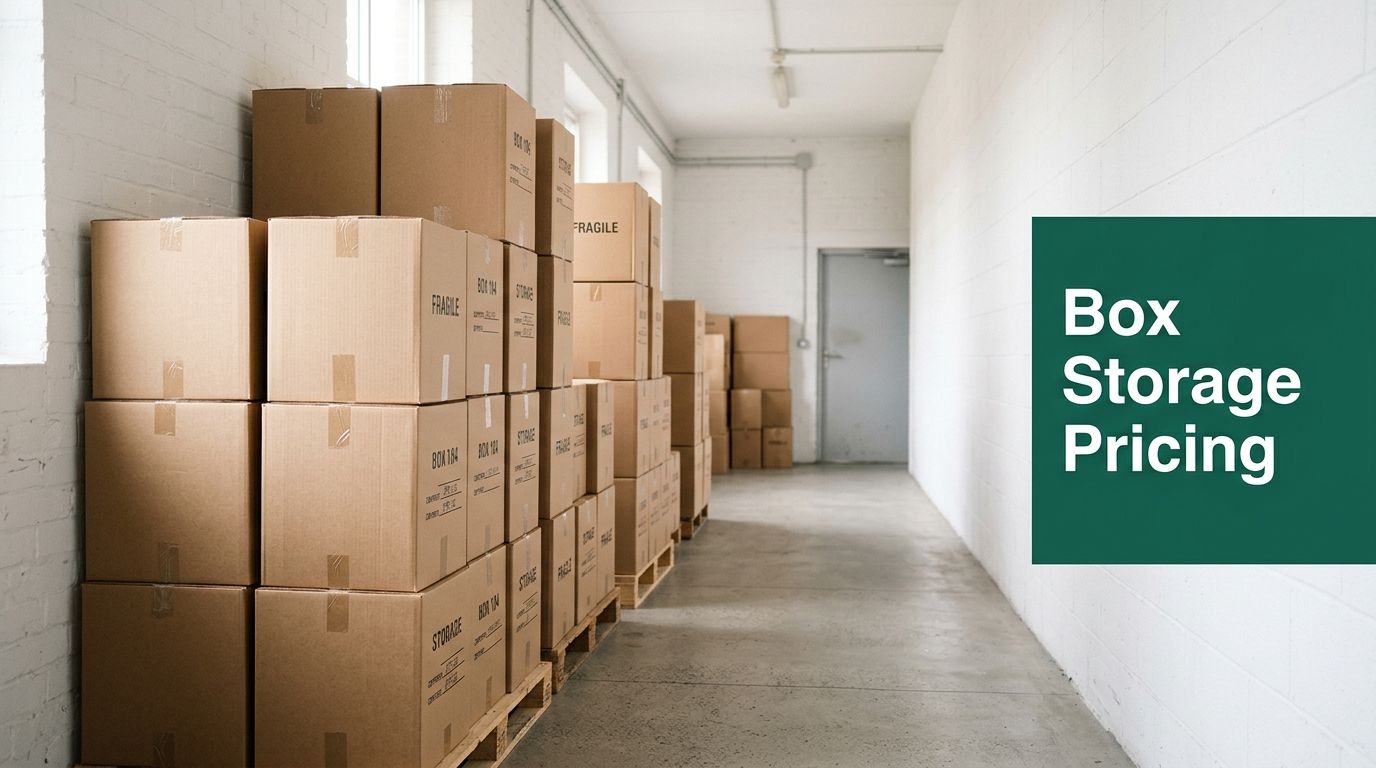
Your winter coats are eating a dining chair. The bike you swear you'll ride again is leaning against a bookshelf. Holiday decorations are stacked in a corner, and the suitcase you meant to unpack fully is now acting as furniture.
That's usually the moment people start looking at box storage pricing.
For apartment renters, city movers, and anyone living with limited closet space, box storage feels like a modern answer to an old problem. Instead of renting an entire storage room, you pack only what you need, send it out, and keep your living space for actual living. It's the storage version of a subscription. You pay for the amount you use, not for empty square footage.
That pay-as-you-grow model didn't appear out of nowhere. In software, services like Box helped normalize subscription pricing with plans ranging from $5 to about $50 per user per month according to this Box pricing overview. That broader shift shaped how people now think about storage. Flexible plans. Monthly billing. Lower entry costs.
Still, the posted price on a storage site rarely tells the whole story. A more pertinent question is simpler and more useful:
What will this cost me over the full time I store my stuff, including pickup, retrieval, and the value of convenience?
Is Your Apartment Shrinking or Is Your Stuff Expanding
A lot of storage decisions start with a small, annoying problem that keeps growing. One bin of winter clothes becomes four. A guitar case takes over a hallway. Moving boxes stay packed long after the move because there's nowhere sensible to put them.
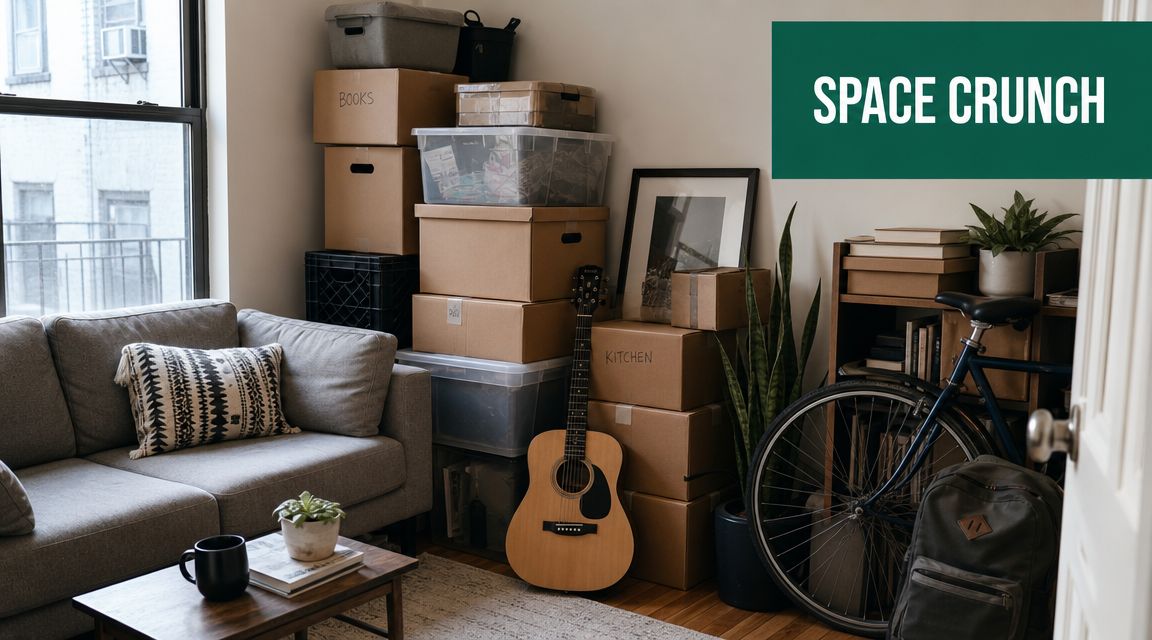
If that sounds familiar, you're probably not looking for “more storage” in the abstract. You're looking for more room in your current life. That's why valet-style storage has become so appealing. The service comes to you, takes the packed items away, and returns them when you ask.
For people in compact homes, that can feel more realistic than renting a unit across town. If you're trying to visualize what clutter pressure looks like in a smaller home, this 800 square foot apartment guide is a useful reference point.
Why this model feels intuitive
Traditional self-storage asks you to think in room sizes. Box storage asks you to think in item groups. That's generally much easier.
You don't need to estimate whether you need half a garage or a closet-sized unit. You ask a more grounded question:
- Seasonal overflow: How many boxes would clear out the entry closet?
- Move in transition: What can leave the apartment for a few months?
- Sentimental storage: Which items matter enough to keep, but not enough to keep nearby?
Box storage works best when your real need is space recovery at home, not constant in-person access.
That distinction matters because pricing makes more sense once you frame the service correctly. You're not only paying for square footage. You're paying to avoid hauling, driving, lifting, and dedicating a Saturday to a storage run.
The Anatomy of Your Box Storage Bill
A box storage bill is usually easier to understand when you treat it like a phone plan. There's the base subscription, then there are the service details that affect what you pay.
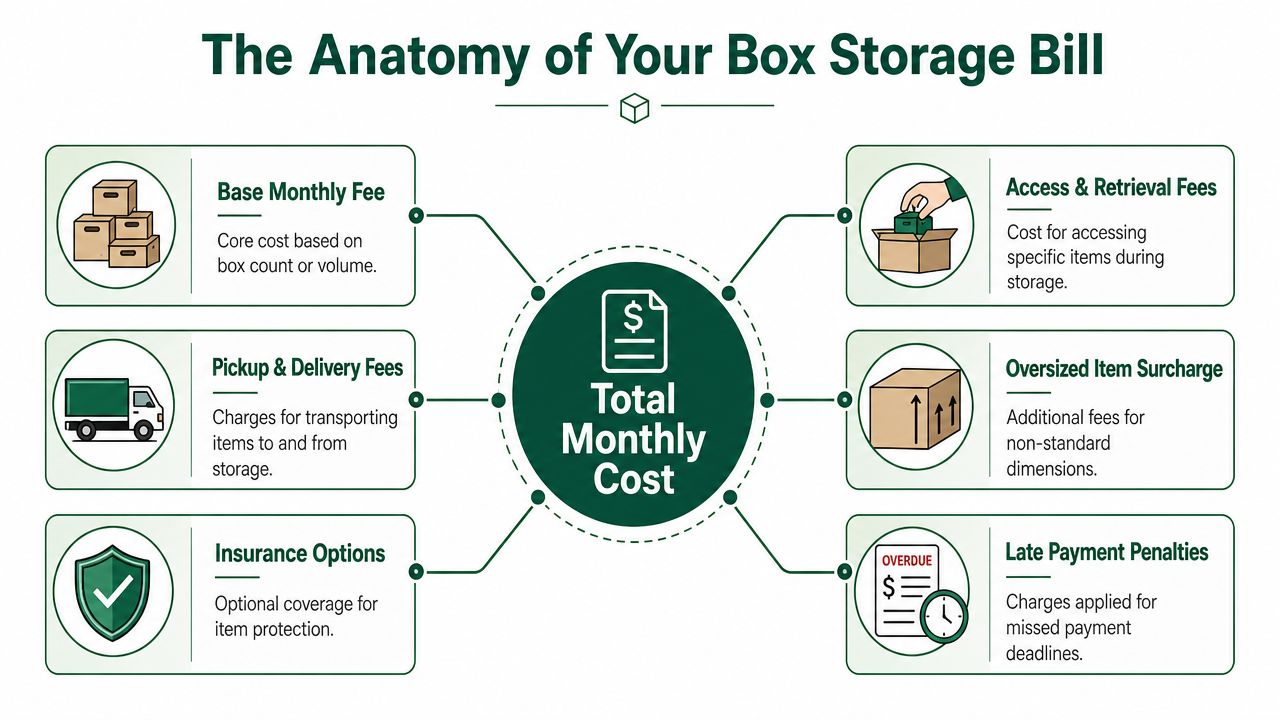
The part often focused on first is the monthly per-box rate. That's important, but it isn't the full cost picture. A better way to read any provider's pricing page is to separate the bill into line items.
If you want to see how one provider presents those line items, the Endless Storage pricing page is a helpful example.
The core line items
Here are the charges to check before you compare providers.
- Base monthly fee: This is the recurring amount tied to each box or item stored.
- Minimums: Some services may require a minimum number of boxes or a minimum monthly charge to make pickup and handling worthwhile.
- Pickup and return logistics: Ask whether transport is included, limited, or charged separately in certain situations.
- Optional protection: Insurance or declared-value coverage can change the monthly total.
- Special item handling: Oddly shaped or oversized items may not price like standard boxes.
- Access fees: Some services charge differently when you request a full return versus a single-item retrieval.
Why the cheapest headline price can mislead
The main trap is assuming storage is priced only by volume. In many subscription businesses, that isn't true. With Box's enterprise software, paid plans include unlimited storage, but the practical difference between tiers includes the single-file upload limit, which rises from 5 GB to 500 GB, and Box Platform pricing starts at $500 per bundle per month according to Box's platform pricing announcement. The lesson carries over well to physical storage. The cost driver often isn't just how much space you use. It's the service level attached to that space.
For physical box storage, that usually means convenience features matter more than people expect. Pickup windows, return speed, handling rules, and item type can affect your total cost more than the advertised starter rate.
Practical rule: Don't ask only “What's the per-box price?” Ask “What events create extra cost after I sign up?”
A simple bill-reading framework
When you compare providers, write down these questions in one place:
| Charge category | What to verify |
|---|---|
| Monthly storage | Is pricing per box, per item, or by volume? |
| Minimum commitment | Is there a minimum box count or monthly spend? |
| Retrievals | Can you request one item back, and is there a fee? |
| Oversized items | Are bikes, skis, monitors, or art priced differently? |
| Supplies | Are boxes included, sold separately, or customer-provided? |
| Billing terms | Is it month-to-month or tied to a longer commitment? |
This is the difference between a clear estimate and a surprise invoice.
Box Storage vs Self-Storage A Cost Comparison
The most common mistake in storage shopping is comparing only the monthly rent line. That makes self-storage look simpler than it really is, and it makes box storage look more expensive than it may be in practice.
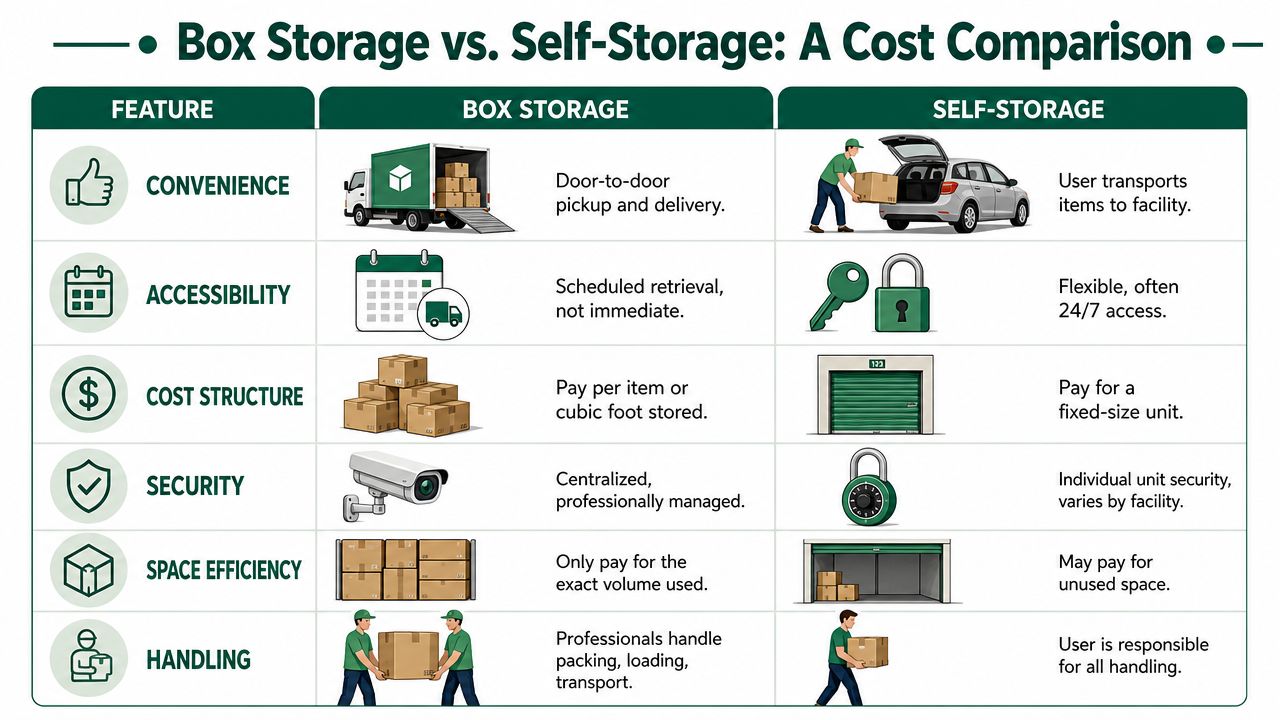
A more useful comparison looks at total cost of ownership. That means monthly price plus the work and logistics attached to the choice. Traditional self-storage may have a lower price at higher volume, but it often asks you to do the transportation, loading, unloading, and repeat trips yourself.
Industry reporting gives us one helpful anchor. A standard 5×5 self-storage unit averaged about $55 per month in one major-market example, while specialized document storage could be as low as $0.50 per box per month according to this document storage cost analysis. Box storage typically sits somewhere between those two ends of the spectrum.
What you're really comparing
Self-storage is a fixed container. Box storage is modular.
That sounds abstract, but it changes the economics:
- With self-storage, you pay for the whole unit whether it's full or half-empty.
- With box storage, you usually pay only for the number of stored boxes or items.
- With self-storage, access is often more immediate.
- With box storage, convenience is front-loaded because pickup and return are part of the model.
If you're comparing providers in Australia rather than the U.S., this practical resource on Perth storage for homes or businesses gives useful local context on how service types differ.
Cost scenario breakdown
Here's a simple way to think through the tradeoff.
| Cost Factor | Box Storage (e.g., Endless Storage) | Traditional Self-Storage |
|---|---|---|
| Space purchased | Pay for stored boxes or items | Pay for a full unit size |
| Transportation | Often part of the service model | Usually handled by you |
| Loading labor | Lower personal labor | Higher personal labor |
| Access pattern | Best for occasional retrieval | Best for frequent access |
| Empty space risk | Low | Higher |
| Convenience value | High for apartment dwellers | Depends on how close the facility is |
A service like box-and-go storage often makes sense when your priority is reclaiming room without making repeated trips.
If you'll visit your things often, a unit may fit better. If you mainly want your apartment back, box storage usually deserves a closer look.
The break-even question that matters
The right question isn't “Which one is cheaper?” It's “Cheaper for what kind of use?”
Self-storage tends to improve in value when you have enough volume to fill a meaningful portion of the unit and when you need regular access. Box storage tends to make more sense when your item count is modest, your home is small, and convenience would otherwise require a car, a rental vehicle, borrowed help, or a lot of carrying.
That's why break-even math should include both money and friction. The monthly number matters. So does the fact that one option turns storage into an errand, and the other turns it into a scheduled service.
Real-World Box Storage Pricing Examples
Real pricing examples help because they expose how providers package the same basic promise in different ways.
One clear reference point is Endless Storage, which lists pricing as low as $7.99 per box per month for two or more boxes, with month-to-month billing, as described on the company website. That's a useful model for people who don't need a whole unit and want to match cost more closely to actual usage.
What to look for in a real pricing page
The important thing isn't only the starter rate. It's how readable the plan is.
When you review a provider, check whether the page answers these questions without forcing you to call sales:
- What counts as a standard box
- Whether there's a minimum
- How returns work
- How non-standard items are handled
- Whether billing is monthly and flexible
Some companies make the base price visible but leave the retrieval rules vague. Others are clearer about operations but less clear about what happens when you store a bike, artwork, or media equipment.
For readers comparing city-level options, this guide to Sydney storage prices is useful because it shows how local market conditions can shape what looks like a reasonable rate.
A practical way to compare providers
Instead of collecting screenshots of price tables, use a worksheet with three columns:
- Monthly storage cost
- Likely retrieval costs during your storage period
- Convenience value for your situation
If you want to turn that into a rough estimate quickly, a storage savings calculator can help you compare modular storage against larger fixed-space options.
The key is consistency. Compare each company using the same assumptions about how long you'll store items, whether you'll need anything back mid-term, and whether you're storing only standard boxes or also awkward items.
How to Estimate Your Total Storage Cost A Worked Example
A useful estimate starts with your life, not the provider's pricing page.
Take Maria. She lives in a studio apartment and wants to free up floor space. She has seasonal clothes, archived design materials, and a few items she doesn't need every week. Her mistake would be to look only at the per-box rate. Your goal is to build a full-cost estimate instead.
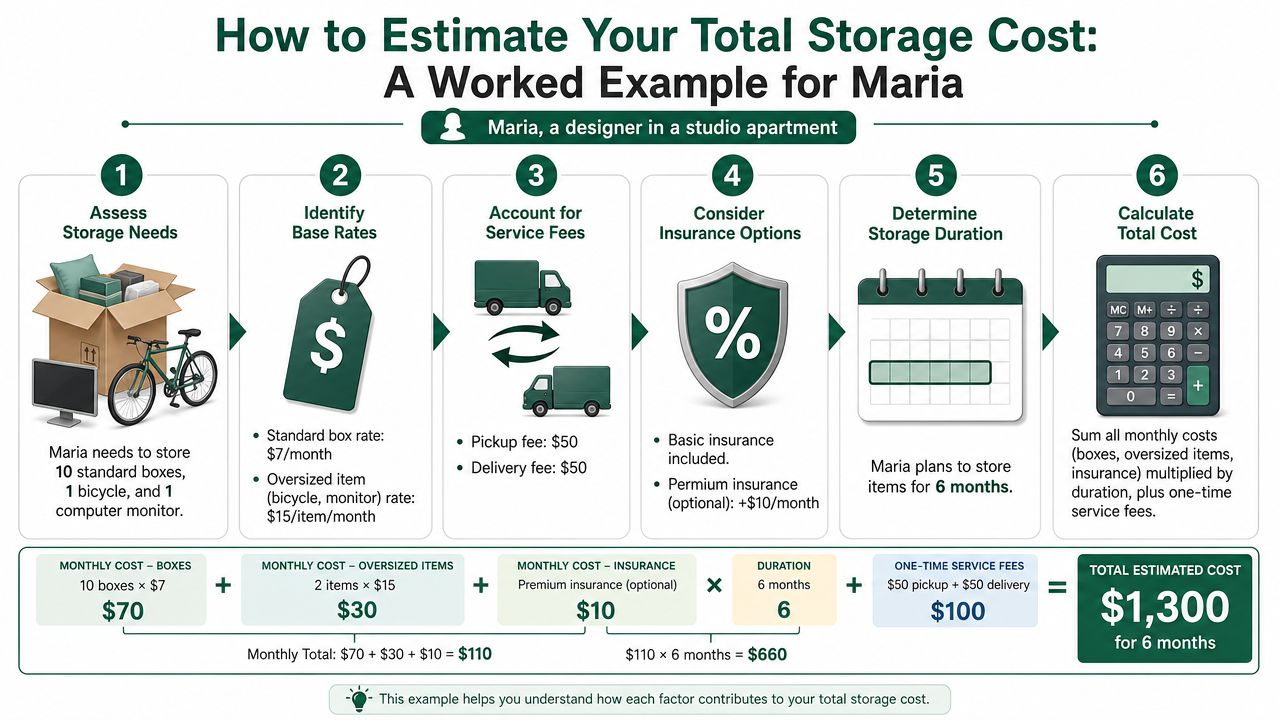
Step 1 list everything you might store
Before you price anything, make an inventory. Not a perfect one. Just a working list.
Maria writes down:
- boxes of winter clothing
- a monitor she rarely uses
- reference books
- fabric samples
- holiday decor
A home inventory list is also a critical tool for estate planning, and it helps with storage budgeting because you can separate standard boxes from fragile or irregular items.
Step 2 group items by billing type
Readers often become confused. Providers may not price everything the same way.
Create buckets like these:
| Item type | Why it matters |
|---|---|
| Standard boxes | Usually the simplest recurring monthly rate |
| Oversized items | May have separate handling or pricing |
| Fragile items | May affect packing choices or protection options |
| Frequently needed items | May raise your expected retrieval cost |
Step 3 check for minimums and service triggers
In software, minimum seat counts often shape what small teams pay. Box's enterprise plans, for example, are sold with a 3-user minimum, as discussed in this enterprise Box pricing analysis. Physical storage can work similarly. A provider may be operationally efficient only above a minimum box count or minimum charge.
So Maria asks:
- Is there a minimum monthly spend?
- Is there a minimum number of boxes?
- Does retrieving one item create a separate event charge?
- Are return trips priced differently from original pickup?
Use a “trigger list.” Write down every action that might create a charge later. Pickup. Return. Partial retrieval. Oversized handling. Late payment.
Step 4 build your own total cost formula
You don't need fancy math. Use this structure:
Total storage cost = recurring monthly storage + optional protection + retrieval-related costs + any one-time service charges
Then apply it across time horizons:
- One month if you're between moves
- Three months for seasonal overflow
- Twelve months for longer-term storage
If your items are packed by volume rather than by count, this guide on how to find cubic feet can help you translate your pile of belongings into a more realistic estimate.
Step 5 price your habits, not just your boxes
Maria's cheapest quote on paper may not be the cheapest in real life if she knows she'll want items returned more than once. On the other hand, a slightly higher monthly rate could still be the better value if it removes the need for transportation and keeps billing simple.
That's the heart of good box storage pricing analysis. You're not just pricing stored objects. You're pricing the service model wrapped around them.
Smart Tips to Lower Your Box Storage Bill
The fastest way to cut storage cost is to store less. That sounds obvious, but people often box first and edit later. That reverses the savings.
Small decisions that matter
- Declutter before packing: Don't pay monthly to keep duplicates, damaged décor, or paperwork you no longer need.
- Pack densely, not randomly: A half-filled box is wasted paid space in another form.
- Separate high-access items: Keep anything you'll need soon at home so you don't trigger retrieval requests.
- Question protection add-ons: Match coverage to the value of the items, not your general anxiety about storage.
- Use one planning sheet: Track what's inside each box so you don't request returns just to check contents.
Timing can reduce friction
Another good move is to batch your storage decisions. Store everything you're reasonably sure you won't need for a while, rather than sending small waves of items over time.
You'll also save yourself money if you estimate your holding period accurately. A three-month need and a one-year need should be priced differently in your spreadsheet, even if the provider bills month to month.
Label every box clearly before it leaves your home. Retrieval confusion is expensive, even when the invoice line is small.
Common Questions About Box Storage Pricing
Can I get just one box back at a time
Often, yes, but you need to verify how the provider treats partial returns. Some services are built for item-by-item retrieval. Others are more efficient when you request several boxes together. The financial question isn't just whether one-box retrieval is allowed. It's whether that request creates an extra service charge or merely changes scheduling.
Is long-term storage always cheaper
Not always. Some providers offer the same monthly structure regardless of duration, while others package value through minimums, bundled services, or operational simplicity. The smart move is to compare your likely total over one month, three months, and a year instead of assuming a lower long-term rate will appear automatically.
What if I need something unexpectedly
That's where service design matters more than the headline rate. If surprise access is common in your life, ask how retrieval requests work, how specific you can be about what comes back, and whether emergency or rush handling changes cost.
When does self-storage make more sense
Usually when you need frequent access, have enough volume to justify a unit, or want to manage your own loading and transport. For smaller urban households storing a limited number of boxes, box storage often wins on convenience and space efficiency.
What's the single best way to avoid overpaying
Build your estimate around behavior. Count your boxes, note any oversized items, decide how long they'll stay out, and realistically consider whether you'll ask for returns during that period. That gives you a real number instead of a teaser price.
If you want a storage option that matches apartment life more closely than a full unit rental, Endless Storage offers a simple way to price by the box and estimate what you'd spend before you commit.
Frequently Asked Questions
Unveiling the Secrets to Effortless Storage
Endless Storage is available nationwide. You pick a plan, tell us where to pickup, and we'll send a UPS van to collect, whichever state you're in.
Your shipping label will be sent to your email within a few minutes, if not instantaneously. It can also be accessed through your customer profile.
Your box will be shipped to one of our climate controlled self storage facilities in our closest self storage facility. Our manager will accept your package, notify you that your box has been received, and securely stored. Only our managers will have access to Endless Storage boxes.
Email us at admin@endless-storage.com click to live chat with us, or send us a message below.
Never! We're committed to transparent pricing with no surprises. You'll lock in your rate with no hidden fees and no long-term contracts.
Fast access guaranteed! Your boxes will arrive at your doorstep within 48 hours of requesting them back. Need to check on delivery? We provide tracking information for complete peace of mind.
Totally flexible! Store month-to-month with no long-term commitment and cancel anytime.
Everything's online! Use your account dashboard to:
• Set up automatic monthly payments
• Request box returns
• Update your address
• Order additional boxes
• Track shipments
Your boxes are insured up to $100 each. Our customer service team will help you file any necessary claims and resolve issues quickly.
Don't worry – we'll email you right away if there's a payment issue. Your items stay safe, though you may have temporary service interruption or late fees until payment is resolved.
When you request our free storage kits, you'll have 30 days to send in your boxes to activate your 3 months of free storage. Think of it like starting a gym membership – your activation window begins when you receive your kits, and your full free trial begins once you send in your first box. During your free months, you'll experience our complete storage service at no cost.
Your 30-day activation window begins when you receive your storage kits. We'll send you an email confirmation when your kits are delivered, marking the start of your activation period.
If you haven't sent any boxes for storage within your 30-day activation window, your free trial will expire and we'll begin charging the regular monthly rate of $9.99 per box. This helps ensure our storage kits go to customers who are ready to use our service.
A box costs $9.99 per month to store (plus sales tax). This price includes free shipping for standard boxes under 50 lbs. and smaller than 16"x16"x16"
Log into your Endless Storage account, locate the box you would like returned, and simply click Return My Box.
Yes, each box stored with us is insured for up to $100 throughout transit as well as the duration of storage within our facilities.
Your box will be at your doorstep within 48 hours of you requesting it back.
Store 10+ boxes? We'll pick them up for free! After your purchase, we'll contact you to schedule a convenient pickup time and arrange UPS collection.
We trust UPS with all shipments, and every box includes $100 insurance coverage. You'll receive tracking information to monitor your items' journey.
Yes! Visit any of our locations by appointment. Just bring a photo ID matching your customer profile.
For everyone's safety, we can't store hazardous materials, firearms, or perishables. All items must fit within our standard boxes.
It's easy! Order your storage kit online, and we'll ship it to you within 1-2 business days. Your shipping labels will be emailed instantly and available in your account.
We're here to help! Email us at admin@endless-storage.com, use our live chat, or send us a message through your account.
To cancel your storage service with Endless Storage, please email your cancellation request to admin@endless-storage.com. Our team will process your request within 2 business days and confirm your cancellation via email.
We understand packing takes time. However, to maintain your free trial benefits, you'll need to send at least one box within the 30-day activation window. If you need more time, you can always start with one box to activate your trial and send the rest later. You can always reach out to admin@endless-storage.com if you have any issues or concerns.
When you request our free storage kits, you're starting a 30-day window to begin using our storage service.
Important: To activate your free trial, send at least one box for storage within 30 days. If no boxes are sent within this 30-day window, a one-time $50 fee applies to cover materials and shipping costs. This fee is clearly disclosed before you sign up.
Think of it like reserving a hotel room – we're setting aside space and sending specialized packing materials for your use. The fee only applies if you request materials but don't begin storage, similar to a hotel's no-show charge.