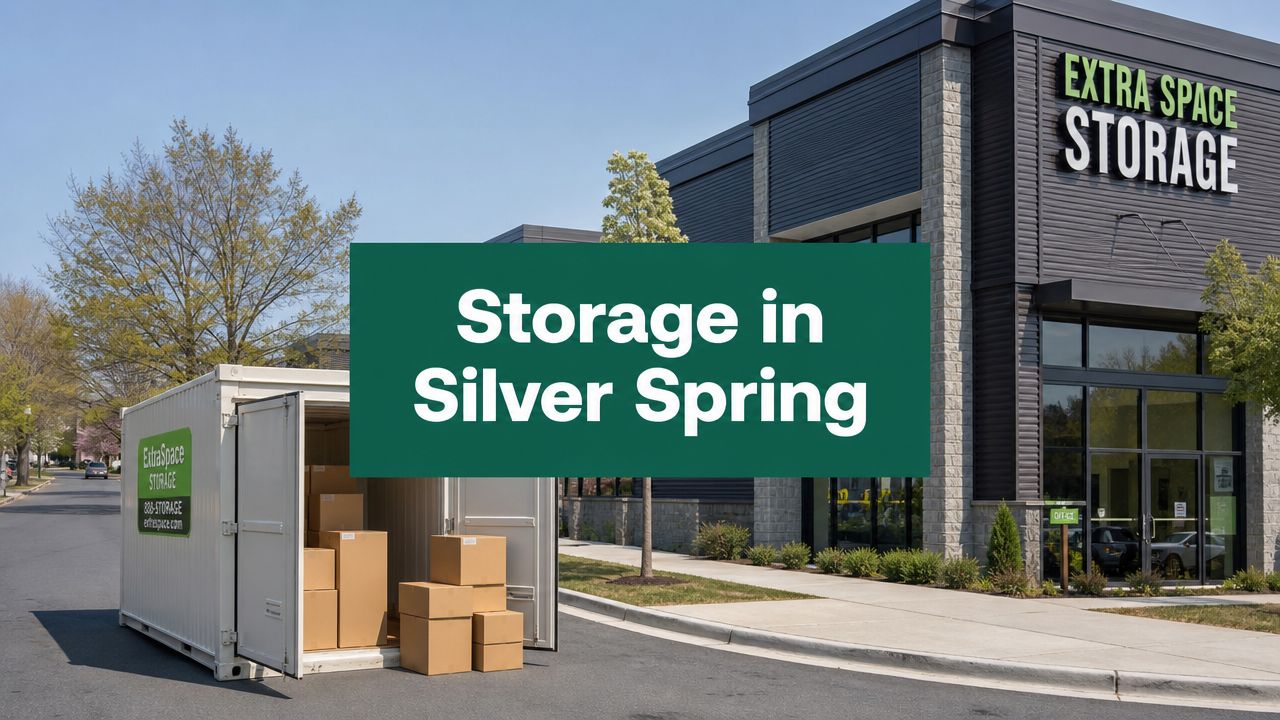
Your hallway has become a staging area. The winter coats won't fit in the closet. The extra chairs from last month's family visit are still in the corner. If you're in the middle of a move, it's worse. Boxes are stacked by the sofa, and every trip to the elevator feels like a small logistics project.
That's why storage in Silver Spring isn't just about renting the biggest unit you can afford. In a place where apartments, transitions, and tight floor plans are part of daily life, the key question is simpler: what kind of storage fits how you live?
Finding Space in a Crowded City
Silver Spring puts a lot within reach, but more space usually isn't one of those things. A compact apartment near downtown can work beautifully until your lease changes, a roommate moves out, a baby arrives, or the seasonal shuffle starts and the closets tap out.

The local demand picture explains a lot. Silver Spring has a population of 81,015 and a median age of 35.2 according to the Silver Spring market overview. In the same local context, 94% of institutional-owned units are in use, which tells you this isn't a sleepy storage market with endless empty rooms. It's a place where people regularly need overflow space during moves, apartment resets, and life transitions.
What people usually get wrong
Most guides start with unit sizes. That's useful, but it skips the harder question. Do you need square footage, or do you need less hassle?
For a Silver Spring renter, those are not the same thing. Someone storing a couch, dining table, and several large bins has one set of needs. Someone trying to get six boxes, a suitcase, and holiday decor out of a one-bedroom has another. That second person often doesn't need “a storage unit” in the traditional sense at all. They need a smarter handoff.
Local reality: In dense neighborhoods, the best storage choice often comes down to how much effort you want to spend getting your stuff there and getting it back.
A better way to think about it
The most useful way to compare storage in Silver Spring is by solution type, not just by dimensions on a price board. Some options are built for furniture-heavy moves. Others are better for short-term overflow, seasonal clothing, documents, or apartment decluttering.
If you want a broader look at how storage models have evolved beyond the old rent-a-room format, this guide to modern storage solutions is a good companion read.
Decoding Your Silver Spring Storage Options
A Silver Spring renter with no car has a different storage problem than someone clearing out a townhouse before a renovation. That is why it helps to sort options by how they fit city life, not just by square footage.
Self-storage units
Traditional self-storage is still the default product in Silver Spring. You rent a unit, bring your own lock, transport everything yourself, and keep access on the facility's schedule.
It works best for furniture, appliances, and larger mixed loads. If you are storing a sofa, bed frame, bike, and ten bins, a standard unit usually makes more sense than any pickup-based service. Extra Space's Silver Spring facility listings also show how wide the local size spread is, from small 5x5 units up to large 10x30 spaces, with asking prices rising fast as unit size increases.
The trade-off is simple. You get space and control, but you also take on the driving, loading, elevator trips, and repeat visits.
Full-service storage
Full-service storage is built for people who want less physical work. The provider picks up your items, stores them off-site, and returns them later.
For apartment dwellers, that changes the math. You may pay more per item or per month, but you avoid renting a van, borrowing a friend's SUV, or losing half a Saturday to traffic and loading docks. If you are comparing pickup storage with move-related help, this overview of moving and storage solutions is useful because it shows where those services overlap.
This option usually fits small urban households better than large home clear-outs.
Mobile storage pods
Pods are designed for people who need time to load. The container is dropped off, you pack it over a day or several days, and the company stores or moves it after pickup.
That setup works well during renovations, home sales, and larger moves. In Silver Spring apartment buildings, it can be awkward. Street parking rules, loading zones, HOA rules, and building management policies can turn a convenient idea into a logistics project. If you do not have a driveway or a reliable curbside loading area, a pod may be harder to use than it looks on paper.
Specialty and climate-controlled storage
Some belongings need a more stable environment. Paper files, photos, electronics, musical instruments, wood furniture, and certain fabrics hold up better in climate-controlled storage than in a basic unit.
For local pricing, StorageCafe's Silver Spring market page lists average rates in the area for standard and climate-controlled units, including 10x10 spaces. The practical question is not whether climate control sounds nice. It is whether the items you are storing would be expensive or frustrating to replace if heat or humidity causes damage.
For holiday decor in plastic bins, maybe not. For records, family documents, or wood furniture you plan to keep for years, often yes.
A more useful way to choose
Use the storage type that matches the job:
- Large furniture, bulky items, frequent access: Traditional self-storage
- A few boxes, soft goods, overflow from apartment living: Full-service or by-the-box storage
- Whole-home transition with time to load: Mobile pod
- Sensitive items that can warp, fade, or mildew: Climate-controlled storage
That last category matters more in cities than many guides admit. A renter in a one-bedroom often does not need a room-sized unit at all. They need pickup, smaller minimums, and a way to store a limited number of items without paying for empty floor space.
For homeowners thinking through broader household storage planning, not just urban apartment overflow, this Perth storage guide for homeowners is a useful outside perspective because it frames storage around actual living patterns, not just facility features.
A Realistic Look at Storage Costs
A Silver Spring renter clears out a hall closet, stores six boxes, and signs up for a 10'x10' unit because that is what every facility page is built to sell. The monthly rate is only the first mistake. The bigger issue is paying for far more space, and far more work, than the job requires.
The baseline numbers in Silver Spring
For traditional self-storage, larger units quickly move from "reasonable" to expensive if you are only storing apartment overflow. Earlier local pricing examples in this guide showed that 10'x10' units in Silver Spring often sit well above the cost of a small 5'x5', with climate control pushing the monthly bill higher still.
That gap matters because many city residents are not storing a couch set and a dining table. They are storing luggage, winter clothes, archived paperwork, baby gear between stages, or a few sentimental items they do not want in a small apartment. A standard unit can still work, but the pricing model is blunt. You rent square footage first and ask whether you needed it second.
For a broader pricing framework, this guide on how much storage units cost does a good job breaking down how monthly rates, unit size, and service model affect the total bill. For a shorter-term planning lens, this essential guide to storage is useful because it focuses on the cases where temporary storage sounds cheap but adds up fast.
The costs that usually get missed
The cost question is simple. How much effort are you buying along with the space?
A traditional unit often adds expenses that never appear in the promo rate:
- Transportation: gas, parking, rideshare, truck rental, or borrowing a car
- Packing supplies: boxes, tape, covers, bins, and mattress bags
- Time: loading at home, unloading at the facility, then repeating the trip later
- Overbuying space: paying for empty floor area because smaller increments are not offered
- Access constraints: gate hours, elevator waits, and the hassle of retrieving one thing from a packed unit
That is why a low advertised rate can still be the more expensive option in practice.
True Cost of Storage Comparison
| Cost Factor | Traditional Self-Storage | By-the-Box Storage |
|---|---|---|
| Monthly pricing model | Fixed fee based on unit size | Pay for the number of boxes or items stored |
| Space efficiency | Can waste money on unused space | Better fit for small-volume storage |
| Transportation | You usually move items yourself | Pickup and return are typically part of the model |
| Time commitment | Higher, especially on move-in day | Lower for small and medium storage jobs |
| Access style | Self-serve visits during facility hours | Request-based retrieval or delivery |
| Best fit | Furniture, large mixed loads, frequent hands-on access | Seasonal items, boxes, apartment overflow, lighter loads |
The practical takeaway
Storage gets cheaper when the service matches the actual problem.
If you are between leases, storing furniture, or expect to visit often, a dedicated unit can still make sense even with the extra logistics. If you live in an apartment and just need breathing room, the better question is not "What size unit should I rent?" It is "Do I need a unit at all, or do I need pickup and a smaller minimum?"
That distinction saves money in Silver Spring more often than people expect.
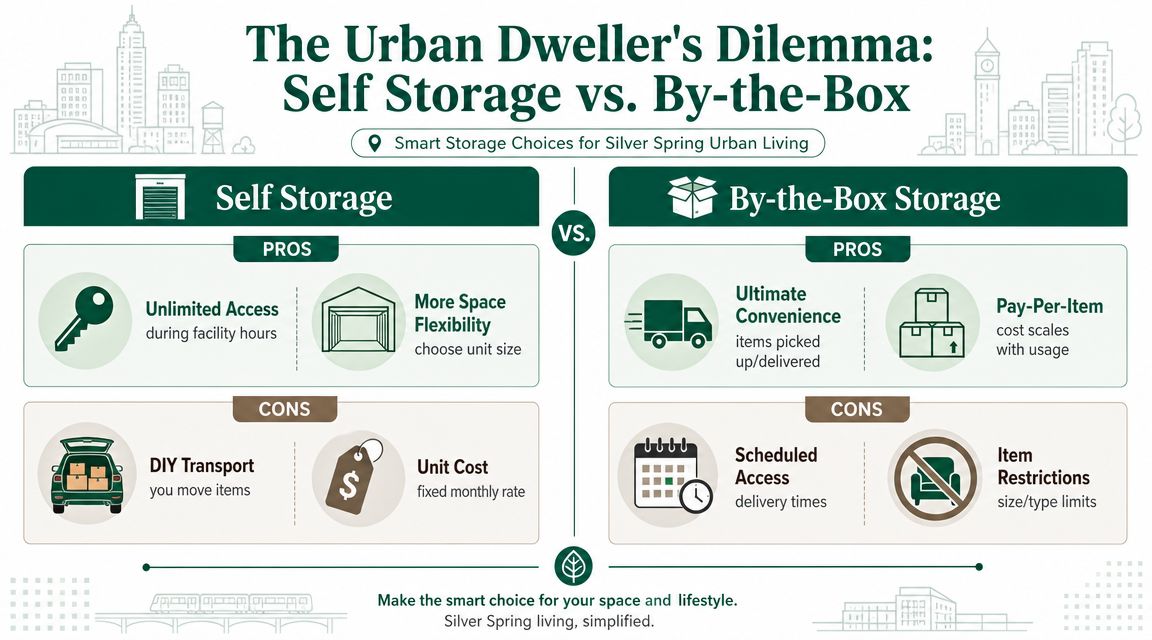
The Urban Dweller's Dilemma Self Storage vs By-the-Box
Apartment living changes the storage equation. A traditional unit might look fine on paper, but the logistics can break the deal fast if you don't have a car, don't want to spend half a day hauling things, or only need to store a handful of boxes.
Why self-storage can feel harder in practice
A lot of Silver Spring facilities are positioned along major roads, which sounds convenient until you remember what that requires. You still need to load your items, get them there, unload them, and repeat the whole process every time you need something back.
That's the mobility problem many local guides ignore. Facility pages emphasize access, unit sizes, and location, but they don't really address the burden of repeated trips for people living an urban, car-light lifestyle. That gap is called out clearly in this look at Silver Spring storage access and road-based convenience, where the practical limitation isn't vacancy. It's the friction of getting to and from the unit.
What by-the-box changes
By-the-box storage flips the model. Instead of renting a room and doing the transport yourself, you store individual boxes or small items and request them back when needed.
For city living, that solves several pain points at once:
- No car required: You're not planning storage around vehicle access.
- No oversized commitment: You don't have to rent more space than your belongings justify.
- Less apartment disruption: Boxes leave without turning your living room into a long-term staging zone.
- Better fit for seasonal overflow: This works especially well for clothing, decorations, books, documents, and keepsake bins.
Here's the trade-off. You're giving up walk-in access. If you like dropping by a unit and rummaging around whenever you want, traditional self-storage still has a clear advantage.
To see how these service-based models work in more detail, this overview of box storage online explains the operational side well.
A quick visual helps make the comparison concrete.
Which one works better for urban life
The answer depends less on square footage and more on routine.
Self-storage is stronger when you have furniture, need broad access, or expect to visit often. By-the-box storage is stronger when your main goal is to remove clutter without adding a transportation chore.
For many apartment residents, the real luxury isn't a larger unit. It's not having to make the trip at all.
If you're weighing short-term storage during a move or temporary reset, this essential guide to storage is useful because it focuses on duration, access, and logistics instead of just unit size.
How to Choose the Right Storage Solution
The best storage decision usually comes from four honest questions, not from picking the cheapest listing first. Individuals often know roughly what they want to get out of the apartment. Fewer people stop to measure whether the storage method matches the job.
Start with the real amount of stuff
Don't estimate by stress level. Inventory by category.
Separate your belongings into groups such as furniture, clothing, decor, books, paperwork, sports gear, and sentimental items. Once you do that, the mismatch becomes obvious for many renters. A lot of guides miss the micro-storage problem. With a local 10'x10' climate-controlled unit costing about $222 per month, apartment dwellers storing only a few boxes of seasonal items are often overbuying capacity, as noted in this Silver Spring storage market analysis.
Ask how often you'll need access
Some people need storage they can browse. Others just need things out of the apartment for a while.
If you'll need frequent in-person access to rotate furniture, pull records, or swap business inventory, a traditional unit is easier. If you mainly need items stored safely until a later date, a service-based model is often cleaner and less disruptive.
Be honest about transport
Many storage plans fall apart at this stage.
- You have a car and don't mind lifting: Self-storage stays in the running.
- You can borrow help for one big move: A unit or pod can still work.
- You don't want driving, loading, or multiple trips: Look harder at pickup-based options.
Match the solution to your situation
A few common Silver Spring-style scenarios make this easier:
The student between leases
You're storing clothing, bedding, books, and a few kitchen items for a break between apartments. You probably don't need a full room. A smaller-scale service usually fits better than a large unit.
The apartment dweller with seasonal overflow
Your hallway closet is full, and your next goal is to reclaim usable living space. Think in boxes, not square feet. Many tend to over-rent by overlooking this.
The household in a larger move
If you're downsizing, renovating, or combining homes, furniture volume changes the answer. Traditional self-storage or a pod often makes more sense because the load includes bulky items and irregular shapes.
The simplest decision rule
Choose the option that solves your biggest headache.
If your headache is volume, rent space. If your headache is friction, use a service. That one distinction clears up most of the confusion around storage in Silver Spring.
Pro Tips for Packing and Protecting Your Belongings
Good storage starts before the first box closes. Packing well makes retrieval easier, reduces damage risk, and saves you from the familiar “I know it's in here somewhere” problem three months later.
Pack for retrieval, not just for departure
People often pack in a rush and sort later. That almost always backfires.
Use uniform boxes when you can. They stack better, carry better, and are easier to label clearly. Label at least two sides of each box, not just the top. If you're storing similar categories, keep them grouped. Holiday decor should live together. Paperwork should stay separate from clothing. Kitchen gear shouldn't be mixed with keepsakes just because there was room.
A solid outside reference is this guide on how to pack for moving, which aligns with the same practical principle: pack so another version of you can understand it later.
Build a simple inventory
Take phone photos before sealing boxes. Then create a note on your phone or computer with box names and rough contents.
“Winter coats, scarves, boots” is useful. “Miscellaneous closet stuff” is not.
If you want a practical walkthrough focused on box prep, this article on how to pack a box for moving covers the basics well.
Think about protection and liability
Storage insurance confuses a lot of people because the terms vary. The key point is simple: don't assume your belongings are fully protected just because they're inside a facility or with a storage provider.
Check three things:
- Your renter's or homeowner's policy: See what off-premises coverage exists.
- The storage provider's coverage terms: Understand what's included and what isn't.
- Your item list: High-value items, documents, and irreplaceable keepsakes deserve extra thought.
Handle dressers and similar furniture carefully
There's one detail most general guides skip. Under the STURDY rule, free-standing clothing storage units over 27 inches tall, such as dressers, must meet specific stability standards, and when you store them they should be empty and placed securely to reduce tip-over risk according to the CPSC guidance on clothing storage units.
That matters in storage too. Don't leave drawers loaded. Don't stack heavy items on top. And don't wedge a tall dresser in a way that makes it unstable when moved or unloaded later.
Conclusion Reclaim Your Space and Simplify Your Life
The best answer for storage in Silver Spring usually isn't the biggest unit or the flashiest promo. It's the option that matches your actual life. If you're storing furniture, a traditional unit may be the right call. If you're trying to get a few boxes, seasonal items, or apartment overflow out of your way without turning it into a weekend project, a smaller and more service-driven option often makes more sense.
That's the main shift that helps. Stop comparing storage only by square footage. Compare it by effort, access, and fit. A unit can be perfectly priced and still be the wrong solution if getting there is a burden or if you're paying for space you'll never use.
Silver Spring has plenty of storage supply. The challenge isn't whether storage exists. It's choosing the version that removes stress instead of adding more of it.
When you get this right, storage stops feeling like a backup plan. It becomes a way to make your apartment easier to live in, your move less chaotic, and your daily routine less cramped. That's the true payoff. More breathing room at home, and fewer loose ends pulling at your attention.
If you want a simpler alternative to renting a whole unit, Endless Storage offers storage-by-the-box with pickup, climate-controlled storage, and return shipping that works especially well for apartment dwellers, seasonal items, and anyone who wants less hassle and more living space.
Frequently Asked Questions
Unveiling the Secrets to Effortless Storage
Endless Storage is available nationwide. You pick a plan, tell us where to pickup, and we'll send a UPS van to collect, whichever state you're in.
Your shipping label will be sent to your email within a few minutes, if not instantaneously. It can also be accessed through your customer profile.
Your box will be shipped to one of our climate controlled self storage facilities in our closest self storage facility. Our manager will accept your package, notify you that your box has been received, and securely stored. Only our managers will have access to Endless Storage boxes.
Email us at admin@endless-storage.com click to live chat with us, or send us a message below.
Never! We're committed to transparent pricing with no surprises. You'll lock in your rate with no hidden fees and no long-term contracts.
Fast access guaranteed! Your boxes will arrive at your doorstep within 48 hours of requesting them back. Need to check on delivery? We provide tracking information for complete peace of mind.
Totally flexible! Store month-to-month with no long-term commitment and cancel anytime.
Everything's online! Use your account dashboard to:
• Set up automatic monthly payments
• Request box returns
• Update your address
• Order additional boxes
• Track shipments
Your boxes are insured up to $100 each. Our customer service team will help you file any necessary claims and resolve issues quickly.
Don't worry – we'll email you right away if there's a payment issue. Your items stay safe, though you may have temporary service interruption or late fees until payment is resolved.
When you request our free storage kits, you'll have 30 days to send in your boxes to activate your 3 months of free storage. Think of it like starting a gym membership – your activation window begins when you receive your kits, and your full free trial begins once you send in your first box. During your free months, you'll experience our complete storage service at no cost.
Your 30-day activation window begins when you receive your storage kits. We'll send you an email confirmation when your kits are delivered, marking the start of your activation period.
If you haven't sent any boxes for storage within your 30-day activation window, your free trial will expire and we'll begin charging the regular monthly rate of $9.99 per box. This helps ensure our storage kits go to customers who are ready to use our service.
A box costs $9.99 per month to store (plus sales tax). This price includes free shipping for standard boxes under 50 lbs. and smaller than 16"x16"x16"
Log into your Endless Storage account, locate the box you would like returned, and simply click Return My Box.
Yes, each box stored with us is insured for up to $100 throughout transit as well as the duration of storage within our facilities.
Your box will be at your doorstep within 48 hours of you requesting it back.
Store 10+ boxes? We'll pick them up for free! After your purchase, we'll contact you to schedule a convenient pickup time and arrange UPS collection.
We trust UPS with all shipments, and every box includes $100 insurance coverage. You'll receive tracking information to monitor your items' journey.
Yes! Visit any of our locations by appointment. Just bring a photo ID matching your customer profile.
For everyone's safety, we can't store hazardous materials, firearms, or perishables. All items must fit within our standard boxes.
It's easy! Order your storage kit online, and we'll ship it to you within 1-2 business days. Your shipping labels will be emailed instantly and available in your account.
We're here to help! Email us at admin@endless-storage.com, use our live chat, or send us a message through your account.
To cancel your storage service with Endless Storage, please email your cancellation request to admin@endless-storage.com. Our team will process your request within 2 business days and confirm your cancellation via email.
We understand packing takes time. However, to maintain your free trial benefits, you'll need to send at least one box within the 30-day activation window. If you need more time, you can always start with one box to activate your trial and send the rest later. You can always reach out to admin@endless-storage.com if you have any issues or concerns.
When you request our free storage kits, you're starting a 30-day window to begin using our storage service.
Important: To activate your free trial, send at least one box for storage within 30 days. If no boxes are sent within this 30-day window, a one-time $50 fee applies to cover materials and shipping costs. This fee is clearly disclosed before you sign up.
Think of it like reserving a hotel room – we're setting aside space and sending specialized packing materials for your use. The fee only applies if you request materials but don't begin storage, similar to a hotel's no-show charge.