When you start shopping for self-storage, the first number you'll likely see is a national average. Right now, that figure is about $132 per month for a standard unit. But honestly, that number is just a starting point.
Think of it like buying a car—the base model price is never what you actually pay. The final cost really depends on where you live, how much space you need, and what features you choose, like climate control. Understanding what drives these costs is the key to not overpaying.
What Do Self Storage Rates Look Like In 2026?
Jumping into the search for a storage unit can feel a little wild, with prices all over the map. To give you a solid financial baseline, let’s look at what you can typically expect to pay per month in 2026 for the most common unit sizes across the U.S. This will help you get your budget in order before we dig into the specific things that make prices go up or down.
This quick chart breaks down the average monthly rent for small, medium, and large units.
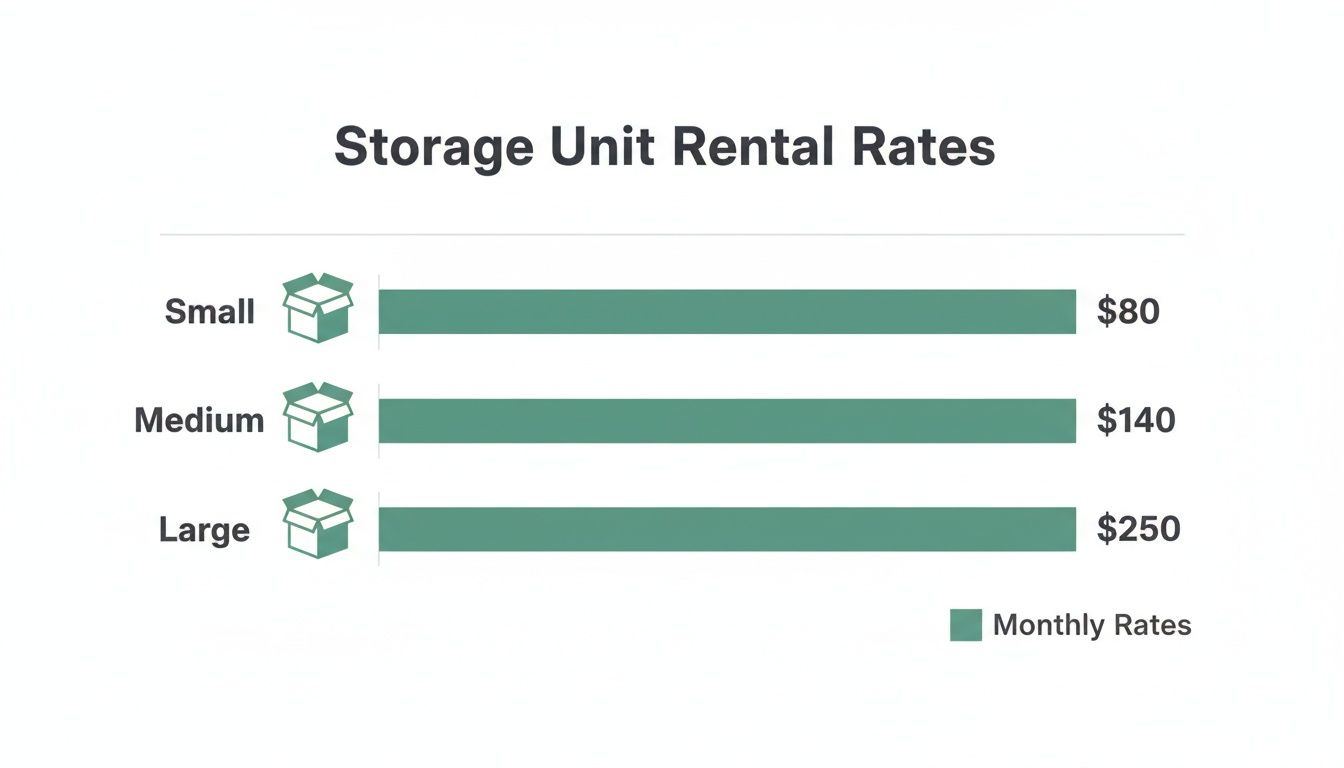
As you can see, jumping from a small to a large unit isn't a small price hike. It’s a good reminder that picking the right-sized unit is one of the biggest ways to keep your storage bill under control.
To give you a more detailed picture, here’s a quick reference guide to the average monthly costs for common self-storage sizes across the United States. Keep in mind, these prices are just estimates and can shift based on your city and the features you add.
2026 National Average Self Storage Rates By Unit Size
| Unit Size | Dimensions (Approx.) | What It Fits | Average Monthly Rate (Non-Climate Controlled) | Average Monthly Rate (Climate Controlled) |
|---|---|---|---|---|
| Small | 5’ x 5’ to 5’ x 10’ | Boxes, small furniture, contents of a walk-in closet | $60 - $90 | $75 - $115 |
| Medium | 10’ x 10’ to 10’ x 15’ | Contents of a one or two-bedroom apartment | $110 - $170 | $140 - $220 |
| Large | 10’ x 20’ to 10’ x 30’ | Contents of a multi-bedroom house, including appliances | $200 - $300 | $260 - $390 |
This table shows just how much extra features, especially climate control, can add to your monthly bill. Always weigh whether you truly need those add-ons for what you're storing.
National Averages and Market Trends
The storage market is always moving, and recent trends show just how much rates can change. By February 2026, the national average for a standard unit settled at $132 per month. That's actually a 0.8% drop from the year before—the first time we've seen an annual decline in three years. Just back in September 2025, that same unit would have averaged $136.
This kind of fluctuation is exactly why predictable, per-box storage services like Endless Storage, with plans starting at just $7.99 per box per month, are becoming so popular. You’re not exposed to the whims of the real estate market.
These price shifts are tied to everything from local demand and new construction to the broader economy. While a national average is a good starting point, where you live matters most. A 10x10 unit in downtown San Francisco will always cost more than the same size unit in a small town. Looking internationally? This guide on the self storage Sydney cost gives a great breakdown of what to expect in another major city in 2026.
Why Do Rates Vary So Much?
Getting a handle on why prices differ is the first step to becoming a smart shopper. It really boils down to a few key things:
- Unit Size: This one’s simple—more space costs more money. The trick is to figure out exactly how much room you need so you don't end up paying for empty air.
- Location: Convenience has a price. Facilities in busy urban centers with high demand will always be more expensive than those out in the suburbs or rural areas.
- Special Features: Amenities like climate control are essential for protecting electronics, wood furniture, or artwork from extreme heat and humidity, but they can raise your monthly bill by 20-30%. Drive-up access and extra security features also add to the final cost.
Once you know how these factors play into the final price, you're in a much better position to choose a unit that works for you. For a deeper dive into what goes into the final number on your bill, check out our complete guide on https://www.endless-storage.com/blog-posts/how-much-are-storage-units.
The Key Factors That Drive Self Storage Rates
Ever wonder why one storage unit costs twice as much as a nearly identical one just a few miles down the road? The price on your rental agreement is never a random number; it’s shaped by a handful of key factors. Getting a handle on these drivers is your best bet for finding a unit that fits your stuff without breaking your budget.
Think of it like buying a car. You don't just pay for the basic model—the final price tag is a mix of the engine size, trim level, and any extras you tack on. Self-storage pricing works the exact same way. Once you understand the five core components of a unit's cost, you can decide which features are must-haves and which are just nice-to-haves.
Unit Size: The Foundation of Your Cost
This one is the most obvious, but it’s where many people make their first mistake. Just like a three-bedroom apartment costs more than a studio, a bigger storage unit will always have a higher monthly rate. The problem is, it's incredibly easy to overestimate how much space you actually need, leaving you paying for empty air month after month.
Before you even start looking, take the time to inventory your items. It’s the only way to be sure you’re paying for the square footage you’ll actually use. It's also worth noting that while a bigger unit has a higher total price, the cost per square foot often goes down as the unit size goes up.
Location: Convenience Comes at a Premium
More than anything else, location dictates what you’ll pay for self-storage. It all comes down to the old real estate mantra: location, location, location. A facility in a dense, high-demand urban center like downtown Chicago or Manhattan will always be more expensive than one in a quiet suburb or rural town.
Keep these location-based dynamics in mind:
- Urban vs. Suburban: A unit in a city center can easily cost 30-50% more than the exact same size unit just 20 miles out of town.
- Proximity to Neighborhoods: Facilities in affluent or fast-growing neighborhoods tend to charge more simply because demand is higher.
- Highway and University Access: Units near major highways or college campuses also see price hikes, especially during the peak moving seasons of late spring and summer.
If you're on a tight budget, just expanding your search radius by a few miles can often lead to some serious savings.
Climate Control: An Insurance Policy for Your Valuables
Climate control is one of the most common—and impactful—add-ons you’ll see. A climate-controlled unit maintains a stable temperature and humidity level, usually somewhere between 55 and 80 degrees Fahrenheit. This feature is less about comfort and more like an insurance policy for your sensitive belongings.
Key Insight: Climate control isn't just about comfort; it's about preservation. It prevents wood from warping, electronics from corroding, and photos or documents from yellowing due to extreme heat, cold, or humidity.
While this feature can bump up your monthly bill by 20-30%, it's absolutely non-negotiable for items like:
- Wooden furniture, musical instruments, and antiques
- Electronics, computers, and media (DVDs, vinyl records)
- Artwork, photographs, and important documents
- Upholstered items and delicate clothing
If you're only stashing things that can handle temperature swings—like garden tools, plastic bins of clothes, or patio furniture—you can save a good chunk of change by sticking with a standard, non-climate-controlled unit.
Access and Other Premium Features
How easily you can get to your belongings also plays a role in the final price. Think of it like a parking garage—that reserved spot right by the elevator is going to cost more than one on the top floor.
- Ground-Floor vs. Upper-Floor: Ground-floor units, especially those with drive-up access, are the most expensive because they offer maximum convenience. You can pull your car or truck right up to the door to load and unload without dealing with elevators or long hallways.
- 24/7 Access: Some facilities offer round-the-clock access for an extra fee. If standard business hours work for your schedule, you can skip this added cost.
This convenience factor is why it's so important to think about how you plan to use your storage, not just what you're storing. For a deeper dive into how these features affect your bill, our guide on the true price of a storage unit offers more insights.
Finally, remember that the overall market plays a huge role. For instance, in a recent October, the average self-storage price in the U.S. fell to $88.93 per month—a 17.7% drop from the previous year. This was directly tied to a slowdown in the housing market, which caused occupancy to fall and forced facility operators to lower rates to attract new customers.
Avoiding Hidden Fees And Seasonal Price Hikes
That great price you see advertised for a storage unit? It's rarely the full story. Think of it like booking a flight—the base fare looks like a steal, but the final cost after taxes and fees can be a whole different number. Getting a handle on these extra costs is the key to budgeting accurately and avoiding any sticker shock on moving day.
The advertised monthly rent is really just the starting point. Most storage facilities have a few standard, one-time charges that can catch you off guard if you’re not prepared. They aren't always "hidden," but they can be buried in the fine print.
Uncovering Common One-Time Fees
Before you even think about signing a rental agreement, you need to ask about any and all upfront costs. They usually fall into a few common categories.
- Administrative Fee: This is a one-time charge for setting up your account, which usually runs between $20 and $30.
- Security Deposit: While they’re becoming less common, some places still ask for a refundable deposit. You'll get it back when you move out, as long as the unit is clean and undamaged.
- Mandatory Insurance: Nearly all facilities require you to have insurance for your belongings. While some will accept your existing homeowner's or renter's policy, many insist you buy their plan, which can add $10 to $25 to your monthly bill.
- Required Lock: You’ll definitely need a lock, and many facilities require you to purchase one directly from them to ensure it meets their security standards.
These initial fees can easily add $50 or more to your move-in total, so make sure you factor them into your budget from the very beginning.
How Seasons Affect Self Storage Rates
Just like hotel prices climb during holiday weekends, self-storage rates shift with seasonal demand. If you have some flexibility, timing your rental can be one of the best ways to lock in a lower price.
Key Takeaway: Peak moving season, which runs from late spring through summer, is the most expensive time to rent a storage unit. Demand goes through the roof as college students head home and families relocate, giving facilities the power to raise their rates.
Here's a quick look at how the seasons stack up:
- Summer (High Season): This is the busiest time of year for storage. Expect to find the highest rental rates and very few promotions.
- Late Spring & Early Fall (Shoulder Season): Prices are often more moderate as demand starts to pick up or wind down. You might find some good deals around May or September.
- Winter (Low Season): From November to February, demand hits its lowest point. This is hands-down the best time to find discounts, move-in specials, and lower base rates.
If you can wait until the off-season, you could save a good chunk of change every month. For a deeper dive into everything that makes up the total cost, check out our article on the real price of storage. By understanding both the extra fees and the seasonal price swings, you can walk into your rental with a much clearer financial picture.
Rethinking Storage With A By-The-Box Model

What if you could stop paying for all that empty air in your storage unit? With traditional self storage, you rent a whole room—a 5x5, a 10x10, or even larger—no matter how much stuff you actually have. That often means paying a hefty monthly fee for a unit that’s half-empty.
Think of it like an old, expensive unlimited data plan. You paid a premium every month, even if you only used a tiny fraction of the data. The by-the-box model is the storage world’s answer to modern, flexible cell phone plans where you only pay for what you use.
The Shift To On-Demand Storage
This newer approach flips the old model on its head, focusing on flexibility and pure convenience. Instead of renting a fixed amount of square footage, you simply pay per item or per box. It’s the perfect fit for anyone who doesn’t need to store big furniture but has plenty of boxes, bins, and smaller belongings.
Services like Endless Storage have this process down to a science. The whole system is designed to get rid of the classic storage headaches—no more renting a truck, hauling heavy items, or playing a frustrating game of Tetris to fit everything in.
The process is refreshingly simple:
- Boxes Come to You: We deliver durable, high-quality storage boxes right to your doorstep. No last-minute runs to the store for supplies.
- Pack on Your Own Time: Take as long as you need to pack your things, whether it's seasonal clothes, holiday decorations, or important documents.
- We Pick It Up: Once your boxes are packed and ready, just schedule a pickup. We’ll take them directly from your home to a secure, climate-controlled facility.
This "valet" style of storage means you never have to set foot in a storage facility again. When you want something back, you just request it online, and that specific box is delivered right back to you.
Why Pay-Per-Item Makes Financial Sense
The biggest win with the by-the-box model is how much it can save you. With traditional self storage, you’re stuck with a fixed monthly rate. If you rent a 10x10 unit for $120 a month but only fill half of it, you’re essentially throwing away $60 every single month on empty space.
Key Insight: By-the-box storage services eliminate the cost of unused space. You pay only for the volume you occupy, which can lead to huge savings, especially for city dwellers or anyone with a smaller amount of stuff.
This model is a game-changer for people in cities like Chicago or New York, where small apartments and high living costs make every square foot of personal space a precious commodity. It's also perfect for college students storing things over the summer, movers stuck between homes, or anyone who just wants to declutter without a big commitment.
For instance, storing a few boxes of winter coats and old photos doesn't really justify renting an entire unit. With plans starting as low as $7.99 per box, the by-the-box model is a much more logical and affordable way to go. If this sounds like it might work for you, you can learn more about how to rent a storage box.
To make it even clearer, let's break down the fundamental differences between these two approaches side-by-side.
Traditional Self Storage vs. Endless Storage By-The-Box
This table gives you a quick side-by-side comparison of the two main storage models, helping you decide which is a better fit for your needs and budget.
| Feature | Traditional Self Storage | Endless Storage (By-The-Box) |
|---|---|---|
| Pricing Model | Fixed monthly rate for a specific unit size. | Pay-per-box or per-item monthly rate. |
| Space Efficiency | Often results in paying for unused, empty space. | You only pay for the exact volume you store. |
| Convenience | You are responsible for packing, transporting, and organizing items. | Boxes are delivered and picked up from your door. |
| Accessibility | Direct, physical access to your unit during facility hours. | Items are retrieved by request and delivered back to you. |
| Ideal User | Storing large furniture, appliances, or the contents of a full house. | Storing boxes, seasonal items, and smaller belongings. |
Ultimately, choosing between a traditional unit and a by-the-box service comes down to what you’re storing and what you value most. Is it direct, physical access? Or is it ultimate convenience and cost efficiency? Your answer will point you in the right direction.
Actionable Ways to Lower Your Storage Bill
Knowing what goes into a self-storage quote is one thing. Using that knowledge to actually shrink your monthly bill is another. The good news is you don't have to just accept the first price you're given. A few smart moves can put you back in control of your expenses.
Think of it like you're shopping for anything else. You wouldn't buy the first car you see without comparing prices or looking for a deal. Applying that same savvy shopper mindset to storage can save you a surprising amount of money.
Start by Rightsizing Your Needs
The single biggest mistake people make is paying for space they never end up using. Before you even start looking for a unit, get serious about decluttering. Go through everything and decide what you truly need to store.
Once you have your final pile of belongings, you can get a much better estimate of the space you’ll need. This simple step keeps you from renting a larger, more expensive unit "just in case." You’ll save money upfront and have less stuff to deal with later.
Shop Around Strategically
Now that you know what size you need, it’s time to start shopping. Don't just pick the storage facility closest to your house. Sometimes, expanding your search by just a few miles can slash your monthly rate, especially if you look in a more suburban area instead of a dense city center.
When you compare facilities, keep an eye out for these money-saving opportunities:
- Move-In Specials: Many places offer the "first month free" or 50% off the first three months. These deals can make a big difference in your initial costs.
- Online Promotions: You can often find special rates by booking your unit online that aren't advertised if you just walk in.
- Time Your Rental: If you have flexibility, try renting during the off-season (usually the winter months). Demand is lower, so facilities are more likely to offer discounts to fill their units.
Question Every Premium Feature
Storage facilities love to upsell premium features, but you don't always need them. Think carefully about whether the extra cost is actually worth it for the items you're storing.
For instance, do you really need 24/7 access if you only plan to stop by during regular business hours? If you're storing old patio furniture and plastic bins that won't be harmed by temperature changes, you can save a lot by skipping the climate-controlled unit.
The self-storage market has been on a rollercoaster, heavily influenced by investor activity. From 2020 to 2022, transaction volume shot up to nearly $50 billion. As the market cooled, peak occupancy rates have since fallen from 92% to 87%, forcing storage operators to get more competitive with their pricing.
This market shift means prices aren't set in stone. That gives you, the customer, more power to find a good deal.
Think Outside the Traditional Unit
Sometimes the best way to save money is to change the game completely. If you’re mostly storing boxes, clothes, and other small items, a traditional self-storage unit might be more than you need.
Instead, consider these alternatives:
- Share a Unit: Team up with a friend or family member who also needs storage and split the cost of a larger unit. The price per square foot is often lower for bigger units, so you both save.
- Use a By-The-Box Service: For anyone not storing furniture, a service like Endless Storage is a perfect fit. You only pay for the boxes you store, completely cutting out the cost of unused space.
By ditching the one-size-fits-all approach, you can find a solution that’s perfectly scaled to what you actually need and what you want to spend. Not sure how much you could save with a by-the-box model? Our Endless Storage Savings Calculator can give you a quick estimate.
Is By-The-Box Storage Right For You
So, you’re weighing your options: a classic self-storage unit or one of the newer by-the-box services? The truth is, there’s no single best answer. Each approach has its own perks, and the right choice really boils down to what you’re storing and what you value most—total control or total convenience.
To figure out what’s right for you, let’s walk through a quick checklist. Answering these questions will help clarify whether a traditional unit or a service like Endless Storage makes the most sense for your situation.
What Are You Storing?
First things first, take a quick inventory of your stuff. Are you looking to store the entire contents of a one-bedroom apartment, complete with a sofa, mattress, and dining room set? If you’ve got large, bulky furniture, a traditional storage unit is probably your best move. You’ll need that open square footage to fit everything.
But if your items are more modular, a by-the-box service is where it’s at. This model is practically designed for things like:
- Boxes of off-season clothes and holiday decorations
- Old documents, stacks of books, or photo albums
- Sentimental keepsakes and your kids' old toys
- Small kitchen appliances or extra sets of bedding
If it fits in a box, you're the perfect fit for by-the-box storage. You pay only for the space your boxes occupy, which means no more paying for a half-empty unit you’re not even using.
How Important Is Convenience?
Next, think about the actual work involved. With a traditional unit, you’re in charge of the entire process. That means renting a truck, hauling everything down the stairs, playing Tetris to load it all, driving to the facility, and then unloading it all again. It can easily turn into a full weekend project.
Key Consideration: By-the-box storage is built around a "hands-off" philosophy. The service does all the heavy lifting for you—from dropping off empty boxes right at your door to picking them up and taking them to a secure facility.
If your main goal is to save time and skip the physical labor, the valet-style service is a game-changer. It’s an especially great fit for anyone living in a busy city, people without a car, or frankly, anyone who’d rather not spend their Saturday hauling boxes. Everything is managed online, effectively bringing the storage to you.
What Kind of Access Do You Need?
Finally, how often will you need to get to your things? Do you need to be able to pop over to your unit on a whim to grab a single item? If you require frequent, unscheduled access to everything you own all at once, then a traditional unit is really the only option that provides that kind of instant, physical access.
On the other hand, if you’re stashing away items you won't touch for months—like your winter ski gear during the summer or dorm room stuff over a break—the by-the-box model is a perfect match. When you do need something back, you just go online, request the specific box you want, and it gets delivered right to your door. It’s scheduled access, but it's a small trade-off for huge gains in convenience and cost savings.
Frequently Asked Questions About Self Storage Rates
When it comes to storage, pricing is always top of mind. Let’s tackle some of the most common questions we hear to help you get a clear picture of the costs involved and make a decision you feel good about.
What Is A Reasonable Price For A 10x10 Storage Unit?
The 10x10 unit is easily the most popular size, so it’s a great benchmark for understanding storage prices. For a standard 10x10 unit without climate control, a reasonable monthly rate is typically between $110 and $170.
If you need a climate-controlled 10x10, you can expect to pay a bit more, usually in the range of $140 to $220 per month. Keep in mind that location is everything. A unit in a major city like Chicago or Los Angeles could push past $200, while the same size in a suburb might dip under $100.
Can I Negotiate Self Storage Rates?
Yes, you can often negotiate rates, but it's not a sure thing. The best time to try is during the winter off-season. Demand is lower, and facilities are more motivated to fill their empty spaces.
You'll have more bargaining power if you’re willing to prepay for a few months upfront or if you're renting a larger, less common unit size. Don’t hesitate to ask about any unadvertised specials or if they’ll match a competitor's offer. The worst they can do is say no, but a simple question might save you a lot of money each month.
When Is By-The-Box Storage Cheaper Than A Unit?
By-the-box storage is almost always the cheaper route if you aren't storing large furniture. It’s a pay-for-what-you-use model, which makes it the smarter financial choice in a few common situations:
- You’re only storing boxes: If you just need to clear out seasonal clothes, documents, books, or keepsakes, you’ll save a ton by not renting an entire room.
- You have a small number of items: For anyone storing fewer than 10-15 boxes, a traditional unit just doesn't make financial sense.
- You live in an expensive city: In high-cost urban areas, even the smallest 5x5 unit can be surprisingly pricey. By-the-box services provide a much more affordable alternative.
Key Takeaway: If you don't need to store a couch or a mattress, you probably don't need a full-size storage unit. By-the-box services eliminate the cost of paying for empty, unused space.
To get a fuller picture of the different storage types and how they can affect pricing, it’s worth diving into a comprehensive guide like this Complete Self-Storage Options Handbook. Understanding all your choices is the best first step toward making a smart financial decision for your specific needs.
Ready to stop paying for empty space and start storing smarter? With Endless Storage, you only pay for the boxes you store, with pickup and delivery right from your door. See how much you can save and get started at https://www.endless-storage.com.
Frequently Asked Questions
Unveiling the Secrets to Effortless Storage
Endless Storage is available nationwide. You pick a plan, tell us where to pickup, and we'll send a UPS van to collect, whichever state you're in.
Your shipping label will be sent to your email within a few minutes, if not instantaneously. It can also be accessed through your customer profile.
Your box will be shipped to one of our climate controlled self storage facilities in our closest self storage facility. Our manager will accept your package, notify you that your box has been received, and securely stored. Only our managers will have access to Endless Storage boxes.
Email us at admin@endless-storage.com click to live chat with us, or send us a message below.
Never! We're committed to transparent pricing with no surprises. You'll lock in your rate with no hidden fees and no long-term contracts.
Fast access guaranteed! Your boxes will arrive at your doorstep within 48 hours of requesting them back. Need to check on delivery? We provide tracking information for complete peace of mind.
Totally flexible! Store month-to-month with no long-term commitment and cancel anytime.
Everything's online! Use your account dashboard to:
• Set up automatic monthly payments
• Request box returns
• Update your address
• Order additional boxes
• Track shipments
Your boxes are insured up to $100 each. Our customer service team will help you file any necessary claims and resolve issues quickly.
Don't worry – we'll email you right away if there's a payment issue. Your items stay safe, though you may have temporary service interruption or late fees until payment is resolved.
When you request our free storage kits, you'll have 30 days to send in your boxes to activate your 3 months of free storage. Think of it like starting a gym membership – your activation window begins when you receive your kits, and your full free trial begins once you send in your first box. During your free months, you'll experience our complete storage service at no cost.
Your 30-day activation window begins when you receive your storage kits. We'll send you an email confirmation when your kits are delivered, marking the start of your activation period.
If you haven't sent any boxes for storage within your 30-day activation window, your free trial will expire and we'll begin charging the regular monthly rate of $9.99 per box. This helps ensure our storage kits go to customers who are ready to use our service.
A box costs $9.99 per month to store (plus sales tax). This price includes free shipping for standard boxes under 50 lbs. and smaller than 16"x16"x16"
Log into your Endless Storage account, locate the box you would like returned, and simply click Return My Box.
Yes, each box stored with us is insured for up to $100 throughout transit as well as the duration of storage within our facilities.
Your box will be at your doorstep within 48 hours of you requesting it back.
Store 10+ boxes? We'll pick them up for free! After your purchase, we'll contact you to schedule a convenient pickup time and arrange UPS collection.
We trust UPS with all shipments, and every box includes $100 insurance coverage. You'll receive tracking information to monitor your items' journey.
Yes! Visit any of our locations by appointment. Just bring a photo ID matching your customer profile.
For everyone's safety, we can't store hazardous materials, firearms, or perishables. All items must fit within our standard boxes.
It's easy! Order your storage kit online, and we'll ship it to you within 1-2 business days. Your shipping labels will be emailed instantly and available in your account.
We're here to help! Email us at admin@endless-storage.com, use our live chat, or send us a message through your account.
To cancel your storage service with Endless Storage, please email your cancellation request to admin@endless-storage.com. Our team will process your request within 2 business days and confirm your cancellation via email.
We understand packing takes time. However, to maintain your free trial benefits, you'll need to send at least one box within the 30-day activation window. If you need more time, you can always start with one box to activate your trial and send the rest later. You can always reach out to admin@endless-storage.com if you have any issues or concerns.
When you request our free storage kits, you're starting a 30-day window to begin using our storage service.
Important: To activate your free trial, send at least one box for storage within 30 days. If no boxes are sent within this 30-day window, a one-time $50 fee applies to cover materials and shipping costs. This fee is clearly disclosed before you sign up.
Think of it like reserving a hotel room – we're setting aside space and sending specialized packing materials for your use. The fee only applies if you request materials but don't begin storage, similar to a hotel's no-show charge.