

You’ve had the same conversation more than once already.
One of you says it makes no sense to keep paying for two places. The other starts arranging the couch, the coffee maker, the dog bed, and the bookshelf that cannot fit in a one-bedroom apartment. Then the exciting part of moving in together collides with the practical part. Two homes are about to become one, and nobody has yet decided what happens to the extra dishes, the duplicate desk chair, or the boxes of keepsakes under the bed.
That gap is where most couples get stuck. Relationship advice covers commitment, communication, and conflict. It says far less about combining two full sets of belongings, especially when you’re dealing with city apartments, limited closets, and zero appetite for making permanent decisions under stress.
The Excitement and Practicalities of Moving in Together
Moving in together is common enough now that the emotional milestone can feel obvious, while the physical logistics catch people off guard. According to recent Census Bureau data, 80% of marriages formed between 2020 and 2022 were preceded by cohabitation (Bowling Green State University). Many couples are making this move. Fewer are getting useful guidance on how to merge homes without creating unnecessary friction.
The first mistake is treating the move like a standard apartment move. It isn’t. You are not just packing boxes and forwarding mail. You are combining routines, furniture, sentimental items, and financial habits into one address.
That changes the planning completely.
If you’re in the stage where the relationship feels solid but the logistics feel messy, practical checklists help. A grounded resource on moving in together can help you think through timing, packing, and what makes a shared move smoother than a solo one.
What usually feels harder than expected
A few pain points show up fast:
- Duplicate essentials: Two toasters, two vacuum cleaners, three sets of pans, and only one kitchen.
- Uneven space: One person may be moving into a furnished apartment while the other is giving up more.
- Sentimental clutter: The item is not useful, but getting rid of it feels loaded.
- Decision fatigue: Small choices pile up until everything starts to feel personal.
Tip: If every object starts to feel symbolic, pause the conversation and return to the actual constraint. Space, function, budget, or timing.
The emotional side of moving can spike even when the relationship is healthy. If the process already feels heavy, this piece on anxiety about moving is worth reading before the packing starts.
A better way to think about the move
Treat this as a shared operations project. That sounds unromantic, but it works.
You need three things before you tape the first box shut. Agreement on what the move means, a simple money plan, and a method for deciding what enters the new home. Couples who skip those steps end up arguing about lamps when the core issue is ownership, fairness, or unspoken expectations.
Your Pre-Move Playbook for Conversations and Paperwork
Before boxes, before movers, before lease signatures, sit down at a table and clear three topics: relationship expectations, money, and paperwork.

Get aligned on what this move means
A shared address does not mean shared expectations.
Couples need plain language here, not vague reassurance. Ask direct questions. Are you treating this as a practical next step, a test run, a long-term partnership move, or a step toward marriage? If one person sees the move as convenience and the other sees it as a clear commitment path, the mismatch will show up later in household decisions.
That matters because timing and intent are not trivial. Research shows that couples who cohabited before engagement face a 48% higher likelihood of divorce compared to those who cohabited after engagement, a pattern described as the pre-engagement cohabitation effect (Institute for Family Studies). The practical takeaway is not “don’t move in together.” It is “do not let logistics make the relationship decision for you.”
A few useful prompts:
- Commitment timeline: What do each of us think this move points toward?
- Exit honesty: If living together does not work, how would we handle it?
- Privacy needs: What does alone time look like inside a shared home?
Build the money agreement before the first bill arrives
Rent is only the obvious category. The primary friction comes from the smaller and less glamorous items. Groceries. Household supplies. Internet. Streaming services. Replacing a broken shelf. Buying a second desk because both of you work from home.
If one person owns the apartment, that creates another layer. Will the other person pay a fixed amount, split variable costs, or contribute through furnishings and recurring expenses? Name that now.
Use one shared document and write it down. If you still have admin tasks hanging over you, keep a clean checklist for how to change address when moving so the official updates do not get lost in the relationship conversation.
Financial Transparency Checklist
| Topic Area | Discussion Point | Our Agreement |
|---|---|---|
| Housing | Rent or housing contribution, due date, transfer method | |
| Utilities | Electricity, internet, water, gas, who manages each account | |
| Groceries | Split evenly, alternate purchases, or category-based approach | |
| Furniture | What comes from each person, what stays personal property | |
| Shared purchases | Approval threshold and payment method for new household items | |
| Emergency costs | How to handle repairs, deposits, or sudden moving expenses | |
| Storage and overflow | Who pays if some belongings need to be stored elsewhere |
Tip: “Fair” does not always mean “50/50.” Fair means both people understand the method and agree to it.
Handle the unsexy paperwork
If you are signing a new lease together, read every line together. If one person is moving into the other’s place, check the lease rules, building policies, guest limits, and any notice requirements.
Also consider a simple cohabitation agreement, especially if one person is bringing in more furniture, paying more of the housing cost, or storing higher-value personal property off-site. It does not have to be dramatic. It just needs to answer basic questions: what belongs to whom, how bills are handled, and what happens if the arrangement ends.
Most conflict in shared living starts where assumptions were never documented.
The Great Consolidation How to Declutter as a Couple
Moving in together becomes tangible at this stage. You are standing in front of two coffee tables, four frying pans, six sets of sheets, and one apartment floor plan that suddenly feels very small.
Existing guidance talks around this point. It focuses on emotional readiness while skipping the hard part of merging possessions, even though that is a major pain point for people in small spaces (ReachLink on moving in together and cohabitation).
A visual checklist helps when the decisions start blurring together.
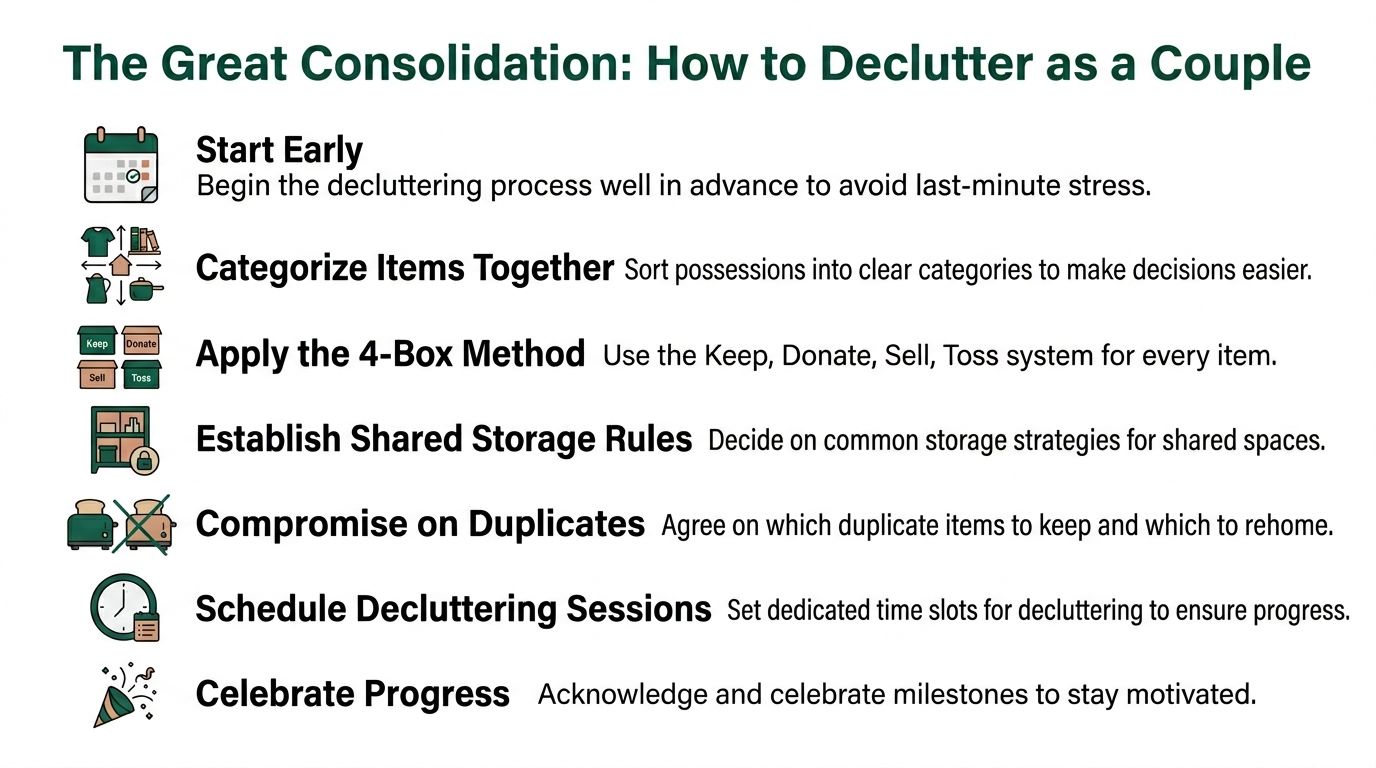
Use the four-box method for every category
Do not declutter by mood. Declutter by category.
Set up four destinations for each round: Keep, Store, Sell/Donate, Discard. Then work one category at a time. Kitchenware first. Books next. Bedding after that. When couples jump from closet to kitchen to decor, they burn energy and lose the thread.
A practical guide to decluttering before moving can help you map this process before you start pulling everything out.
Here’s the rule that keeps it manageable:
- Keep: Items that fit the new home and serve a clear purpose now.
- Store: Useful or meaningful items that do not fit the current layout.
- Sell/Donate: Good-condition items that add no value to the shared setup.
- Discard: Broken, expired, mismatched, or never-used items.
Decide duplicates with a neutral standard
Duplicates cause more arguments than big furniture because they seem small but carry ownership baggage.
Use a neutral filter:
- Best condition wins
- Most functional wins
- Best size for the new space wins
- If tied, the easier item to replace leaves
That keeps the discussion grounded in the apartment, not the ego.
Say you have two blenders. One is newer, one has sentimental history because it came from a first apartment after college. Keep the better blender for the kitchen. Put the sentimental one in storage if it matters enough. Do not force a symbolic argument into a practical slot.
Make room for sentimental items without letting them run the floor plan
Not every item deserves shelf space, but some items deserve respect.
Couples get stuck here. One person sees clutter. The other sees memory, family history, or a part of identity. The wrong move is dismissing the attachment. The better move is assigning the item a category without trying to resolve its emotional meaning in the same conversation.
Useful language sounds like this:
- “I get why this matters to you. I just don’t think it needs to live in the living room.”
- “This doesn’t fit our current apartment, but I’m not asking you to get rid of it.”
- “Can we separate ‘not now’ from ‘never’?”
Later in the process, a short reset helps. This video is a good companion if you need motivation to keep the sort moving without turning it into a fight.
Key takeaway: The shared home should be built around current function first. Memory items can still matter without taking over active space.
Set rules for shared storage inside the home
Couples declutter well and then ruin the result by leaving storage rules vague.
Pick these in advance:
- Entryway rule: What can stay visible near the door.
- Bathroom rule: How many backup products stay under the sink.
- Closet rule: Whether shelf space is split evenly or by actual use.
- Kitchen rule: Which cabinets are shared, which are personal.
A home feels calmer when storage choices are predictable.
Smart Storage Solutions for a Seamless Transition
After the decluttering session, you will still have a pile that does not belong in the apartment but also should not be forced into a donate bin. That is normal.
Storage transitions from a last resort to a smart buffer at this point. Not a place to dump random boxes. A place to buy time for better decisions.
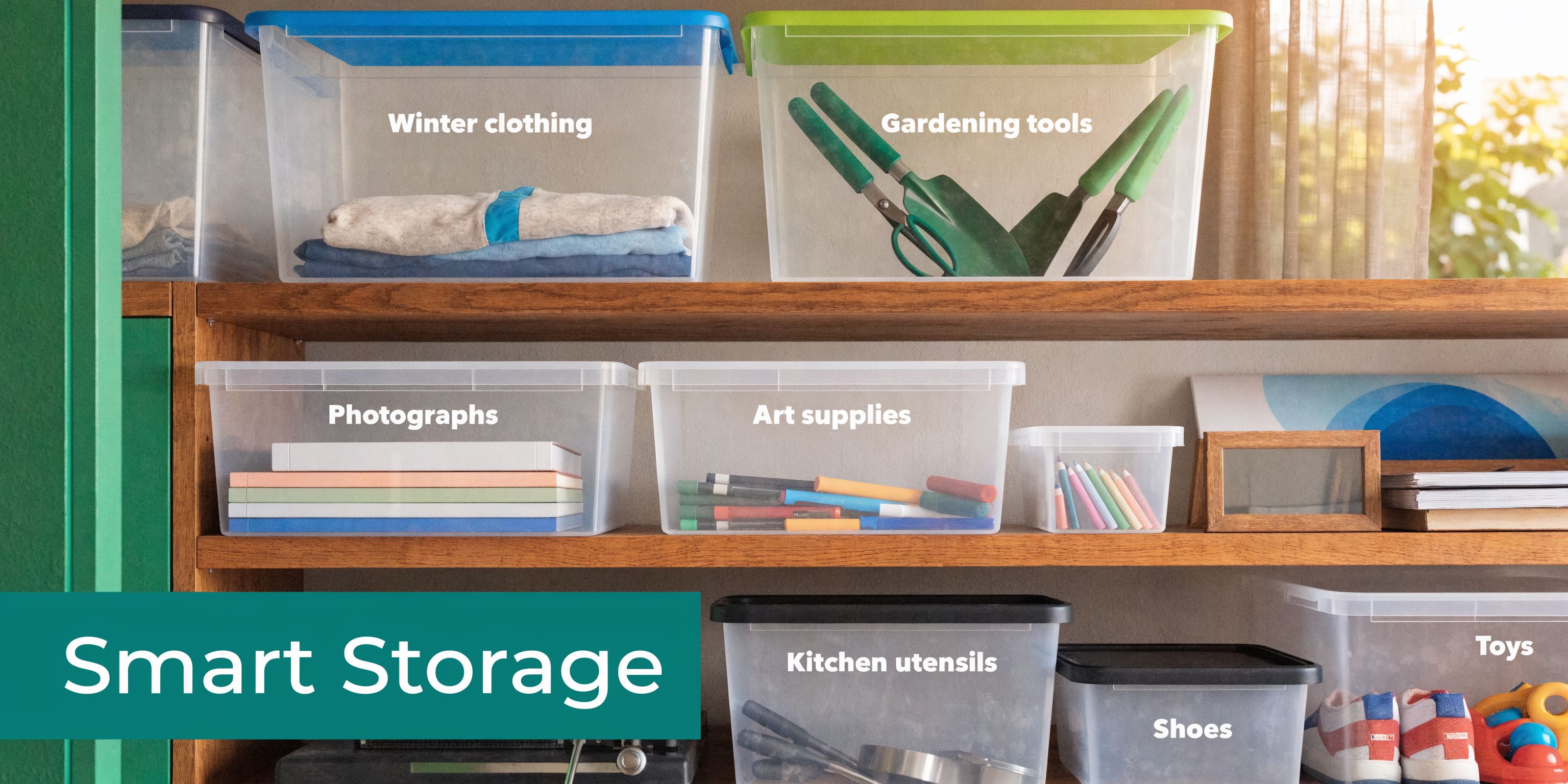
Why flexibility matters more than volume
Many couples do not need a giant storage unit. They need breathing room for selected items. Off-season clothes. Extra cookware. Sentimental decor. The better lamp that does not fit this apartment but might fit the next one.
That matters because many cohabiting arrangements are transitional in practice. Among adults born in the 1980s, only about 6% of cohabiting relationships that have not transitioned to marriage remain intact after 10 years (Institute for Family Studies on cohabitation and marriage). You do not need to read that as pessimism. Read it as a reminder not to make rigid household decisions just because your current floor plan is tight.
What works better than forced purging
The bad options look like this:
- keeping too much in the apartment and living in clutter
- throwing away useful items because the move deadline is close
- renting more storage space than needed
The better option is selective, reversible storage. Store only what does not fit now, label it clearly, and revisit it after you have lived together for a while.
For apartment dwellers, storage solutions for apartments are most useful when they support that middle ground. Enough flexibility to reduce pressure. Enough structure to keep stored items intentional.
What belongs in temporary storage
A short list emerges:
- Seasonal clothing and gear: Heavy coats, holiday items, sports equipment
- Sentimental decor: Family pieces you are not ready to display
- Duplicate household goods: Extra kitchen items, backup lamps, spare linens
- Transition furniture: The chair or shelf that may work later in a larger place
This isn't hoarding; it's sequencing.
If you force every decision into a same-day yes or no, small apartment living can start with resentment instead of relief. Smart storage gives the household time to settle before you make final calls.
Tip: Label stored items by category and owner. “Kitchen overflow” is useful. “Miscellaneous” is how boxes disappear for a year.
Mastering Moving Day Logistics and Unpacking
A shared move goes better when one person owns the timeline and both people know the plan. That does not mean one person does all the work. It means somebody is keeping the sequence straight so the day does not turn into six parallel emergencies.

Four weeks out
Book movers or reserve the vehicle. Confirm elevator access if the building requires it. Check move-in windows, loading zones, and key pickup details.
Use a structured moving checklist and timeline so the admin work does not sit in somebody’s head.
Also decide the move format. Are both homes being emptied on the same day? Is one person moving first into a partially set-up space? Same-day moves sound efficient, but staggered moves can be easier in small buildings.
Two weeks out
This is packing week, not “thinking about packing” week.
Use a labeling system that answers three questions on every box:
- Destination room
- Primary owner
- Priority level
Examples work better than abstract labels. “Kitchen. Shared. Open first.” is useful. “Stuff” is useless.
Pack three types of boxes
| Box Type | What goes in it | Why it matters |
|---|---|---|
| Day One | chargers, toilet paper, medication, basic tools, dish soap, paper towels, pajamas | lets you function without digging |
| Fast Setup | bedding, coffee setup, shower items, one pan, one knife, one plate set | gets the home operational quickly |
| Deep Storage | books, decor, out-of-season clothes, archives | can wait without stress |
On moving day
Start with a final sweep of each old place before the movers leave. Open cabinets, drawers, bathroom storage, oven, fridge, and the top shelf of every closet. The last forgotten items are typically chargers, cleaning products, and paperwork.
At the new place, one person should direct placement. That is not bossy. It is efficient. If boxes land in the wrong room, unpacking gets harder and resentment rises fast.
Keep one running note on your phone for immediate problems:
- wall damage
- missing hardware
- boxes that did not arrive
- items to buy on day one
Unpack by function, not by category perfection
Do not try to make the apartment beautiful on night one. Make it usable.
Unpack in this order:
- Bedroom so you can sleep well
- Bathroom so you can shower and reset
- Kitchen basics so you can eat and clean up
- Workstation or desk area if either of you works from home
Leave decor and nonessential styling for later. Couples create avoidable stress by trying to “finish” the apartment before they have even learned how they use it together.
Key takeaway: The first job of unpacking is reducing friction, not creating a final aesthetic.
Life After Unpacking Setting Shared Household Norms
The boxes are gone, but the primary test of moving in together starts in the ordinary parts of the week. Dishes. Groceries. Laundry. Noise. Guests. Who notices the trash first and who keeps pretending not to.
Much advice mentions that couples move in together for financial reasons, but many guides do a poor job of helping people manage ongoing money, asset division, and shared costs when one partner already owns furnishings (Easy Storage on tips before moving in together). That gap shows up after the move, not before it.
Create household systems before annoyance becomes identity
Do not assign chores by stereotype or habit. Assign them by tolerance, schedule, and reliability.
A practical split might look like this:
- one person handles dishes and kitchen reset
- the other handles trash, recycling, and bathroom cleaning
- laundry is separate, while sheets and towels are shared
- groceries are split between planning and purchasing
The key is clarity. “We both clean” sounds fair and produces confusion. “You vacuum Saturdays, I do bathroom and kitchen wipe-down Sundays” is much easier to maintain.
Review the budget after the first month
Your pre-move budget was a draft. Now you have real life data.
Sit down after a few weeks and review:
- recurring bills you forgot about
- overspending categories
- supplies you buy more often than expected
- whether one person is carrying more of the household burden
If one person brought most of the furniture, revisit whether that should affect future shared purchases. If one person uses more storage, closet, or utility-intensive space, talk about that directly instead of letting it become a private grievance.
Schedule low-pressure check-ins
The best shared households do not rely on mind reading. They run on short, regular check-ins.
Keep it simple. Pick one evening every week or every other week and talk about three things:
- what is working
- what feels uneven
- what needs to change this week
For scheduling and daily coordination, some couples find a best shared calendar for couples useful for chores, rent reminders, social plans, and apartment tasks. The tool matters less than the habit of putting shared responsibilities somewhere both people can see.
Tip: If a complaint repeats three times, it is no longer a one-off irritation. It needs a system.
A good move-in does not depend on perfect compatibility. It depends on making practical decisions early, revisiting them when reality changes, and treating the home like something you are building together instead of inheriting by default.
If you’re combining households and need a flexible way to handle the overflow, Endless Storage gives you a simple option. Store the items that matter but do not fit yet, keep your apartment livable, and avoid making rushed decisions during an already stressful transition.
Frequently Asked Questions
Unveiling the Secrets to Effortless Storage
Endless Storage is available nationwide. You pick a plan, tell us where to pickup, and we'll send a UPS van to collect, whichever state you're in.
Your shipping label will be sent to your email within a few minutes, if not instantaneously. It can also be accessed through your customer profile.
Your box will be shipped to one of our climate controlled self storage facilities in our closest self storage facility. Our manager will accept your package, notify you that your box has been received, and securely stored. Only our managers will have access to Endless Storage boxes.
Email us at admin@endless-storage.com click to live chat with us, or send us a message below.
Never! We're committed to transparent pricing with no surprises. You'll lock in your rate with no hidden fees and no long-term contracts.
Fast access guaranteed! Your boxes will arrive at your doorstep within 48 hours of requesting them back. Need to check on delivery? We provide tracking information for complete peace of mind.
Totally flexible! Store month-to-month with no long-term commitment and cancel anytime.
Everything's online! Use your account dashboard to:
• Set up automatic monthly payments
• Request box returns
• Update your address
• Order additional boxes
• Track shipments
Your boxes are insured up to $100 each. Our customer service team will help you file any necessary claims and resolve issues quickly.
Don't worry – we'll email you right away if there's a payment issue. Your items stay safe, though you may have temporary service interruption or late fees until payment is resolved.
When you request our free storage kits, you'll have 30 days to send in your boxes to activate your 3 months of free storage. Think of it like starting a gym membership – your activation window begins when you receive your kits, and your full free trial begins once you send in your first box. During your free months, you'll experience our complete storage service at no cost.
Your 30-day activation window begins when you receive your storage kits. We'll send you an email confirmation when your kits are delivered, marking the start of your activation period.
If you haven't sent any boxes for storage within your 30-day activation window, your free trial will expire and we'll begin charging the regular monthly rate of $9.99 per box. This helps ensure our storage kits go to customers who are ready to use our service.
A box costs $9.99 per month to store (plus sales tax). This price includes free shipping for standard boxes under 50 lbs. and smaller than 16"x16"x16"
Log into your Endless Storage account, locate the box you would like returned, and simply click Return My Box.
Yes, each box stored with us is insured for up to $100 throughout transit as well as the duration of storage within our facilities.
Your box will be at your doorstep within 48 hours of you requesting it back.
Store 10+ boxes? We'll pick them up for free! After your purchase, we'll contact you to schedule a convenient pickup time and arrange UPS collection.
We trust UPS with all shipments, and every box includes $100 insurance coverage. You'll receive tracking information to monitor your items' journey.
Yes! Visit any of our locations by appointment. Just bring a photo ID matching your customer profile.
For everyone's safety, we can't store hazardous materials, firearms, or perishables. All items must fit within our standard boxes.
It's easy! Order your storage kit online, and we'll ship it to you within 1-2 business days. Your shipping labels will be emailed instantly and available in your account.
We're here to help! Email us at admin@endless-storage.com, use our live chat, or send us a message through your account.
To cancel your storage service with Endless Storage, please email your cancellation request to admin@endless-storage.com. Our team will process your request within 2 business days and confirm your cancellation via email.
We understand packing takes time. However, to maintain your free trial benefits, you'll need to send at least one box within the 30-day activation window. If you need more time, you can always start with one box to activate your trial and send the rest later. You can always reach out to admin@endless-storage.com if you have any issues or concerns.
When you request our free storage kits, you're starting a 30-day window to begin using our storage service.
Important: To activate your free trial, send at least one box for storage within 30 days. If no boxes are sent within this 30-day window, a one-time $50 fee applies to cover materials and shipping costs. This fee is clearly disclosed before you sign up.
Think of it like reserving a hotel room – we're setting aside space and sending specialized packing materials for your use. The fee only applies if you request materials but don't begin storage, similar to a hotel's no-show charge.