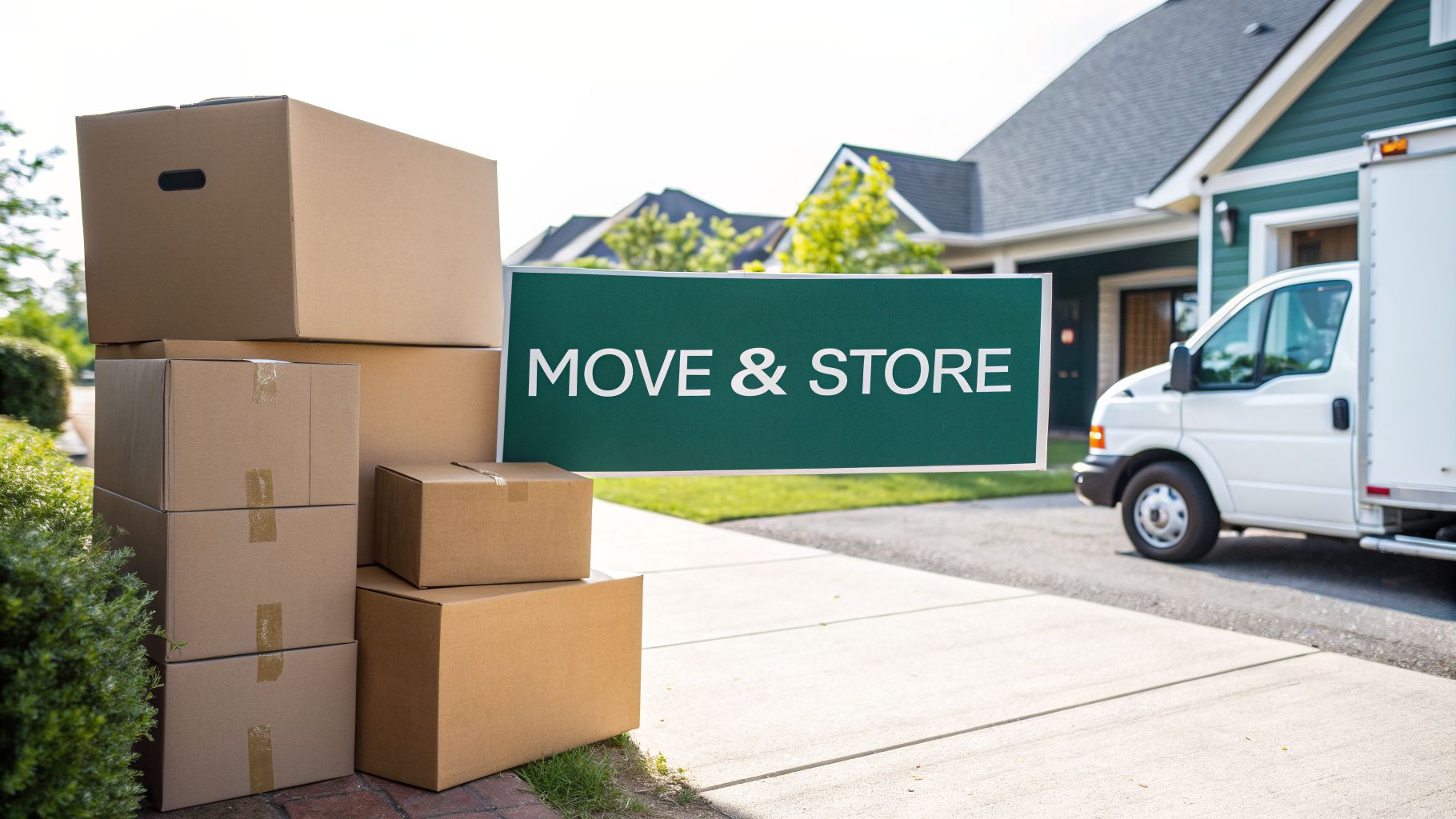
A long-distance move is already a huge undertaking. But when you throw storage into the equation, things can get complicated—fast. A long distance moving with storage service is built for that tricky gap when your move-out and move-in dates just don’t line up, giving you a secure place for your things between homes.
This integrated approach helps you sidestep the logistical headache of juggling separate moving and storage companies.
The New Way to Handle a Long-Distance Move With Storage
What do you do when the lease on your city apartment ends weeks before you get the keys to your new house across the country? It’s a classic moving nightmare. Traditionally, you'd be stuck in a frustrating, multi-step shuffle: hire movers to haul your stuff to a local self-storage unit, then hire a completely different moving crew in your new city to pick it all up again.
This old-school method is more than just a hassle. It’s expensive, stressful, and totally impractical for a modern move. Thankfully, there’s a much smarter way to handle it now.
Integrated Solutions for Modern Movers
Today’s moving services blend logistics and storage into one seamless experience. Instead of renting an entire storage unit you might not even fill, you can opt for a storage-by-the-box service. Companies like Endless Storage will ship durable boxes right to your door. You pack what you need stored, and they coordinate the pickup, secure storage, and nationwide delivery to your new address whenever you're ready.
This approach has some major perks:
- No Double Handling: Your belongings are picked up once and delivered once. You never have to step foot in a storage facility or manage multiple moving crews.
- Pay Only for What You Use: Forget paying for a whole unit. With this model, you pay per box, per month—perfect for storing smaller collections of items like seasonal clothing, books, or keepsakes.
- Complete Flexibility: With month-to-month plans, you can easily extend your storage time if your move-in date gets pushed back.
Comparing Storage Options for Your Long-Distance Move
To see the difference clearly, it helps to compare the old way with the new. Here’s a quick breakdown of how traditional self-storage stacks up against modern storage-by-the-box for a long-distance move.
The takeaway is simple: for many long-distance movers, especially those with gaps in their timeline, the convenience and cost-effectiveness of storage-by-the-box make it the clear winner.
This streamlined approach is more relevant than ever. With major population shifts from states like California and New York to places like Texas and Florida, countless people are facing the exact housing gaps that make integrated storage a lifesaver.
Key Takeaway: The biggest win of combining moving and storage is turning a complicated, multi-vendor headache into a single, coordinated process. It saves you time, stress, and often money compared to the old way.
As you navigate your own move, knowing how to manage your belongings is half the battle. Our complete guide on storage pickup and delivery dives deeper into how these modern services work. This new way of thinking about logistics gives you the power to handle any moving timeline, no matter how unpredictable it gets.
Building Your Smart Move and Store Timeline
A long-distance move that involves storage is a logistical puzzle. A successful one doesn't just happen—it’s the result of smart, strategic planning. The single most important thing you can do is create a detailed timeline to keep the process from spiraling into last-minute chaos. Think of it as your personal playbook.
The trick is to work backward from your move-in date, even if you don't have a permanent address yet. Let's break down the key phases to make sure every box, booking, and confirmation falls right into place.
Three Months Out: The Research and Decluttering Phase
With about twelve weeks to go, your main job is gathering information and getting rid of stuff you don't need. This is all about laying the groundwork now to prevent a massive headache later. Don't underestimate how long it takes to sort through years of accumulated belongings.
Start by digging into your moving and storage options. Get quotes from traditional long-distance movers and compare them with integrated services like Endless Storage that combine shipping and storage into one simple process. Think about what you really need—are you storing a few boxes of off-season clothes or half your apartment?
Next, it’s time to declutter. Go room by room and be ruthless. A simple way to tackle this is the four-box method:
- Keep: Items you genuinely love and use that are definitely coming with you.
- Store: Things you need to keep but won't need right away, like winter coats for a summer move or sentimental family heirlooms.
- Donate/Sell: Anything in good condition that you just don't use anymore.
- Toss: Anything broken, expired, or truly unusable.
For anyone doing this in a small apartment, the key is consistency. Spend 30 minutes every single day on one tiny area—a junk drawer, a single bookshelf, or the back of your closet. It keeps you from getting buried under a mountain of stuff in a cramped space.
Two Months Out: The Booking and Supply Gathering Phase
Now that you’ve lightened your load and have a better idea of what you’re moving and storing, it’s time to lock things in. Two months out is the sweet spot for booking. If you wait much longer, especially during the peak moving season from May through September, you’ll face limited availability and much higher prices.
Here’s your action plan for this phase:
- Book Your Movers and Storage: Make your final choice and get your dates on the calendar. If you're using a storage-by-the-box service, order your kit now so it arrives with plenty of time to pack.
- Get Your Packing Supplies: Don't put this off. Stock up on sturdy boxes, packing tape, bubble wrap, and good markers.
- Notify Important People: If you're renting, give your landlord official notice. This is also a good time to start researching schools, doctors, and other services in your new city.
This timeline shows just how much simpler a modern, integrated moving and storage solution is compared to the old, clunky way of doing things.
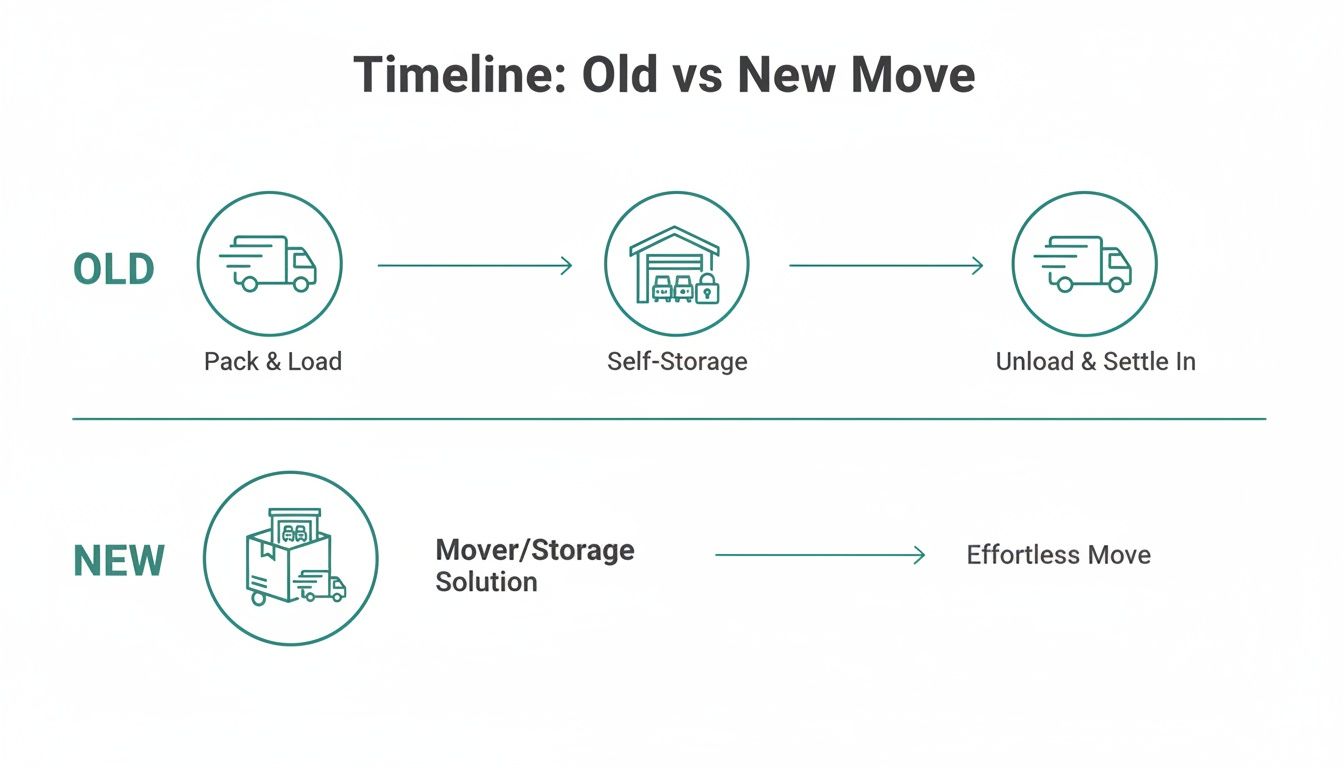
As you can see, integrated solutions cut out the entire step of hauling things to a separate self-storage unit yourself, which saves a ton of time and effort.
The Final Month: Packing and Coordination
With four weeks left, your focus shifts to packing everything up and finalizing the details. This is where your long distance moving with storage plan really comes together. Start by packing things you rarely use, like out-of-season clothing, guest room linens, and books you won't be reading anytime soon.
As you pack, create a digital inventory. It sounds like a lot of work, but you’ll thank yourself later. Just label each box with a number and a brief description of what’s inside, then log it in a simple spreadsheet. This is a lifesaver when you need to remember where you packed the holiday decorations or important tax files. For a deeper dive, check out our guide on creating a packing timeline for moving.
During the last two weeks, it’s all about confirmation.
- Call your moving and storage providers to double-check pickup dates and times.
- Arrange for your utilities to be transferred or shut off.
- Pack an "essentials" box with everything you'll need on day one: toiletries, a change of clothes, medications, phone chargers, and a basic tool kit.
By breaking the process into these manageable chunks, you can tackle your move methodically and ensure a smooth, organized transition to your new home.
How to Pack and Label for a Hybrid Move
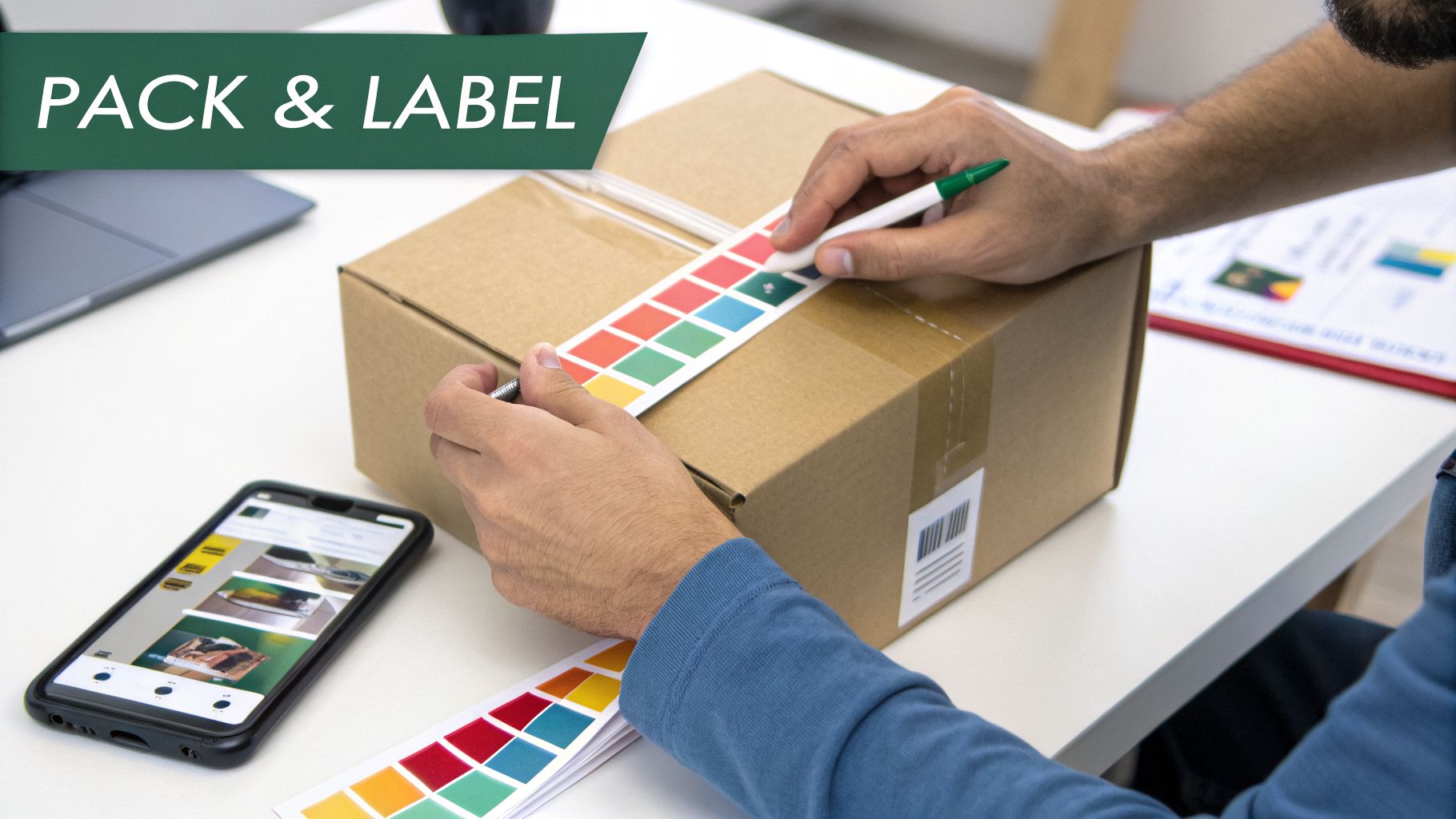
When you're doing a hybrid move—sending some things straight to your new place and others into storage—your packing system is everything. Get it wrong, and you could be staring at a pile of winter coats in your new Miami condo while your coffee maker sits in a warehouse across the country.
A smart packing and labeling strategy is your best defense against that kind of chaos. The most effective method I've seen is a simple color-coding system. It’s visual, intuitive, and almost impossible to mess up, even when movers are in a hurry.
Implement a Color-Coding System
First things first: assign a specific, high-contrast color to each destination. You’ll want to grab a few rolls of colored packing tape or a pack of big, bright labels. Consistency is key, so make sure anyone helping you pack knows the system.
- Green for New Home: Use green tape or labels on every box you'll need right away. This is your "Go" pile—think kitchen gear, bedding, toiletries, and clothes for the first week.
- Blue for Storage: Slap a blue label on everything heading into your long distance moving with storage unit. These are the items you can live without for a while, like seasonal decor, family heirlooms, or that extra furniture you're saving.
- Red for "Open First": A bright red label is for your survival kit. This box should contain medications, chargers, important papers, a change of clothes, and a small toolkit. It either travels with you in your car or is the absolute last thing on the truck and the first thing off.
This simple visual system makes the loading process so much smoother. A mover sees a blue box and knows exactly where it goes, no questions asked.
Pro Tip: Stick labels on at least two sides of every box. That way, you can still see where it's supposed to go no matter how it gets stacked in the truck or storage unit.
Create a Digital Inventory
A digital inventory is your secret weapon for a hybrid move, especially if you’re using a service like Endless Storage where you can’t just walk in and rifle through your stuff. It turns a wall of identical boxes into a searchable catalog of your belongings.
You can start with a simple spreadsheet or a dedicated inventory app. Just create columns for the box number, its color code (Home/Storage), a quick description of what's inside, and which room it belongs in. Something like: "Box 14 | Blue (Storage) | Winter Sweaters & Scarves | Bedroom."
Want to take it to the next level? Snap a quick photo of the contents before you seal the box and link to it in your spreadsheet. Trust me, six months from now when you’re trying to remember which box has your grandmother’s china, you’ll be glad you did.
Tailor Your Packing for Each Destination
Not all packing is created equal. Items going into long-term storage need a bit more TLC than things just making a trip across town to your new house.
For Long-Term Storage:
- Use sturdy, uniform boxes. They stack much better and hold up over time.
- Protect from moisture and pests. Plastic bins are great for sensitive items like photos. Make sure you don't pack anything with a strong smell that could attract pests.
- Clean everything first. All clothing, linens, and appliances should be completely clean and dry to prevent mold and mildew from setting in.
For Your New Home:
- Pack for accessibility. Put the things you’ll need on day one in their own clearly marked boxes.
- Pack by room. Labeling boxes like "Kitchen - Pots & Pans" will make unpacking feel a lot less overwhelming.
- Be careful with fragile items. Double-wrap anything breakable and mark those boxes as "FRAGILE" on all sides in big, bold letters.
This approach might feel a little tedious upfront, but it pays off in a big way with a smoother, less stressful move. For more tips on getting your system just right, you can read our detailed guide on how to label boxes for a move and really master the process.
Coordinating Logistics for a Seamless Transition

This is it—the moment all your planning pays off. Nailing the timing for your long distance moving with storage is how you turn a chaotic scramble into a smooth handoff between your old life, your temporary storage, and your new beginning.
Get it right, and it feels effortless. But a misstep here can cause a frustrating traffic jam right at your front door.
The secret is aligning your storage pickup with your long-distance movers to create a streamlined workflow. You definitely don’t want two different crews tripping over each other, and you don’t want dead time in your schedule that leaves you stranded. Let’s break down two proven ways to make this happen.
Choosing Your Logistics Workflow
You have two main strategies for managing a hybrid move. The right one for you will come down to your living situation, how much you need to declutter, and your overall timeline. Both are designed to prevent the headache of having everyone show up at once.
Workflow 1: Store First to Declutter
This approach is a lifesaver if you’re feeling buried in clutter before the big moving day. The idea is simple: get your storage items out of the house before your long-distance movers are even scheduled to arrive. This clears out physical space and, more importantly, mental space.
- Schedule your storage pickup a few days, or even a week, before your moving truck shows up.
- Pack and stage your “Storage” boxes in a dedicated spot, like a spare room or a corner of the garage.
- Once those items are gone, your home is instantly more open and far easier for your movers to navigate on the main day.
Workflow 2: The Parallel Pickup
If you're on a tight schedule or just want to get it all done at once, this is your method. Your storage items get picked up on the same day as your move, just by a separate service. This works incredibly well with storage-by-the-box, since a carrier like UPS can swing by without needing the same clearance as a massive moving truck.
Your long-distance movers can focus on the heavy furniture and "New Home" boxes, while your smaller "Storage" boxes are collected independently. It’s a clean division of labor that keeps everything flowing.
I once helped a friend move from a tiny city apartment using this exact method. The professional movers handled the sofa and bed, while we left the pre-labeled storage boxes by the door for a scheduled courier. It was shockingly smooth and kept the crowded hallway clear for everyone.
Demystifying the Return Trip
Getting your belongings out of storage is just as crucial as getting them in. With a traditional self-storage unit, you're on the hook for hiring another moving crew, driving to the facility, and loading everything up again. But with on-demand storage, the whole process is worlds simpler.
When you're ready for your stuff, you just log into your account and request a delivery. You pick which boxes you want back, plug in your new address, and the storage company ships them right to your door. It’s a game-changer, especially if you have an uncertain move-in date.
Planning for Your Items' Arrival
Let’s walk through a common scenario: you’re moving from New York to Austin. Your new house won't be ready for two months, so you're staying in a small, furnished rental in the meantime.
- Before Your Move: You use a storage-by-the-box service to send ten boxes of winter clothes, extra books, and kitchen gadgets you won't need right away into storage. Your movers only have to take your essentials to the rental.
- During Your Stay: You live comfortably in your temporary apartment without tripping over a mountain of boxes.
- Getting Your Stuff Back: A week before getting the keys to your permanent home in Austin, you log into your storage account. You confirm your new address and schedule the delivery for all ten boxes. They arrive right after you move in, ready to be unpacked.
This level of control transforms a potentially stressful ordeal into a completely manageable process. If you're hunting for more ways to simplify your cross-country journey, check out our other long distance moving tips. Ultimately, coordinating your move and storage is all about planning ahead and choosing a service that fits your life—not the other way around.
Navigating Costs and Insurance for Your Move
Let’s be honest—the two things that can truly make or break a complex move are a clear budget and solid insurance. When you’re planning a long distance moving with storage scenario, getting a handle on the costs and protections involved is non-negotiable. It’s what separates a smooth transition from one filled with surprise fees and anxiety.
The financial side isn't as daunting as it sounds. It really boils down to two very different ways of paying for storage: the old-school self-storage unit versus the modern storage-by-the-box approach.
Comparing Storage Pricing Models
With traditional self-storage, you’re renting a fixed space. You pick a unit—say, a 5'x10' or 10'x10'—and pay a set monthly fee whether you pack it to the ceiling or only use a tiny corner. This makes sense if you’re storing bulky furniture, but it’s often a waste of money if all you have are boxes.
Storage-by-the-box services like Endless Storage completely flip the script. You pay a small monthly fee for each individual box you store. This is a total game-changer for anyone moving long-distance who just needs to store things like seasonal clothes, books, or keepsakes for a few months. You only pay for the exact space you use, which means no more shelling out for a half-empty storage unit.
This flexible, pay-for-what-you-need model is a direct response to how people actually move today. In fact, trends show that integrating storage is solving huge problems for the roughly 20% of moves that are long-distance. For movers using Endless Storage, it means affordable, insured, nationwide access that closes timing gaps without the hidden costs.
Key Takeaway: If you're mainly storing boxes and not large furniture, the per-box pricing model almost always offers better value and flexibility for a long-distance move with a temporary storage gap.
Understanding Your Insurance Coverage
Insurance is your safety net, but it’s definitely not a one-size-fits-all deal. In a hybrid move, your belongings get passed between different hands, and you need to know who covers what and when. You’ll be dealing with two separate policies: one from your movers and one from your storage provider.
Mover's Insurance (Valuation): While your items are on the truck, they're covered by the moving company’s valuation policy. The free, default option is Released Value Protection, which is frankly terrible—it only covers items at $0.60 per pound. You should always ask for Full Value Protection. It costs extra, but it ensures your belongings are repaired, replaced, or you're reimbursed for their current market value.
Storage Insurance: The second your items land at the storage facility, the mover's policy is off the hook. This is where your storage provider's insurance kicks in. A service like Endless Storage, for instance, includes a base level of insurance for each box as part of the monthly fee.
To make sure your items are protected from start to finish, understanding these essential insurance tips for a stress-free move is a must.
A Checklist for No-Gap Coverage
Never, ever assume you're fully covered. Before you sign a single contract, get on the phone with both your moving company and your storage provider. Ask them these exact questions to make sure there are no dangerous gaps in your protection.
- What is the exact dollar amount of coverage per pound under the standard valuation?
- What does it cost to upgrade to Full Value Protection, and what’s the process?
- Does your policy cover "mechanical derangement" (when an electronic item stops working with no visible damage)?
- What is the total declared value of my storage insurance policy per box?
- What is the claims process if an item is lost or damaged in transit versus in storage?
Getting clear, written answers to these questions is non-negotiable. For a deeper dive into protecting your belongings specifically while they’re warehoused, check out our complete guide on insuring items in storage.
Common Questions About Moving With Storage
Even the most organized move comes with a few nagging questions, especially when you’re trying to coordinate movers and storage. Getting those answers sorted out now will save you a world of stress later. Let's tackle some of the most common things people wonder about when planning a hybrid move.
How Do I Decide What Goes Into Storage?
Staring at a room full of your belongings and trying to decide what to store can feel impossible. The easiest way to break through the overwhelm is to stop thinking about what you might need and focus on what you'll definitely need right away.
This isn't about decluttering your whole life, just streamlining your move-in. I always tell people to sort their stuff into three simple buckets:
- Immediate Need (Take with You): Think survival mode for the first few weeks. This is your core wardrobe, essential toiletries, daily kitchen gear, work-from-home setup, and the basic furniture you can't live without.
- Seasonal or Infrequent Use (Store): This is the sweet spot for storage. We're talking holiday decorations, out-of-season clothes, hobby equipment you won't use immediately, and sentimental items you want to keep safe but don't need on day one.
- Uncertain Future (Store): Downsizing or moving somewhere temporarily? You probably have furniture you love but aren't sure will fit. Storing it buys you time to settle in and make a thoughtful decision instead of cluttering up your new space.
This approach makes your actual move-in day so much more manageable. You can get the essentials in place first and deal with everything else once you've had a chance to breathe.
Can I Access My Stuff While It's in Storage?
This is a huge question, and the answer really boils down to the kind of storage you pick. Your experience with a traditional self-storage unit is completely different from an on-demand service.
With a local self-storage facility, you’ve got the keys. You can drive over during business hours, unlock your unit, and dig through your boxes. It's hands-on.
On-demand long distance moving with storage, however, swaps that physical access for pure convenience. You can't just pop over to the warehouse, but you can get your things back with just a few clicks.
With a service like Endless Storage, you just log into your online account, pick the exact boxes you need back, and they get shipped right to your new address. Most of the time, they arrive within 48 hours. It's a model built for people who would rather click a button than rummage through a storage unit.
What Happens if My Move-In Date Changes?
Ah, the dreaded moving delay. It happens more often than anyone would like—a holdup with construction, a last-minute issue with the old tenants, you name it. This is where a flexible storage plan is an absolute lifesaver.
If you're using a traditional storage unit, you'll probably just keep paying the monthly rent until you're finally ready to move your stuff out. The real advantage, though, comes with modern storage solutions that don’t lock you into long-term contracts. If your move-in gets pushed back a week or even a month, you just let your plan roll over. No penalties, no complex contracts to deal with—it takes a massive layer of stress out of an already uncertain situation.
How Far in Advance Should I Book Everything?
When it comes to moving, timing is everything. To get the best rates and avoid finding out every company is booked, you need to plan ahead.
Aim to book your long-distance movers and your storage services at least eight to twelve weeks in advance. This is non-negotiable if you’re moving during peak season, which runs from roughly May through September.
If you wait until the last month, you'll run into two big problems: the best companies will be sold out, and any company with an opening will likely charge a steep premium. Booking early locks in your spot and gives you plenty of time to get your supplies, pack without panicking, and coordinate everything smoothly. It’s the single best thing you can do for a less stressful move.
Planning your long-distance move shouldn't be a logistical nightmare. Endless Storage offers a simple, flexible solution by shipping storage boxes to your door and delivering them to your new home whenever you're ready. Learn how to simplify your move today.
Frequently Asked Questions
Unveiling the Secrets to Effortless Storage
Endless Storage is available nationwide. You pick a plan, tell us where to pickup, and we'll send a UPS van to collect, whichever state you're in.
Your shipping label will be sent to your email within a few minutes, if not instantaneously. It can also be accessed through your customer profile.
Your box will be shipped to one of our climate controlled self storage facilities in our closest self storage facility. Our manager will accept your package, notify you that your box has been received, and securely stored. Only our managers will have access to Endless Storage boxes.
Email us at admin@endless-storage.com click to live chat with us, or send us a message below.
Never! We're committed to transparent pricing with no surprises. You'll lock in your rate with no hidden fees and no long-term contracts.
Fast access guaranteed! Your boxes will arrive at your doorstep within 48 hours of requesting them back. Need to check on delivery? We provide tracking information for complete peace of mind.
Totally flexible! Store month-to-month with no long-term commitment and cancel anytime.
Everything's online! Use your account dashboard to:
• Set up automatic monthly payments
• Request box returns
• Update your address
• Order additional boxes
• Track shipments
Your boxes are insured up to $100 each. Our customer service team will help you file any necessary claims and resolve issues quickly.
Don't worry – we'll email you right away if there's a payment issue. Your items stay safe, though you may have temporary service interruption or late fees until payment is resolved.
When you request our free storage kits, you'll have 30 days to send in your boxes to activate your 3 months of free storage. Think of it like starting a gym membership – your activation window begins when you receive your kits, and your full free trial begins once you send in your first box. During your free months, you'll experience our complete storage service at no cost.
Your 30-day activation window begins when you receive your storage kits. We'll send you an email confirmation when your kits are delivered, marking the start of your activation period.
If you haven't sent any boxes for storage within your 30-day activation window, your free trial will expire and we'll begin charging the regular monthly rate of $9.99 per box. This helps ensure our storage kits go to customers who are ready to use our service.
A box costs $9.99 per month to store (plus sales tax). This price includes free shipping for standard boxes under 50 lbs. and smaller than 16"x16"x16"
Log into your Endless Storage account, locate the box you would like returned, and simply click Return My Box.
Yes, each box stored with us is insured for up to $100 throughout transit as well as the duration of storage within our facilities.
Your box will be at your doorstep within 48 hours of you requesting it back.
Store 10+ boxes? We'll pick them up for free! After your purchase, we'll contact you to schedule a convenient pickup time and arrange UPS collection.
We trust UPS with all shipments, and every box includes $100 insurance coverage. You'll receive tracking information to monitor your items' journey.
Yes! Visit any of our locations by appointment. Just bring a photo ID matching your customer profile.
For everyone's safety, we can't store hazardous materials, firearms, or perishables. All items must fit within our standard boxes.
It's easy! Order your storage kit online, and we'll ship it to you within 1-2 business days. Your shipping labels will be emailed instantly and available in your account.
We're here to help! Email us at admin@endless-storage.com, use our live chat, or send us a message through your account.
To cancel your storage service with Endless Storage, please email your cancellation request to admin@endless-storage.com. Our team will process your request within 2 business days and confirm your cancellation via email.
We understand packing takes time. However, to maintain your free trial benefits, you'll need to send at least one box within the 30-day activation window. If you need more time, you can always start with one box to activate your trial and send the rest later. You can always reach out to admin@endless-storage.com if you have any issues or concerns.
When you request our free storage kits, you're starting a 30-day window to begin using our storage service.
Important: To activate your free trial, send at least one box for storage within 30 days. If no boxes are sent within this 30-day window, a one-time $50 fee applies to cover materials and shipping costs. This fee is clearly disclosed before you sign up.
Think of it like reserving a hotel room – we're setting aside space and sending specialized packing materials for your use. The fee only applies if you request materials but don't begin storage, similar to a hotel's no-show charge.