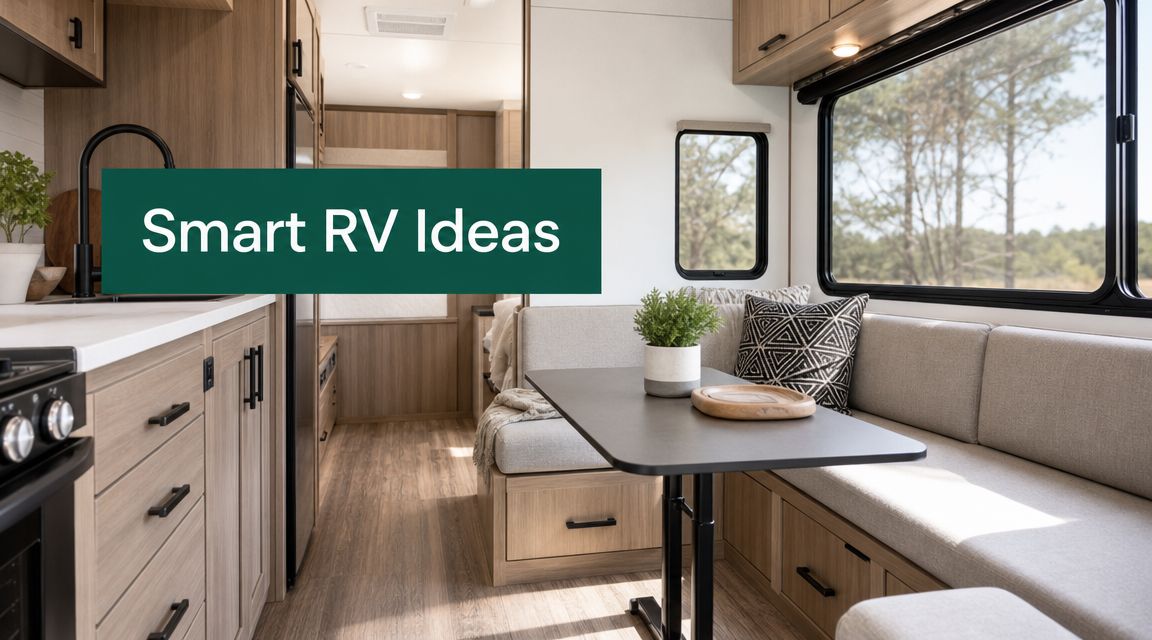
Reimagine Your Road: Transform Your Mobile Space
Living in an RV feels a lot different when every cabinet opens cleanly, every item has a place, and your seating doesn't double as a junk pile. A cramped layout isn't always a size problem. Most of the time, it's a planning problem. The good news is that good ideas for RV interior upgrades don't have to start with a full renovation.
The best RV interiors work like well-designed studio apartments. They make one space handle sleeping, cooking, storage, and sometimes work, without feeling chaotic. That shift is showing up across the industry. One RV design article reports that more than 40% of RV owners prefer minimalist interiors, over 60% favor earthy or light neutral palettes, nearly 70% incorporate smart technology, and about 45% seek sustainable materials, all tied to the practical need to make compact spaces feel organized and livable in daily use, according to RV interior design trends and statistics from Germaine RV.
If you're staring at a dinette you barely use, overhead cabinets stuffed with duplicates, or a bed platform hiding wasted space, you're in the right place. These ideas focus on function first. Some are simple DIY fixes. Some are product swaps. Some are about removing things entirely and storing them offsite when they don't belong in your everyday living footprint.
If you're also planning bigger upgrades, it's worth browsing RV flooring and kitchen remodels for layout inspiration before you buy anything.
1. Multi-Functional Furniture with Hidden Storage
The fastest way to improve an RV interior is to make one piece do two jobs. If a bench seat only seats people, it's wasting valuable volume. If an ottoman stores blankets, chargers, and dog gear, it's earning its place.
I've found that the best swaps are the boring ones. A lift-top coffee table beats a decorative side table every time. A dinette bench with hinged lids is more useful than freestanding chairs because the chairs slide, rattle, and take up floor space when you're not moving.
What earns its footprint
A few pieces consistently work well in RVs:
- Storage ottomans: Good for shoes, cords, games, and bedding you need often.
- Bench seating with compartments: Better than loose seating in almost every small rig.
- Murphy beds with drawers below: Best when you need daytime floor space.
- Slim kitchen islands on locking casters: Useful only if they don't block walkways or slide-outs.
The trade-off is access. Hidden storage sounds great until you realize you have to move cushions and lift a heavy lid every morning to reach socks or cookware. Daily-use items belong in easy-reach storage. Hidden compartments are better for backup supplies, tools, spare linens, and things you don't need at every stop.
Avoid the common mistake
Don't buy residential furniture and hope it fits. Measure width, depth, clearance, and lid swing before you order. Also check whether the item can be secured for travel.
Practical rule: If you have to unload three things to reach one thing, that storage system will fail in real life.
For more layout-friendly examples, this guide to hidden storage ideas is useful for thinking beyond obvious cabinets. For true overflow, seasonal gear doesn't belong stuffed into every bench and bed cavity. That's where a service like Endless Storage makes more sense than sacrificing your daily living area.
2. Vertical Wall Storage and Shelving Systems
Most RVs run out of floor space long before they run out of wall space. That's why vertical storage works so well. A bare wall in the kitchen, bathroom, or entry area can hold far more than people expect, without making the RV feel packed.
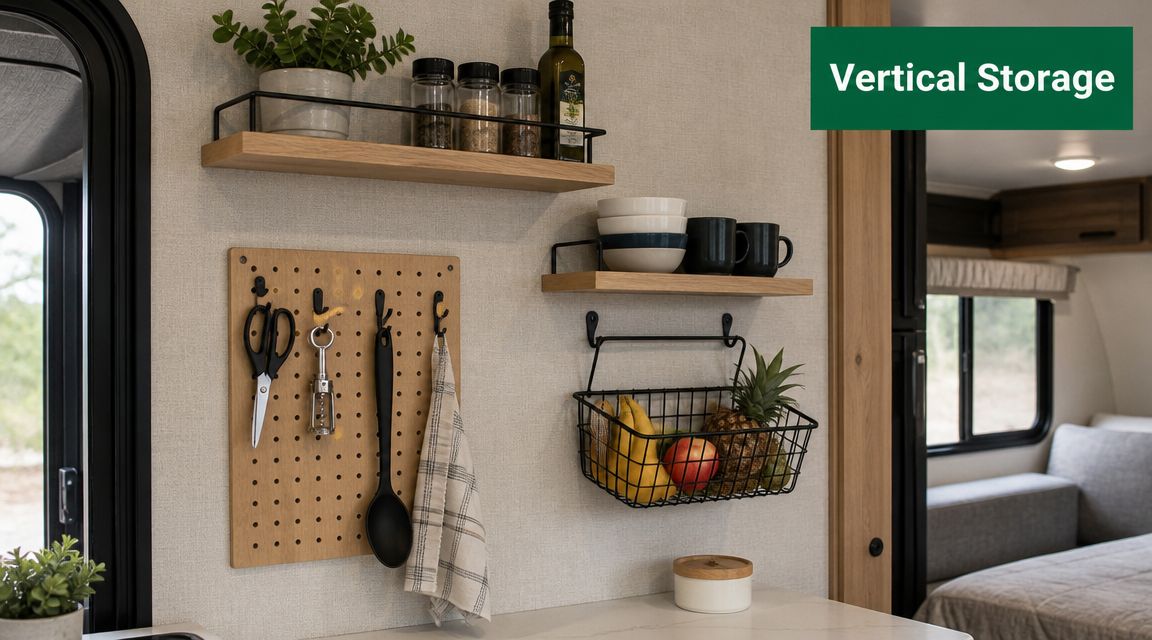
Floating shelves look clean, but pegboards are often more practical. In a real RV, needs change. One month you're carrying camera gear and charging cables. The next month it's cooking tools and coffee supplies. Pegboards, magnetic strips, and rail systems let you adapt without rebuilding.
Best places to build up, not out
Use vertical storage where it improves access, not just appearance.
- Inside cabinet doors: Add spice racks, cutting board slots, or shallow bins.
- Kitchen backsplash zones: Mount rails with hooks for utensils and mugs.
- Entry walls: Install a small catch-all for keys, headlamps, and leashes.
- Bathroom walls: Use narrow shelves for toiletries and rolled hand towels.
Lightweight materials matter. Thin aluminum shelves, plastic bins, and compact hooks usually hold up better than chunky wood pieces that add weight and strain fasteners. Keep heavier items lower and lighter items at eye level.
A lot of search results for ideas for RV interior upgrades focus on wallpaper, cushions, and paint. That's fine for weekend use, but it misses a bigger issue for long-term living. The gap is ergonomics. As noted in this review of low-budget RV remodeling ideas, most advice stays aesthetic and barely addresses how to make tiny spaces work for sleeping, cooking, and storage over time. Vertical systems help because they preserve walkways while still increasing usable storage.
3. Under-Bed Storage Containers and Drawers
Under-bed storage is where a lot of RVs either become efficient or stay frustrating. The space is usually large enough to matter, but awkward enough that people treat it like a dumping ground. That creates two problems. You lose visibility, and you forget what you own.
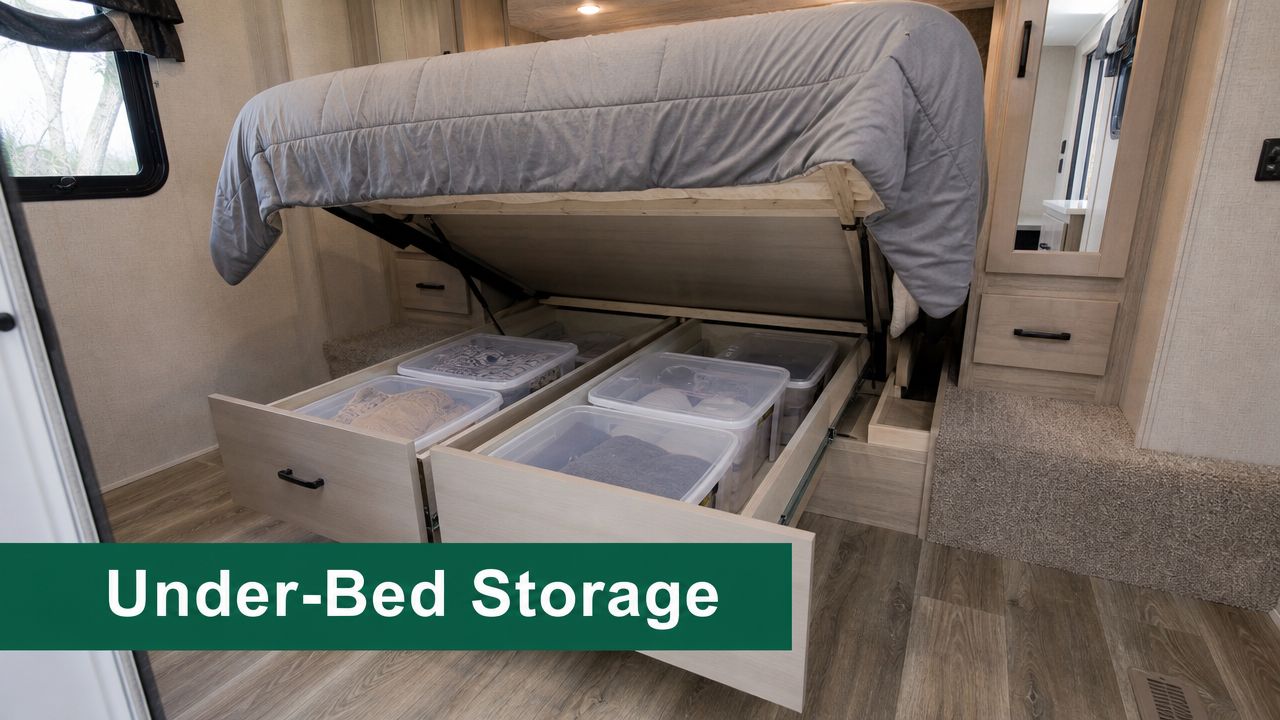
The fix isn't glamorous. Use containers that fit the opening, slide smoothly, and match the way you access the bed. If your mattress platform lifts from one side, broad bins with handles work. If access is tight, shallow drawers or low-profile boxes are better.
How to make it usable every week
A good under-bed setup usually includes three categories:
- Daily support items: Extra sheets, towels, laundry supplies, and backup toiletries.
- Trip support items: Leveling blocks, hoses, repair kits, and weather gear.
- Rotating storage: Off-season clothes, spare blankets, and hobby equipment.
Clear bins help, but labels matter more. In practice, "winter layers," "spare cords," and "dog supplies" are faster to manage than bins full of mixed categories. Moisture control helps too, especially if your rig deals with condensation or temperature swings.
Put heavy items toward the center of the rig, not all on one outer edge. Storage isn't just about fit. It's about balance while driving.
If you want more ideas on configuring this zone, smart under-bed storage solutions offer solid small-space examples that translate well to RV layouts. The biggest trade-off here is temptation. Just because the space exists doesn't mean it should hold everything you own. Keep under-bed storage for items that support daily life, not long-term overflow.
4. Decluttered Minimalist Interior Design
Minimalism in an RV isn't a style trend first. It's a survival skill. Clutter makes a small space feel smaller, and in a moving vehicle, clutter also turns into noise, shifting weight, and constant visual stress.
That shift toward stripped-back interiors is easy to understand. Over the last two decades, RV ownership has increased 62%, and manufacturers have moved interiors away from basic travel cabins toward more residential, lifestyle-focused spaces, according to RV design trend reporting from Swavelle. That evolution mirrors what full-timers already know. A livable RV needs to feel like a compact home, not a storage locker with wheels.
Keep the room, lose the extras
A minimalist RV doesn't mean empty shelves and no personality. It means every object clears one of two tests. It either solves a recurring problem or adds enough daily comfort to justify the space it takes.
That usually means:
- Fewer kitchen duplicates: One skillet you trust beats three cheap pans.
- A tighter wardrobe: Clothes that layer well outperform niche outfits.
- Cleaner surfaces: Open counters make cooking and cleaning easier.
- Lighter colors: Neutrals and wood tones make cramped spaces feel calmer.
For many people, the hardest category isn't junk. It's sentimental items. If you're not ready to get rid of keepsakes, archived paperwork, or family pieces, move them out of the RV instead of forcing them into your living space. This step-by-step declutter guide for small apartments fits RV life surprisingly well because the same constraints apply.
If you're reducing belongings before a move or major reset, this Perth decluttering guide also offers a practical mindset for cutting volume without making rushed decisions.
5. Modular and Removable Storage Solutions
Permanent modifications aren't always the smartest move. If you're testing a full-time layout, renting an RV, or still figuring out your habits, modular storage is safer. It lets you adjust as your routine changes.
I like modular systems most in the first few months of a new setup. People think they need custom cabinetry right away, but many don't yet know what should live near the entry, what belongs in the kitchen, or how much desk space they need. Removable bins, tension-rod shelves, stackable drawers, and hook-on baskets let you experiment before drilling into walls.
Where modular storage shines
These are the spots where removable solutions usually outperform permanent ones:
- Wardrobes: Clip-in shelves and hanging organizers beat a costly rebuild.
- Pantries: Stackable bins let you rework food zones fast.
- Bathroom cabinets: Small caddies and pull bins stop products from disappearing into deep shelves.
- Garage bays and pass-throughs: Crates and labeled tubs keep outdoor gear sortable.
The downside is stability. Anything modular has to be secured for travel. That's where many attractive solutions fail. If a pretty wire basket slides, rattles, or tips over on a turn, it isn't the right solution for an RV.
Use modular storage to learn your habits. Once the setup proves itself on the road, then decide what's worth making permanent.
If you rotate gear by season, modular containers can multiply quickly. Rather than keeping empty bins and off-season contents in the RV year-round, store those extras elsewhere and keep only active modules inside.
6. Custom Cabinet Modifications and Organizers
Most RV cabinets waste space because they're built as empty boxes. A deep cabinet without organizers becomes a pile. A drawer without dividers turns into a catch-all. Cabinet modifications don't need to be fancy to fix that.
Simple inserts usually do more than expensive cosmetic upgrades. Pull-out shelves, under-sink caddies, door-mounted spice racks, and drawer dividers turn hard-to-reach storage into something you can use one-handed. That's what matters when the galley is narrow and you're cooking in a tight lane.
Start with the cabinets you fight with
Don't redo every cabinet at once. Begin with the problem zones you touch every day.
- Silverware and tool drawers: Add dividers so items stop shifting together.
- Deep lower kitchen cabinets: Use slide-out trays or wire pull baskets.
- Under-sink voids: Fit around plumbing with stepped organizers or bins.
- Bathroom medicine storage: Separate daily items from backups.
This kind of work also lines up with a broader remodeling pattern. The U.S. interior design market generated USD 35.0 billion in 2024 and is projected to reach USD 41.8 billion by 2030, with a 3.2% CAGR from 2025 to 2030, and remodeling is identified as the fastest-growing segment in Grand View Research's U.S. interior design market outlook. For RV owners, that supports a practical reality. Small upgrades that improve function often deliver more value than tearing everything out.
If you want visual examples before modifying your own cabinets, this walkthrough is worth watching.
7. Door and Exterior Wall-Mounted Storage
Doors are some of the most overlooked storage surfaces in an RV. They don't seem like much until you realize a single bathroom or closet door can hold toiletries, cleaning supplies, shoes, or pantry overflow without touching the floor plan.
Inside the rig, over-door organizers work best for soft, lightweight items. Shoes, gloves, chargers, hair tools, and small pantry packets all fit well. Outside the rig, mounted racks and cargo carriers help with bikes, hoses, and camp gear, but only when you use them selectively. Exterior storage can turn into a mobile garage if you're not careful.
What works, and what gets annoying fast
Good candidates for door and wall-mounted storage include:
- Bedroom or closet doors: Shoes, socks, hats, and laundry supplies.
- Bathroom doors: Toiletries, medicine pouches, and spare paper goods.
- Cabinet doors: Foil, wraps, spices, and cleaning cloths.
- Exterior mounting points: Bikes, folding chairs, and outdoor mats.
The main trade-off is interference. Thick organizers can keep doors from closing cleanly, hit adjacent fixtures, or bang around when driving. Before you install anything, check swing clearance and latch strength.
A simple test helps. Load the organizer, shut the door, drive a short rough route, then open it again. If items spill, sag, or move around, the system needs downsizing or a better retention method.
8. Compact and Space-Saving Appliances
Appliances can either support RV living or dominate it. The wrong coffee maker, microwave, or portable washer can steal counter space every day for a task you only do once in a while. That's why compact, multi-use appliances usually beat full-size single-purpose ones.
Combination units are often the smartest buy. A microwave-convection combo saves space over separate units. An Instant Pot-style multi-cooker can replace a rice cooker, slow cooker, and sometimes even a second burner. Portable induction cooktops also make sense if your cooking style is simple and you want more flexible prep space when not in use.
Buy for habits, not for fantasy cooking
Ask hard questions before replacing appliances.
- What do you use every week? Daily coffee or daily baking aren't the same storage problem.
- Can one appliance replace two others? That's the sweet spot in RV design.
- Will it stay put in transit? Countertop convenience means nothing if it has to be packed away after every drive.
- Does it fit your power setup? Compact still has to match the rig's electrical reality.
Newer RV design coverage has leaned into modular layouts, smart-home automation, solar power, and eco-friendly materials such as bamboo and reclaimed wood, as noted earlier in trend reporting. Appliance choices fit that same mindset. The best ones reduce clutter, support flexible living, and don't force the rest of the kitchen to work around them.
A small appliance is only space-saving if you don't need to store three accessories and a padded bag with it.
9. Organized and Accessible Closet Systems
RV closets get overwhelmed fast because they're usually shallow, narrow, and expected to hold everything. The fix isn't just "own fewer clothes," although that helps. Instead, the fix is making the closet visible and layered so you can reach what you have.
Slim velvet hangers are one of the simplest upgrades you can make. They stop clothes from sliding, create a cleaner line, and reduce wasted width. After that, add vertical tiers. A second rod, hanging shelves, or under-rod bins often adds more usable organization than trying to cram everything onto one bar.
Build around a real wardrobe
A closet works better when it's arranged for your routine, not your ideal self.
- Daily wear at eye level: Put the clothes you repeat most where you can grab them fast.
- Shoes low and contained: Soft hanging organizers beat loose piles on the floor.
- Small accessories grouped: Use pouches or bins for belts, socks, and seasonal extras.
- Off-season items out of the way: Don't let bulky layers bury what you need now.
If you want closet planning ideas that transfer cleanly to RVs, this guide on smart closet storage solutions is helpful. And if you're planning a built-in system or more customized hanging zones, it also helps to design your custom closet system with actual dimensions instead of guessing.
One thing that doesn't work well is storing your entire year of clothing in the RV. Rotate seasonally. Keep what's current in the closet and move the rest out.
10. Efficient Kitchen Pantry and Food Storage Solutions
A messy pantry wastes more than space. It wastes food, time, and patience. In an RV, food storage has to survive motion, fit odd cabinet dimensions, and stay visible enough that cans and dry goods don't disappear into the back.
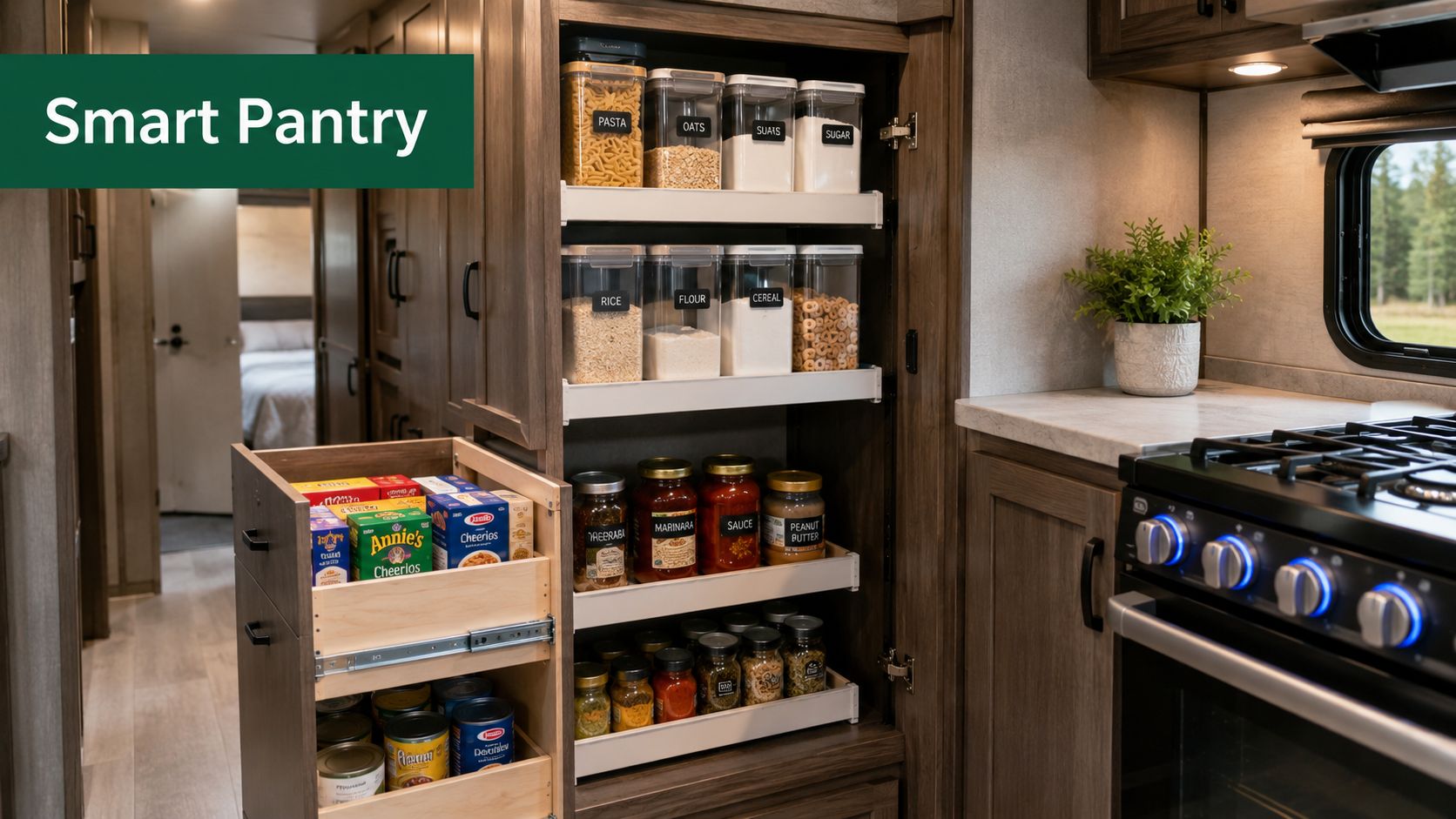
The best pantry setups are boring in a good way. Clear containers, narrow bins, shelf risers, and pull-out trays make inventory obvious. If you can't see it, you'll buy it twice or let it expire. That's especially true for spices, baking supplies, snack packets, and canned staples.
Set up a pantry you can maintain
A reliable RV pantry usually includes:
- Tiered organizers: Best for canned goods and short jars.
- Uniform containers: Better stacking, easier labeling, less visual noise.
- Door-mounted spice storage: Frees shelf depth for bulkier items.
- A FIFO habit: First in, first out keeps older stock moving.
Label containers with contents and, when useful, purchase or expiration information. Keep your most-used items at eye level. Put backup inventory somewhere else if it starts crowding out everyday cooking tools.
For more detailed pantry organization ideas, this kitchen pantry guide is a solid reference. If you like to buy non-perishables in bulk, don't force all of that volume into the RV. Store excess elsewhere and rotate it in as needed. That's one of the simplest ways to keep a small kitchen functional for long-term living.
10 RV Interior Ideas: Side-by-Side Comparison
| Item | 🔄 Implementation Complexity | ⚡ Resource Requirements | 📊 Expected Outcomes | 💡 Ideal Use Cases | ⭐ Key Advantages |
|---|---|---|---|---|---|
| Multi-Functional Furniture with Hidden Storage | Moderate–High: may need customization or pro install | Higher upfront cost; durable materials; space planning | Significant space saved; reduced visible clutter; limited extra capacity | Small RVs needing dual-purpose pieces and long-term solutions | Integrates storage into furniture for high utility per footprint |
| Vertical Wall Storage and Shelving Systems | Low–Moderate: simple installs, occasional reinforcement | Low cost; lightweight materials; possible wall reinforcement | Better accessibility and visible storage; limited heavy-load capacity | Kitchens, entryways, and vertical dead zones in RVs | Affordable, keeps floor space open and customizable |
| Under-Bed Storage Containers and Drawers | Low: often plug-and-play or simple installs | Low cost for bins/drawers; moisture protection advised | Large hidden capacity; dust-protected storage; retrieval limits for heavy items | Bedding, clothing, seasonal items that fit under beds | Cost-effective use of wasted space without wall changes |
| Decluttered Minimalist Interior Design | High: behavioral change and sustained discipline | Low monetary cost; significant time investment | Perception of larger space, lower weight, easier upkeep | Full-time RVers, those reducing possessions or prioritizing comfort | Improves efficiency, reduces stress, and saves fuel via lower weight |
| Modular and Removable Storage Solutions | Low: tool-free options common; easy reconfiguration | Moderate per-unit cost; lightweight, movable units | Flexible, transferable storage; may need securing during travel | Renters, frequently reconfiguring RVs, seasonal rotations | Non-permanent, adaptable, and renter-friendly |
| Custom Cabinet Modifications and Organizers | Moderate–High: precise measuring and installation | Moderate cost; time or pro installation; custom parts | Maximizes cabinet volume and access; constrained by original size | Owners wanting optimized cabinetry without replacing units | Tailored fit for specific items and improved daily usability |
| Door and Exterior Wall-Mounted Storage | Low–Moderate: simple interior installs; robust exterior mounts | Low interior cost; exterior requires weatherproof mounts and locks | Uses overlooked surfaces; easy access but possible exposure | Frequently-used items, shoes, toiletries, outdoor gear | Inexpensive, preserves interior living area by using doors/walls |
| Compact and Space-Saving Appliances | Moderate: fit, power, and ventilation considerations | Higher upfront cost; possible electrical/plumbing changes | Frees counters/cabinets; lowers energy/weight; reduced capacity | RVs needing efficient appliances and lower resource use | Maintains functionality with smaller footprint and improved efficiency |
| Organized and Accessible Closet Systems | Low–Moderate: retrofit-friendly with measured installs | Low–moderate cost for rods, hangers, and organizers | Doubles hanging space; clearer wardrobe selection; maintenance required | Those using capsule wardrobes or needing better clothing access | Increases visibility/accessibility and reduces garment damage |
| Efficient Kitchen Pantry and Food Storage Solutions | Low–Moderate: simple organizers and labeling routines | Moderate cost for airtight containers and organizers | Better inventory control, reduced waste, optimized cabinet use | Camp cooks, long trips, small kitchens managing food stock | Improves meal planning and preserves food with visible organization |
Your Blueprint for a Better RV Interior
A better RV interior rarely comes from one dramatic change. It usually comes from a series of smaller decisions that make daily life easier. A bench starts storing tools instead of dead space. A closet starts reflecting the season you're currently in. A kitchen stops carrying duplicate gadgets and starts supporting the meals you really cook.
That's why the best ideas for RV interior upgrades usually look practical before they look impressive. Hidden storage works because it clears surfaces. Vertical systems work because they protect floor space. Cabinet organizers work because they shorten the distance between needing something and reaching it. The visual payoff comes after the functional payoff, not before it.
If you're reworking your RV for long-term living, think in layers. First, fix access. Make sure the items you use every day are easy to reach. Second, reduce friction. Remove anything that rattles, blocks a walkway, or creates a pile-up point. Third, decide what doesn't belong in the rig at all. That's the step many people skip, and it's the one that often changes the interior most.
For full-timers and extended travelers, the primary challenge isn't decorating a small space. It's protecting that space from slow clutter. Seasonal gear, sentimental items, old paperwork, extra clothing, hobby equipment, and bulk household overflow can gradually eat into your living area. Once that happens, even a well-designed RV starts feeling tight.
That is why off-RV storage can be part of a smart interior plan, not a separate problem. If an item isn't supporting your current season, route, or daily routine, it doesn't need to live under the bed, in the wardrobe, or stuffed into an overhead cabinet. Keeping the RV lean makes everything easier. Cleaning is faster. Packing is simpler. Mornings feel calmer. Travel days involve less shifting and less hunting for essentials.
Start with the one zone that's annoying you most right now. Maybe it's the pantry. Maybe it's the under-bed compartment. Maybe it's the front entry where shoes, bags, and cables collect. Fix that area completely before moving to the next. Momentum matters more than perfection.
An RV interior should support the life you're living on the road. If a piece, appliance, or storage system doesn't earn its place, change it. That's how a cramped rig becomes a functional home.
If your RV is overflowing with off-season clothes, keepsakes, backup kitchen gear, or the stuff you don't want to get rid of but can't justify carrying, Endless Storage gives you a cleaner option. You can store by the box, skip the self-storage drive, and keep your RV set up for daily living instead of long-term overflow.
Frequently Asked Questions
Unveiling the Secrets to Effortless Storage
Endless Storage is available nationwide. You pick a plan, tell us where to pickup, and we'll send a UPS van to collect, whichever state you're in.
Your shipping label will be sent to your email within a few minutes, if not instantaneously. It can also be accessed through your customer profile.
Your box will be shipped to one of our climate controlled self storage facilities in our closest self storage facility. Our manager will accept your package, notify you that your box has been received, and securely stored. Only our managers will have access to Endless Storage boxes.
Email us at admin@endless-storage.com click to live chat with us, or send us a message below.
Never! We're committed to transparent pricing with no surprises. You'll lock in your rate with no hidden fees and no long-term contracts.
Fast access guaranteed! Your boxes will arrive at your doorstep within 48 hours of requesting them back. Need to check on delivery? We provide tracking information for complete peace of mind.
Totally flexible! Store month-to-month with no long-term commitment and cancel anytime.
Everything's online! Use your account dashboard to:
• Set up automatic monthly payments
• Request box returns
• Update your address
• Order additional boxes
• Track shipments
Your boxes are insured up to $100 each. Our customer service team will help you file any necessary claims and resolve issues quickly.
Don't worry – we'll email you right away if there's a payment issue. Your items stay safe, though you may have temporary service interruption or late fees until payment is resolved.
When you request our free storage kits, you'll have 30 days to send in your boxes to activate your 3 months of free storage. Think of it like starting a gym membership – your activation window begins when you receive your kits, and your full free trial begins once you send in your first box. During your free months, you'll experience our complete storage service at no cost.
Your 30-day activation window begins when you receive your storage kits. We'll send you an email confirmation when your kits are delivered, marking the start of your activation period.
If you haven't sent any boxes for storage within your 30-day activation window, your free trial will expire and we'll begin charging the regular monthly rate of $9.99 per box. This helps ensure our storage kits go to customers who are ready to use our service.
A box costs $9.99 per month to store (plus sales tax). This price includes free shipping for standard boxes under 50 lbs. and smaller than 16"x16"x16"
Log into your Endless Storage account, locate the box you would like returned, and simply click Return My Box.
Yes, each box stored with us is insured for up to $100 throughout transit as well as the duration of storage within our facilities.
Your box will be at your doorstep within 48 hours of you requesting it back.
Store 10+ boxes? We'll pick them up for free! After your purchase, we'll contact you to schedule a convenient pickup time and arrange UPS collection.
We trust UPS with all shipments, and every box includes $100 insurance coverage. You'll receive tracking information to monitor your items' journey.
Yes! Visit any of our locations by appointment. Just bring a photo ID matching your customer profile.
For everyone's safety, we can't store hazardous materials, firearms, or perishables. All items must fit within our standard boxes.
It's easy! Order your storage kit online, and we'll ship it to you within 1-2 business days. Your shipping labels will be emailed instantly and available in your account.
We're here to help! Email us at admin@endless-storage.com, use our live chat, or send us a message through your account.
To cancel your storage service with Endless Storage, please email your cancellation request to admin@endless-storage.com. Our team will process your request within 2 business days and confirm your cancellation via email.
We understand packing takes time. However, to maintain your free trial benefits, you'll need to send at least one box within the 30-day activation window. If you need more time, you can always start with one box to activate your trial and send the rest later. You can always reach out to admin@endless-storage.com if you have any issues or concerns.
When you request our free storage kits, you're starting a 30-day window to begin using our storage service.
Important: To activate your free trial, send at least one box for storage within 30 days. If no boxes are sent within this 30-day window, a one-time $50 fee applies to cover materials and shipping costs. This fee is clearly disclosed before you sign up.
Think of it like reserving a hotel room – we're setting aside space and sending specialized packing materials for your use. The fee only applies if you request materials but don't begin storage, similar to a hotel's no-show charge.