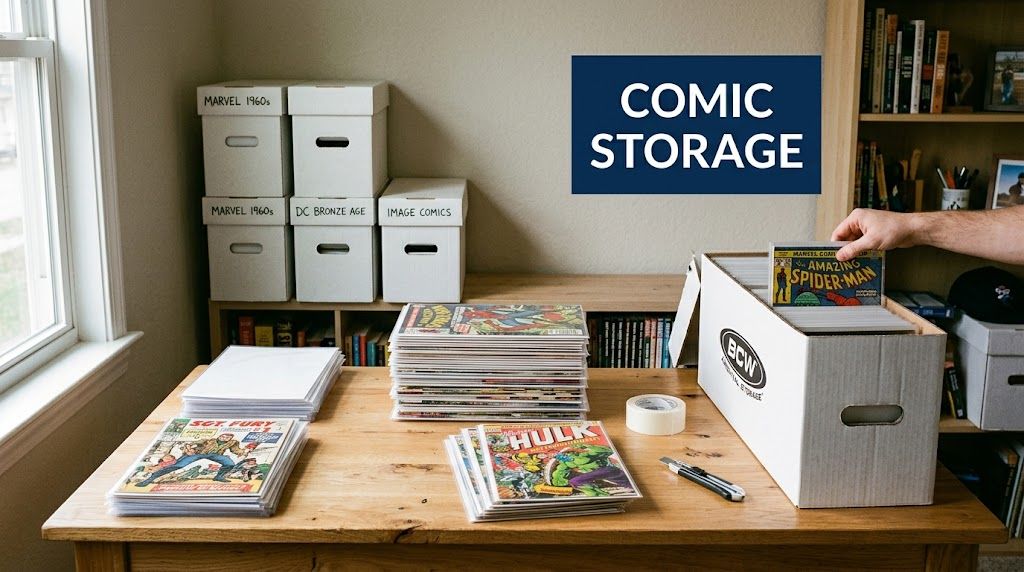
Comics have a way of multiplying in a small apartment. One shelf becomes two. A neat stack beside the bed turns into a short box in the closet, then another under the desk, then a pile you swear is temporary sitting too close to a radiator or exterior wall. The collecting part stays fun. The storage part starts to feel like low-grade panic.
That moment matters more than most collectors think. If your books are still loose, stacked, or crammed into whatever space is left, storage stops being an organization problem and becomes a preservation problem. Paper, ink, staples, and cover gloss all react to handling, pressure, light, and unstable air.
If you're trying to figure out how to store comic books in a studio, a one-bedroom, or any apartment where every closet already has a job, the answer isn't “build a museum room.” It's to make better choices in the space you have. Protect each issue correctly. Put the right books in the right place. Use your best home space for access copies and your safest overflow option for the rest.
Your Growing Collection and the Storage Challenge
You come home with a few new issues, slide them onto the shelf, and realize the shelf stopped being enough months ago. In a small apartment, that moment arrives fast. The hall closet already holds coats and luggage. The bed frame has limited clearance. The one bookcase that looks good in the living room sits too close to a window.
So the collection starts spreading into whatever space is open. Short boxes end up under the desk. Read piles sit on the floor beside the couch. Back issues get tucked onto a high closet shelf where they are hard to check and easy to ignore. That setup may feel temporary, but temporary storage has a way of lasting for years.
Convenient apartment storage often comes with real risk. Floor stacks collect dust and take pressure from anything set on top of them. Shelves near windows get more light and heat than collectors expect. Boxes pushed against exterior walls can sit in a pocket of colder or damper air than the rest of the room. If you want a broader framework for paper preservation, the same basic principles used for storing books long term without avoidable damage apply here too.
Practical rule: If you would not store important documents in that spot for a few years, don't store comics there either.
The hard part for apartment collectors is not understanding that comics need stable conditions. The hard part is finding enough stable space inside a home where every square foot already has a job. General advice like "keep them in a cool, dry place" is fine as far as it goes. It just does not answer what to do when your coolest closet is full and your driest open wall gets afternoon sun.
That is why collectors in small spaces need a tiered plan.
- Keep current reads and favorite runs at home where you can reach them without dragging out three boxes.
- Give higher-value or sentimental books the best in-home spot you have, not the spot you wish you had.
- Move overflow into properly packed, off-site box storage when the apartment stops offering safe space.
I have seen plenty of collections stay in good shape in small apartments, but only after the owner stopped treating every issue the same way. Daily-access books can live nearby if they are protected and stored well. Long runs, duplicates, completed story arcs, and books you want to preserve more than browse usually do better boxed, labeled, and moved out of the traffic of daily life.
Storage is part of collecting. In a city apartment, it is also a space-management decision. Once the collection grows past your safe in-home capacity, professional box storage stops sounding excessive and starts looking practical.
First Steps to Proper Comic Preservation
The first job isn't buying more boxes. It's changing how you handle the books you already have.
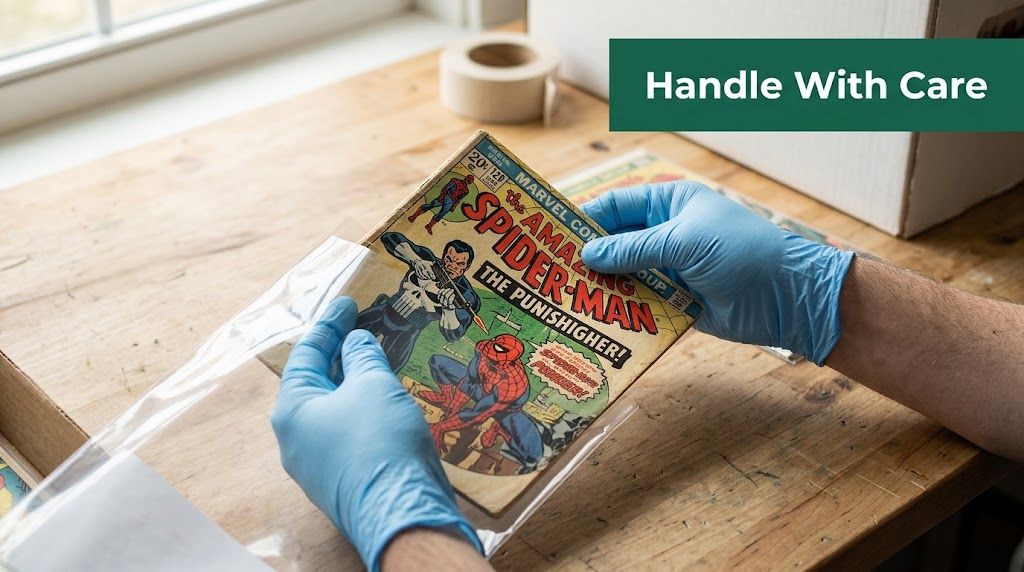
The Henry Ford's conservators recommend starting on a clean, dry surface, minimizing handling, and keeping liquids away from the work area in their comic preservation tips. That sounds simple because it is simple. It also prevents a lot of avoidable damage.
Start with a clean setup
Before you touch the collection, clear a table or desk. Dry it completely. Move drinks, food, pens, tape guns, and anything sticky or sharp somewhere else.
Then handle comics with clean, dry hands or clean gloves. You don't need to turn the whole process into a lab routine, but you do need to avoid transferring skin oils, moisture, and grime onto old paper.
A few habits matter immediately:
- Skip rubber bands: They press into edges, leave residue, and can warp a stack over time.
- Never use paper clips: Metal pressure points and scratches are a terrible trade for quick sorting.
- Don't fold a comic back on itself: Even casual reading habits can stress the spine.
- Keep books off the floor: Floors collect dust and are the first place to lose against spills or dampness.
Triage the collection before you buy everything
If your collection is already spread across shelves, bins, and stacks, don't wait until you've purchased every supply to get organized. Sort first.
I'd divide the books into three groups:
Immediate protection
Anything loose, older, fragile, or already bending goes here first.Read often
These books still need protection, but you'll want easy access.Archive later
Overflow, duplicates, and runs you aren't actively reading can wait a bit if they're currently stable and not under pressure.
This keeps the project from turning into a giant expensive stall. You're not trying to create a perfect archive in one pass. You're trying to stop active damage.
For a broader preservation mindset that also applies well to paper-based collections, this guide on storing books long term with preservation in mind is useful background.
What not to use
A lot of comic damage starts with “good enough” materials that aren't good enough. PVC vinyl bags are one of the big mistakes. Cheap wood-pulp cardboard, wood-pulp mat boards, wooden boxes, and random household containers can also create problems over time.
If the storage material itself can discolor, off-gas, or hold dampness, it shouldn't be touching your comics.
Storage location matters just as much as storage materials. Basements, attics, and other damp or high-swing spaces raise the risk of mold and paper damage. Apartment collectors sometimes think they're safe because they don't have a basement or attic, then recreate the same problem in a utility nook, near a bathroom wall, or beside a heater.
Later in the process, it helps to see good handling and packing in motion:
Bag and board one book correctly
Once you've sorted, protect each book individually. Slide the comic into an archival bag with a backing board, then seal it without forcing a too-tight fit. The point is support and protection, not compression.
If you're overwhelmed, set a small target. Do one stack. Then one box. Preservation gets easier fast once the routine becomes mechanical.
Choosing Your Archival Armor Supplies
Supply choices decide whether your collection stays flat, clean, and readable, or turns into a stack of bent corners and aging plastic. In a small apartment, they also decide how much floor and closet space your hobby takes over.
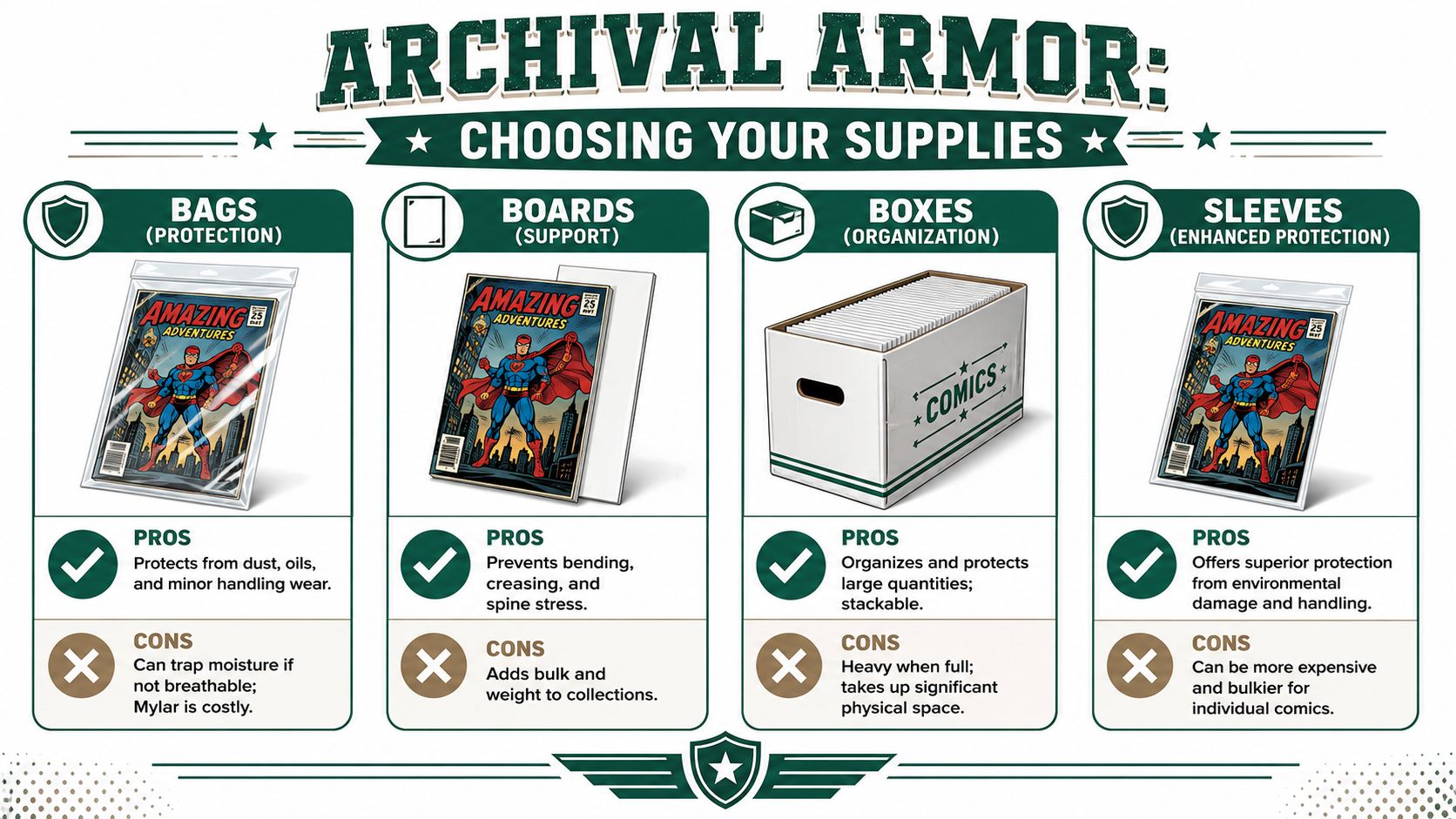
For long-term preservation, comics should be stored in archival bags made from polypropylene, polyethylene, or polyester such as Mylar or Melinex, with acid-free, lignin-buffered backing boards, then kept upright in acid-free boxes to reduce spine stress and crushing, according to this long-term preservation overview.
Bags and sleeves
The bag handles daily contact. Every pull from a box, every shelf shuffle, every fingerprint risk starts here.
Here's the practical comparison:
| Supply | Best use | Trade-off |
|---|---|---|
| Polypropylene bag | Everyday protection for most collections | Lower cost, but less durable for long storage than polyester |
| Polyethylene bag | Good all-purpose storage | Reliable and flexible, but still not the premium long-term option |
| Polyester bag such as Mylar/Melinex | Key issues and books you plan to keep for decades | Better long-term stability, but the cost adds up fast |
Collectors in apartments usually do better with a tiered setup than an all-premium one. Put keys, signed books, and older issues in polyester. Use good archival polypropylene or polyethylene for the rest. That keeps the budget under control and leaves room for better boxes, which often matter more once the collection starts spreading into closets, under-bed space, and off-site storage.
Collector's shortcut: Match the bag to the value and condition of the book, not to a late-night buying panic.
Boards are not optional
Boards do more than keep a comic looking neat. They reduce flex, help prevent corner blunting, and give the book support when you slide it in and out of a box.
Use acid-free, lignin-buffered boards. Those two terms matter because the board sits against the comic for years. Cheap boards can yellow, transfer acids, or warp before the comic does. I have seen books stored in bargain supplies come out looking straight but feeling soft and tired at the spine.
If you are buying in bulk, compare thickness as well as price. A flimsier board may save money upfront, but it does less to support a full box packed upright.
Boxes do the heavy lifting
Boxes are where apartment reality shows up. A storage system can be archivally sound on paper and still be annoying enough that you stop using it correctly.
Long boxes hold more, but they get heavy fast and are awkward in narrow closets or on high shelves. Short boxes waste a little space by volume, but they are easier to carry, easier to label, and far easier to rotate if you are storing part of the collection at home and part elsewhere. For many city collectors, that trade-off is worth it.
Material matters too. Acid-free cardboard boxes are a solid default and easier on the budget. Archival plastic boxes give better resistance to bumps, moisture exposure from minor household mishaps, and repeated handling, which can make sense for books you access often or transport to a storage unit.
For related packing logic that applies to any delicate collection, these tips on packing materials for fragile items are useful when you're comparing sturdiness, cushioning, and container quality.
Short box or long box
The right choice depends less on abstract capacity and more on your apartment layout.
- Short boxes: Better for closet shelves, under-bed storage, and anyone carrying boxes down stairs
- Long boxes: Better if you have one stable shelf with enough depth and do not move the boxes often
- Acid-free cardboard boxes: Lower-cost option for building a larger system
- Archival plastic boxes: Better physical protection, with a higher upfront cost
A packed long box can become a chore to move, and chores get postponed. In practice, that often leads to overstuffed shelves, floor stacks, or books left in shopping bags because there is no easy place to put them. Short boxes keep the system usable, which is half the battle in a one-bedroom apartment.
If your apartment has any humidity concerns, especially in lower-level units or older buildings, learn the basics of choosing the right dehumidifier unit before you decide whether cardboard is enough or plastic storage is the safer call.
The best supply setup for small apartments
If space is tight, build around access and weight first, then upgrade materials where the collection deserves it.
A setup that works well for many urban collectors looks like this:
- Archival bags for every comic
- Acid-free boards for every comic
- Short boxes as the main storage format
- Polyester bags for keys and higher-value issues
- One active reading box and separate long-term boxes
- Overflow moved into a professional box storage service before stacks start creeping into bad spots
That last point matters. Once boxes start living beside heaters, against exterior walls, or in crowded utility closets, the supply choice stops being the main problem. Good materials still matter, but too much collection in too little apartment usually calls for a second location. Professional box storage is often the cleanest answer. It keeps the collection organized without forcing your home storage into places that were never good for paper in the first place.
Creating the Ideal Storage Environment at Home
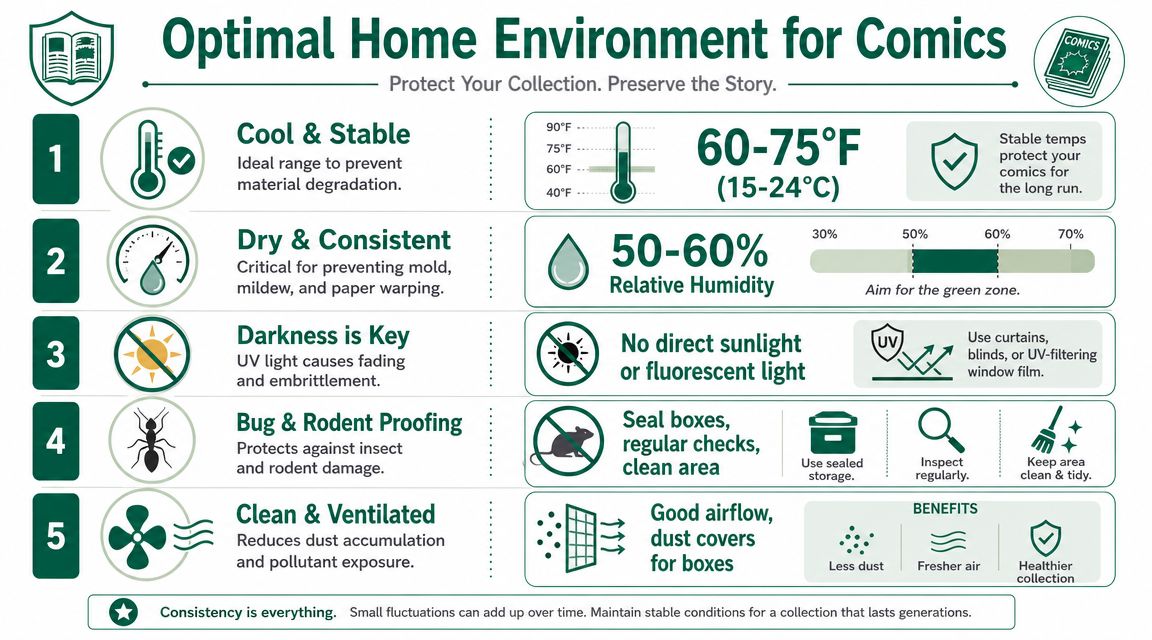
In a small apartment, the danger usually is not bad intent. It is the box that ends up beside a radiator because the closet is full, or the stack that gets pushed against an outside wall because that corner looks unused. Comics can be bagged, boarded, and boxed correctly and still age fast if the room swings between damp, hot, and dry.
Paper likes consistency. A stable room with low light and moderate humidity will do more for a collection than expensive supplies stored in a bad spot.
Where comics should live in a small apartment
The best home location is usually an interior closet, under a bed in a climate-stable room, or a low shelf away from windows and plumbing. In apartment terms, that means choosing the least dramatic part of the unit. Hall closets often beat living room shelving. Bedroom closets often beat any space near a kitchen or bathroom.
Look for these traits:
- Interior placement: Less exposure to outdoor temperature shifts
- Low light: Better protection against fading and paper breakdown
- Distance from plumbing: Lower leak and steam risk
- Clean airflow: Enough circulation to avoid stale, damp pockets
- Easy access: A spot you can maintain, check, and rotate through
Access matters more than people admit. If boxes are too hard to reach, they start migrating into worse locations. In a studio or one-bedroom, a good storage system has to work with daily life, not against it.
If one room runs damp for part of the year, learn the basics of choosing the right dehumidifier unit before adding equipment. An oversized machine can dry a small room too aggressively, and an undersized one will barely change the conditions around the boxes.
What to do if your apartment isn't ideal
A lot of city apartments have one weak point. Summer humidity, winter radiator heat, poor insulation, or a closet with dead air. You may not be able to fix the whole apartment, but you can improve the area around the collection.
Start with monitoring. Put a small hygrometer near the boxes and check it during weather swings, not just on a pleasant day. If that area keeps drifting damp, move the books before trying to solve everything with gadgets.
For difficult rooms, sealed polypropylene or polyethylene containers can help, especially for books you do not need to access every week. Add humidity-control packets and replace them on schedule. The trade-off is simple. Better moisture buffering, less ventilation, and less convenience. For active reading copies, I still prefer standard comic boxes in a stable closet because they are lighter and easier to sort through.
Collectors who are trying to judge whether their apartment is "good enough" usually benefit from seeing real storage benchmarks. This guide to temperature ranges in climate-controlled storage gives a practical reference point for what stable conditions look like outside the abstract advice to keep things cool and dry.
Light is slower than moisture, but it still causes damage
Moisture creates obvious problems. Light creates gradual ones. Covers fade, inks lose punch, and paper gets more brittle over time.
Keep display selective. Frame or shelf a copy you can live with rotating out later, and keep the rest boxed in the dark. If a shelf gets afternoon sun, it is decoration space, not archive space.
For apartment collectors, this is usually the point where home storage stops being a materials question and becomes a square-footage question. Once the safest closet is full, the next available spaces are often the exact ones you should avoid. That is when professional box storage starts making practical sense. It lets you keep a smaller home-access set nearby and move overflow into a cleaner, more stable environment instead of forcing long boxes into utility corners, entryways, or other bad paper-storage spots.
If you remember one rule, make it this: choose the most stable space you have, even if it is less convenient.
Long-Term Solutions for the Serious Collector
Once the books are protected and the home environment is as good as you can make it, one problem remains. Volume. A large collection doesn't stop taking space just because it's packed correctly.
For urban collectors, conventional advice often falters. The Library of Congress acknowledges the broader challenge in its care guidance for comics: people often need practical ways to separate a home-access collection from a larger archived one when space is limited. That is the apartment collector's dilemma.
Build a system you can actually search
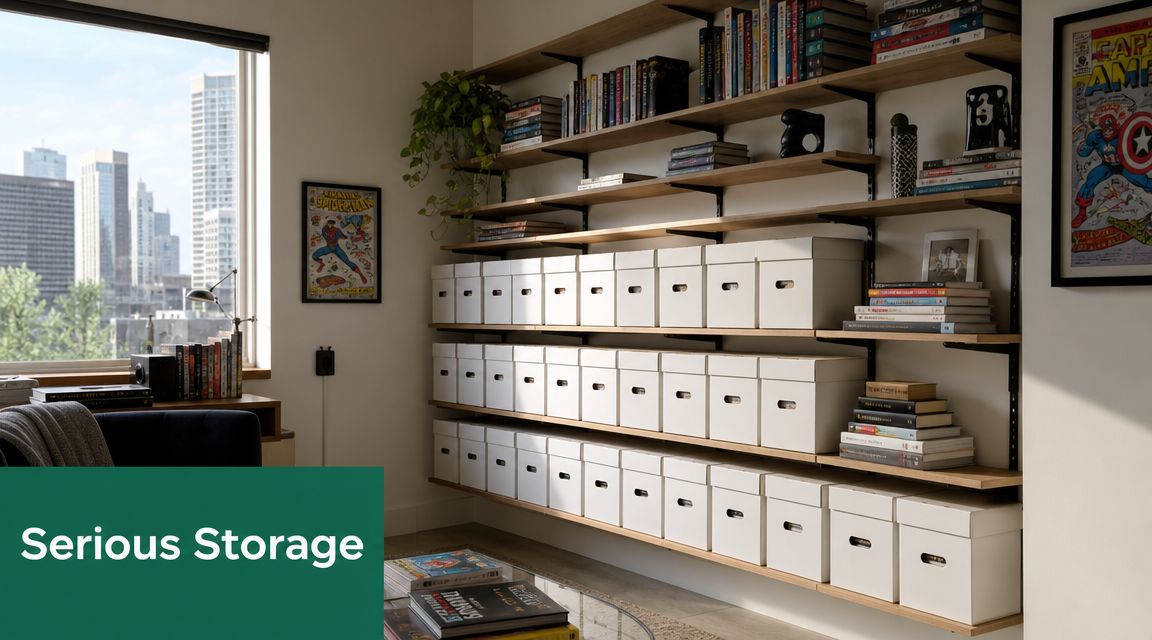
The first long-term upgrade is organization, not another buying spree. Label every box clearly and keep the labeling scheme simple enough that you won't abandon it after three weekends.
Good labels usually include:
- Title or publisher
- Issue range or story arc
- Era or volume
- Priority tag such as read, archive, duplicate, or display
Then track the boxes in a spreadsheet or a collection app like CLZ Comics if you prefer digital cataloging. The tool matters less than consistency. You want to know what is in Box 4 without opening Box 1 through Box 3 to find out.
Use tiered storage
Most serious collectors don't need every comic at home all the time. They need access to some comics, confidence about the rest, and a system that doesn't damage the collection just to keep it nearby.
Tiered storage works well:
| Tier | What goes there | Best location |
|---|---|---|
| Access tier | Current reads, favorites, books you pull often | Best closet, cabinet, or shelf in the apartment |
| Protected home tier | Important books you don't browse constantly | Interior closet or sealed archival boxes |
| Archive tier | Overflow, duplicates, completed runs, lower-access material | Stable off-site storage |
This solves a problem many collectors create for themselves. They keep everything in reach, then overpack shelves, stack boxes badly, and expose the entire collection to daily apartment conditions.
The biggest storage mistake in a small apartment usually isn't owning too many comics. It's insisting that all of them need to live in the same room.
Why box-based off-site storage makes sense
Traditional self-storage can work, but for apartment collectors it often introduces new friction. You need a car trip, you rent more space than the collection needs, and you may end up paying for empty air around a few boxes because that's how units are sold.
A box-based service fits the comic problem better. Comics are naturally containerized. They sort well by run, title, era, or priority. You can move the overflow off-site by box instead of by room.
If you're comparing off-site methods, it helps to understand broader climate controlled storage options and what stable storage conditions should provide before trusting any facility with paper collectibles.
For collectors who are planning farther ahead, these long-term storage tips for preserving stored items are a good framework for thinking beyond the next closet cleanout.
What belongs off-site first
If you're deciding what leaves the apartment first, don't start with value alone. Start with use.
Move these categories first:
- Completed runs you rarely touch
- Duplicates and reader copies
- Bulk modern issues
- Seasonal display books
- Anything forcing you to stack or overfill home boxes
Keep home access for the books you read, rotate, or want close. That's the balance that lets a collection keep growing without making your apartment feel like the storage unit.
Protecting Your Passion for Years to Come
A long box under the bed works for a while. Then a short box slides into the hall closet, another ends up beside the sofa, and suddenly a small apartment starts storing comics badly because there is nowhere left to put them properly.
Long-term protection comes down to staying consistent once the collection outgrows your best shelf. Good habits matter more than fancy gear. Bag and board the books you want to keep. Keep boxes filled enough that issues stay upright without slumping. Avoid windows, radiators, exterior walls, and any spot that swings between damp and dry.
I use a short checklist when a collection starts spreading into living space:
- Keep every issue supported. Replace torn bags, warped boards, and overstuffed boxes before they cause bends.
- Track where the books are. A simple inventory by title, run, or box number saves time and prevents rough searching later.
- Separate access copies from archive copies. The books you read often can stay home. The rest should stop competing with your apartment.
- Plan for transport before you need it. Moves, repairs, and lease changes are when corners get bumped and boxes get dropped.
- Protect the collection financially too. Review options for insuring items in storage if replacing the books would hurt.
Handling matters during moves as much as it does on the shelf. Guidance on Perth fragile removals and storage points to the same rule comic collectors should follow anywhere. Fragile collections hold up better when they are packed deliberately, carried upright, and never treated like ordinary household boxes.
For apartment collectors, the hardest part is not knowing the rules. It is having enough stable space to keep following them year after year. Once overflow forces boxes into closets with poor airflow or stacks them in awkward corners, off-site box storage stops being a luxury and starts being the practical way to protect the collection.
You do not need a perfect archive room. You need a system you can maintain in real life, in the space you have. That is what keeps a collection sharp, organized, and worth owning later on.
If your comic boxes are starting to overtake your apartment, Endless Storage gives you a practical way to protect the overflow without renting a whole storage unit. You can keep your favorite books at home, archive the rest by box in climate-controlled storage, and get them returned when you need them. For city collectors, that's often the cleanest way to make space without compromising preservation.
Frequently Asked Questions
Unveiling the Secrets to Effortless Storage
Endless Storage is available nationwide. You pick a plan, tell us where to pickup, and we'll send a UPS van to collect, whichever state you're in.
Your shipping label will be sent to your email within a few minutes, if not instantaneously. It can also be accessed through your customer profile.
Your box will be shipped to one of our climate controlled self storage facilities in our closest self storage facility. Our manager will accept your package, notify you that your box has been received, and securely stored. Only our managers will have access to Endless Storage boxes.
Email us at admin@endless-storage.com click to live chat with us, or send us a message below.
Never! We're committed to transparent pricing with no surprises. You'll lock in your rate with no hidden fees and no long-term contracts.
Fast access guaranteed! Your boxes will arrive at your doorstep within 48 hours of requesting them back. Need to check on delivery? We provide tracking information for complete peace of mind.
Totally flexible! Store month-to-month with no long-term commitment and cancel anytime.
Everything's online! Use your account dashboard to:
• Set up automatic monthly payments
• Request box returns
• Update your address
• Order additional boxes
• Track shipments
Your boxes are insured up to $100 each. Our customer service team will help you file any necessary claims and resolve issues quickly.
Don't worry – we'll email you right away if there's a payment issue. Your items stay safe, though you may have temporary service interruption or late fees until payment is resolved.
When you request our free storage kits, you'll have 30 days to send in your boxes to activate your 3 months of free storage. Think of it like starting a gym membership – your activation window begins when you receive your kits, and your full free trial begins once you send in your first box. During your free months, you'll experience our complete storage service at no cost.
Your 30-day activation window begins when you receive your storage kits. We'll send you an email confirmation when your kits are delivered, marking the start of your activation period.
If you haven't sent any boxes for storage within your 30-day activation window, your free trial will expire and we'll begin charging the regular monthly rate of $9.99 per box. This helps ensure our storage kits go to customers who are ready to use our service.
A box costs $9.99 per month to store (plus sales tax). This price includes free shipping for standard boxes under 50 lbs. and smaller than 16"x16"x16"
Log into your Endless Storage account, locate the box you would like returned, and simply click Return My Box.
Yes, each box stored with us is insured for up to $100 throughout transit as well as the duration of storage within our facilities.
Your box will be at your doorstep within 48 hours of you requesting it back.
Store 10+ boxes? We'll pick them up for free! After your purchase, we'll contact you to schedule a convenient pickup time and arrange UPS collection.
We trust UPS with all shipments, and every box includes $100 insurance coverage. You'll receive tracking information to monitor your items' journey.
Yes! Visit any of our locations by appointment. Just bring a photo ID matching your customer profile.
For everyone's safety, we can't store hazardous materials, firearms, or perishables. All items must fit within our standard boxes.
It's easy! Order your storage kit online, and we'll ship it to you within 1-2 business days. Your shipping labels will be emailed instantly and available in your account.
We're here to help! Email us at admin@endless-storage.com, use our live chat, or send us a message through your account.
To cancel your storage service with Endless Storage, please email your cancellation request to admin@endless-storage.com. Our team will process your request within 2 business days and confirm your cancellation via email.
We understand packing takes time. However, to maintain your free trial benefits, you'll need to send at least one box within the 30-day activation window. If you need more time, you can always start with one box to activate your trial and send the rest later. You can always reach out to admin@endless-storage.com if you have any issues or concerns.
When you request our free storage kits, you're starting a 30-day window to begin using our storage service.
Important: To activate your free trial, send at least one box for storage within 30 days. If no boxes are sent within this 30-day window, a one-time $50 fee applies to cover materials and shipping costs. This fee is clearly disclosed before you sign up.
Think of it like reserving a hotel room – we're setting aside space and sending specialized packing materials for your use. The fee only applies if you request materials but don't begin storage, similar to a hotel's no-show charge.