
The absolute best way to store your baseball cards is to build a multi-layer fortress around them. Think of it like this: first, a soft penny sleeve, then a rigid toploader, and finally, everything neatly filed away in archival-safe boxes. This classic combo is your best defense against bent corners and surface scratches, locking in the card's condition and value for years.
Protecting Your Collection from the Start

Whether you’re sitting on a potential high-value rookie card or just want to protect the sentimental favorites from your childhood, proper storage is the bedrock of any serious collection. It's about so much more than just preventing a bent corner; it’s about defending your cards against the invisible enemies that can absolutely ruin them over time.
I like to think about card protection in layers. The most basic layer is individual protection, which is your first line of defense. This almost always means slipping a card into a soft sleeve before giving it a more rigid home. For common cards you don't care much about, a simple penny sleeve might be enough. But for anything you value—personally or financially—you'll want to add a more robust second layer.
To give you a clearer picture, here’s a quick rundown of the protection levels most collectors use.
Quick Guide to Card Protection Levels
Each level offers a different degree of security, so you can match your storage method to the value and importance of the card.
Understanding Environmental Threats
Beyond physical dings and drops, the real long-term battle is against the environment itself. These silent destroyers can degrade a mint-condition card faster than any accidental spill. The main culprits you need to fight are:
- Humidity: Too much moisture in the air is a card killer. It can cause the cardboard to warp, bow, or even stick to other cards. Over time, this can lead to mold, which is basically a death sentence for a card.
- Temperature: Extreme heat or wild temperature swings are just as bad. They can make the cardstock brittle and incredibly fragile. This is exactly why attics and unfinished basements are the worst places to store your collection.
- Light: Direct sunlight or even harsh indoor fluorescent lighting will bleach the color right out of your cards. This UV damage is permanent and will tank a card’s value and eye appeal.
To keep your baseball cards looking crisp for years, you have to get serious about long-term care. The principles are surprisingly similar to learning how to store antique books and preserve your collection. Both hobbies demand a real commitment to controlling the environment.
The Foundation of Smart Storage
The choices you make right at the beginning will determine how well your collection holds up decades from now. By starting with the right materials and just a basic awareness of those environmental risks, you're building a strong foundation for the future. Believe me, establishing good habits now saves you from costly—and often heartbreaking—mistakes down the road.
This guide is all about practical, real-world advice for every kind of collector. If you're brand new to this, you might also find our beginner's guide on how to store collectibles a great place to start. This first step is all about making smart, proactive decisions to protect your passion and your investment from day one.
Choosing the Right Supplies for Card Preservation

The supplies you pick to store your baseball cards can make the difference between preserving a treasure for decades and watching it slowly, heartbreakingly fall apart. Walking into a card shop or browsing online can feel overwhelming, but a few key principles will help you choose the right gear with confidence. Your first and most important rule: always look for the two magic phrases: acid-free and PVC-free.
These terms are non-negotiable. Acidic materials, like those in old shoeboxes or cheap paper, will yellow and weaken your cards. PVC (polyvinyl chloride), a common plastic, releases chemical plasticizers that create a cloudy, oily film on card surfaces, causing permanent damage. I’ve seen it happen firsthand to cards stored in those cheap binder pages from the '90s. It’s a sad sight.
The Essential First Layer: Penny Sleeves
For any card you care about, your first line of defense is the humble penny sleeve. These thin, soft plastic sleeves are the most basic and crucial part of any storage system. They shield card surfaces from fingerprints, dust, and tiny scratches when you’re handling them or sliding them into harder cases.
- Function: Provides that initial barrier against surface scratches, dust, and finger oils.
- Material: Stick with polypropylene sleeves. They are stable, acid-free, and PVC-free.
- Best Practice: Never, ever put a raw card directly into a rigid holder. That friction can cause micro-scratches on the glossy surface before you know it.
At just a few dollars for a pack of 100, penny sleeves are the single best investment you can make for the health of your collection. Think of them as the primer coat before you paint; it’s a small, inexpensive step that guarantees a much better final result.
Stepping Up Protection: Rigid and Semi-Rigid Holders
Once a card is snug in its penny sleeve, it needs a sturdier home to protect it from bends, dings, and pressure. This is where toploaders and semi-rigid holders come in.
Toploaders are the industry standard for most collectors. These are the familiar stiff plastic holders that offer fantastic protection against impacts and bending. They’re perfect for rookies, inserts, and any low-to-mid-value cards you want to keep in mint condition.
Semi-rigid holders, like the popular Card Savers, are thinner and more flexible. While they don’t offer the same brute-force impact protection as a toploader, they are the preferred holder for submitting cards to grading companies like PSA. Their flexibility makes it easier for graders to safely remove the card without causing any corner or edge damage.
Pro Tip: Match the holder to the card's purpose. If a card is staying in your personal collection, a toploader is a great, affordable choice. If you're even thinking about getting it professionally graded down the road, putting it in a semi-rigid holder now saves you a step later.
For Your Best Cards: One-Touch vs. Graded Slabs
For your most valuable or cherished cards—the real jewels of your collection—you need elite-level protection. Your two main options are one-touch magnetic holders and professional grading.
One-Touch Magnetic Holders: These are high-quality, two-piece rigid cases that snap together with a strong magnet. Many offer UV protection to prevent fading from light exposure and feature recessed "arrowhead" corners to keep the card’s delicate corners pristine. They're a fantastic way to display autographed cards or high-value raw cards with a premium look and feel.
Professional Grading (Slabs): This is the pinnacle of card protection and authentication. Companies like PSA, Beckett (BGS), and SGC will verify your card’s authenticity, grade its condition on a 10-point scale, and encapsulate it in a sonically sealed, tamper-proof plastic case—often called a "slab."
Grading doesn't just provide maximum physical protection; it also certifies the card's condition, which solidifies its market value. With the sports trading card market valued at $11.52 billion in 2024 and projected to keep growing, protecting the certified value of your top assets has never been more important. You can dig into the full analysis of the sports trading card market growth on Zion Market Research.
Knowing how to protect individual cards is fundamental, but what about the materials needed to ship a whole box of them? You might find our detailed guide on choosing the right packing materials for fragile items useful, as many of the same principles apply.
Organizing Your Collection for Access and Display

Now that your cards are individually protected in sleeves and toploaders, it's time to think bigger. We're zooming out from the single card to the collection as a whole. This is all about creating a system that not only keeps your cards safe in bulk but also makes them easy to find and enjoy. A good organization system turns "Where did I put that '89 Griffey Jr. rookie?" into a quick grab instead of an hour-long excavation project.
There’s no one "right" way to organize—the best method is the one that makes sense for your collection and how you interact with it.
- By Year and Set: This is the go-to for set builders. Keeping all your 1987 Topps cards together makes it simple to see which ones you're still hunting for.
- By Player: My personal favorite for star players. It’s incredibly satisfying to have a dedicated box or binder just for your Ken Griffey Jr. or Mickey Mantle cards.
- By Team: A fantastic approach for die-hard fans. It lets you see the evolution of your favorite team through the years, all in one place.
Honestly, most experienced collectors I know use a hybrid approach. They might sort their main collection by year but pull out all their favorite players or valuable rookies into a separate, more accessible spot.
Archival Boxes: The Workhorse of Bulk Storage
For any collection that’s more than a shoebox full, archival-quality cardboard boxes are going to be your best friend. And I don’t mean the leftover boxes from your last move. True archival boxes are built from acid-free and lignin-free materials, which is crucial. Standard cardboard breaks down over time and releases chemicals that will yellow and damage your cards.
These boxes are typically named for the number of cards they hold, like a 3,200-count or a 5,000-count "monster box." They are the absolute best solution for storing large runs of common cards, base sets, or even stacks of sleeved and toploaded cards that you don't need to look at every day. When packed correctly, they provide a dark, secure, and stable home for your collection.
The Great Binder Debate
Binders are amazing for one thing: browsing. There's nothing like flipping through the pages of a complete set. But there's a huge catch. If you’re using a classic, round O-ring binder from your school days, you need to stop. Right now. The curve of the rings puts pressure on the cards closest to the spine, eventually leaving a permanent, value-killing dent.
The only safe option for long-term storage is a D-ring binder. The flat side of the "D" lets the pages lie perfectly flat, eliminating the pressure points that cause damage. Always use them with high-quality, non-PVC pocket pages to prevent chemical leeching.
Binders are great for your mid-to-low-value sets, but they offer almost no protection from drops or being crushed. For that reason, I never put my high-end cards in a binder.
If you’re staring at stacks of cards and need more ideas, you might want to check out our detailed guide on how to organize your baseball cards for easy access.
Advanced Solutions for High-Value Assets
When your collection starts to include cards that are serious financial assets, your storage game needs to level up. A cardboard box just won't cut it for a card worth thousands of dollars.
- Specialized Card Cases: For graded cards in slabs, you can get heavy-duty cases that look like something out of a spy movie. These briefcases usually have dense foam interiors with perfect cutouts for PSA, BGS, or SGC slabs. They hold everything securely, making them perfect for transport and protecting against shocks.
- Fireproof Safes: For the absolute crown jewels of your collection, a home fireproof safe offers incredible peace of mind. Look for a model that's rated for both fire and water protection. A word of warning, though: a sealed safe can trap moisture. I always toss in a few desiccant packs to keep the humidity down.
To help you decide, here’s a quick rundown of how these bulk storage methods stack up against each other.
Comparing Bulk Storage Methods
When you're deciding how to store your organized collection, each method has its own set of trade-offs. The right choice depends on your collection's value, size, and how often you plan to access it.
Ultimately, the goal is to build a system you can actually maintain. A well-organized collection is a happy collection—and one that's far easier to manage, protect, and enjoy for years to come.
Mastering Your Storage Environment
You could have your cards locked away in the most expensive cases imaginable, but if they're stored in the wrong place, you're still fighting a losing battle. While physical protection is the first step, mastering your storage environment is what separates a good collection from a truly preserved one. It's all about defeating the invisible threats that silently degrade your cards over time: humidity, temperature, and light.
I’ve seen it happen. A friend of mine stashed his collection in a basement he thought was perfectly dry. Months later, he discovered his prized rookie cards had developed a slight curve and a musty smell from the subtle, constant moisture. Once that damage is done, it's irreversible. Attics are just as bad—they're a card collector’s nightmare where extreme temperature swings between summer and winter can make cardboard brittle and fragile.
Ideal Climate Conditions for Card Storage
To truly preserve your collection for the long haul, you need to aim for stability. The gold standard for archival storage means keeping a consistent environment within a pretty specific range.
- Ideal Temperature: Aim for a steady 65-70°F (18-21°C). The key here is consistency. Avoid any location with rapid temperature swings.
- Ideal Humidity: Keep the relative humidity between 45% and 55%. Too high, and you risk warping and mold; too low, and the card stock can become dangerously brittle.
Think of your collection like fine wine—it needs a "cellar" with stable conditions. For most of us, an interior closet on the main floor of the house is the best bet. It’s naturally buffered from the extreme shifts that plague basements, attics, and garages.
Creating a stable environment is what takes you from simply protecting your cards to truly preserving them. This is how you ensure your collection looks just as good in 20 years as it does today.
Practical Ways to Control Your Environment
Achieving these ideal conditions at home might sound daunting, but it’s more manageable than you think. You don't need a high-tech, sealed vault to get fantastic results.
If you’re using a space prone to dampness, like a finished basement room, a small, inexpensive dehumidifier is a total game-changer. Just set it to your target humidity level, and it’ll automatically pull excess moisture from the air. This small investment can prevent thousands of dollars in damage.
For cards stored in sealed, airtight boxes, you can create a perfect "micro-climate" with desiccant packs. These are those little silica gel packets you find in new shoe boxes, and they are incredibly effective at absorbing moisture in a contained space. Just toss a few into your storage boxes to keep the contents bone-dry and safe. They're cheap, easy to replace, and offer serious peace of mind.
To get a better sense of how professional facilities manage these factors, our guide on the benefits of climate-controlled storage offers a deeper look into creating the perfect preservation environment.
The Irreversible Threat of Light Damage
Of all the environmental enemies, ultraviolet (UV) light is probably the most insidious and unforgiving. Exposure to direct sunlight—or even long-term exposure to indoor fluorescent lights—will permanently fade the vibrant colors on your cards. This damage is cumulative and simply cannot be undone.
I once saw a gorgeous Mickey Mantle card that had been displayed on a shelf for years. The side facing the room was noticeably lighter and more washed-out than the back. Its value had been slashed, all because it wasn't kept in the dark.
The absolute best thing you can do to prevent fading is to store your collection in complete darkness. This means using opaque, light-proof archival boxes and keeping them tucked away inside a closet or cabinet. While it’s tempting to display your prized possessions, save that for less valuable cards or use UV-protective holders for only very short periods. For your true investment pieces, darkness is their best friend.
Smart Storage Solutions for Urban Collectors
Living in a small apartment or condo brings its own unique set of headaches for baseball card collectors. Every square foot is prime real estate, and a growing collection can quickly feel like it’s staging a hostile takeover of your home. The key for city dwellers is to think strategically, wringing every last inch out of your limited space while making sure your cards are properly protected.
This isn't about just cramming boxes into a closet and hoping for the best. It’s about building efficient, secure systems that actually work within the realities of city living. The goal is simple: manage your collection without it managing you.
Maximizing Your Home Storage Space
First things first, let's optimize the space you've already got. An interior closet is your best friend here—it's usually dark, buffered from the wild temperature swings outside, and shielded from direct sunlight. The real trick is to use that space vertically and efficiently.
- Go Modular: Instead of one of those giant, back-breaking "monster boxes," think in terms of multiple smaller, stackable archival boxes. Something like the 1,600-count or two-row shoebox styles are perfect. They're way easier to lift, move around, and arrange on a closet shelf.
- Create a Micro-Climate: If you have to store cards in a less-than-ideal spot, you can create a stable "micro-climate." Just place your archival boxes inside a larger, sealed plastic tote. Then, toss in a few renewable desiccant canisters to soak up any ambient moisture. This creates a surprisingly dry, secure little world for your cards.
- Label Everything: Seriously, this one is non-negotiable. When your boxes are stacked six-deep in a cramped closet, you absolutely need to know what's in each one without an archeological dig. A clear, consistent labeling system is your treasure map to finding that one specific card you're hunting for.
At the end of the day, controlling the environment around your cards is the single most critical part of long-term storage.
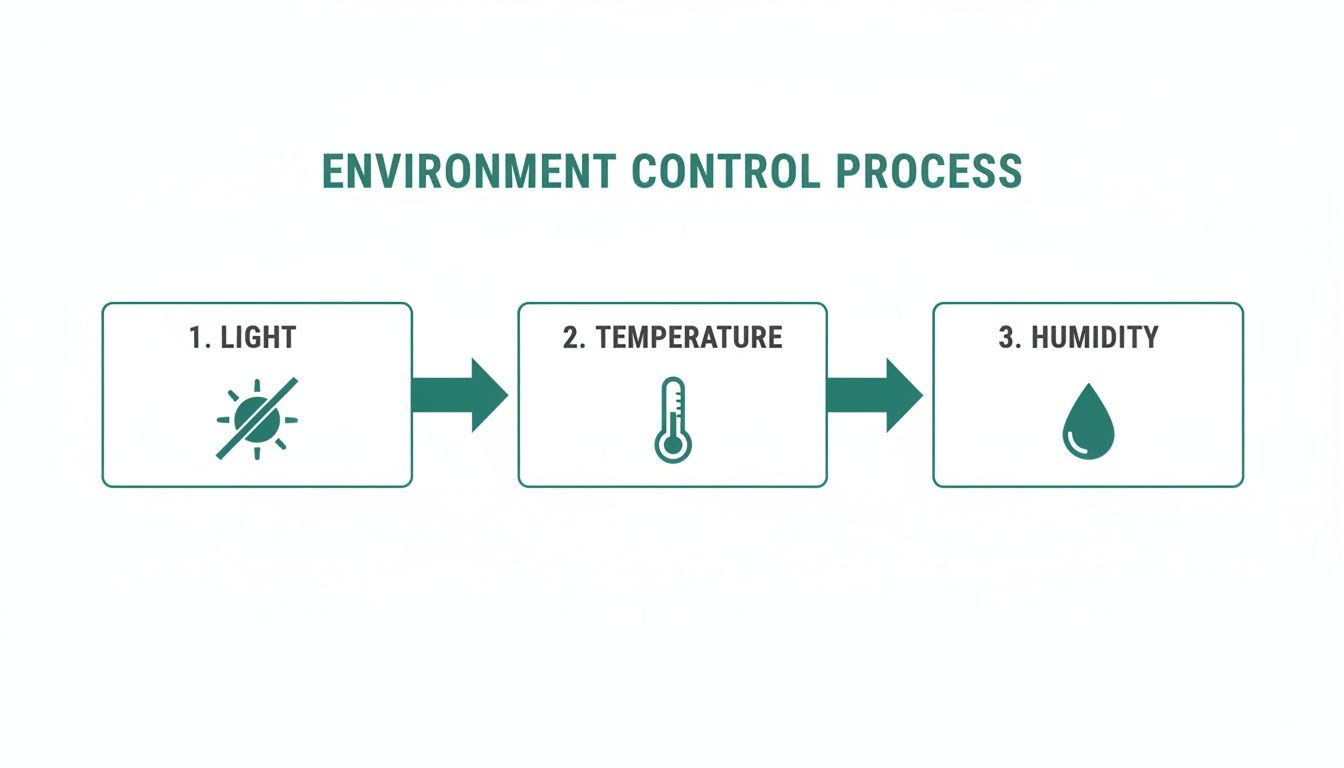
As you can see, you're defending against three main enemies: light, temperature, and humidity. If you can get a handle on all three, you’ve built a solid defense system for preserving your collection's condition and value.
When to Consider Off-Site Storage
There comes a point where your collection might just flat-out outgrow your apartment. Or maybe its value has climbed so high that keeping it at home without specialized protection starts to feel risky. This is when professional, climate-controlled storage becomes a genuinely smart move. It’s not just about getting your closet back; it’s about protecting your assets.
For collectors who are tight on room or just want a more secure off-site option, checking out a complete self-storage options handbook can give you some great insights into what’s out there.
Services that offer storage-by-the-box are a particularly good fit for urban collectors. Instead of renting an entire storage unit you’ll never fill, you can just store individual boxes in a secure, climate-controlled facility. This model is often way more affordable and convenient, especially since they usually handle the pickup and delivery of your boxes.
Preparing Your Collection for an Off-Site Service
Shipping your collection off to a storage facility requires some careful prep work. You're handing your prized possessions over to someone else, so solid packing and documentation are crucial for your own peace of mind.
- Take a Detailed Inventory: Before a single card leaves your apartment, you need a record of what you own. Use a spreadsheet or a collection management app to catalog your most valuable cards. Make sure to include details like the player, year, set, card number, and an estimated value. Snapping photos of your key cards is another wise move.
- Pack for Security: Don't just toss your cards in a box. Every single card should be in a penny sleeve, at a minimum. Your valuable cards need to be in toploaders or semi-rigid holders. Pack the boxes tightly with bubble wrap or other filler material so the cards can't shift and slam into each other during transit.
- Use High-Quality Boxes: Stick with the sturdy, archival-safe boxes provided by the storage service or use your own. Tape them up securely and label them clearly with your inventory number or a general description of what’s inside.
An accurate inventory is your single most important tool. It’s not just for organization; it’s the essential document you’ll need for insurance purposes should anything ever go wrong.
Insurance and Retrieval Logistics
Never, ever assume your homeowners or renters insurance will fully cover your collection, especially if you have high-value cards. Most standard policies have frustratingly low limits for collectibles.
- Check Your Policy: The first step is to actually read your existing insurance policy to see what its coverage limits are for collectibles like sports cards.
- Ask the Storage Service: Reputable by-the-box storage services usually include a baseline level of insurance (often $250-$500) per box. You can almost always buy additional coverage for higher-value contents. This is an absolute must for any box containing significant assets.
- Plan for Retrieval: Make sure you understand the retrieval process. How fast can you get a box back? Most services offer 48-hour return shipping, which is perfect for when you want to access your collection, sell a card, or take something to a show. Knowing these logistics ahead of time makes the whole process feel seamless and secure.
Common Questions on Storing Baseball Cards
After helping collectors for years, I've noticed the same key questions pop up time and again. It's totally understandable—navigating the nuances of proper card storage can feel tricky, especially when you're dealing with valuable or sentimental pieces.
This section tackles some of the most frequent concerns I hear. I'll give you direct, actionable answers drawn from real-world experience to help you make the best decisions for your collection and get your storage strategy on solid ground.
What Is the Absolute Best Way to Store My Most Valuable Cards?
For your top-tier, investment-grade cards, you need to think like you're building a fortress. There isn't a single magic bullet; it's all about layering multiple levels of defense to protect against every possible threat.
First, always start with a fresh, soft penny sleeve. From there, place that sleeved card into a premium rigid holder. A one-touch magnetic case is an excellent choice, as it provides superb physical protection and often includes UV-filtering properties to guard against light damage.
For maximum security and to lock in its market value, the ultimate step is professional grading. Sending a card to a trusted company like PSA or Beckett gets it authenticated, graded, and permanently sealed in a tamper-proof "slab." Once graded, these slabs should be stored in a dark, dry, and stable environment. For the absolute highest level of protection, nothing beats a fireproof safe or an insured, climate-controlled storage service.
Are Binders a Safe Way to Store Cards?
Binders can be a perfectly safe and enjoyable way to store your collection, but only if you use the right materials. The wrong binder can absolutely destroy your cards over time, a tough lesson many collectors from the 80s and 90s learned the hard way.
Here’s what you need to know:
- Avoid O-Ring Binders: The classic round rings you used in school are a card’s worst enemy. They create pressure points that will eventually leave permanent dents on the cards closest to the spine.
- Choose D-Ring Binders: Always, always opt for a D-ring binder. The flat side of the "D" allows the pages to lie perfectly flat, which eliminates that risk of pressure damage.
- Insist on Quality Pages: Only use archival-safe pocket pages that are explicitly labeled "PVC-free" and "acid-free." PVC pages contain chemicals that can leech out over time, creating a cloudy film that ruins a card's surface.
While binders are fantastic for browsing your favorite mid-to-low value sets, they offer very little protection against drops or impacts. For this reason, they just aren't the right home for your most valuable pieces.
Think of binders as a great way to display and enjoy the bulk of your collection, but reserve your more elite storage methods for the cards you can't afford to replace. This tiered approach is the hallmark of a smart collector.
How Do I Stop My Cards From Fading?
Fading is the silent killer of a card's eye appeal and value. Once it happens, the damage is permanent. The culprit is ultraviolet (UV) light, which comes from direct sunlight and even from many indoor fluorescent bulbs.
The only way to stop it is to prevent exposure in the first place. The most important rule is to keep your cards in the dark. Never display them on a wall, shelf, or desk that gets hit by sunlight at any point during the day. Seriously. The safest home for your collection is inside a light-proof archival box, tucked away in an interior closet or cabinet.
If you absolutely must display a special card, use a holder that offers UV protection. Many one-touch magnetic cases and specialized framing options are made with UV-filtering acrylic. Even with this protection, it's wise to limit the card's exposure and keep your true gems safely stored in darkness.
My Apartment Has Fluctuating Temperatures. What Should I Do?
This is an extremely common challenge for urban collectors. Apartments are often at the mercy of building-wide heating and are surrounded by exterior walls, leading to frustrating temperature and humidity swings. The best solution is to create a controlled "micro-climate" for your collection.
Start by placing your cards in their archival boxes. Then, put those boxes inside a larger, airtight plastic tote. To manage the moisture inside, add a few renewable silica gel desiccant packs. This simple setup creates a much-needed buffer against the room's changing conditions.
Store this container in the most stable part of your apartment—typically an interior closet away from windows, vents, and outside walls. For any collection with significant value, the most reliable and secure option is using an off-site, climate-controlled storage service. It offers a professional solution to a difficult at-home problem. If you think this might apply to you, our guide to insuring items in storage can help you understand how to fully protect your assets.
Managing a large collection in a small space can be tough. Endless Storage offers a simple, secure solution by storing your baseball card boxes in our climate-controlled facilities. We pick them up, keep them safe, and deliver them back whenever you need them. Visit https://www.endless-storage.com to get started today.
Frequently Asked Questions
Unveiling the Secrets to Effortless Storage
Endless Storage is available nationwide. You pick a plan, tell us where to pickup, and we'll send a UPS van to collect, whichever state you're in.
Your shipping label will be sent to your email within a few minutes, if not instantaneously. It can also be accessed through your customer profile.
Your box will be shipped to one of our climate controlled self storage facilities in our closest self storage facility. Our manager will accept your package, notify you that your box has been received, and securely stored. Only our managers will have access to Endless Storage boxes.
Email us at admin@endless-storage.com click to live chat with us, or send us a message below.
Never! We're committed to transparent pricing with no surprises. You'll lock in your rate with no hidden fees and no long-term contracts.
Fast access guaranteed! Your boxes will arrive at your doorstep within 48 hours of requesting them back. Need to check on delivery? We provide tracking information for complete peace of mind.
Totally flexible! Store month-to-month with no long-term commitment and cancel anytime.
Everything's online! Use your account dashboard to:
• Set up automatic monthly payments
• Request box returns
• Update your address
• Order additional boxes
• Track shipments
Your boxes are insured up to $100 each. Our customer service team will help you file any necessary claims and resolve issues quickly.
Don't worry – we'll email you right away if there's a payment issue. Your items stay safe, though you may have temporary service interruption or late fees until payment is resolved.
When you request our free storage kits, you'll have 30 days to send in your boxes to activate your 3 months of free storage. Think of it like starting a gym membership – your activation window begins when you receive your kits, and your full free trial begins once you send in your first box. During your free months, you'll experience our complete storage service at no cost.
Your 30-day activation window begins when you receive your storage kits. We'll send you an email confirmation when your kits are delivered, marking the start of your activation period.
If you haven't sent any boxes for storage within your 30-day activation window, your free trial will expire and we'll begin charging the regular monthly rate of $9.99 per box. This helps ensure our storage kits go to customers who are ready to use our service.
A box costs $9.99 per month to store (plus sales tax). This price includes free shipping for standard boxes under 50 lbs. and smaller than 16"x16"x16"
Log into your Endless Storage account, locate the box you would like returned, and simply click Return My Box.
Yes, each box stored with us is insured for up to $100 throughout transit as well as the duration of storage within our facilities.
Your box will be at your doorstep within 48 hours of you requesting it back.
Store 10+ boxes? We'll pick them up for free! After your purchase, we'll contact you to schedule a convenient pickup time and arrange UPS collection.
We trust UPS with all shipments, and every box includes $100 insurance coverage. You'll receive tracking information to monitor your items' journey.
Yes! Visit any of our locations by appointment. Just bring a photo ID matching your customer profile.
For everyone's safety, we can't store hazardous materials, firearms, or perishables. All items must fit within our standard boxes.
It's easy! Order your storage kit online, and we'll ship it to you within 1-2 business days. Your shipping labels will be emailed instantly and available in your account.
We're here to help! Email us at admin@endless-storage.com, use our live chat, or send us a message through your account.
To cancel your storage service with Endless Storage, please email your cancellation request to admin@endless-storage.com. Our team will process your request within 2 business days and confirm your cancellation via email.
We understand packing takes time. However, to maintain your free trial benefits, you'll need to send at least one box within the 30-day activation window. If you need more time, you can always start with one box to activate your trial and send the rest later. You can always reach out to admin@endless-storage.com if you have any issues or concerns.
When you request our free storage kits, you're starting a 30-day window to begin using our storage service.
Important: To activate your free trial, send at least one box for storage within 30 days. If no boxes are sent within this 30-day window, a one-time $50 fee applies to cover materials and shipping costs. This fee is clearly disclosed before you sign up.
Think of it like reserving a hotel room – we're setting aside space and sending specialized packing materials for your use. The fee only applies if you request materials but don't begin storage, similar to a hotel's no-show charge.