
Staring into a jam-packed closet can feel completely overwhelming, especially when you're already tight on space. This isn't just about tidying up a bit; it's about putting a real, sustainable system in place to reclaim that valuable real estate and make your daily routine a whole lot simpler. We're going to cut through the chaos and give you a clear roadmap to take your closet from a source of stress to a space that actually works for you.
And the payoff is huge, going way beyond just a neater wardrobe. Imagine opening your closet door and feeling a sense of calm instead of chaos. That's a big deal, especially when you consider that 68% of urban dwellers in small apartments are battling clutter. A proper cleanout isn't just about appearances; it can free up as much as 20% more usable living space in compact homes and has been shown to reduce daily stress by 15-20%.
Your Path to an Organized Closet
Taking on a project like this is a real investment in your own peace of mind. It doesn't matter if you're tackling personal items or sorting through office supplies; a major reorganization often starts with successfully cleaning out a storage closet. The positive effect tends to ripple out, making other areas of your home suddenly feel much more manageable.
To pull this off without getting stuck, you need a solid plan. We’ve broken the entire journey down into distinct phases, each with its own clear goal. This approach keeps you moving forward, ensuring you see steady, visible progress from the moment you start.
A closet cleanout is less about what you get rid of and more about what you decide to keep. It's an opportunity to define your style, simplify your choices, and create a space that truly serves you every single day.
Here's a quick look at the key stages we'll walk through, all designed to get you from cluttered to calm.
Your Closet Decluttering Roadmap
Here’s a quick look at the key stages for transforming your closet from cluttered to calm.
This roadmap will be our guide, ensuring you stay on track and see this project through to the finish line.
We'll dive into each of these phases, step by step:
- Preparation and Mindset: This is all about gathering your supplies and mentally preparing for the task ahead.
- Sorting and Deciding: We'll use a structured system to categorize every single item without the guesswork.
- Deep Cleaning and Repairs: Resetting the physical space is crucial for a truly fresh start.
- Strategic Organization: This is where we put everything back in a way that maximizes your space and makes your life easier.
- Maintenance and Upkeep: Finally, we’ll set you up with simple habits to keep your closet organized for good.
A Practical System for Sorting Your Belongings
Alright, everything is out of the closet. Now for the moment of truth. This is where the magic really happens, and a good system is what separates a truly organized closet from a slightly less-chaotic pile of stuff shoved back inside. Forget a simple keep-or-toss dilemma; we're going to use a much smarter four-category system.
This approach makes you really think about what each item is doing in your life right now. You’ll need four distinct zones—laundry baskets, empty boxes, or even just designated corners of the room will work perfectly.
The Four Essential Piles
Breaking it down into specific categories makes the whole process feel less overwhelming and more like a series of quick, logical decisions.
- Keep: This is the easy stuff. These are the clothes and accessories you love, wear all the time, and that genuinely fit your life today. If there's no hesitation, it's a keeper.
- Donate/Sell: Got items that are in great shape but just aren't you anymore? This is their home. They still have plenty of life left in them, just not in your closet.
- Store: Think of this as the "not right now" pile. It’s the perfect spot for off-season gear, sentimental pieces you can't part with, or that formal outfit you only need once in a blue moon.
- Trash/Recycle: Be honest and ruthless here. This is for anything stained, hopelessly stretched out, or broken beyond repair. Some things have just reached the end of the line.
Feeling a little paralyzed by the mountain of stuff on your floor? This decision tree can give you a clear path forward when you don't know where to start.

Sometimes just having a visual guide is enough to get the momentum going. It reminds you to start small and follow a structured process instead of just giving up.
Questions to Guide Your Decisions
To keep things objective and move past any "what if" guilt, run through a quick mental checklist as you pick up each item.
For the Keep pile, ask yourself:
- Have I actually worn this in the last 12 months?
- Does it fit me well today and make me feel good when I wear it?
- Does it work with my current style and lifestyle?
For the Donate/Sell pile, consider:
- Is this item clean, undamaged, and in good condition?
- Could someone else get real use and enjoyment out of this?
- Is it valuable enough to make the effort of selling it worthwhile?
For the Store pile, think about:
- Is this a seasonal piece I know I'll need in a few months (like a heavy parka or summer dresses)?
- Does this have huge sentimental value that I'm just not ready to let go of?
- Do I need this for a specific, infrequent event (like a wedding or a ski trip)?
For the Trash/Recycle pile, be direct:
- Is it damaged, pilled, stained, or broken beyond a simple fix?
- Are there holes or faded spots that can't be repaired?
Remember, the goal isn't just to get rid of things. It's to thoughtfully curate a wardrobe that actively works for you, not a museum of clothes you used to be.
This system really works. Believe it or not, the average US closet contains about $616 billion in unworn clothing. A solid cleanout often means keeping around 40% of your items and finding a new home for the rest. Plus, donating helps divert some of the 11 billion pounds of textiles that hit landfills every year.
And hey, while you're sorting, if you stumble upon any old gadgets, this guide to recycling electronic equipment is a great resource for getting rid of them responsibly. For an even deeper dive into what to keep and what to toss throughout your home, don't miss our https://www.endless-storage.com/blog-posts/decluttering-checklist.
The Deep Clean That Resets Your Space
With all your clothes and belongings sorted into piles, you're now staring at a beautifully empty closet. This isn't just a pause in the process—it's the perfect opportunity for a complete reset. Taking the time to deep clean now means your curated wardrobe will return to a pristine, fresh home.
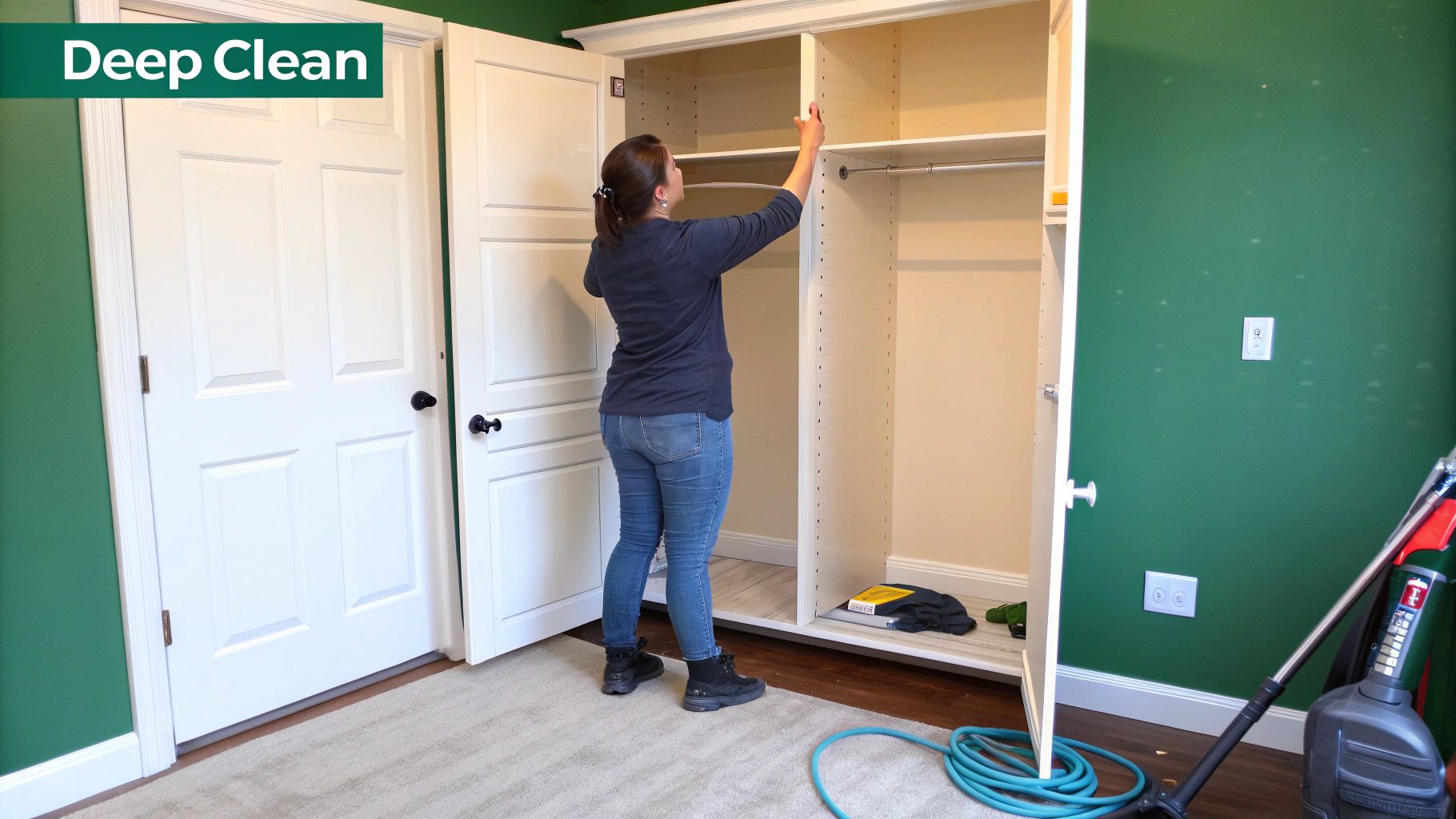
Honestly, this step is what elevates a simple tidy-up into a true home refresh. Don’t just give it a quick wipe. This is your chance to get into every corner and make the space feel brand new.
Your Deep Cleaning Checklist
My rule of thumb is to always start from the top and work my way down. This way, you’re not knocking dust onto surfaces you just cleaned. It’s a small thing, but it saves you from re-doing your work.
- Dust and Wipe Down Everything: Grab a microfiber cloth and hit the shelves, hanging rods, and even the walls. Pay extra attention to those top shelves and back corners where dust bunnies love to throw a party.
- Vacuum Thoroughly: Use your vacuum's hose attachment to get into all the nooks and crannies—the floor, along the baseboards, and even up to the ceiling for any rogue cobwebs.
- Wash Surfaces: For scuffs and grime, a mild all-purpose cleaner and a damp cloth usually do the trick. A magic eraser is an absolute lifesaver for stubborn marks on painted surfaces.
Once the basic cleaning is done, take a moment to really look at the space. This is the ideal time for those minor improvements that make a huge difference down the road.
Finishing Touches and Minor Repairs
Before you even think about putting your clothes back in, consider these final high-impact steps. They add a layer of care and protection that helps maintain all your hard work.
For instance, give the hanging rod a little jiggle. Is it secure? Do the shelf brackets feel wobbly? Tightening a few screws now can prevent a massive headache (and a pile of clothes on the floor) later. A quick coat of touch-up paint on scuffed walls or shelves can also make the entire closet look professionally refreshed.
A deep clean isn't just about removing dirt; it’s about restoring the space. Simple touches like adding cedar blocks or a fresh coat of paint transform a utilitarian storage area into a pleasant part of your room.
Finally, think about scent. Tossing in a few cedar blocks or a sachet not only repels moths but also keeps your clothes smelling fantastic. These small details contribute to that deeply satisfying “finished” feeling and make opening your closet a much nicer experience every day.
If you’re looking for more tips for a full-scale scrub-down, our move out cleaning checklist has plenty of useful ideas you can borrow.
With your clothes sorted and the closet itself sparkling clean, it’s time for the most rewarding part: putting everything back. But this isn’t just about refilling the space—it's about building a smart, sustainable system that actually works for your real life. The goal is an organized closet that’s easy to maintain, not just one that looks good for a single photo.
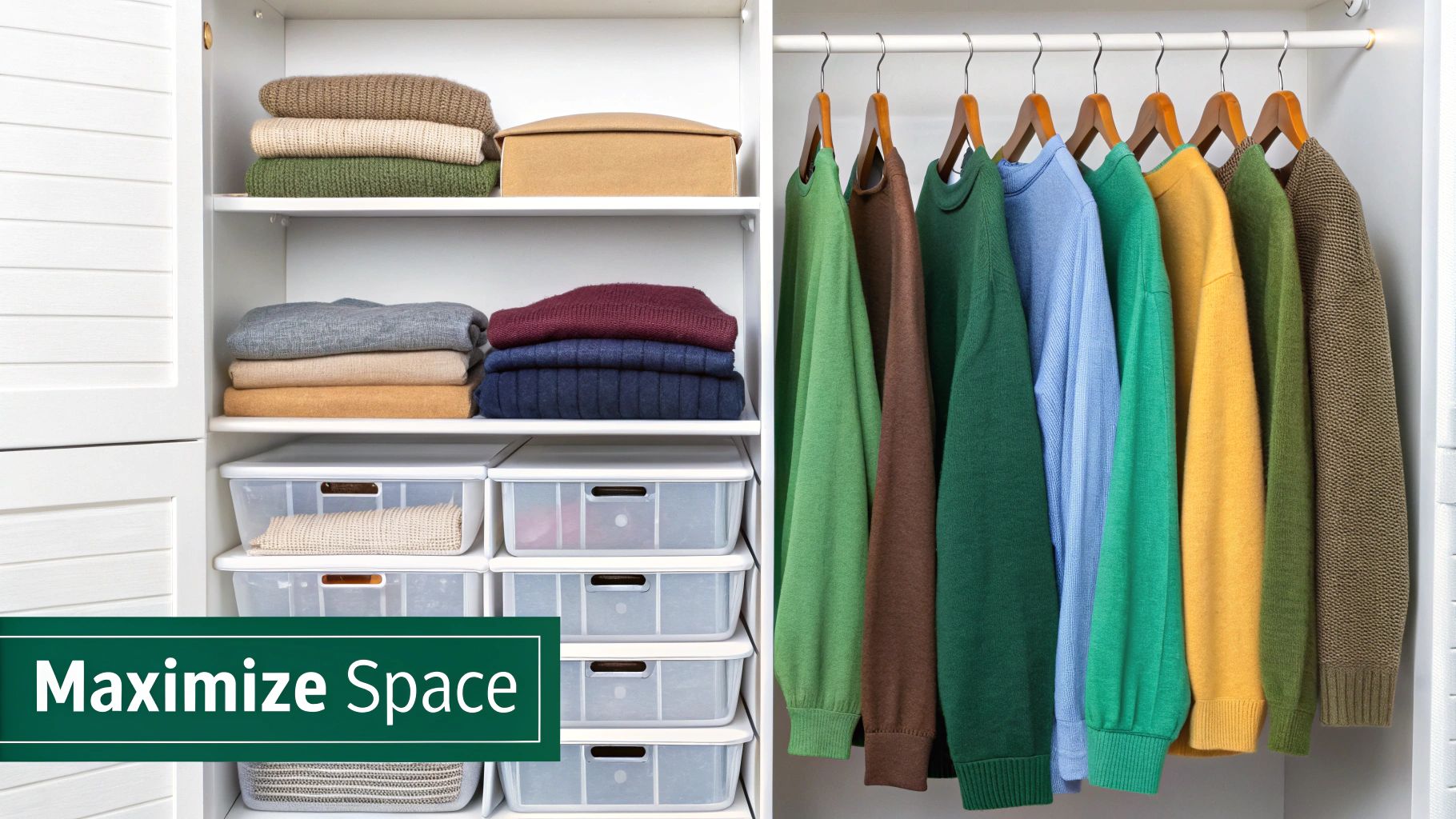
The first thing to look at is the tools you’re using. Simple swaps can make a monumental difference. For instance, ditching those mismatched plastic and wire hangers for a uniform set of slim velvet hangers can instantly create up to 30% more space on your rod. Plus, their non-slip texture keeps clothes from ending up in a heap on the floor.
Building a Smarter System
Think about your closet in zones. Group similar items together—all your t-shirts in one area, trousers in another. This simple logic saves you precious minutes every single morning because you’ll know exactly where to look for what you need.
From there, you can start bringing in some simple but effective organizational tools:
- Leverage Vertical Space: Don't let the area below your hanging clothes go to waste. A hanging shoe organizer or a set of fabric shelves can create new storage spots for folded items or accessories.
- Divide and Conquer: Drawer dividers are an absolute game-changer for corralling smaller items like socks, belts, and scarves. They stop drawers from becoming a jumbled mess and let you see everything at a glance.
- Use Clear Bins for Visibility: For items on high shelves, like out-of-season accessories or sentimental pieces, clear bins are a must. You can easily see what’s inside without having to pull everything down.
These strategies are particularly vital for anyone with limited square footage. In major cities, where apartments can average just 600 square feet, over 50% of residents struggle with not having enough storage. Getting creative with your organization can reclaim significant space.
In fact, the demand for better solutions is a big reason why the custom closets market is expected to surge from USD 33.7 billion in 2026 to a staggering USD 67.9 billion by 2035. You can dig into more market insights on home organization from Woodworking Network if you're curious about the trends.
Pro Tips for Long-Term Success
Once everything is in its place, a few expert habits can ensure your hard work actually lasts. These aren't complicated rules, just small adjustments that prevent clutter from creeping back in.
One of the best techniques I’ve seen is the "hanger trick." Turn all your hangers to face the wrong way. As you wear an item, turn its hanger back the right way. After six months, you'll have a clear visual of what you genuinely wear and what you can probably part with.
The most beautifully organized closet is useless if it’s too complicated to maintain. Your system should serve you, not the other way around. Simplicity is the key to lasting order.
Another powerful habit is the ‘one-in, one-out’ rule. For every new item of clothing you bring home, an old one must be donated or sold. This simple practice prevents your carefully organized space from becoming overstuffed again.
By putting these systems in place now, you're not just cleaning out a closet; you're creating a framework for effortless organization for years to come. For even more ideas, check out our expert guide on how to maximize closet space.
Smart Storage for Seasonal and Sentimental Items
After sorting through everything, you'll inevitably have a pile of things you love but simply don't need right now. This is your "Store" pile—a collection of bulky winter parkas, special-occasion outfits, and cherished keepsakes that hog prime real estate in your daily closet.
If you live in a smaller apartment or home, trying to cram these belongings back in is the fastest way to undo all your hard work. It recreates the very clutter you just spent hours eliminating.
This is where a smarter approach comes in. Instead of sacrificing precious closet space to items you only use a few times a year, modern off-site storage can be a total game-changer. It’s a solution designed for how people actually live, especially in cities where every square foot is at a premium.
Why Off-Site Storage Works for Your Closet Cleanout
Think about it: your closet should serve your current life. Storing heavy ski gear next to your summer dresses just makes it harder to find what you need each morning. By moving these less-frequently used items to a secure, climate-controlled facility, you free up both physical and mental space.
This isn’t about the old-school self-storage unit where you have to haul everything yourself. Modern services handle the logistics for you by sending boxes right to your door. You pack them up, they swing by to pick them up, and you can digitally track your inventory online. Need that fancy dress for a wedding? Just request it back.
A perfect "Store" box might contain:
- Seasonal Clothing: Heavy sweaters, wool coats, and flannel shirts when spring rolls around.
- Special Event Attire: Formal wear, costumes, or specific vacation outfits.
- Sentimental Heirlooms: Old photo albums, your wedding dress, or your kids' first baby clothes.
This strategy is a key part of learning how to clean out a closet effectively. It recognizes that some items are too important to get rid of but too impractical to keep in your everyday rotation.
Keeping sentimental items shouldn't mean sacrificing your living space. Smart storage allows you to honor your memories while creating a functional, clutter-free home that serves your present needs.
A Workflow for Smart Storage
Integrating this step into your closet cleanout is surprisingly simple. Once you’ve finalized that "Store" pile, you can create a quick system for packing everything away safely and efficiently.
- Prep Your Items: First things first, make sure everything is clean and completely dry before it goes into a box. This is crucial for preventing mildew and ensuring your clothes are fresh and ready to wear the moment you get them back.
- Use Quality Boxes: Sturdy, uniform boxes are your best friend here. They're easier to stack and do a much better job of protecting your belongings during transit and storage.
- Create a Simple Inventory: As you pack each box, jot down a quick list of what’s inside. You can tape the list directly to the box or just keep a note on your phone. This makes it effortless to remember where you put that one specific sweater.
- Schedule a Pickup: Once everything is packed, simply arrange for the boxes to be collected. No need to rent a truck or spend a Saturday driving to a storage facility.
By embracing this method, you get the best of both worlds. Your daily closet is streamlined and functional, holding only what you need for the current season. Meanwhile, your treasured and seasonal items are kept safe, secure, and out of sight until you need them again.
For more in-depth advice, you might be interested in our guide on how to store seasonal clothes to protect them year-round.
Your Closet Cleanout Questions Answered
Even the best-laid plans can hit a snag, and a closet cleanout is no exception. You start out strong, feeling motivated, but then you hit a wall. It’s completely normal. Knowing what hurdles might pop up can help you power through without losing steam.
This is your go-to guide for those moments you feel stuck. Whether you’re staring down a mountain of clothes with only an hour to spare or holding onto a t-shirt from a decade ago, these answers will get you back on track.
How Much Time Should I Set Aside?
This is where most people trip up. It always takes longer than you think. Be honest with yourself and look at your calendar.
For a standard closet, you’ll want to block out at least 3 to 4 hours of totally uninterrupted time. No phone calls, no errands, just you and your wardrobe. If you’re tackling a bigger walk-in, you might be looking at a full-day project.
The real goal here is to finish the sorting phase in one go. Why? Because nothing kills motivation faster than living with piles of clothes all over your bedroom for days. If you’re genuinely short on time, break it down by category. Do all your shoes one afternoon, then all your sweaters the next. Just make sure you finish an entire category before you stop.
A successful closet cleanout is a sprint, not a marathon. Dedicating a solid block of time prevents burnout and ensures you cross the finish line with a fully organized space, rather than getting stuck halfway through the mess.
What Should I Do with Sentimental Items?
Ah, the sentimental stuff. This is easily the toughest part of the process. Letting go of items tied to powerful memories feels like letting go of the memory itself.
First, ask yourself if the memory is truly in the object, or if it lives inside you. You’d be surprised how often a quick, high-quality photo of that old concert t-shirt or bridesmaid dress can preserve the feeling perfectly without taking up precious hanger space.
For the items you just can't part with—but know you’ll never wear or use again—off-site storage is a perfect middle ground. Your treasures stay safe and sound, but they aren't cluttering up your daily life. It’s a key strategy for honoring your past while making room for your present.
What Is the Secret to Keeping My Closet Organized?
A closet cleanout isn't a one-and-done deal. The real secret is maintenance. Your beautifully organized space won't stay that way on its own, but a few simple habits make it almost effortless.
- Adopt the 'One-In, One-Out' Rule: This is your new mantra. Every time a new piece of clothing comes in, a similar item has to go out. No exceptions.
- Schedule a 15-Minute Refresh: Once a month, set a timer for 15 minutes and do a quick reset. Put everything back in its designated spot, refold any stray sweaters, and straighten up your hangers.
- Conduct a Seasonal Review: Twice a year, when you’re swapping out your seasonal clothes, do a quick assessment. It's the perfect time to spot anything you haven't worn all season and decide if it's time to let it go. For tips on what to do with those items, check out our guide on where to donate old clothes.
Ready to store those seasonal and sentimental items to free up valuable closet space? Endless Storage sends boxes right to your door, picks them up for you, and keeps everything safe until you need it again. Get started with your clutter-free closet today.
Frequently Asked Questions
Unveiling the Secrets to Effortless Storage
Endless Storage is available nationwide. You pick a plan, tell us where to pickup, and we'll send a UPS van to collect, whichever state you're in.
Your shipping label will be sent to your email within a few minutes, if not instantaneously. It can also be accessed through your customer profile.
Your box will be shipped to one of our climate controlled self storage facilities in our closest self storage facility. Our manager will accept your package, notify you that your box has been received, and securely stored. Only our managers will have access to Endless Storage boxes.
Email us at admin@endless-storage.com click to live chat with us, or send us a message below.
Never! We're committed to transparent pricing with no surprises. You'll lock in your rate with no hidden fees and no long-term contracts.
Fast access guaranteed! Your boxes will arrive at your doorstep within 48 hours of requesting them back. Need to check on delivery? We provide tracking information for complete peace of mind.
Totally flexible! Store month-to-month with no long-term commitment and cancel anytime.
Everything's online! Use your account dashboard to:
• Set up automatic monthly payments
• Request box returns
• Update your address
• Order additional boxes
• Track shipments
Your boxes are insured up to $100 each. Our customer service team will help you file any necessary claims and resolve issues quickly.
Don't worry – we'll email you right away if there's a payment issue. Your items stay safe, though you may have temporary service interruption or late fees until payment is resolved.
When you request our free storage kits, you'll have 30 days to send in your boxes to activate your 3 months of free storage. Think of it like starting a gym membership – your activation window begins when you receive your kits, and your full free trial begins once you send in your first box. During your free months, you'll experience our complete storage service at no cost.
Your 30-day activation window begins when you receive your storage kits. We'll send you an email confirmation when your kits are delivered, marking the start of your activation period.
If you haven't sent any boxes for storage within your 30-day activation window, your free trial will expire and we'll begin charging the regular monthly rate of $9.99 per box. This helps ensure our storage kits go to customers who are ready to use our service.
A box costs $9.99 per month to store (plus sales tax). This price includes free shipping for standard boxes under 50 lbs. and smaller than 16"x16"x16"
Log into your Endless Storage account, locate the box you would like returned, and simply click Return My Box.
Yes, each box stored with us is insured for up to $100 throughout transit as well as the duration of storage within our facilities.
Your box will be at your doorstep within 48 hours of you requesting it back.
Store 10+ boxes? We'll pick them up for free! After your purchase, we'll contact you to schedule a convenient pickup time and arrange UPS collection.
We trust UPS with all shipments, and every box includes $100 insurance coverage. You'll receive tracking information to monitor your items' journey.
Yes! Visit any of our locations by appointment. Just bring a photo ID matching your customer profile.
For everyone's safety, we can't store hazardous materials, firearms, or perishables. All items must fit within our standard boxes.
It's easy! Order your storage kit online, and we'll ship it to you within 1-2 business days. Your shipping labels will be emailed instantly and available in your account.
We're here to help! Email us at admin@endless-storage.com, use our live chat, or send us a message through your account.
To cancel your storage service with Endless Storage, please email your cancellation request to admin@endless-storage.com. Our team will process your request within 2 business days and confirm your cancellation via email.
We understand packing takes time. However, to maintain your free trial benefits, you'll need to send at least one box within the 30-day activation window. If you need more time, you can always start with one box to activate your trial and send the rest later. You can always reach out to admin@endless-storage.com if you have any issues or concerns.
When you request our free storage kits, you're starting a 30-day window to begin using our storage service.
Important: To activate your free trial, send at least one box for storage within 30 days. If no boxes are sent within this 30-day window, a one-time $50 fee applies to cover materials and shipping costs. This fee is clearly disclosed before you sign up.
Think of it like reserving a hotel room – we're setting aside space and sending specialized packing materials for your use. The fee only applies if you request materials but don't begin storage, similar to a hotel's no-show charge.