

Trying to get a straight answer on cross-country moving costs can feel like guesswork. Forget vague estimates—the final price really comes down to three things: how much stuff you have, how far it’s going, and when you’re moving.
How to Get an Accurate Cross Country Moving Quote
Nailing down a solid quote is your first real step toward a successful move. It’s not just about getting a price; it’s about setting a budget you can trust and dodging those dreaded last-minute fees. The goal is to get a firm number, not just a shot in the dark.
This takes more than a quick phone call. You need to know what drives the cost and what details movers need from you to give you a number that won't change on moving day.
The Main Factors Driving Your Quote
Think of your quote as a reflection of the truck space, fuel, and manpower your move requires. The more you have and the farther it goes, the more resources it takes.
It all boils down to these three things:
- The Weight of Your Belongings: This is the big one. Movers charge based on the total weight of everything you own. It's simple math—moving a four-bedroom house will cost a lot more than a studio apartment.
- The Distance of the Move: Fuel isn't cheap, and long hauls mean more hours for the driving team and more wear on the truck. A move from New York to California is a much bigger undertaking than one from New York to Ohio, and the price will reflect that.
- The Time of Year: Moving is a seasonal business. The peak season runs from May through September, and the high demand can bump your price by 20-30% or more. If you can move during the off-season, you’ll almost always save money.
This infographic breaks down how your stuff, the mileage, and the season all come together to determine your final bill.
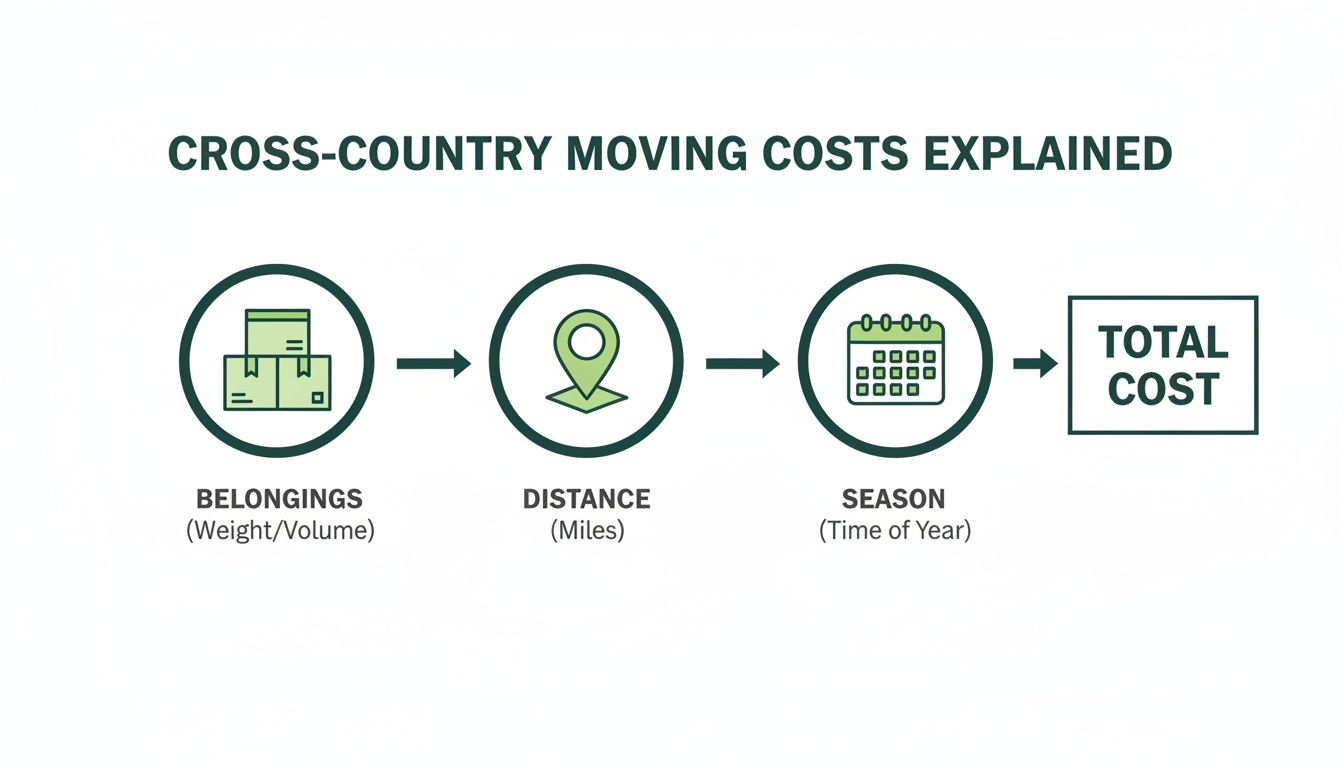
The final price is a direct result of the resources needed to handle your specific volume of goods over a set distance during a particular time of year.
The Moving Industry and Your Quote
The long-distance moving market is a crowded field, which is good news for you. Competition has led to better tools and faster quotes. But it also means you have to be careful and do your homework. For a closer look at the numbers, our guide on how to estimate moving costs is a great place to start: https://www.endless-storage.com/blog-posts/how-to-estimate-moving-costs
Pro Tip: For a complete walkthrough of the entire relocation process, this ultimate cross-country moving guide is an incredible resource. It breaks down every stage of the move so you can stay organized from start to finish.
Ultimately, understanding what goes into your price is the best way to avoid getting overcharged. It lets you walk into conversations with movers confidently, ask the right questions, and fairly compare the cross-country moving quotes you get.
Create a Home Inventory for Pinpoint Quote Accuracy
If you want to get truly accurate cross country moving quotes, the most critical thing you can do is create a detailed home inventory. A vague list is a recipe for disaster—and a surefire way to get hit with surprise charges on moving day.
This inventory isn't just a simple checklist. It's the raw data movers use to calculate the estimated weight and volume of your entire shipment, which is exactly how they determine your price. Asking for a quote without an inventory is like asking a contractor to price out a kitchen remodel without ever stepping inside the house. The number you get back will be a wild guess, at best.
Choose Your Inventory Method
Building your list doesn't have to be a huge chore. The trick is to be methodical and see it through. Just pick one approach and stick with it so nothing falls through the cracks.
Here are a few proven ways to tackle it:
- Digital Spreadsheets: A simple Google Sheet or Excel file works wonders. Just create columns for the item, the room it’s in, and any notes about its size or condition. It's clean, simple, and easy to email to movers.
- Mover-Provided Apps: Many moving companies now have their own smartphone apps that walk you through a virtual survey. You can go room-by-room, selecting items from their pre-filled lists and even snapping photos as you go.
- Video Walkthroughs: This is a surprisingly effective and simple method. Just record a slow, narrated video tour of your entire home. Make sure to open every closet, cabinet, and drawer. A video provides undeniable proof of what you're shipping.
For a more structured path, our comprehensive home inventory checklist and template can guide you room by room, ensuring you don't forget about those items tucked away in the back of the closet.
Be Brutally Honest About Your Belongings
The quality of your quote is directly tied to the quality of your inventory. This is not the time to estimate or round down.
Be incredibly specific. Don't just write "books"—try to estimate how many boxes they'll take up. Instead of just "clothes," note how many wardrobes or boxes you expect to pack. It's this level of detail that turns a vague estimate into a quote you can actually count on.
Remember, a mover’s estimate is only as good as the information you give them. Every forgotten box in the attic or piece of gym equipment in the garage adds weight and cost on moving day, which can easily turn a solid quote into a point of conflict.
This is also the perfect time to declutter. Before you even start asking for cross country moving quotes, figure out what you’re going to sell, donate, or toss. Every single item you get rid of is one less thing you have to pay to move.
Identify Specialty and High-Value Items
Some of your belongings will need special handling, and these can have a big impact on your quote. Movers need to know about them ahead of time so they can bring the right equipment and crew.
Make sure to list these items separately on your inventory.
Common Specialty Items Include:
- Large Furniture: Pianos, pool tables, oversized sectional sofas.
- Heavy Equipment: Treadmills, home gyms, large tool chests.
- Fragile Antiques: Grandfather clocks, delicate china cabinets, large artwork.
- Valuable Electronics: High-end home theater systems, large-screen TVs.
Forgetting to mention your baby grand piano until the movers show up is a classic mistake that can add hundreds of dollars to your bill. When you provide a complete and honest inventory from the start, you give movers the power to give you a quote you can truly rely on. It’s a proactive step that sets you up for a smooth move without any nasty financial surprises.
Understanding Your Quote Type and What It Means

Once you have your home inventory nailed down, you’re ready to get some actual cross country moving quotes. You’ll quickly find out that not all quotes are created equal. Getting a handle on the different types is probably the most critical thing you can do to avoid a nasty surprise on moving day.
Think of it as setting the rules of the game before you play. If you don't know how the final bill is calculated, you're flying blind. Let’s break down the three main estimates you’re going to run into.
The Non-Binding Quote
A non-binding quote is the most common type of estimate you'll see, but it’s also the one with the most wiggle room—and potential risk for you. It's essentially the mover's best guess of your final cost, based on the estimated weight of your stuff.
The real price gets figured out only after the truck is loaded and weighed. If your shipment is heavier than the estimate, your cost goes up. If it's lighter, it goes down.
For example, your quote might be for an estimated 6,000 pounds. But if the truck scales show 6,700 pounds after loading, you’re on the hook for that extra 700 pounds. While federal regulations provide some protection (the 110% rule), it’s a recipe for budget uncertainty.
The Binding Quote
A binding quote is exactly what it sounds like: a guaranteed, locked-in price. As long as you don't sneak in extra items that weren't on your original inventory, the price you were quoted is the price you pay. Period.
This is a fantastic choice if you’re on a tight budget and need predictability. The cost won't budge, even if your shipment ends up weighing more than the mover first thought.
Key Takeaway: With a binding quote, the risk of underestimating the weight is on the moving company, not you. This provides peace of mind and makes budgeting for your move much more predictable.
The flip side is also true, though. If your things weigh less than the estimate, you still pay the full, agreed-upon price. You won't get a refund for the difference. To see how these numbers come together, you can learn more by decoding the cost of professional movers in our complete guide.
The Binding-Not-To-Exceed Quote
This is the gold standard of cross country moving quotes—truly the best of both worlds. A binding-not-to-exceed quote means your final cost will never go above the estimated price, but it could go down.
Just like a regular binding quote, your price is capped. But here’s the kicker: if your shipment ends up weighing less than estimated, your bill gets adjusted downward, and you pay the lower amount. You get the security of a fixed price with the potential for savings.
To help you decide which quote is best for your situation, here's a quick comparison.
Comparing Moving Quote Types
Understand the key differences between binding, non-binding, and binding-not-to-exceed estimates to choose the right option for your move.
| Quote Type | How It Works | Best For | Potential Risk |
|---|---|---|---|
| Non-Binding | An estimate based on weight; final cost can change. | Experienced movers who are confident in their inventory's weight. | The final cost could be significantly higher than the estimate. |
| Binding | A fixed, guaranteed price based on your inventory. | Anyone on a strict budget who needs price certainty. | You won't get a refund if your items weigh less than estimated. |
| Binding-Not-To-Exceed | A capped price that can go down but not up. | Everyone; it offers the most protection and potential savings. | Can be harder to find, as it puts all the risk on the mover. |
This table makes it clear that a binding-not-to-exceed quote offers the most consumer protection, combining price security with the chance for savings.
No matter which mover you talk to, make sure you confirm the quote type in writing. It’s a non-negotiable step.
Questions to Ask Your Mover:
- Is this quote a binding, non-binding, or binding-not-to-exceed estimate?
- Can you please state that clearly in writing on the official quote?
- What happens if my shipment's actual weight is different from the estimate?
- Are there any circumstances where this price could change?
Getting straight answers to these questions is the best way to compare your offers apples-to-apples and partner with a mover who operates with transparency.
Comparing Quotes and Spotting Mover Red Flags
So you've got a few cross country moving quotes in your hands. It’s tempting to just grab the cheapest one and move on, right? We’ve seen it a hundred times, and it's a classic mistake. The goal here isn't just to find the lowest number, but to find the best value—and most importantly, to sidestep a disastrous experience with a rogue mover.
Now the real work starts: comparing your offers apples-to-apples. This means you’ll have to dig deeper than the final price and learn to spot the difference between a trustworthy partner and a potential nightmare.
How to Compare Quotes Line by Line
At first glance, three different quotes can feel like they're written in three different languages. One company might break down every single charge, while another lumps services into big, vague categories. To make a fair comparison, you need to break each quote down and see how they really stack up.
Look for these key line items on each estimate:
- Transportation Charges: This is the base cost for hauling your stuff, usually based on the weight of your shipment and the distance of your move.
- Labor Costs: How much are they charging for the crew? Is it a flat rate for the job, or are you paying by the hour? This can make a huge difference.
- Fuel Surcharges: This fee can fluctuate. Check if it’s a fixed percentage or if it’s tied to the current price of fuel.
- Packing Materials: If you’re having the movers pack for you, are they charging per box or as a single flat fee? This is an area where costs can sneak up on you.
- Valuation Coverage: Every quote has to include the basic, legally-required coverage of 60 cents per pound. You'll want to compare the costs for upgrading to Full Value Protection.
- Additional Fees: Keep an eye out for shuttle fees (if a big rig can't get to your house), stair fees, or long-carry fees (for long walks from the truck to your door).
Lay your quotes out side-by-side and compare these specific categories. You might discover that a quote with a low transportation cost is making up for it with outrageous packing fees. This is how you uncover the true cost behind the numbers.
A legitimate moving company will always give you a detailed, written estimate that clearly breaks down all the charges. If a quote is just one number with zero explanation, that’s a major red flag.
Red Flags That Scream "Stay Away"
While comparing costs is a big piece of the puzzle, vetting the company itself is even more critical. Rogue movers are notorious for luring customers with incredibly low prices, only to hold their belongings hostage for more money later on. Luckily, they often leave clues.
Be on high alert for any of these warning signs:
- An Unusually Low Bid: If one estimate is way, way lower than the others, it's almost certainly too good to be true. This is a classic "low-ball" tactic they use to get your business before jacking up the price with hidden fees.
- Large Cash Deposit Demanded: Reputable movers will never ask for a big cash deposit before the move. Payment is almost always due upon delivery, and usually with a credit card or certified check.
- Missing USDOT Number: Every single licensed interstate mover must have a U.S. Department of Transportation (USDOT) number. If you can't easily find it on their website and quote, they are likely not a legitimate company.
- Vague or Generic Business Name: Scammers love to hide behind generic names like "Interstate Movers" or "National Moving Services" to make themselves harder to track down when things go wrong.
- No Physical Address: If the company’s website doesn't list a local address or only provides a P.O. box, you should be very cautious.
If you spot any of these red flags, your best move is to simply walk away, no matter how tempting the price is. If you want to dive deeper into vetting movers, our guide on how to choose a moving company offers an extensive checklist to help protect yourself.
Must-Ask Questions Before You Sign
Before you commit to anyone, it's time for one last round of questions to confirm everything. Getting clear, direct answers is your final line of defense against a bad move.
- Can you confirm your USDOT and MC numbers? Get the numbers and then immediately verify them yourself on the FMCSA's Mover Search Tool.
- Who will be handling my actual move? Some companies are brokers that just sell your job to a third-party carrier. You need to know exactly who will be in your home and responsible for your belongings.
- What is your claims process? Things can happen. If something gets damaged, how do you file a claim? What's the typical timeline for getting it resolved?
- Are your crew members full-time employees or temporary labor? Full-time crews are generally more experienced, better trained, and more accountable.
Choosing a mover based on their transparency, professionalism, and verifiable credentials—not just the bottom-line price—is the real secret to a predictable and successful cross-country move.
What If You Don't Need a Giant Moving Truck?

Not every cross-country move involves a five-bedroom house. If you're in an apartment, have a smaller household, or just want to stagger when your things arrive, paying for a full-service mover can feel like a huge waste of money. There's a much more flexible way to handle it.
By-the-box storage and shipping services are a game-changer for anyone who needs a smarter approach. Instead of paying for a half-empty truck, you only pay for the exact space you use—one box at a time. This simple shift can lead to some serious cost advantages over traditional moving companies.
Escaping High Minimum Weight Charges
Traditional moving companies almost always build their cross country moving quotes around minimum weight requirements. These minimums usually start around 2,000-3,000 pounds. So, even if you’re only shipping 1,500 pounds of stuff, you're stuck paying for the full minimum. It’s incredibly inefficient.
For anyone in a studio or one-bedroom apartment, that means you're literally paying for empty space on a truck. By-the-box services sidestep this problem entirely.
This model is perfect for bridging the gap between your old home and your new one. You can ship essential items with you in your car, while your less-urgent belongings are securely stored and shipped to you exactly when you need them.
This kind of flexibility lets you settle into your new place without facing a mountain of boxes on day one. It's a strategic way to manage the chaos of a long-distance move on your own terms.
How By-The-Box Moving Works
The whole process is designed to be as convenient and stress-free as possible. It completely flips the old moving model on its head.
Here’s how a service like Endless Storage typically operates:
- Get Your Supplies: We send you a free kit with custom-sized, heavy-duty boxes and packing materials, delivered right to your door.
- Pack on Your Own Time: You pack everything at your own pace. There are no movers on the clock, so you can take as long as you need.
- Schedule a Quick Pickup: Once you’re ready, you schedule a pickup right from your home. We then transport your boxes to a secure, climate-controlled storage facility.
- Request Delivery Anywhere: When you're settled and ready for your things, just log into your account and request delivery to your new address, anywhere in the country.
This system is ideal for items you don't need the second you arrive—things like seasonal clothes, books, extra kitchen gear, or sentimental keepsakes. You can see more on how this works in our guide on portable storage for moving, which breaks down all the benefits for long-distance relocations.
The Real-World Savings
Let's look at the numbers. In 2026, over 40 million Americans are expected to move. The 2.1% who relocate to another state—that's more than 7 million people—are all looking for competitive cross country moving quotes. This is especially true for city apartment dwellers who often have to downsize or store things.
That's where a service like Endless Storage really shines, offering per-box storage from just $7.99 per month for two or more boxes. That comes with free shipping kits and 48-hour returns, perfect for managing the transition of a cross-country move. A recent 2026 moving trends analysis digs deeper into these relocation costs and patterns.
By ditching those high minimum weight charges, you can easily save hundreds, if not thousands, of dollars. It’s a practical and affordable middle ground between a full-blown move and trying to cram everything you own into your car.
Common Questions About Cross Country Moving Quotes
Even with a stack of quotes on your desk, a few questions always seem to pop up. It's completely normal. Getting clear answers is the final step to feeling confident and ready for your cross country move.
Think of this as your final gut-check before you sign anything. The details really do matter, and knowing the answers to these common questions will save you from any unwelcome surprises on moving day.
How Far in Advance Should I Get Quotes?
When it comes to getting quotes, timing is everything. For the best prices and widest selection of movers, you’ll want to start collecting cross country moving quotes at least 8 to 12 weeks before your move.
This is non-negotiable if you’re moving during peak season, which runs from May through September. In these busy months, schedules book up lightning-fast and prices creep up. Booking early not only helps you snag your preferred mover but often locks in a much better rate.
If your move is in the off-season (October to April), you have a little more breathing room. A 4 to 6-week window can work. Still, more time is always your best friend. It gives you the space to do your homework, schedule in-home surveys without feeling rushed, and thoughtfully compare every offer.
What Is Valuation Coverage and Do I Need Extra Insurance?
This is one of the most misunderstood parts of a moving quote. Let's clear it up: Valuation coverage isn't insurance. It’s simply a statement of the moving company's maximum liability if something of yours gets lost or broken.
Federal law requires movers to provide two options:
- Released Value Protection: This is the standard, no-cost option, and it's almost always a bad deal. It offers minimal coverage at just 60 cents per pound per item. So if your 10-pound, $1,000 laptop gets damaged, you would only be reimbursed for $6.
- Full Value Protection (FVP): This is the option you pay extra for, and it's well worth it. With FVP, the mover is responsible for the current replacement value of any lost or damaged possession. This provides far more peace of mind.
Even with FVP, there are limits. If you have high-value items like fine art, antiques, or expensive electronics, buying a separate, third-party moving insurance policy is a smart move for total protection.
Can I Negotiate My Cross Country Moving Quote?
Yes, you can absolutely negotiate your quote, but you need to come in with a strategy. Your biggest advantage is having several comparable quotes from other reputable moving companies.
Don't just ask for a random discount. Instead, let your top-choice company know that a competitor offered a similar service for less and politely ask if they can match the price. Sometimes, a mover might not be able to budge on the price, but they may be willing to sweeten the deal by throwing in free packing supplies or waiving a small fee.
Having a flexible moving date is another great bargaining chip. If you can move on a weekday or during a company's slow period, they may be more inclined to give you a discount to fill an open slot in their schedule.
What If the Final Cost Is Higher Than My Quote?
What happens here depends entirely on the type of quote you agreed to. If you went with a non-binding estimate, a federal regulation called the "110 Percent Rule" is your safety net.
At the time of delivery, you are only legally required to pay up to 110% of the original written estimate. The moving company cannot demand more at that time. Any remaining balance must be billed to you after 30 days, giving you time to review and dispute any charges.
If you have a binding or binding-not-to-exceed quote, the story is simpler. The mover cannot charge you more than the price you both agreed on, as long as you didn't add more items to your shipment.
Remember, getting accurate estimates applies to every part of your move. For example, if you're relocating with pets, you'll need to get specialized pet transport quotes in addition to your household goods estimate. Always, always get every quote in writing.
Don't let all the moving parts of a cross-country relocation stress you out. For the things you don't need immediately—like seasonal clothes, books, or extra decor—Endless Storage offers a refreshingly simple alternative. We ship you boxes, you pack them on your schedule, and we pick them up for storage. When you're settled, we'll deliver them right to your new front door. Learn more about our by-the-box storage and shipping at https://www.endless-storage.com.
Frequently Asked Questions
Unveiling the Secrets to Effortless Storage
Endless Storage is available nationwide. You pick a plan, tell us where to pickup, and we'll send a UPS van to collect, whichever state you're in.
Your shipping label will be sent to your email within a few minutes, if not instantaneously. It can also be accessed through your customer profile.
Your box will be shipped to one of our climate controlled self storage facilities in our closest self storage facility. Our manager will accept your package, notify you that your box has been received, and securely stored. Only our managers will have access to Endless Storage boxes.
Email us at admin@endless-storage.com click to live chat with us, or send us a message below.
Never! We're committed to transparent pricing with no surprises. You'll lock in your rate with no hidden fees and no long-term contracts.
Fast access guaranteed! Your boxes will arrive at your doorstep within 48 hours of requesting them back. Need to check on delivery? We provide tracking information for complete peace of mind.
Totally flexible! Store month-to-month with no long-term commitment and cancel anytime.
Everything's online! Use your account dashboard to:
• Set up automatic monthly payments
• Request box returns
• Update your address
• Order additional boxes
• Track shipments
Your boxes are insured up to $100 each. Our customer service team will help you file any necessary claims and resolve issues quickly.
Don't worry – we'll email you right away if there's a payment issue. Your items stay safe, though you may have temporary service interruption or late fees until payment is resolved.
When you request our free storage kits, you'll have 30 days to send in your boxes to activate your 3 months of free storage. Think of it like starting a gym membership – your activation window begins when you receive your kits, and your full free trial begins once you send in your first box. During your free months, you'll experience our complete storage service at no cost.
Your 30-day activation window begins when you receive your storage kits. We'll send you an email confirmation when your kits are delivered, marking the start of your activation period.
If you haven't sent any boxes for storage within your 30-day activation window, your free trial will expire and we'll begin charging the regular monthly rate of $9.99 per box. This helps ensure our storage kits go to customers who are ready to use our service.
A box costs $9.99 per month to store (plus sales tax). This price includes free shipping for standard boxes under 50 lbs. and smaller than 16"x16"x16"
Log into your Endless Storage account, locate the box you would like returned, and simply click Return My Box.
Yes, each box stored with us is insured for up to $100 throughout transit as well as the duration of storage within our facilities.
Your box will be at your doorstep within 48 hours of you requesting it back.
Store 10+ boxes? We'll pick them up for free! After your purchase, we'll contact you to schedule a convenient pickup time and arrange UPS collection.
We trust UPS with all shipments, and every box includes $100 insurance coverage. You'll receive tracking information to monitor your items' journey.
Yes! Visit any of our locations by appointment. Just bring a photo ID matching your customer profile.
For everyone's safety, we can't store hazardous materials, firearms, or perishables. All items must fit within our standard boxes.
It's easy! Order your storage kit online, and we'll ship it to you within 1-2 business days. Your shipping labels will be emailed instantly and available in your account.
We're here to help! Email us at admin@endless-storage.com, use our live chat, or send us a message through your account.
To cancel your storage service with Endless Storage, please email your cancellation request to admin@endless-storage.com. Our team will process your request within 2 business days and confirm your cancellation via email.
We understand packing takes time. However, to maintain your free trial benefits, you'll need to send at least one box within the 30-day activation window. If you need more time, you can always start with one box to activate your trial and send the rest later. You can always reach out to admin@endless-storage.com if you have any issues or concerns.
When you request our free storage kits, you're starting a 30-day window to begin using our storage service.
Important: To activate your free trial, send at least one box for storage within 30 days. If no boxes are sent within this 30-day window, a one-time $50 fee applies to cover materials and shipping costs. This fee is clearly disclosed before you sign up.
Think of it like reserving a hotel room – we're setting aside space and sending specialized packing materials for your use. The fee only applies if you request materials but don't begin storage, similar to a hotel's no-show charge.