
The Real Cost of Hiring Movers A Complete Breakdown
So, what’s it really going to cost to hire movers? The short answer: a local move will likely run you about $1,250, while a long-distance move averages closer to $4,900. But think of those numbers as a starting point, not the final price tag. Your actual cost depends entirely on how much stuff you have, how far it’s going, and what services you tack on.
Your Quick Guide to Moving Costs

Trying to pin down the cost of hiring movers can feel like trying to hit a moving target. Prices are always shifting based on where you live, the time of year, and just how complicated your move is. It’s a lot like booking a flight—the base fare seems straightforward, but extras like baggage fees, seat selection, and travel insurance can pile up fast. Moving quotes operate on the same principle.
At its core, the initial price is shaped by two things: the sheer volume of your belongings and the distance they need to travel. A small, local apartment move might be done in a few hours, but relocating a large family home across the country is a completely different beast—a multi-day logistical puzzle.
Breaking Down the National Averages
That $1,250 national average is for local moves, which are typically under 50 miles. This covers a standard 2-3 bedroom home. However, that figure can jump in big metro areas, where you might see hourly rates hitting $200+ for just two movers and a truck.
Keep in mind that most companies have a 2-3 hour minimum. So even if you think your studio apartment move will be super quick, you can expect the bill to start somewhere between $216-$375.
A well-planned budget is your best tool against unexpected expenses. By understanding the key cost drivers, you can identify where to save money without sacrificing a smooth moving experience.
And don't forget the extras. To truly get a handle on the total investment, you need to be aware of the hidden costs of moving that can pop up, like extra charges for stairs, packing materials, or long-carry distances from the truck to your door.
To give you a clearer picture, this table breaks down what you can generally expect to pay.
Average Moving Costs At a Glance
Here’s a quick summary of typical costs you might encounter based on the type of move and the size of your home.
These figures are a great starting point, but every move is unique. For a more detailed walkthrough, check out our complete guide on how to estimate moving costs to build your own personalized budget.
How Moving Companies Calculate Your Bill

Figuring out how movers come up with your final bill is the first step to creating a realistic budget. The easiest way to think about it is this: a local move is like taking an hourly taxi across town, while a long-distance move is like buying a plane ticket. The pricing is totally different, and knowing which one you’re dealing with is key.
The main thing that separates the two is distance. If your move is under 50-100 miles, it’s almost always considered “local” and billed by the hour. Anything further than that gets bumped into the “long-distance” category, where you'll get a flat-rate price based on the weight of your stuff and the mileage.
Local Moves: The Hourly Rate Model
For moves around town, the cost of hiring movers all comes down to time. You’re paying for the crew and the truck on a per-hour basis. It sounds simple, but a few details can affect how many hours you actually end up paying for.
Keep in mind the clock usually starts the second the crew leaves their warehouse. It only stops once they’ve dropped the last box at your new place and driven back to their home base. This is what the industry calls "portal-to-portal" pricing.
Key Takeaway: With hourly moves, efficiency is everything. The more prepared you are, the faster the team can work—and that saves you real money.
The hourly rate itself is influenced by a few factors:
- Crew Size: A two-person crew is pretty standard, but if you have a larger home, you might need three or four movers. A bigger crew costs more per hour (say, $150/hour for three people versus $100/hour for two), but they work much faster. Sometimes, that means you actually save money overall.
- Minimum Hours: Most companies have a booking minimum, usually around 2-4 hours. So, even if your move only takes an hour and a half, you'll still be billed for the full minimum.
- Move Complexity: Things like multiple flights of stairs, a long walk from the truck to your front door, or tight hallways will naturally slow the crew down. This adds to your total time.
One of the best ways to keep those hours low is to be completely ready when they arrive. Our guide on packing for movers is packed with tips to help you get organized and speed up the loading process.
Long-Distance Moves: The Flat-Rate Model
Once you're moving across state lines or past that 100-mile mark, the pricing model flips to a flat rate. This is where the taxi vs. plane ticket analogy really hits home. Instead of a running meter, you get a single, fixed price based on two big things.
First, the weight of your shipment. The movers will weigh their truck when it’s empty and then weigh it again after all your belongings are loaded. The difference between those two numbers is the total weight of your stuff.
Second is the mileage between your old home and your new one. The combination of weight and distance is used to create a binding quote. As long as you don't add more items after they've given you the estimate, that price is locked in.
For a deeper dive into all the line items you might see on an invoice, this article on the real cost of movers breaks it down really well. The flat-rate structure gives you peace of mind on long hauls, protecting your wallet from unexpected costs due to things like traffic jams or bad weather.
The Key Factors That Drive Up Your Moving Quote

Think of a moving quote less like a fixed price tag and more like a recipe. Several key ingredients come together to create the final number, and understanding them is the best way to keep your budget in check and avoid any sticker shock on moving day.
At the heart of every estimate are two major variables: how much stuff you have and how far it needs to go. These two factors are the foundation of your bill, whether you’re moving across town or across the country.
The Volume and Weight of Your Belongings
It’s a simple rule of moving: the more you own, the more you pay. For local moves priced by the hour, a mountain of boxes and furniture translates directly into more time spent loading and unloading the truck.
For long-distance moves, where the bill is tied to the shipment's weight, every single item adds pounds and, therefore, dollars to your total.
This is exactly why decluttering before a move is one of the most powerful money-saving tricks in the book. Selling, donating, or tossing things you no longer need can shave hours off a local job or hundreds of pounds off a cross-country haul.
The weight of your belongings directly impacts the cost of hiring movers for long-distance trips. Cutting just 500 pounds from your shipment can save you anywhere from $250 to $350 on a cross-country move.
Let’s put that into perspective. A one-bedroom apartment with about 3,500 pounds of stuff might take 3-5 hours for a local move, running you $240-$500. But a three-bedroom house with 10,000 pounds of belongings? That estimate can easily jump to $560-$1,000.
Travel Distance and Destination
The journey from your old front door to your new one is the second pillar of your moving quote. A move down the street is a completely different beast than a relocation to another state, and the pricing reflects that.
On local moves, distance adds to the "portal-to-portal" time—the clock starts when the crew leaves their home base, runs through your move, and stops when they get back. Even a few extra miles can tack on a surprising amount of billable time.
Long-distance moves are even more sensitive to mileage. The cost is calculated per mile and also factors in fuel, driver wages, and vehicle wear and tear over hundreds or thousands of miles. A longer trip means a higher bill. It’s that straightforward.
Timing and Seasonality
When you move can be just as important as what you move. The moving industry has a very clear peak season, which runs from roughly May through September. During these summer months, demand for movers skyrockets, and prices follow suit.
Moving companies often bump their rates by 20-30% during this busy period. If you have any flexibility, booking your move in the off-season (October through April) can unlock some serious savings. Moving on a weekday instead of a weekend will almost always be cheaper, too.
Here’s how timing can inflate your costs:
- Peak Season Surcharge: Expect to pay a premium if you move between Memorial Day and Labor Day.
- Weekend Rates: Saturdays and Sundays are prime time, leading to higher hourly rates and fewer available slots.
- End-of-Month Rush: Leases often end on the last day of the month, creating a huge demand that lets companies charge more.
Common Moving Cost Factors and Their Impact
To give you a clearer picture, here’s a breakdown of the most common variables that will shape your final bill.
Thinking through these factors ahead of time helps you anticipate the true cost and find opportunities to cut back.
Access and Logistical Challenges
Finally, the physical layout of your home—both the one you’re leaving and the one you’re moving to—can add what some people call "hidden" costs. Movers need to account for anything that makes the job slower, harder, or more dangerous, and these often appear as "accessorial charges" on your invoice.
Be on the lookout for these common obstacles:
- Stairs: Most movers add a fee per flight of stairs, often $50-$75 per flight. This applies to both your origin and destination.
- Long Carries: If the truck has to park far from your door (usually more than 75 feet), you'll likely see a "long carry" fee for the extra work.
- Elevator Use: Moving in or out of an apartment building might involve an elevator fee from the moving company, separate from any building management fees.
- Specialty Items: Moving a piano ($200-$400), a gun safe ($100-$500), a hot tub, or other bulky items requires special skills and equipment, which comes at a price.
By keeping these key factors in mind, you can take control of your moving budget, spot potential cost drivers early, and make smart decisions to keep your final bill as low as possible.
Comparing Professional Movers to Other Options
Hiring a full-service moving company is incredibly convenient, but it’s not the only way to get from your old home to your new one. The cost of hiring movers is just one piece of the puzzle; you also have to weigh the value of your own time, effort, and sanity.
Think of it like getting dinner. You can go to a full-service restaurant (professional movers), order a meal kit for delivery (portable containers), or buy groceries and cook from scratch (a DIY move). Each option gets you fed, but the cost, effort, and experience are vastly different. Let's look at the most popular alternatives to see which path makes the most sense for you.
The Full DIY Move with a Rental Truck
The do-it-yourself move is the ultimate hands-on approach. You’re the one renting the truck, buying the boxes, wrapping the furniture, and recruiting friends or family to help with the heavy lifting. On paper, this often seems like the cheapest way to go, but it comes with its own set of costs—both in dollars and in physical strain.
Here's a realistic look at what a DIY move actually entails:
- Truck Rental: This is your biggest line item, typically running $30-$100 per day for local moves, plus mileage fees that can be anywhere from $0.79 to $1.29 per mile. For a long-distance trek, a one-way rental can easily set you back $1,500-$3,000.
- Fuel Costs: Moving trucks are not known for being gas-sippers. A cross-country trip can easily add hundreds of dollars to your budget that you might not have planned for.
- Equipment Rental: You'll need to rent moving blankets, dollies, and furniture pads, which can tack on another $50-$100 to your total.
- Your Time and Labor: This is the biggest hidden cost. Packing, loading, driving for hours (or days), unloading, and then returning the truck can consume days of your life.
A DIY move can definitely save you money if you have a very small apartment, a lot of free time, and a strong back (or some very generous friends). However, the risk of damaging your belongings or even injuring yourself is significantly higher.
Portable Moving Containers
Portable moving containers have become a popular middle-ground solution. The concept is simple: a company drops off a large container at your home, you load it up at your own pace, and then they pick it up and transport it to your new address.
This hybrid approach blends DIY packing with professional transportation, giving you a nice balance of cost savings and convenience.
Portable containers are an excellent choice if you value flexibility. Having weeks to pack and unpack removes the intense pressure of a single moving day, which can be a total game-changer for busy families or anyone who prefers to take their time.
Costs for moving containers vary based on the container size and the distance of your move. Generally, you can expect to pay between $800 and $2,500 for a local move and $2,000 to $5,000+ for a long-distance one. This price usually includes the container rental for a month, transportation, and delivery, making it a great option if you also need some temporary storage between homes.
Weighing the Pros and Cons
So, how do you choose? Your decision ultimately comes down to your priorities. While many people try to save a buck by moving themselves, real numbers show that satisfaction rates are often higher with professionals. For instance, some data shows that 76% of those who hired movers were satisfied with the service, even if they were initially wary of the price.
If you’re trying to move a 1,500 sq. ft. home locally, movers might cost between $384-$793—a price many people find well worth it to avoid the stress and physical labor.
The right choice really depends on your specific situation.
Ultimately, comparing the cost of hiring movers to other options is about more than just the final bill. You're balancing money against time, convenience, and peace of mind. For those looking for the absolute most affordable option, our guide on the cheapest way to move can provide even more detailed strategies for a budget-friendly relocation.
Actionable Strategies to Lower Your Moving Bill
Knowing what drives moving costs is one thing; actually doing something about it is another. The good news is your final moving bill isn't carved in stone. With a bit of smart planning, you can bring those numbers down significantly without turning your move into a logistical nightmare.
Think of it like booking a vacation on a budget. You wouldn’t just grab the first flight you see for a holiday weekend—you’d hunt for deals, travel in the off-season, and pack light to dodge baggage fees. That exact same logic works perfectly for cutting your moving costs.
These strategies are all about putting money back into your pocket. From getting rid of stuff to being clever about your move date, each tip is a practical lever you can pull to lower your quote and keep your budget happy.
Lighten Your Load Before You Pack
This is the golden rule of moving: less stuff equals less cost. Simple as that. For local moves priced by the hour, fewer boxes mean the crew finishes faster. For long-distance moves based on weight, every single item you don't take directly reduces your final bill.
Before you even think about buying packing tape, do a serious decluttering of your home. Go through every room, closet, and drawer with a critical eye and sort everything into three piles: keep, donate/sell, and toss. Be ruthless. If you haven't used it in a year, it’s probably time to let it go.
This one step can make a huge difference. For example, trimming just 500 pounds from a long-distance move can save you anywhere from $250 to $350.
Be Strategic with Your Scheduling
Timing is one of the biggest factors you can control. The moving industry has a clear peak season from May through September, and during these months, prices can jump by as much as 20-30%. If you have any flexibility, moving in the fall or winter will almost always save you money.
The specific day you choose matters, too.
- Avoid Weekends: Friday and Saturday are the most popular—and most expensive—days to move. If you can swing a Tuesday or Wednesday, you’ll often find lower hourly rates.
- Steer Clear of the Month's End: The last few days of the month are a mad dash as leases end. Booking your move mid-month is usually cheaper and gives you a better chance of landing your top-choice moving company.
For a deeper look at how the calendar impacts your costs, check out our guide on the best time to move.
Source Smart and Pack Smart
Packing materials can sneak up on you and become a surprisingly big line item on your budget. While full-service movers will happily sell you supplies, they often come with a markup. You can slash this cost by being a little resourceful.
Start collecting free boxes weeks ahead of time from local liquor stores, grocery stores, and online community groups. Instead of buying rolls of bubble wrap, use what you already have—towels, linens, and clothes are perfect for cushioning fragile items. It’s a win-win for your wallet and the environment.
Key Insight: Taking on the packing yourself is one of the most effective ways to lower your bill. Full packing services are incredibly convenient, but they can easily add $1,000-$2,000 to the cost of moving an average home.
This decision tree can help you weigh your options between hiring movers, using a moving container, or going the full DIY route.
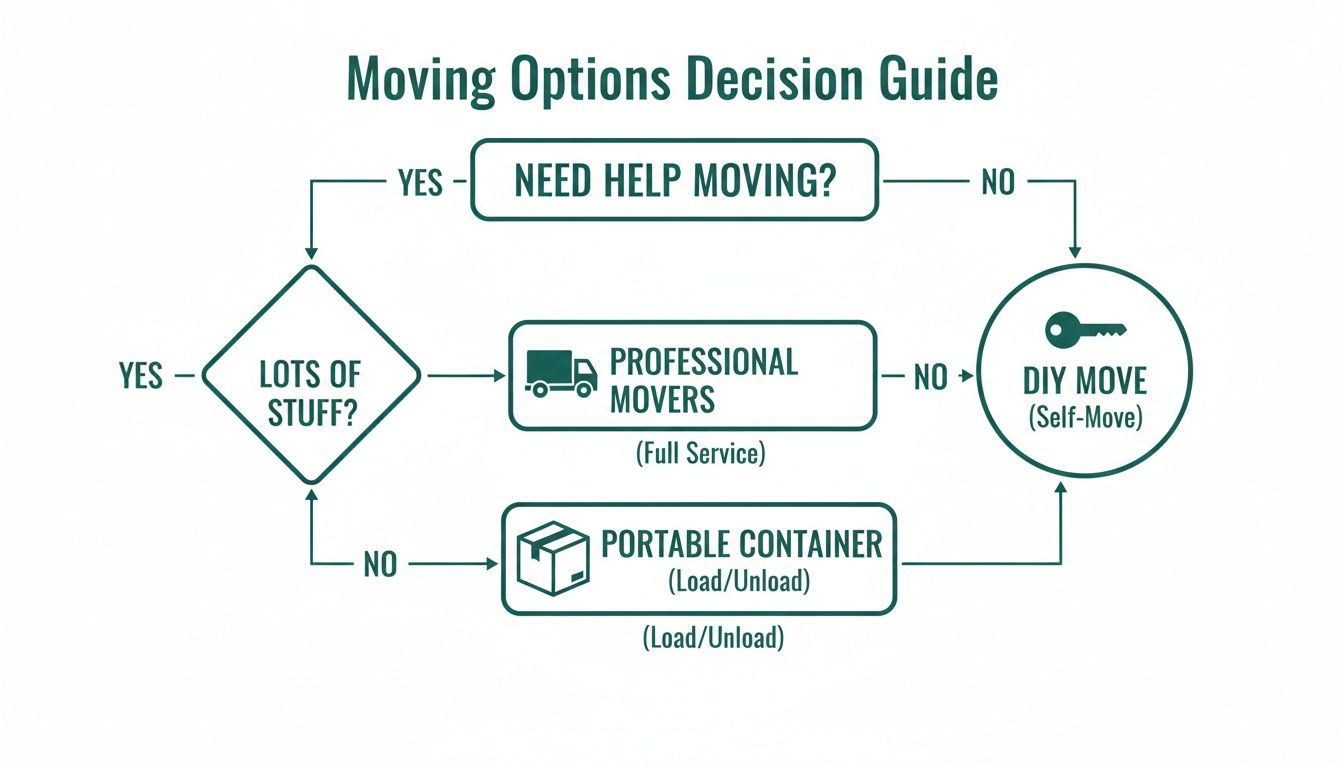
As the chart shows, the best choice is all about balancing your budget against how much time and physical effort you're willing to put in. These cost-saving strategies are crucial when you consider that the total average moving cost was $3,020 in 2025, with professional local movers making up an average of $1,692 of that total.
Your Top Moving Cost Questions, Answered
Even with the perfect moving plan in place, a few questions always seem to surface as the big day approaches. Getting clear on the finer details, like tipping etiquette and what’s really covered by insurance, will help you finalize your budget with confidence and sidestep any last-minute surprises.
Let's dive into the most common questions we hear.
Should I Tip My Movers and How Much?
While no one will force you to, tipping your movers is a standard practice and a fantastic way to show appreciation for their hard work. Think of it like tipping at a restaurant—it’s a reflection of your satisfaction with the service you received.
A good rule of thumb is to tip 15-20% of the total moving bill, which you can then ask the crew leader to divide among the team. If you'd rather tip a flat amount, here’s a common breakdown per mover:
- Half-day move (4-5 hours): $20 - $40 each
- Full-day move (8+ hours): $50 - $80 each
Ultimately, how much you tip is up to you. Consider factors like how complex the move was, how efficient the crew was, and your overall happiness with the job they did.
What Is Moving Insurance and Do I Need It?
By law, moving companies must offer two basic types of liability coverage, but they are worlds apart. Understanding the difference is crucial for protecting your belongings.
The default, free option is called Released Value Protection. Don't let the "protection" part fool you—the coverage is minimal. It reimburses you at a flat rate of just 60 cents per pound for any damaged items. So if your 10-pound TV gets smashed, you'd only get $6 back.
For true peace of mind, especially when moving valuable items, upgrading your coverage is essential. The small upfront cost of Full Value Protection far outweighs the potential financial loss from damaged or lost belongings.
The much safer choice is Full Value Protection. This costs extra, but it holds the moving company liable for the full replacement value of any lost or damaged goods. If there’s anything you own that you couldn't afford to easily replace out-of-pocket, this upgrade is a must.
How Far in Advance Should I Book Movers?
Booking your movers early is one of the smartest things you can do, especially if you’re moving during the peak season from May to September. Nailing down your spot well in advance doesn't just guarantee you'll get a truck—it can also help you lock in a better rate before prices shoot up.
Here’s a general timeline to follow:
- Local Moves: Try to book at least four weeks before your move-out date.
- Long-Distance Moves: Start looking and book 8-12 weeks in advance.
Waiting until the last minute is a recipe for stress. You'll have fewer options and almost always end up paying a premium for the convenience.
Feeling overwhelmed by the sheer volume of stuff you need to move? Endless Storage offers a simple solution. We provide storage-by-the-box, sending you free kits to pack your items. Once you're ready, we pick them up and store them securely, returning them with 48-hour notice whenever you need them. Free up space and simplify your move by visiting https://www.endless-storage.com to get started.