
Cheapest Way to Ship Heavy Items: Maximize Savings & Efficiency
Let's get right to it: for most heavy items under 150 pounds, your best bet is usually UPS Ground or FedEx Ground, especially if you find a discounted rate through a third-party platform. If your item is heavier than that, you'll likely save the most by shipping it as less-than-truckload (LTL) freight.
This guide will walk you through all the options so you never have to second-guess if you’re getting a good deal.
Finding the Cheapest Way to Ship Heavy Items
Shipping something heavy can come with serious sticker shock. We're here to cut through the confusion and give you a clear roadmap for finding the most affordable option, whether you're a city dweller, moving across the country, or just trying to clear out some clutter.
This isn't just about saving a few bucks on a single package. It's about learning the strategies to make smart decisions every time. You’ll get the inside scoop on how to pick the right service, pack your items efficiently, and sidestep those surprise fees that can bust your budget.
What We'll Cover
We're going to dive deep into the essential strategies and services for shipping heavy items without overpaying. We’ll look at:
- Parcel vs. Freight: There's a critical weight tipping point—usually between 70 and 150 lbs—where freight becomes way cheaper than standard parcel shipping. We'll show you how to spot it.
- A Look at the Carriers: We'll compare the big names like USPS, UPS, and FedEx and highlight when to use each for heavy packages.
- Packing Smarter: You’ll learn how to minimize what carriers call "dimensional weight" and keep your items safe without driving up the cost.
- Other Options to Consider: Sometimes, traditional shipping isn't the answer. We'll explore services that mix shipping and storage, which can be a total game-changer for moves or big decluttering projects. To truly find the cheapest way to ship heavy items, you need to explore various strategies, including practical tips to reduce shipping costs.
Key Takeaway: The "cheapest" method is not a one-size-fits-all answer. It depends entirely on your item's weight, dimensions, destination, and timeline. Comparing options is non-negotiable for finding the best rate.
Whether you're sending one bulky box or coordinating a larger move, our goal is to give you the confidence to ship affordably. And if you're in the middle of a bigger relocation, our guide on the cheapest way to move has even more insights that work perfectly with the strategies here.
Weighing Your Options: Parcel vs. Freight Shipping
Getting the cheapest rate for a heavy item all comes down to one crucial choice: do you ship it via parcel or freight? This decision sets the stage for everything else, from how you'll pack it to the final cost. It’s not just about picking the cheaper option on a computer screen; it’s about understanding the specific point where one method becomes drastically more affordable than the other.
Think of it like deciding between a taxi and a city bus. A taxi (parcel shipping) gets you and your luggage directly where you need to go, perfect for a quick, straightforward trip. A bus (freight), on the other hand, is built for moving larger groups or bulkier items along a set route, and it costs a lot less per person. For your shipment, the weight and size will tell you which ride makes more sense.
The real decision-making happens in that gray area between 70 and 150 pounds. If your item is under 70 pounds, a parcel carrier like UPS or FedEx is almost always your best bet. If it’s over 150 pounds, you're firmly in freight territory. That tricky 80-pound gap is where you can find serious savings by knowing which way to go.
Understanding Parcel Shipping for Heavy Items
When we say "parcel shipping," we're talking about the everyday services you get from carriers like UPS, FedEx, and USPS. These systems are designed for individual boxes that one person can lift and that can move through automated sorting facilities. For heavy items, you’re pushing the upper limits of what these services are built to handle.
Here’s what you’re looking at:
- UPS Ground and FedEx Ground are your go-to choices, as both will accept packages up to 150 pounds.
- USPS Ground Advantage can be a contender for some items, but it taps out at 70 pounds, making it unsuitable for anything truly heavy.
A classic example is shipping a big, dense box of textbooks that weighs about 60 pounds. That’s a perfect job for UPS or FedEx Ground. It’s heavy, sure, but it’s well within their limits and will be far cheaper than trying to send it via freight.
When Freight Shipping Becomes the Cheaper Choice
For anything too heavy for standard parcel services but not big enough to need an entire truck, you'll want to look at LTL freight shipments. Less-Than-Truckload (LTL) shipping is a service where your shipment shares space on a large truck with other people's stuff heading in a similar direction. The beauty of this is that you only pay for the portion of the truck your item takes up.
Let's say you're shipping a vintage pinball machine that weighs 250 pounds. That's way too heavy for any parcel service. With LTL freight, that machine would be secured to a pallet and loaded onto a truck with other goods, which dramatically cuts down the cost compared to hiring a dedicated truck.
This little decision tree can help you picture which path is right for your item.
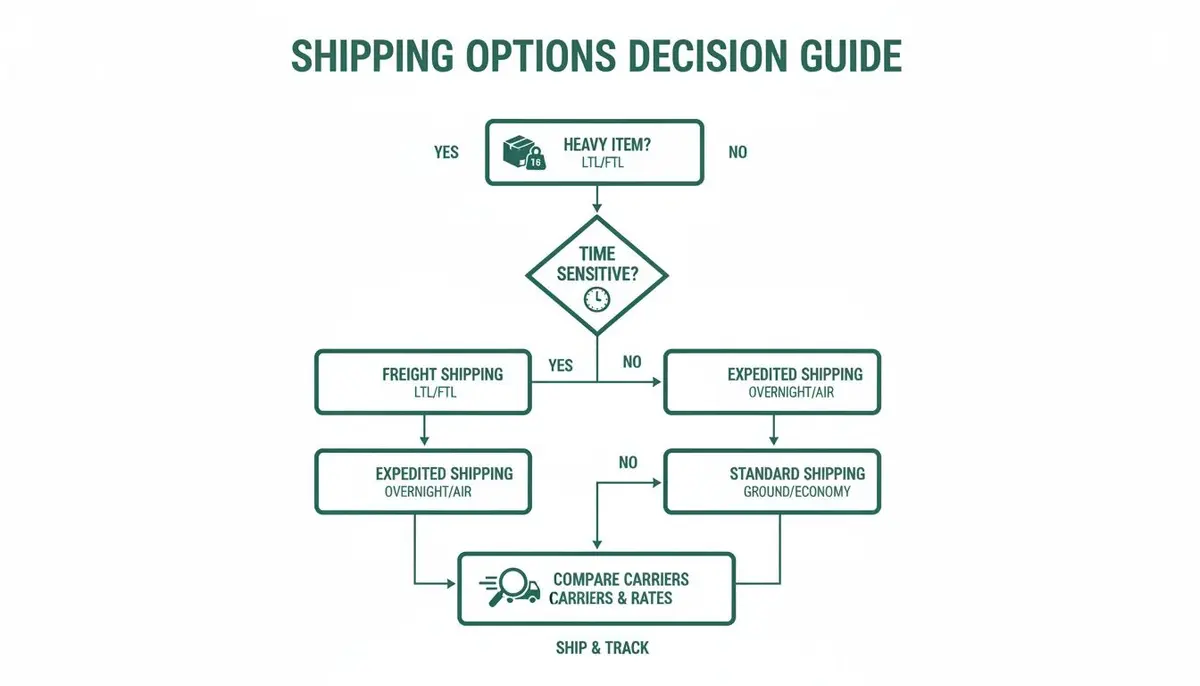
As you can see, once your item's weight and size start climbing, freight just becomes the more practical and cost-effective option.
To help you decide, here’s a quick breakdown of the core differences between parcel and LTL freight.
Parcel Shipping vs LTL Freight At a Glance
| Factor | Parcel Shipping (UPS, FedEx, USPS) | LTL Freight Shipping |
|---|---|---|
| Best for | Single or multiple boxes, typically under 70 lbs each. Max weight is 150 lbs. | Single or multiple large items over 150 lbs, or palletized shipments. |
| Cost Structure | Priced per package. Rates increase significantly with weight and size. | Priced by weight, dimensions, and freight class. More economical for heavy items. |
| Handling | Packages are processed through automated sorting hubs with lots of touchpoints. | Items are typically palletized and handled less frequently, reducing damage risk. |
| Surcharges | Common fees for residential delivery, fuel, and handling for heavy/large boxes. | Fewer surcharges, but may include fees for liftgate service or residential delivery. |
| Packaging | Requires a sturdy, standard cardboard box. | Requires robust packaging, often crating or securing items to a pallet. |
| Tracking | Detailed, real-time tracking from pickup to delivery. | Good tracking, but updates may be less frequent (e.g., at each terminal). |
This table shows that each service is optimized for different kinds of shipments. Choosing the right one is the first step toward saving money.
The Cost Breakdown: Parcel vs. Freight
The way parcel and freight carriers price their services is fundamentally different. Parcel shipping is priced on a per-package basis, and the cost can shoot up quickly as weight increases. Freight, however, is priced based on weight, dimensions, and something called freight class—a standardized number that categorizes items based on how dense and easy to handle they are.
For really heavy stuff—think furniture or appliances over 100 pounds—freight carriers like UPS Freight or FedEx Freight LTL almost always win on cost. While UPS Ground can take a box up to 150 pounds, the per-pound cost for freight is often much lower. For a 100-pound package, you might pay $2-$3 per pound with a parcel service, but less than $1 per pound for a palletized freight shipment. This is because you’re sharing the cost of the truck with others.
Pro Tip: Always watch out for surcharges. Parcel carriers are notorious for adding fees for residential delivery, fuel, and an "additional handling" charge for anything over 70 pounds. These can pile up and sometimes make an LTL freight quote the better deal, even for an item that technically comes in under the 150-pound parcel limit.
Making the right choice here means you're not overpaying. Trying to ship a 200-pound workbench via parcel would be incredibly expensive, just like it would be inefficient to book freight for a 40-pound box. If you’re shipping furniture specifically, it’s worth taking a closer look at our guide on how to use a furniture shipping cost calculator. By understanding these two distinct shipping worlds, you’re already on your way to finding the cheapest method for your heavy items.
Mastering the Details: Accurate Measurements and Smart Packaging
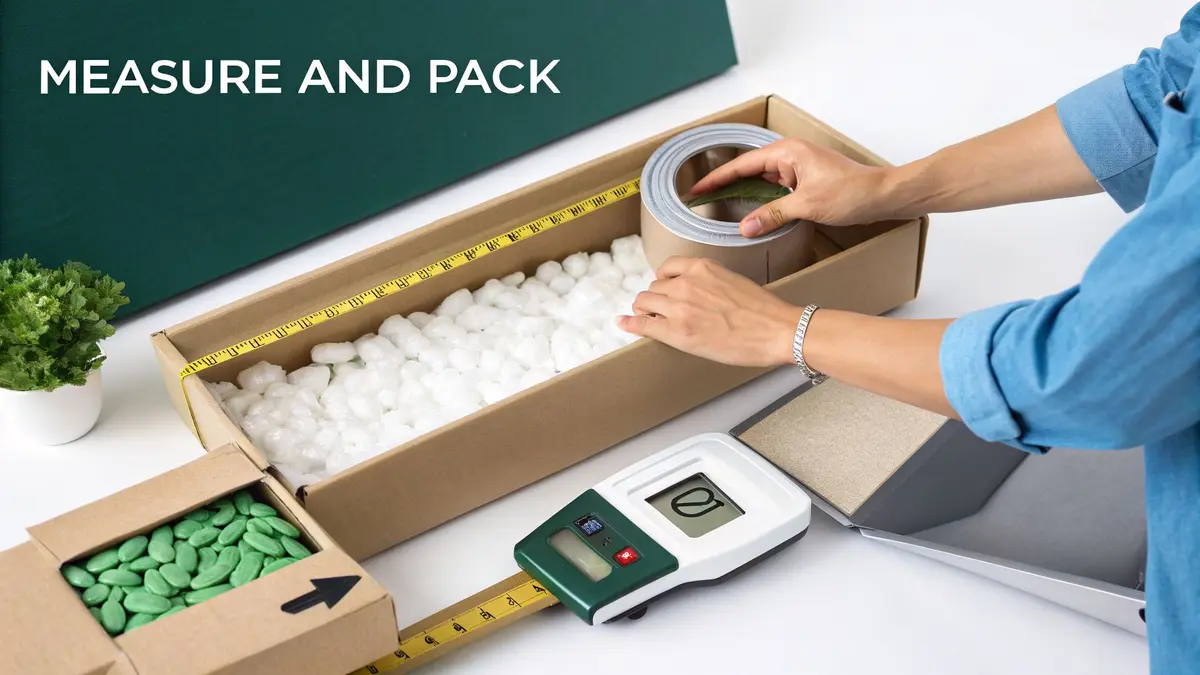
The real work of saving money on shipping heavy items happens long before you ever see a shipping label. Getting the cheapest rate often comes down to precise prep work, which helps you sidestep those frustrating—and expensive—carrier surcharges. It’s not just about saving a few bucks; it’s about shipping smarter.
The secret is a little industry concept that all the major carriers use to their advantage: dimensional weight.
The Truth About Dimensional Weight
Carriers like UPS, FedEx, and USPS don’t just bill you for how much a package weighs. They also bill you for how much space it hogs on their trucks and planes. This is where dimensional weight (or DIM weight) comes into play. It's a formula that essentially turns your package's size into a "theoretical" weight.
The carrier then looks at the package’s actual weight and its dimensional weight and charges you for whichever number is higher. It’s how a big, feather-light box of pillows can cost just as much to ship as a small, dense box of books.
Here’s how they calculate it. Carriers multiply the package's length, width, and height (in inches), then divide that total by a special "DIM divisor." Let's say a carrier uses a divisor of 139:
- A box that's 20x15x10 inches has a volume of 3,000 cubic inches.
- Divide 3,000 by 139, and you get a dimensional weight of 21.6 lbs.
- If your box actually weighs 15 lbs, you’ll be billed for 22 lbs. If it weighs 30 lbs, you’ll be billed for the actual 30 lbs.
Getting your measurements wrong by even an inch can easily bump your package into a much higher price bracket. A simple bathroom scale and a tape measure are your best friends here. Always measure the longest side, the next-longest, and the height, then round up to the nearest whole inch.
Key Insight: A smaller box is always a cheaper box. Your primary goal is to make your package as compact as possible without compromising its safety. Shaving just one inch off each side can dramatically lower your billable weight.
Smart Packaging For Heavy Items
Once you know your item's measurements, it's time to pick packaging that keeps it safe without adding extra bulk or weight. This can feel like a balancing act, but a few simple strategies make all the difference.
First, find a box that’s just big enough for your item plus about two inches of cushioning on all sides. Using a giant box is a classic mistake that inflates your dimensional weight and your bill. Always spring for a new, sturdy box—used ones can lose up to 50% of their strength and are much more likely to get crushed in transit.
Next, get smart about your cushioning. Packing peanuts are light, but they can shift and settle, leaving your item exposed. I've had much better luck with these lightweight but more reliable alternatives:
- Bubble wrap: Perfect for protecting delicate surfaces and filling in gaps.
- Air pillows: Almost weightless and fantastic for bracing items so they can't move.
- Crumpled packing paper: A great, low-cost option for stuffing into small voids.
When you're packing, wrap your item snugly and place it dead center in the box. Fill every last bit of empty space so nothing can slide around. The "shake test" is my go-to final check. If you hear or feel anything moving, it needs more cushioning. If you need more ideas on what to use, checking out the best packing supplies for moving can give you some great options that work for shipping, too.
When To Disassemble And Consolidate
For big things like furniture or exercise equipment, it’s almost always cheaper to ship them in pieces. An assembled desk, for example, is an instant candidate for massive oversized package fees because of its awkward shape and size.
Take the time to break it down. By packing the pieces into a tighter, more rectangular box, you'll slash its dimensional weight. This one move can honestly save you hundreds of dollars.
Finally, if you’re sending multiple heavy items to the same place, run the numbers both ways. Is it cheaper to send them in one huge box or several smaller ones? Sometimes, sending two 40-pound boxes costs less than one 80-pound box, especially since that single heavy box might trigger an "Additional Handling" surcharge from the carrier.
Choosing the Right Carrier and Service for Heavy Items
You’ve carefully weighed, measured, and packed your item. Now comes the moment that really impacts your wallet: picking the right shipping service. This is where you can either lock in major savings or accidentally overspend.
Not all carriers handle heavy shipments the same way. Knowing who excels at what is the key to finding the best deal. It’s less about just picking the cheapest name you see on a list and more about matching your package to the service that’s truly built for it. Let's dig into the top players and see where you can find the absolute cheapest way to ship heavy items.
The USPS Sweet Spot Under 70 Pounds
Many people write off the United States Postal Service (USPS) for heavy packages, but that can be a big mistake. For anything under 70 pounds, you should always get a quote from USPS. They have a niche where they’re often unbeatable.
Here's where they really shine for heavier stuff:
- USPS Ground Advantage: This is your best bet for items that aren't on a tight deadline. It’s frequently the most budget-friendly choice for packages in the 20-50 pound range, especially if you aren’t shipping it clear across the country.
- Priority Mail Flat Rate Boxes: These are a lifesaver for dense, heavy items. If it fits, it ships for one price. Got a bunch of hand tools or some cast-iron cookware? If you can squeeze it into a Large Flat Rate box and it’s under the 70-pound limit, the weight doesn't matter.
The moment your package tips the scales over 70 pounds, however, USPS is out. That's when the private carriers step into the ring.
The Heavyweight Battle: UPS Ground vs. FedEx Ground
Once your package lands in that 70-150 pound zone, the real competition is between UPS Ground and FedEx Ground. For most people shipping a single heavy item, one of these two will almost always be the cheapest option.
So, who wins? Honestly, it’s a toss-up. Their rates are fiercely competitive and can change based on a dozen factors. I’ve found that UPS Ground often has a slight edge on pricing for residential deliveries, thanks to their massive ground network that’s designed for it.
FedEx Ground, on the other hand, can sometimes pull ahead with cheaper rates to business addresses or on specific routes. There's no single champion, which is why getting quotes from both is non-negotiable. For a deeper dive into shipping large packages, our guide on the best way to ship large boxes has even more tips.
Real-World Scenario: Imagine you're shipping a 90-pound home gym system from Chicago to Miami. You pull quotes from both UPS and FedEx. The prices will likely be within a few dollars of each other. The real savings, however, come from how you buy the label.
Your Secret Weapon: Third-Party Shipping Platforms
Here it is—the single most important piece of advice for finding the cheapest way to ship heavy items: Never buy your postage directly from the carrier’s website or at one of their retail stores. You will almost certainly pay too much.
Instead, you need to use a third-party shipping platform. Services like Pirate Ship, Shippo, or ShipStation have special agreements with the carriers. They give you—a regular person—access to deeply discounted "commercial" rates that are usually reserved for massive companies. We’re not talking about a few cents, either. You can easily slash your shipping costs by 30-50% or more.
The best part? These platforms are typically free to use and let you compare real-time rates from everyone in one place.
The Power of Commercial Pricing in Action
The difference these platforms make is staggering. In 2026, you might get a retail quote of $150 to ship a 100-pound package, but you don't have to pay that. While UPS Ground is often the winner for items up to 150 pounds, that's only true if you're using these discounted rates.
Shipping experts point out that using a platform like Pirate Ship can bring the cost of shipping a 50-pound engine cross-country down from a retail rate of $200-$230 to as low as $88.27. FedEx Ground is right there with them, quoting around $74.64 for a similar 50-pound shipment through these platforms. You can read what shipping experts have to say on Red Stag Fulfillment to see more examples.
This shows perfectly why it's not just about which carrier you choose, but how you choose to pay them.
Don't Forget Regional Carriers
If you want to take your savings to the next level, take a look at regional carriers. This only works if your package is staying within a certain part of the country.
Companies like OnTrac (primarily in the West) or Spee-Dee Delivery (in the Midwest) can sometimes beat the national giants on price for deliveries inside their service footprint. They don't go everywhere, but if your origin and destination are in their zone, it's always worth a quick check. You might be surprised by what you find.
Thinking Outside the Box: Modern Shipping Alternatives
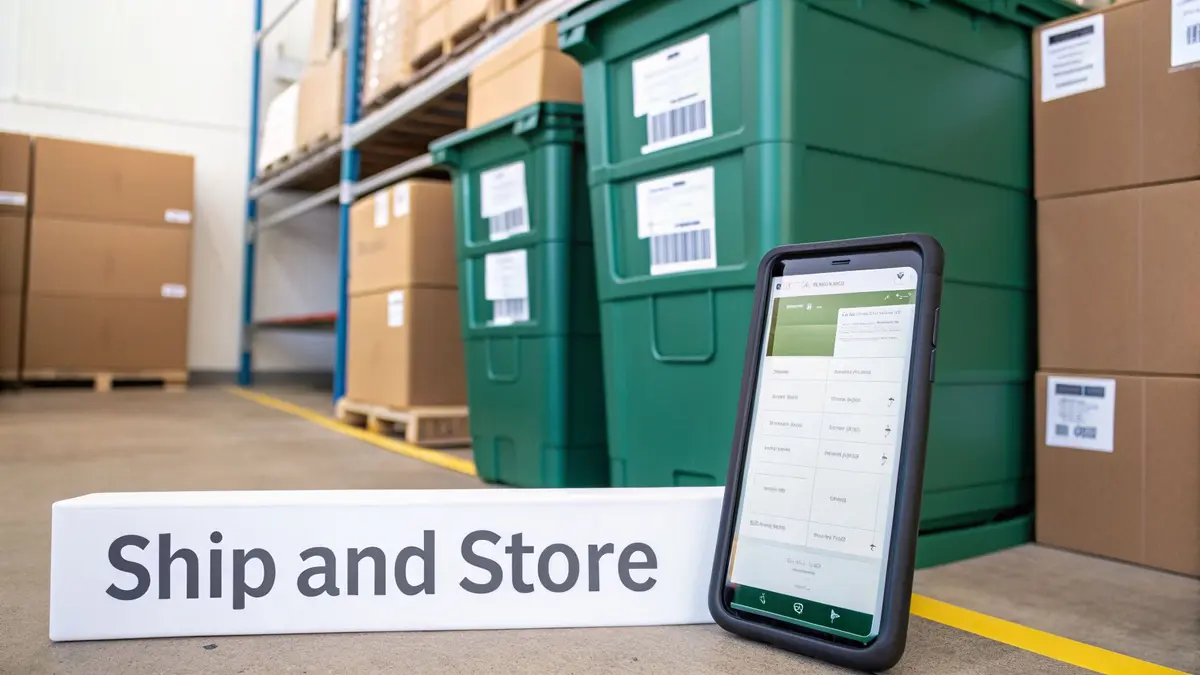
Sometimes the cheapest way to ship something heavy isn't about finding a lower rate—it's about rethinking the entire process. What if you didn't have to pay a massive one-time fee to send an item across the country? Imagine instead storing it affordably and having it delivered only when you actually need it. This shift in thinking is a lifesaver for anyone dealing with bulky seasonal gear, moving between apartments, or just trying to get some space back.
When you’re staring at multiple large items, consolidated freight or a small moving service feels like the logical next step. But those services are built for immediate, one-way trips. They don’t solve the problem of what to do with things you need to keep but don't need right now. This is where a more flexible, modern solution comes into play.
The New Way: Ship-and-Store Services
A new category of "ship-and-store" services has popped up, and it completely flips the script on shipping heavy items. The concept is refreshingly simple: instead of shipping things straight to your new place, you send them to a secure storage facility. They hold onto everything for a low monthly fee and then ship items back to you whenever you’re ready.
This method really shines in situations like:
- Seasonal Items: Think about that bulky air conditioner, your set of winter tires, or all those holiday decorations. Shipping them back and forth every year is an expensive headache. Storing them remotely until you need them is just plain smarter.
- Temporary Moves: If you’re a college student heading home for the summer or living somewhere short-term, you definitely don’t need all your stuff at once. A ship-and-store service keeps your belongings safe without cluttering up a small space.
- Apartment Downsizing: Moving into a smaller place often forces you to make tough choices. Instead of selling or tossing valuable items, you can store them affordably until you have more room.
This strategy turns a one-time, expensive shipping headache into a manageable, low-cost monthly expense. It's about paying for access to your items, not just for their immediate transit.
How It Works in Practice
The whole process is designed to be as straightforward as possible. A ship-and-store company will typically send you custom-sized, heavy-duty boxes and all the packing supplies for free. You just pack your things, slap on the prepaid shipping labels they provide, and schedule a pickup.
From there, your boxes are sent to a secure, often climate-controlled facility. You can manage everything through an online account, which usually includes a photo inventory of your stored boxes. When you want something back—whether it’s one box or all of them—you just put in a request online, and it’s shipped right to your door.
This model is proving to be a powerful cost-saving tool. For example, Endless Storage, a nationwide provider, has perfected this with climate-controlled, insured storage starting at just $7.99/month per box, including free inbound shipping. In fact, 60% of their users in small apartments have cut their moving costs by 40% compared to traditional methods simply by not having to ship heavy items themselves. For more on this, you can discover more about these cost-cutting methods on eFulfillment Service.
By blending the logistics of shipping with the flexibility of storage, you get total control over your belongings and your budget. This is especially helpful for anyone navigating the chaos of a move. For a deeper dive into how this fits into a bigger relocation strategy, check out our guide on using portable storage for moving.
Frequently Asked Questions About Shipping Heavy Items
Even after you've mapped out your strategy, a few nagging questions always seem to pop up right when you're ready to ship. We get it. That's why we've put together some straight, no-nonsense answers to the most common questions we hear.
Think of this as your quick-reference guide. We’re here to clear up any lingering confusion about everything from which carrier to choose to how you can avoid those frustrating surprise fees.
What Is Definitely the Cheapest Carrier for a 50-Pound Box?
For a 50-pound box, your best bet is almost always UPS Ground or FedEx Ground. The real trick, though, is to buy your shipping label through a third-party discount platform.
USPS Ground Advantage can sometimes be a contender on shorter, regional trips, but its prices tend to get steep pretty quickly as the distance grows.
The golden rule is to always compare real-time quotes. A service that’s cheapest from New York to Chicago might get beaten by a competitor on a trip from New York to Los Angeles. Using a platform like Pirate Ship or Shippo makes this comparison instant and gives you access to commercial rates you simply can't get at the post office.
How Can I Avoid Surprise Fees When Shipping Heavy Items?
Precision is your number one defense against unexpected charges. Most surprise fees stem from one of two things: inaccurate measurements or not knowing the carrier's specific rules.
Here’s how to sidestep them:
- Be Exact: Get out an accurate scale and measuring tape. If you're off by even a little on the weight or dimensions, the carrier's system will catch it. That leads to an audit and a painful upcharge on your bill. Always round up to the nearest inch and pound.
- Watch for Surcharges: Keep an eye out for the big three: residential delivery, additional handling (for packages over 70 lbs or with weird shapes), and fuel surcharges. These are often where the hidden costs pile up on heavy shipments.
- Use the Right Box: Your safest and cheapest option is a new, sturdy, rectangular cardboard box. This one simple choice helps you dodge the vast majority of handling fees that get tacked on for odd shapes, unboxed items, or flimsy packaging.
Is It Cheaper to Ship Furniture Assembled or Disassembled?
It is always, without a doubt, significantly cheaper to ship furniture disassembled. There is no situation where shipping a fully assembled desk or bookshelf costs less than shipping it broken down.
Assembled furniture is what we call a dimensional weight nightmare. Carriers charge you for the enormous amount of space it hogs on a truck, which can lead to jaw-dropping shipping costs and oversized package fees.
Taking the time to break the item down into its most compact form and packing it neatly into a standard rectangular box will slash its billable weight. This single step can easily save you hundreds of dollars.
Pro Tip: When you disassemble furniture, put all the hardware—screws, bolts, allen wrenches—into a sealed plastic bag. Tape that bag securely to the largest piece inside the box so it doesn’t get lost.
How Does a Service Like Endless Storage Compare to Self-Storage?
For individual heavy items like your snowboard, family heirlooms, or a set of golf clubs, a "ship-and-store" service is often much more practical and affordable than a traditional self-storage unit. They really solve two very different problems.
Traditional self-storage forces you to rent an entire unit—usually a 5'x5' at a minimum—even if you're only storing a few bulky boxes. You're also completely on the hook for the hassle and cost of hauling your stuff to and from the facility.
A ship-and-store service, like ours, handles all the transportation for you. You’re only charged for the specific items you store, not for a bunch of empty space. This makes it a far more flexible, and often cheaper, solution if you don't need a full storage unit but want to get those heavy items out of the way.
Navigating the world of shipping heavy items can feel complex, but it doesn't have to be. For those tricky situations where you need to store items long-term or between moves, Endless Storage offers a simple, affordable solution. We handle the pickup, storage, and delivery, so you can focus on what matters. Learn more about our by-the-box storage.