Let’s get this out of the way right up front: The answer is a hard no. You absolutely cannot live in a storage unit. It's illegal, incredibly dangerous, and will get you kicked out immediately. While it might cross someone's mind in a tough spot, it's a common misconception that's full of risk.
Understanding the Fundamental Barriers
When you sign a rental agreement for a storage unit, you're not getting a lease for a tiny apartment. You're licensing a space strictly meant for storing inanimate objects—your stuff. Think of it like a safety deposit box at a bank; you can put your valuables in it, but you can't sleep there. This distinction is critical and is backed by law, the rental contract, and basic common sense.
The reasons why are clear and non-negotiable, falling into a few major categories. This flowchart breaks down the immediate problems you'd run into.
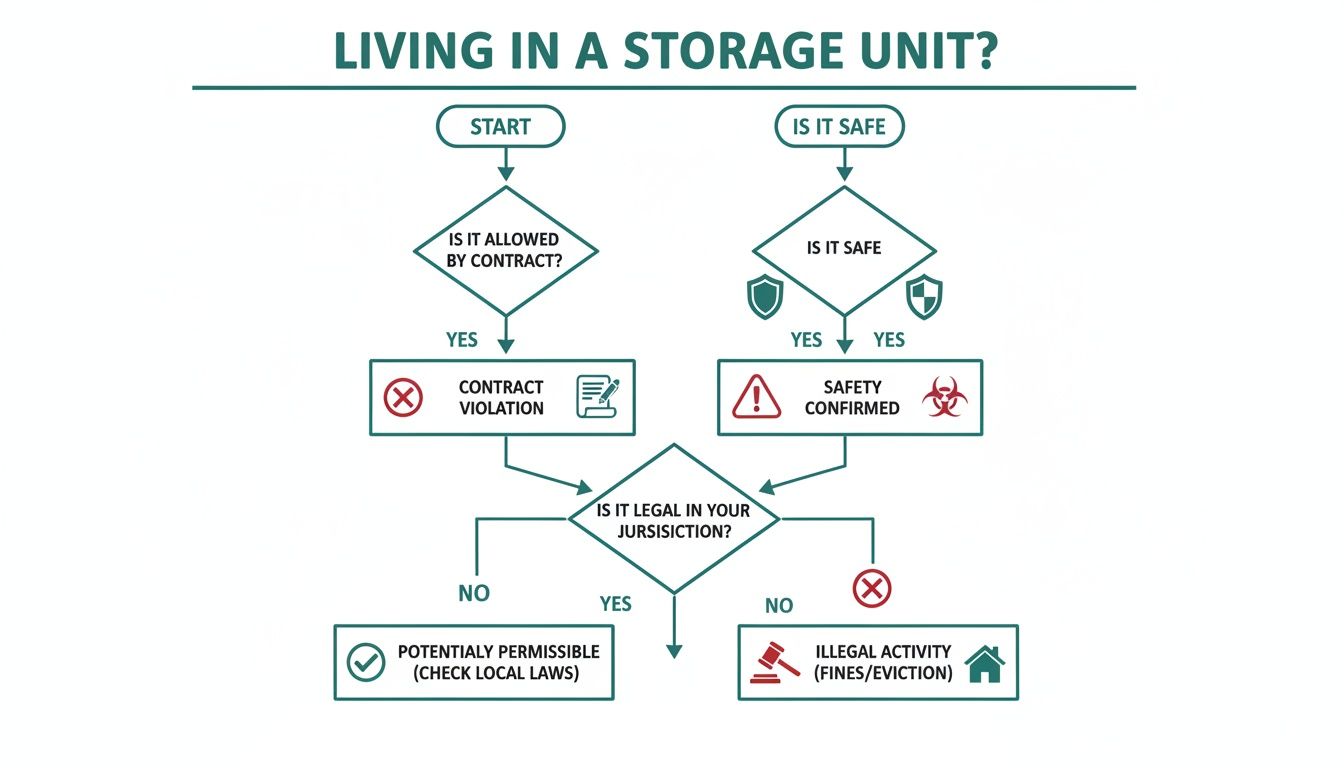
As you can see, even trying to stay overnight triggers a domino effect of violations, each with its own serious consequences.
To put it plainly, here's a quick summary of why this is never a workable solution.
Why Living in a Storage Unit Is Not an Option
These core issues make it impossible to even consider a storage unit as a temporary home.
Legal and Contractual Prohibitions
First and foremost, it's flat-out illegal. City and state zoning laws are very specific: storage facilities are commercial properties, not residential ones. They haven’t been designed, inspected, or approved for people to live in. Period.
Your rental agreement will spell this out in no uncertain terms, explicitly forbidding any form of living, sleeping, or residency. You can get a better sense of standard facility rules by checking out our guide on what you need for a self-storage unit.
Breaking these rules means immediate eviction, potential fines, and losing access to all your belongings. With over 69,400 self-storage facilities in the U.S., these regulations are widespread and strictly enforced. States like California and New York have cracked down hard on this; a sweep in Los Angeles, for instance, led to the eviction of over 200 people found living in units, citing extreme fire hazards and zoning violations.
Key Takeaway: Every storage facility rental agreement is a legally binding contract that explicitly prohibits living on the premises. There are no loopholes or exceptions to this rule.
Trying to get around these rules isn't just a breach of contract—it's breaking the law. The consequences are far more severe than just losing your unit, and that’s before you even consider the serious dangers to your personal safety.
Navigating the Legal and Contractual Maze
The thought of using a storage unit as a temporary home might pop up as a creative solution during a tough spot, but it’s an idea that crumbles fast once you look at the rules. The answer to "can you live in a storage unit?" isn't just a simple "no." It's a hard "absolutely not," backed by laws and the policies of every storage facility out there. The entire system is specifically designed to prevent it.
It all starts at the local level with zoning ordinances. These are the rules that tell a city how different plots of land can be used. Residential zones are for homes and apartments, while commercial zones are for businesses. Storage facilities are always built on commercially zoned land, legally classifying them as warehouses for stuff, not shelters for people.
This isn't just about paperwork; it's a huge safety issue. Buildings where people live have to meet incredibly strict codes for fire safety, proper ventilation, plumbing, and even basic structural soundness. A storage facility is built to a completely different, and much lower, standard—one that’s focused on keeping objects secure, not keeping humans alive.
The Rental Agreement: The Unbreakable Rule
When you rent a storage unit, you're signing a legally binding contract. It's helpful to think of this less like an apartment lease and more like an agreement for a rental car. You're allowed to use the car for its intended purpose—driving—but the contract is very clear you can't live in it. It's the exact same principle here.
Every single storage rental agreement has a "use of premises" clause. This part of the contract leaves no room for interpretation:
The rented space is to be used for the sole purpose of storing personal property. The unit is not to be used for any form of habitation, including but not limited to sleeping, cooking, or residing.
This isn't a suggestion; it's a non-negotiable rule. Signing that paper means you legally agree that you understand and will follow this rule. Breaking it isn't a small mistake—it’s a major breach of your contract that sets off some very serious and immediate consequences. It's always smart to know what you're signing up for, and you can see a full rundown in our guide on what's needed to rent a storage unit.
Unpacking the Consequences of Breaking the Rules
So, what actually happens if you ignore the contract and try to move in anyway? The facility's management is legally required to act fast. The process is not a forgiving one.
First up is an immediate eviction. This isn't like a residential eviction that can take weeks or months and involve court dates. Because you've broken a key clause in a commercial contract, the facility can lock you out almost instantly. Once they confirm someone is living in a unit, they'll terminate the lease on the spot and deny all access.
From there, a wave of financial penalties hits. These often include:
- Hefty Fines: Facilities have steep fines for this kind of violation, easily running into the hundreds or even thousands of dollars.
- Cleaning and Damage Fees: Any mess left behind or damage done to the unit from trying to live in it will be billed directly to you.
- Legal Costs: If the facility has to get law enforcement or lawyers involved, you could be on the hook for their fees, too.
But the most devastating result is the potential forfeiture of your property. Most rental agreements have a lien clause. This gives the facility the legal right to seize everything you have in the unit and auction it all off to cover your unpaid rent, fines, and other fees. In just a few days, you could be left with absolutely nothing—no place to stay and none of your belongings. Trying to live in a storage unit is a gamble where the only outcome is losing it all.
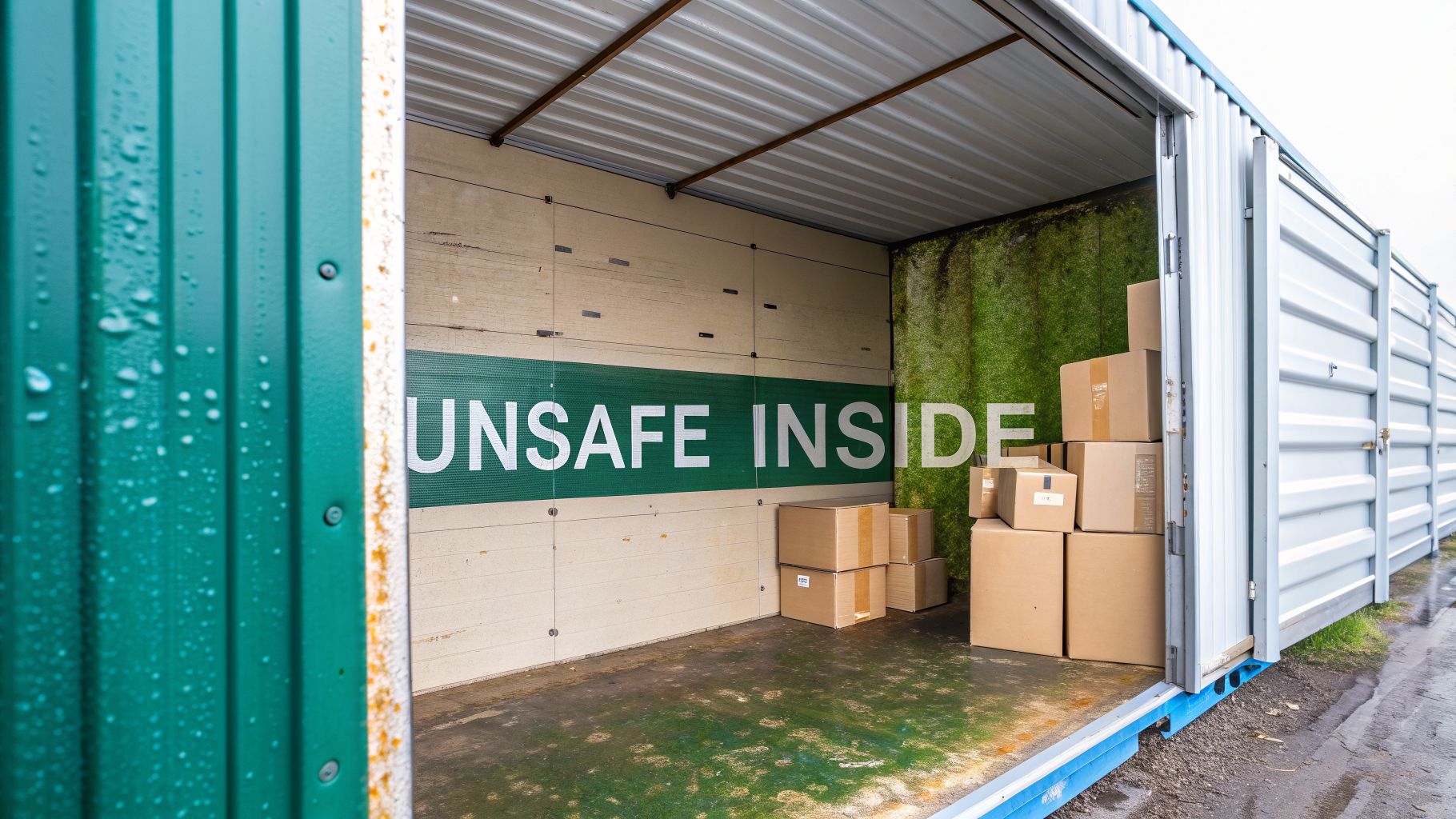
Beyond the legal trouble and broken leases, there’s a much more immediate reason you can’t live in a storage unit: it’s incredibly dangerous. These places are designed to store things, not people. Trying to live in one is like camping inside a sealed shipping container—it’s a trap that only looks like a shelter.
The most life-threatening risk is the complete lack of ventilation. Storage units are built to be airtight to protect belongings from the elements, which means there’s virtually no fresh air. As you breathe, carbon dioxide builds up to toxic levels, leading to dizziness, headaches, and, in the worst-case scenario, suffocation.
That sealed-in design also makes the unit a petri dish for mold. Any moisture you bring in—from damp clothes, a spilled drink, or even just humidity—has nowhere to go. It doesn't take long for toxic mold to flourish, releasing spores that can cause severe respiratory issues and long-term health problems.
The Dangers of Extreme Temperatures
Another huge hazard is the total lack of climate control in a standard unit. Think of it as a metal box sitting out in the open. On a hot summer day, the temperature inside can easily climb above 120°F (49°C). It becomes a literal oven, and you could suffer from heatstroke in just a few hours.
The opposite happens in winter. With no insulation or heat source, the unit turns into a freezer, putting you at serious risk of hypothermia. You might think a climate-controlled unit is the answer, but those systems aren't built for human comfort. They just keep the temperature in a range that’s safe for furniture, not people. If you want to see how these systems are meant to work, you can learn more about how climate control self-storage protects belongings.
A standard storage unit offers no protection from the elements. It amplifies them, turning summer heat and winter cold into deadly threats. It is not a home; it is an oven or a freezer, depending on the season.
The Unseen Fire and Sanitation Hazards
Maybe the scariest risk of all is fire. Homes and apartments have to follow strict fire codes, with smoke detectors, fire-rated walls, and multiple exits. A storage unit has none of that. If a fire starts in your unit or a neighboring one, it can spread with terrifying speed, trapping you inside with no warning and no way out.
Using any unapproved electrical device, like a space heater or a hot plate, makes this danger even greater. The wiring in a unit is typically only meant for a single lightbulb and can easily be overloaded. A recent report from the National Fire Protection Association noted a 12% increase in storage facility fires due to improper use. One such fire in Chicago not only destroyed over $500,000 in property but also displaced several people who had been secretly living there.
Finally, there’s the complete lack of plumbing. No running water, no toilet, no shower. This isn't just an inconvenience; it's a direct route to getting sick. Without proper sanitation, hygiene is impossible. Improperly disposed of waste creates a serious biohazard, attracting pests and spreading diseases. When you add it all up, a storage unit is one of the most unsanitary and dangerous places a person could ever try to live.
The Reality of Day-to-Day Life in a Metal Box
Forget any fantasy about a cheap, secret hideaway. The practical reality of trying to live in a storage unit is a relentless grind of stress, discomfort, and paranoia. This isn't a quirky life hack; it’s a grim and unsustainable existence that quickly dissolves when you’re faced with the daily struggle for basic human needs.
Imagine waking up before sunrise on a cold concrete floor inside a steel box. It's pitch black and freezing, as the thin metal walls offer zero insulation. You can't turn on a real heater—the risk of fire or carbon monoxide poisoning is just too high, and it would immediately alert the facility manager to your presence.
The Constant Fear of Discovery
Every single moment is spent in hiding. You can’t make noise. You can’t produce smells. You have to meticulously time your entrances and exits to avoid raising suspicion. Your entire life shrinks to fit within the facility's access hours, often forcing you out into the elements for hours at a time, just to avoid being locked in overnight.
The paranoia is constant. Every car that drives by, every footstep in the hallway, every time the manager makes their rounds—it's a fresh wave of anxiety. This isn't living; it's a state of perpetual fear.
Living in a storage unit means becoming a ghost in your own life. You exist in the shadows, constantly looking over your shoulder, unable to perform the simplest daily tasks without risking discovery and eviction.
The psychological toll is immense. This constant stress eats away at your mental health, compounding the physical hardships and making a desperate situation feel even more hopeless. You're isolated, hidden, and always on edge.
The Search for Basic Necessities
Simple tasks that most people take for granted become monumental challenges. Just think about the basics and how impossible they become when you're secretly living in a storage unit.
- Hygiene: Where do you shower? You're forced to rely on public restrooms, gym memberships, or truck stops. Basic cleanliness turns into a daily, exhausting logistical puzzle.
- Food: Cooking is completely out of the question. Hot plates and camp stoves are fire hazards that are strictly forbidden. Your diet is limited to cold, non-perishable foods that won't create any tell-tale odors.
- Mail and Utilities: You can't get mail delivered to a storage unit, which makes establishing residency for a job or any kind of service impossible. There are no power outlets for charging a phone, no internet, and absolutely no plumbing.
Using makeshift heaters to survive the cold is not only a fire risk but a serious health hazard. In recent years, New York City health departments cited over 150 cases of carbon monoxide issues from such devices in non-residential spaces. Industry data shows that insurance claims for "habitation damage" in storage units have spiked 18%, and evictions for this violation have surged by 25% in many markets, with fines ranging from $500 to $5,000.
The Security Paradox
While the facility might have a gate and cameras, your unit is far from a secure home. The lock on your roll-up door is designed to protect objects, not a person. It offers minimal defense against a determined thief.
More importantly, you are incredibly vulnerable. If you have a medical emergency, no one will know you're there. You can't call for help without revealing your situation. You're trapped, isolated, and completely on your own, turning what seems like a secure facility into a very personal prison.
If you are using a storage unit correctly for its intended purpose, be sure to check out our tips for organizing your storage unit to maximize space and safety for your belongings.
Smarter Ways to Create More Living Space
The urge to find more room to breathe is universal, but trying to live in a storage unit is a dangerous and illegal dead end. The real goal isn't just finding a cheap room; it's about making your actual living space more comfortable and functional. Instead of resorting to a metal box, modern solutions exist that can help you declutter, downsize, and reclaim your home.
This is where on-demand storage really shines. Think of it less like renting a garage and more like having a "closet in the cloud." Rather than hauling your belongings to a facility, a service picks them up, stores them securely, and brings them back whenever you need them.
This approach directly solves the space crunch without putting your safety at risk or forcing you to break the law. It’s all about creating more room in your home by smartly managing the things you don’t need every day.
The Modern Alternative to Self-Storage
Traditional self-storage was built for a different time. It forces you to rent an entire unit, lug your stuff back and forth, and visit a facility anytime you need to grab something. On-demand storage flips that model on its head, offering a far more convenient and efficient way to handle your belongings.
Here’s a look at how it generally works:
- Boxes Come to You: The company delivers sturdy, high-quality storage boxes right to your doorstep.
- You Pack on Your Time: Fill the boxes with whatever is cluttering up your space—seasonal clothes, old documents, hobby supplies, you name it.
- Scheduled Pickup: Once you’re all packed, you just schedule a pickup online, and a team comes to get your boxes.
- Secure, Climate-Controlled Storage: Your things are taken to a professional, climate-controlled facility, protecting them from humidity and extreme temperatures.
- On-Demand Return: Need something back? Just log into your account and request it. The specific box is delivered right back to you.
This model is a game-changer for anyone in a small apartment or just tired of the clutter. You can find out more about these services and other alternatives to traditional storage units that are a much better fit for a modern lifestyle.
Why Choose On-Demand Storage?
Let's break down how this newer approach to storage compares to the old-school way.
Traditional Self-Storage vs. Modern On-Demand Storage
Essentially, on-demand storage is built for convenience. You never have to rent a truck, drive across town, or dig through a dusty unit to find one specific item. It turns decluttering from a massive weekend project into a simple, manageable process.
With on-demand storage, you aren't renting a physical space; you're subscribing to a service that manages your excess belongings. This frees up your home and your time, letting you focus on living in your space, not just storing things in it.
This service also offers incredible peace of mind. Knowing your valuables are in a professional, climate-controlled environment is a huge relief compared to worrying about them in a standard metal unit. For those looking for legitimate and flexible housing, a nomadic lifestyle can also be a much safer and more practical choice. There are great full-time RV living tips that show how to create a mobile home base legally and safely—a stark contrast to the dangers of a storage unit.
Ultimately, modern storage empowers you to expand your living area without moving, making your current home feel bigger and more organized.
Finding Safe Housing and Support Resources
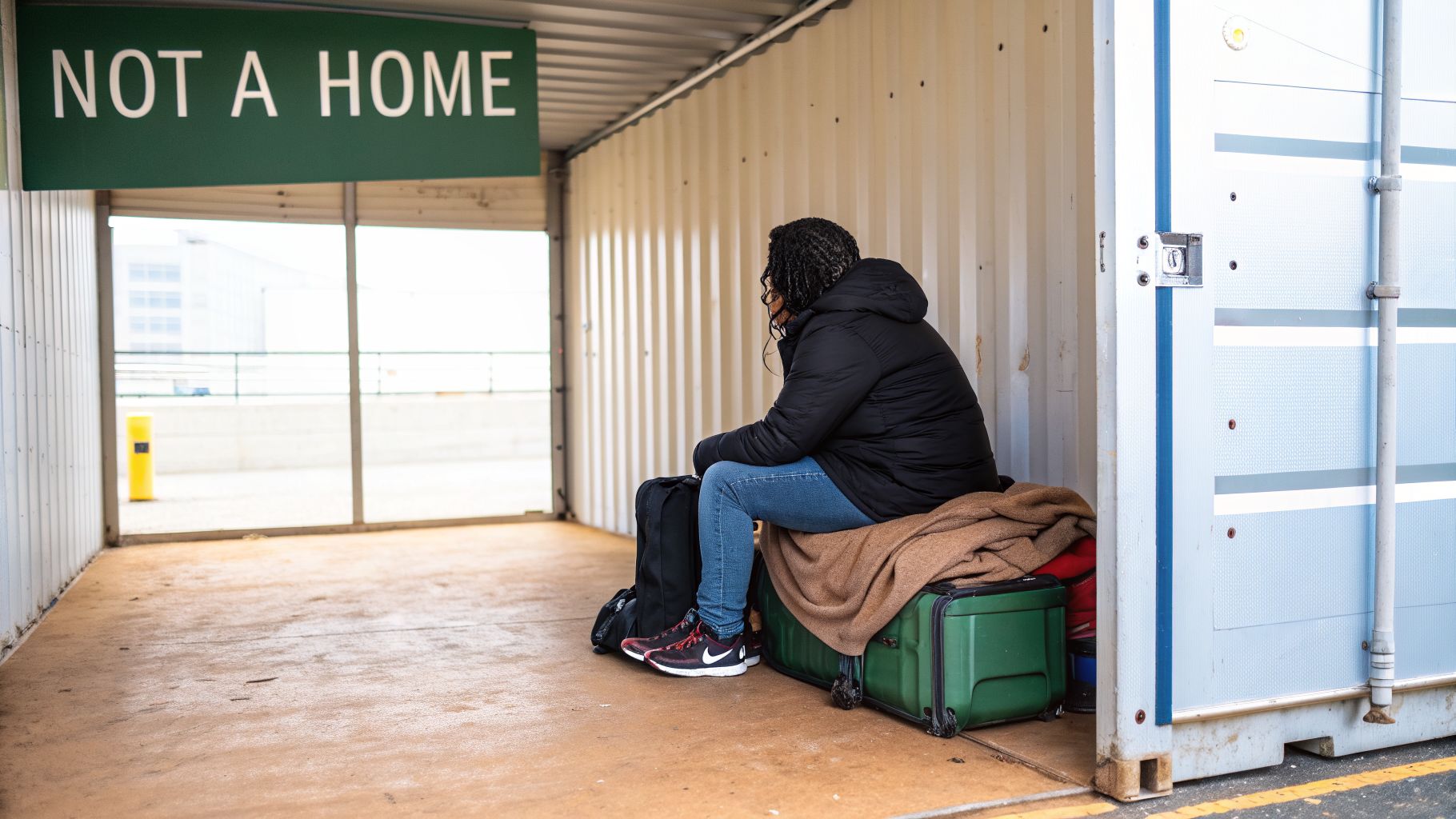
If you're reading this, chances are you're going through a tough time and exploring every possible option for shelter. Let's be direct: living in a storage unit isn't a safe or legal path. But the need for a roof over your head is real, and this section is here to point you toward genuine, practical help.
Instead of resorting to a dangerous and unlawful choice, there are dedicated organizations ready to assist people in your exact situation. The trick is knowing who to call first.
Where to Turn for Immediate Housing Assistance
When a housing crisis hits, you need help tonight, not in a few weeks. The first move is to connect with services that can offer a safe place to stay right away. Thankfully, many programs are built for just this kind of rapid response.
Here are some of the best places to start:
- Dial 2-1-1: This is a free, confidential hotline that connects you with local health and human services. Just by calling 2-1-1, you'll talk to a trained specialist who can point you to emergency shelters, food banks, and other vital support in your own community.
- The National Call Center for Homeless Veterans: If you've served in the military, call 1-877-4AID-VET (1-877-424-3838). This line is open 24/7 with trained counselors who can connect you to services and support networks designed specifically for veterans.
- The Salvation Army: With locations all over the country, The Salvation Army is a well-known resource for emergency shelter, meals, and other crucial social services. A quick search for your local branch online will show you what help is available near you.
Think of these resources as your first line of defense. They provide immediate safety and a starting point to figure out what comes next.
Your safety is the top priority. These organizations exist to provide a secure environment where you can get back on your feet, a service that a storage unit can never offer.
Finding Long-Term Support and Stability
Once you've secured a safe place for the night, the next step is finding a more permanent solution. Many organizations focus on helping people find stable housing and financial footing, offering everything from rental assistance to job placement programs.
A fantastic national resource is the National Alliance to End Homelessness. Their website is packed with information and can help you locate community action agencies in your area. These local agencies are key, as they often handle the federal funds for things like rental assistance and housing vouchers.
Additionally, websites like FindHelp.org let you type in your zip code and search for a whole range of free or low-cost services, including:
- Housing Assistance: Help finding affordable apartments, transitional housing, and even assistance with security deposits.
- Food Programs: A map of local food pantries and info on how to apply for benefits like SNAP.
- Financial Aid: Programs that can help with utility bills, rent, and other essential costs.
- Legal Services: Free legal advice for tenants who might be facing eviction or other housing-related legal battles.
Navigating this journey can feel overwhelming, but you don’t have to do it by yourself. The resources listed here are run by people who genuinely want to help you find a safe, legal, and lasting home. While a storage unit might seem like the only option in a moment of desperation, these organizations offer a real path forward.
Frequently Asked Questions About Storage and Residency
Even when you know all the legal and safety reasons why living in a storage unit is a bad idea, a few practical questions tend to pop up. Let's dig into some of the most common ones to clear up any confusion once and for all.
What Happens If You Get Caught Living in a Storage Unit
Let’s be direct: if you're found living in a storage unit, the fallout is fast and harsh. You’ll face immediate eviction because you've broken a major rule in your rental contract. The manager will terminate your lease on the spot and lock you out, cutting off access to all your belongings inside.
It doesn’t stop there. Depending on local laws and the facility’s rules, you could be hit with trespassing charges and serious fines. Even worse, most rental agreements allow the facility to place a lien on your property and auction it off to cover their costs. You could lose everything you own and still be without a place to live.
Are There Any Exceptions for Short-Term Stays
No. There are zero exceptions, not even for a single night. Your rental agreement is crystal clear, and so are the laws that govern these facilities: no form of human habitation is allowed, no matter how short.
Safety codes and zoning laws don't offer a pass for "just one night." Spending even a few hours inside a unit to sleep is a serious violation. It carries the exact same risks of eviction, fines, and having your property seized as a long-term stay.
The rules are black and white for a reason—they protect the facility, the other renters, and you. The second you use the unit for anything other than storing items, you're officially in violation.
Can I Run a Business from a Storage Unit
This one's a bit of a gray area, and the answer completely depends on the facility's specific rules and what kind of business you have in mind. While the question "can you live in a storage unit" is a hard no, some places do allow very limited business activities. Things like storing inventory for an online shop or archiving company documents are usually fine.
However, using the unit as a workshop, an office where you meet clients, or any kind of active workspace is almost always forbidden. The reasons come down to liability, insurance restrictions, and the simple fact that these units don't have the right utilities. Always read your contract closely and, more importantly, get written permission from the manager before doing any business activity on-site.
For a deeper dive into how storage facilities are meant to be used, you can check out this complete self-storage options handbook.
Why Not Just Use a Camping Toilet and a Generator
Using fuel-powered devices like portable generators or camping heaters inside a storage unit is incredibly dangerous and strictly prohibited. Generators release deadly carbon monoxide—a silent, odorless killer that can build up to fatal levels in a sealed, unventilated space like a storage unit.
On top of that, any appliance that burns fuel is a massive fire hazard, especially when it's surrounded by flammable items packed into a tight space. This isn't just a bad idea; it violates fire codes, breaks your lease, and puts your life, your belongings, and everyone else at the facility in serious danger. It is never a safe or acceptable option.
If you're looking for a smart, safe, and legal way to create more space in your home, Endless Storage offers a modern solution. We'll pick up your items, store them in our secure, climate-controlled facilities, and deliver them back whenever you need them—all without you ever having to visit a storage unit. Learn more at https://www.endless-storage.com.
Frequently Asked Questions
Unveiling the Secrets to Effortless Storage
Endless Storage is available nationwide. You pick a plan, tell us where to pickup, and we'll send a UPS van to collect, whichever state you're in.
Your shipping label will be sent to your email within a few minutes, if not instantaneously. It can also be accessed through your customer profile.
Your box will be shipped to one of our climate controlled self storage facilities in our closest self storage facility. Our manager will accept your package, notify you that your box has been received, and securely stored. Only our managers will have access to Endless Storage boxes.
Email us at admin@endless-storage.com click to live chat with us, or send us a message below.
Never! We're committed to transparent pricing with no surprises. You'll lock in your rate with no hidden fees and no long-term contracts.
Fast access guaranteed! Your boxes will arrive at your doorstep within 48 hours of requesting them back. Need to check on delivery? We provide tracking information for complete peace of mind.
Totally flexible! Store month-to-month with no long-term commitment and cancel anytime.
Everything's online! Use your account dashboard to:
• Set up automatic monthly payments
• Request box returns
• Update your address
• Order additional boxes
• Track shipments
Your boxes are insured up to $100 each. Our customer service team will help you file any necessary claims and resolve issues quickly.
Don't worry – we'll email you right away if there's a payment issue. Your items stay safe, though you may have temporary service interruption or late fees until payment is resolved.
When you request our free storage kits, you'll have 30 days to send in your boxes to activate your 3 months of free storage. Think of it like starting a gym membership – your activation window begins when you receive your kits, and your full free trial begins once you send in your first box. During your free months, you'll experience our complete storage service at no cost.
Your 30-day activation window begins when you receive your storage kits. We'll send you an email confirmation when your kits are delivered, marking the start of your activation period.
If you haven't sent any boxes for storage within your 30-day activation window, your free trial will expire and we'll begin charging the regular monthly rate of $9.99 per box. This helps ensure our storage kits go to customers who are ready to use our service.
A box costs $9.99 per month to store (plus sales tax). This price includes free shipping for standard boxes under 50 lbs. and smaller than 16"x16"x16"
Log into your Endless Storage account, locate the box you would like returned, and simply click Return My Box.
Yes, each box stored with us is insured for up to $100 throughout transit as well as the duration of storage within our facilities.
Your box will be at your doorstep within 48 hours of you requesting it back.
Store 10+ boxes? We'll pick them up for free! After your purchase, we'll contact you to schedule a convenient pickup time and arrange UPS collection.
We trust UPS with all shipments, and every box includes $100 insurance coverage. You'll receive tracking information to monitor your items' journey.
Yes! Visit any of our locations by appointment. Just bring a photo ID matching your customer profile.
For everyone's safety, we can't store hazardous materials, firearms, or perishables. All items must fit within our standard boxes.
It's easy! Order your storage kit online, and we'll ship it to you within 1-2 business days. Your shipping labels will be emailed instantly and available in your account.
We're here to help! Email us at admin@endless-storage.com, use our live chat, or send us a message through your account.
To cancel your storage service with Endless Storage, please email your cancellation request to admin@endless-storage.com. Our team will process your request within 2 business days and confirm your cancellation via email.
We understand packing takes time. However, to maintain your free trial benefits, you'll need to send at least one box within the 30-day activation window. If you need more time, you can always start with one box to activate your trial and send the rest later. You can always reach out to admin@endless-storage.com if you have any issues or concerns.
When you request our free storage kits, you're starting a 30-day window to begin using our storage service.
Important: To activate your free trial, send at least one box for storage within 30 days. If no boxes are sent within this 30-day window, a one-time $50 fee applies to cover materials and shipping costs. This fee is clearly disclosed before you sign up.
Think of it like reserving a hotel room – we're setting aside space and sending specialized packing materials for your use. The fee only applies if you request materials but don't begin storage, similar to a hotel's no-show charge.