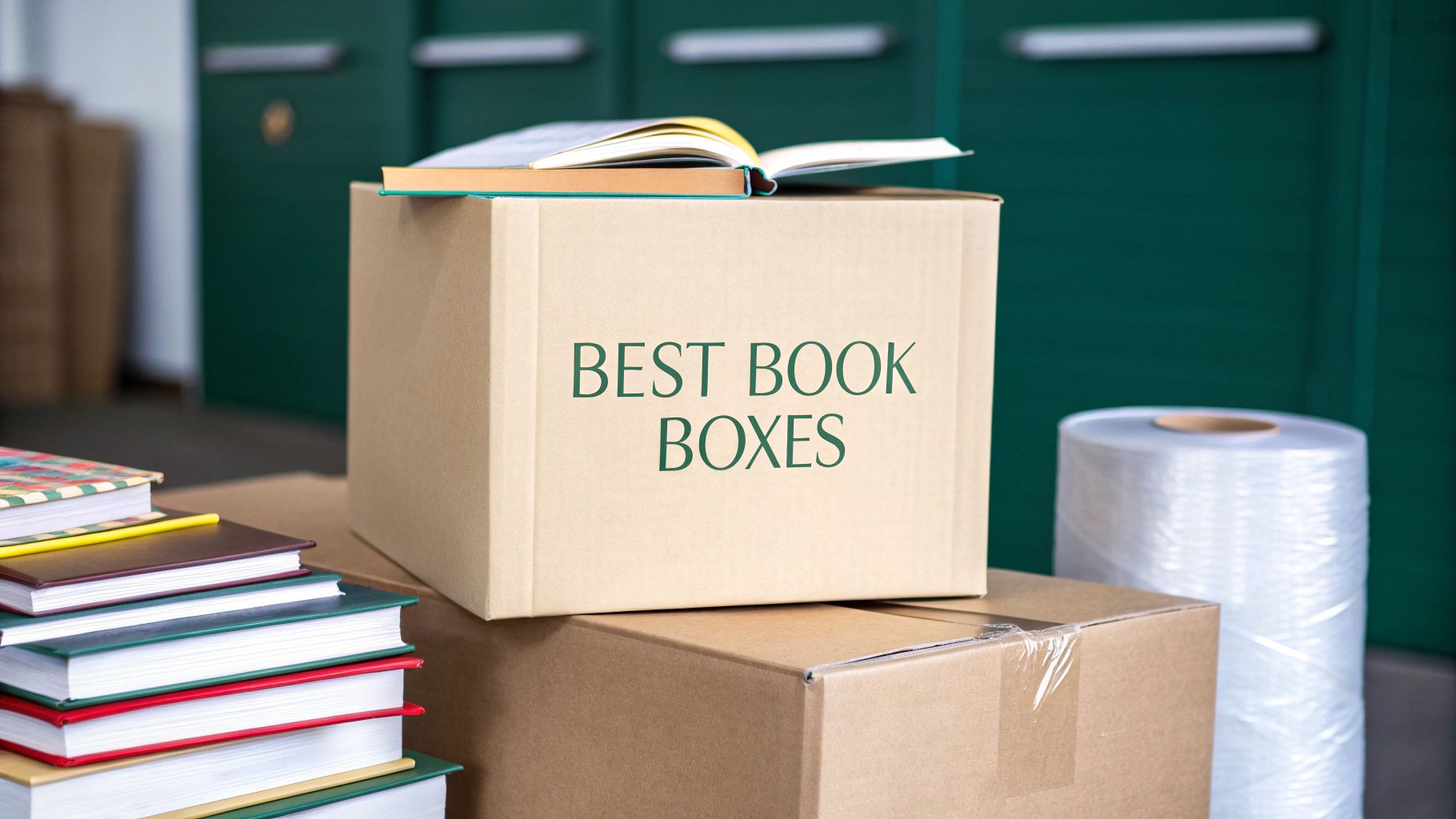
For anyone who loves their books, moving them can be a surprisingly stressful part of the whole process. The secret weapon? Small, sturdy boxes, usually around 1.5 cubic feet, often sold specifically as "book boxes." Their compact size is a game-changer, keeping them from getting too heavy to lift and protecting your collection from damage.
Why the Right Box Is So Crucial for Your Books
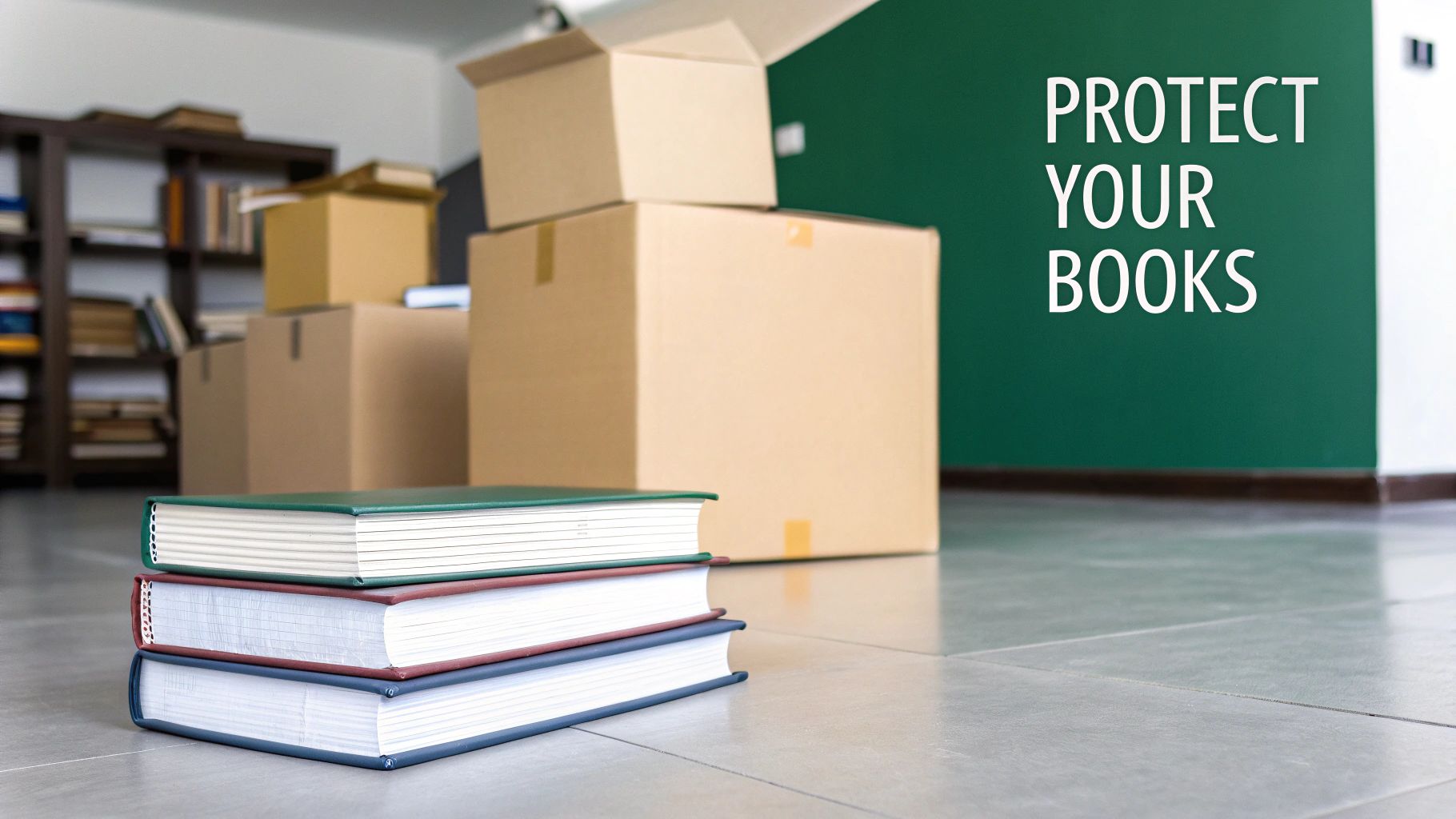
If you have a decent-sized library, you already know the deal. Unlike clothes or pots and pans, books are deceptively heavy and surprisingly delicate. Nothing’s worse than unpacking to find a treasured hardcover with a bent corner or a whole box of paperbacks crushed under their own weight. We’ve all been there.
That's why picking the right box isn't just about logistics—it's an act of preservation. The unique density and uniform shape of books demand a specific kind of container, and those generic, oversized boxes just don't cut it.
The Pitfalls of Using the Wrong Box
Grabbing a large box might feel efficient at the moment, but it’s a recipe for disaster. A big box packed with books can easily top 50-60 pounds, making it a serious safety hazard to lift. Even worse, the box itself is at risk, with the bottom likely to give out mid-move. I've seen it happen, and it's not pretty.
Here are the common problems I see from using the wrong boxes:
- Crushed Spines: When books are packed too loosely in a big box, they shift around and slam into each other, cracking or bending the spines.
- Bent Corners and Torn Pages: Without a snug fit, covers and pages are completely exposed and vulnerable during transit.
- Total Box Failure: A standard-duty cardboard box just isn't built to handle the concentrated weight of a full load of books.
The golden rule for packing books is simple: keep every single box under 40 pounds. This makes them manageable to carry and ensures the box can actually support its contents without falling apart.
To help you get started, here's a quick rundown of the best box types for different kinds of book collections.
Quick Guide to Book Box Types
Choosing the right container from the start makes a world of difference.
Setting the Stage for a Successful Move
Protecting your collection begins with the right foundation. It’s not just about the box itself, but also about how you use it. When you understand the ideal dimensions, material strength, and proper packing techniques, a huge, daunting task becomes a completely manageable process.
This guide will give you actionable advice on the best moving boxes for books, covering everything from industry-standard options to specialty containers for your most valuable editions. We’ll also dive into proven packing techniques and clever organizational strategies to make sure your library arrives at its new home safe and sound. By starting with the right supplies, you're setting yourself up for a smooth, damage-free move. For more general tips, check out our guide on how to pack moving boxes for a stress-free experience.
Choosing the Best Moving Boxes for Your Library
Let's get down to the nitty-gritty of what makes a good book box. Sure, you can technically stuff books into any old box, but understanding the subtle differences between your options will save your collection—and your back—come moving day.
The first step is to ditch the "one-size-fits-all" mentality. Your library is diverse, from light paperbacks to massive, coffee-table art books. Each requires a container built for its specific needs.
The Industry Standard: The Small Book Box
Walk into any moving supply store, and you’ll find a small box specifically labeled a "Book Box." This isn't just slick marketing; it's the gold standard for good reason. These boxes typically measure 1.5 cubic feet (around 16" x 12" x 12"), a size perfectly calibrated for the dense weight of books.
This specific size acts as a natural safeguard, making it pretty tough to pack a box that goes over the recommended 40-pound limit. It also creates a snug fit that stops books from shifting around, which is the number one cause of bent corners and damaged spines. For most of your paperbacks and standard hardcovers, this is absolutely the best moving box you can get.
When to Upgrade to Heavy-Duty Boxes
A standard cardboard box has a single layer of that wavy corrugated paper inside. Heavy-duty boxes, on the other hand, boast a double-walled construction, giving them a serious upgrade in strength and crush resistance. But when do you actually need to spend the extra money on them?
Think about these scenarios:
- Valuable Collections: If you’re packing first editions, signed copies, or delicate antique books, the extra rigidity of a double-walled box is non-negotiable. It's an essential layer of protection against bumps and drops.
- Heavy Academic Tomes: A stack of dense textbooks or legal volumes can easily overwhelm a standard box, even a small one. The extra structural integrity keeps the bottom from giving out.
- Long-Term Storage: If your books are heading into storage for months or years, double-walled boxes are a must. They hold their shape far better when stacked, preventing the boxes at the bottom of the pile from getting slowly crushed over time.
Think of it as cheap insurance for your most prized or heaviest books. The small extra cost is nothing compared to replacing a beloved, damaged volume.
Pro Tip: When you're stacking boxes, always put the heavier, double-walled ones on the bottom. This creates a solid foundation and protects the more fragile, standard boxes you place on top.
Specialty Options for Unique Collections
Beyond the basic book box, a couple of other specialty containers can be lifesavers for certain parts of your library.
Media boxes, which are usually long and shallow, are fantastic for all those mass-market paperbacks you have. Their dimensions are perfect for lining up smaller books spine-up, which makes organizing and unpacking a breeze.
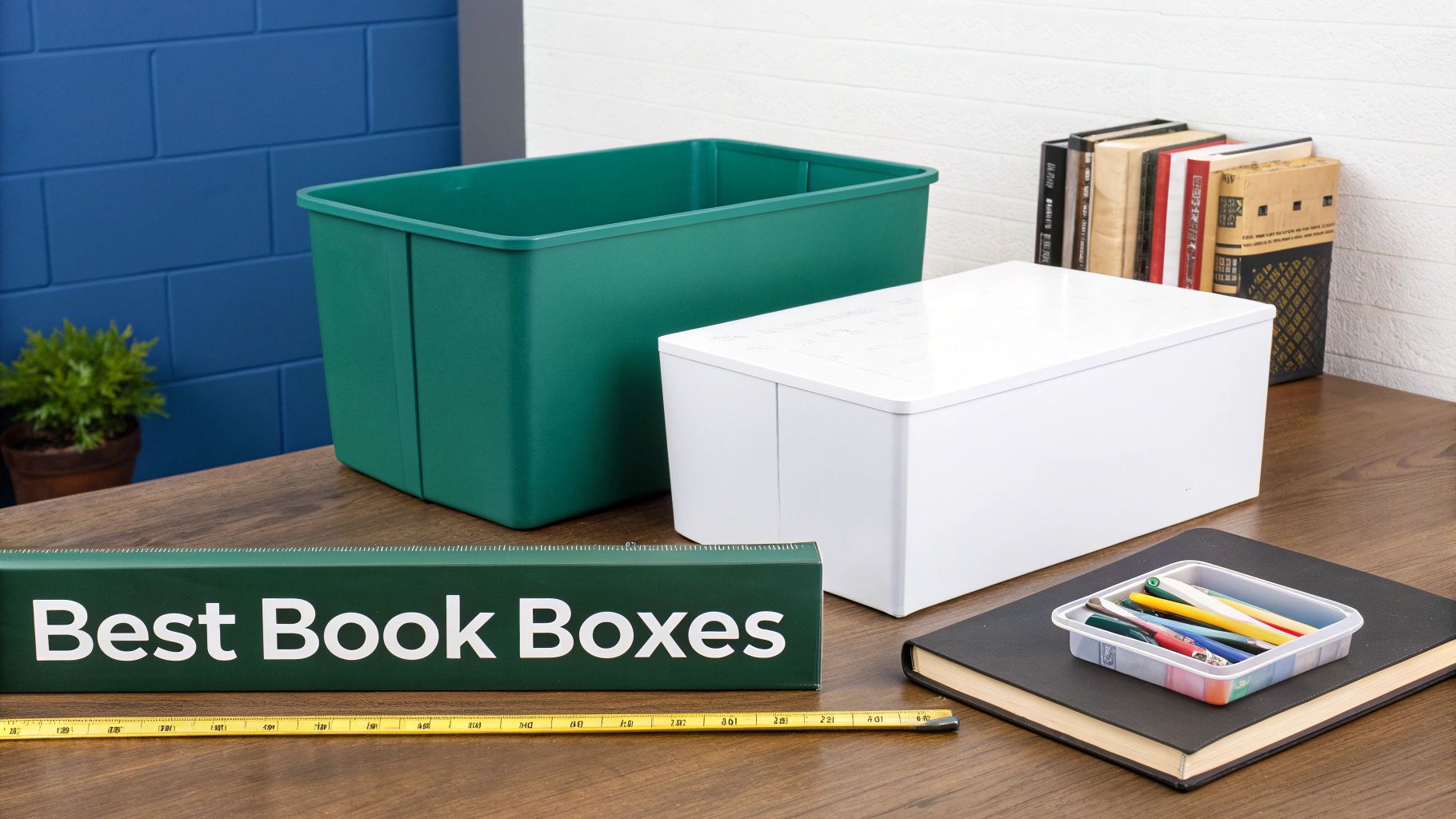
Another solid option is reusable plastic bins. These are an excellent investment if you move a lot or need a bomb-proof solution for storage. Their biggest advantages are durability and moisture resistance—a huge plus if you're moving on a rainy day or storing things in a potentially damp basement. The trade-off? They're more expensive upfront and take up more space when you're not using them.
Making the Right Choice: A Comparison
Picking the best moving boxes for your books really comes down to balancing the needs of your collection with your budget and moving situation.
In the end, the best strategy is usually a mix-and-match approach. Grab standard book boxes for the bulk of your library, invest in a few heavy-duty ones for the really special stuff, and maybe consider plastic bins if long-term storage is in your future. For a deeper dive into all the materials you'll need, be sure to check out our complete guide to the best packing supplies for moving.
Mastering How to Pack Books for a Move
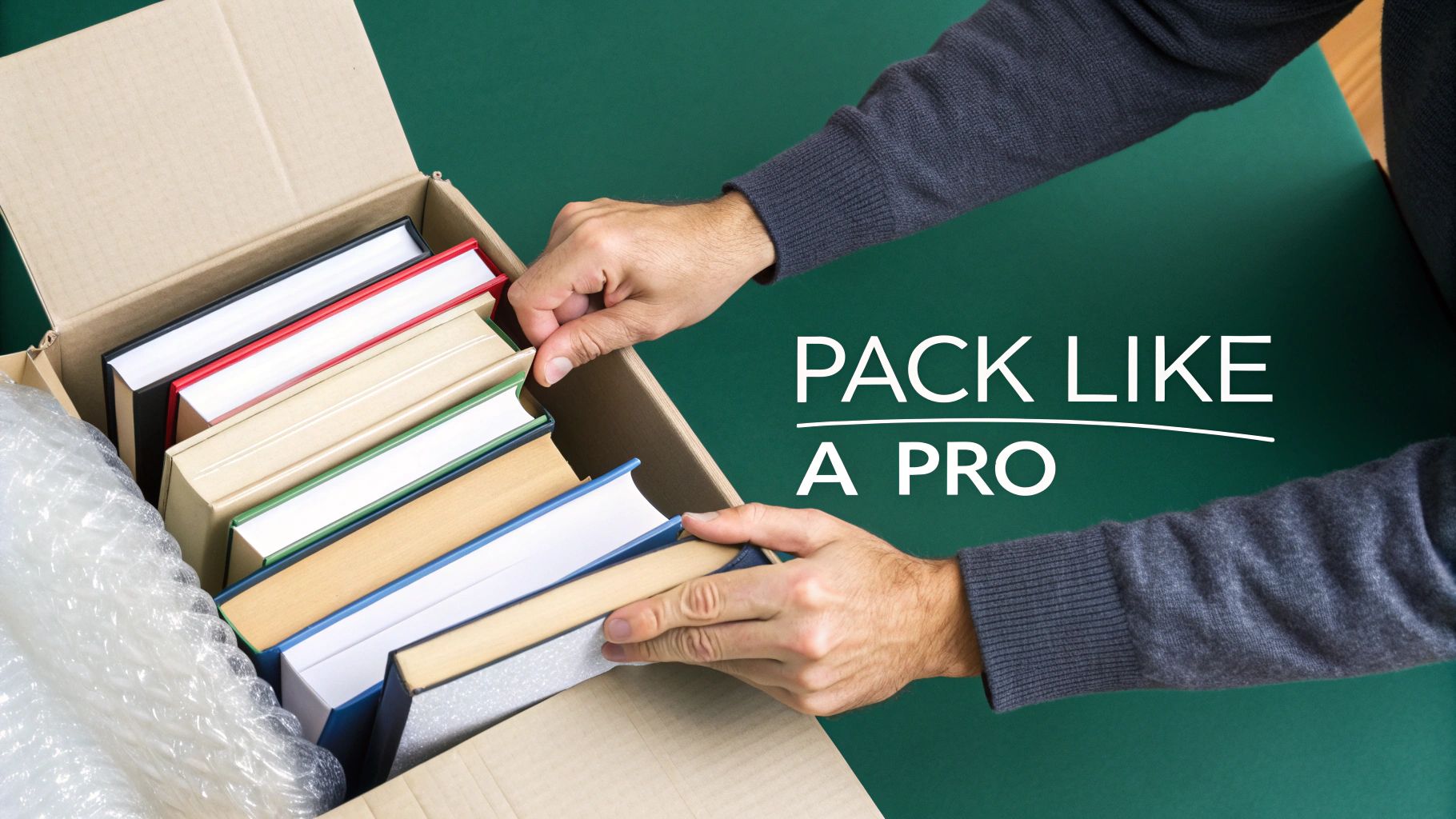
Once you've picked out the perfect boxes, the real work begins: packing your books correctly. A great box is only half the battle. Your packing technique is what stands between your library arriving safely and a heartbreaking mess of bent covers, crushed spines, and torn pages.
The entire goal here is to stop things from shifting around inside the box. When books can slide and jostle during a move, damage is practically guaranteed. That means packing them snugly and filling every last bit of empty space with cushioning.
Laying the Foundation for a Secure Pack
Before you even think about putting a book in a box, you need to gather the right supplies. Beyond the box itself, a few other items are non-negotiable for a secure move.
- Strong Packing Tape: This is not the place to cut corners. High-quality packing tape is essential for reinforcing the bottom of the box and sealing it up tight. I always recommend at least two strips along the bottom seam and another strip along each edge to give it maximum strength.
- Packing Paper: Simple, crumpled packing paper is your best friend for lining the box and stuffing into gaps. It’s cheap, surprisingly effective, and won’t leave ink smudges all over your books.
- Bubble Wrap: For the really special stuff—signed first editions, fragile antique hardcovers, or anything sentimental—bubble wrap offers that extra layer of shock absorption that brings peace of mind.
Always start by lining the bottom of each box with a cushion of crumpled packing paper. This creates a critical buffer zone, absorbing the inevitable shocks from bumps and drops on the way to your new place.
The Art of Arranging Books in a Box
How you actually place the books inside the box makes a massive difference. There isn't a single "right" way that works for everything, so you’ll want to adapt your technique based on the types of books you’re packing.
The most important rule? Keep the weight reasonable. My golden rule is to keep every single box under 40 pounds. This isn't just about saving your back; it also prevents the box itself from buckling or bursting under the strain.
To help you visualize the best approach for different book types, here’s a quick comparison of the most effective packing methods.
Book Packing Techniques Comparison
Each technique has its place, and often the best-packed box uses a combination of these methods to create a dense, stable, and well-protected block of books.
Key Takeaway: Never, ever pack books with their paper edges facing down (sometimes called "spine up"). This puts all the weight on the binding, which can cause pages to bend, warp, or even completely separate from the spine. Always pack them flat or with the spine down.
Common Mistakes to Avoid When Packing
Even with the best moving boxes for books, a few common slip-ups can lead to disaster. Just being aware of these pitfalls is half the battle. The moving boxes market, valued at USD 3.48 billion in 2020, has grown to offer specialized options that can help, but good technique is still king.
Here are the top mistakes I see people make all the time:
- Overpacking a Box: This is easily the most frequent—and dangerous—mistake. A box that’s too heavy is a hazard to your back and is far more likely to split open at the worst possible moment.
- Using Weak or Old Boxes: A used box might seem like a smart way to save a few bucks, but if it has any sign of moisture damage or weakened corners, it's just not worth the risk. Your book collection deserves fresh, sturdy containers. For a full breakdown of packing strategies, our guide offers more on the best way to pack books for moving.
- Leaving Gaps Inside: Any empty space is an open invitation for books to shift and get damaged. You have to fill all those voids with crumpled packing paper to create a snug, secure fit.
- Forgetting to Tape Properly: A single strip of cheap tape along the bottom seam is a failure waiting to happen. Use strong packing tape and the "H-tape" method—one strip down the middle seam and one across each end—to fully secure the bottom.
Labeling and Organizing for Seamless Unpacking

Let's be honest. Packing is a puzzle, but unpacking can feel like a full-blown scavenger hunt if you haven’t laid the groundwork. A smart labeling system is your secret weapon, turning hours of frustrating guesswork into a smooth, methodical process. It’s the difference between finding your favorite novel right away and tearing open a dozen identical boxes in a desperate search.
The first step is to move beyond just scribbling "Books" on the side with a marker. While it’s not wrong, that single word won’t help you prioritize or find anything specific when you’re surrounded by a sea of cardboard.
Develop a Clear Labeling System
Your future self will thank you for taking a few extra minutes to create a detailed labeling strategy. Think about how you organize your books on your shelves now and try to mimic that system on your boxes. This small effort upfront pays off big time during unpacking.
Here are a few proven methods you can use on their own or mix and match:
- Label by Genre or Subject: Keep like with like. Label boxes with clear categories like "Cookbooks," "Sci-Fi Paperbacks," or "History Hardcovers."
- Organize Alphabetically: If you have a huge fiction collection, break it down into manageable chunks. Labels like "Fiction A-H" and "Fiction S-Z" will make finding a specific author a breeze.
- Sort by Destination Room: Think ahead to your new space. Label boxes based on where they will eventually live, using identifiers like "Office Reference," "Living Room Shelf," or "Bedside Table Books."
This level of detail transforms each box from a total mystery into a clearly defined piece of your library.
Create a Digital Inventory
For a truly foolproof system, especially if you have a massive collection, pair your physical labels with a digital inventory. It might sound like overkill, but trust me, it’s a game-changer. All you need is a simple spreadsheet or even a notes app on your phone.
Here’s the simple breakdown:
- Number Every Box: Give each box a unique number (e.g., Book Box #1, Book Box #2).
- Log the Contents: In your app or spreadsheet, create an entry for each number. Briefly list the key authors or book series you packed inside. For example, "Box #7: Stephen King collection, Neil Gaiman hardcovers."
- Find Books Instantly: When you’re in your new place and need a specific book, a quick search of your digital list will tell you exactly which box to grab.
This approach completely eliminates the need to rummage through every single container. If you want to dive deeper, you can learn more about effective systems in our complete guide on how to label boxes for moving.
A Visual Shortcut for Faster Sorting
Use different colored masking tape or dot stickers for different rooms. Assign blue for the office, green for the living room, and yellow for the bedroom. This lets you and your movers know where a box goes from across the room—no reading required.
Invest in Quality Labeling Tools
A permanent marker is a good start, but investing in better tools can make your labels more durable and easier to read. For example, effective label printer machines can create clear, professional-looking labels that won't smudge or fade during transit. They produce uniform, easy-to-read labels that stick.
No matter which tools you choose, consistency is everything. Always label at least two sides of every box—I recommend a side and the top. This ensures you can identify the contents even when they’re stacked high. Your meticulous work during the packing phase is the single best investment you can make for a stress-free unpack.
Smart Storage Solutions for Your Book Collection
So, you’ve meticulously packed your entire library. The last box is taped shut, and then it hits you: where is all of this going to go? This is a reality check for a lot of us, especially if you're moving into a smaller apartment in the city where every square inch is precious real estate.
You love your books and can't imagine parting with them, but stacking boxes in the living room corner just isn't a long-term plan. This is where thinking about an 'off-site library' can be a real game-changer, giving you a way to keep your collection without sacrificing your living space.
The Rise of By-the-Box Storage
Renting a traditional self-storage unit for a few dozen boxes of books often feels like paying for a whole lot of empty air. It’s expensive and, frankly, inefficient. A much smarter alternative that’s become incredibly popular is storage-by-the-box.
The concept is simple: instead of renting an entire room, you only pay for the exact number of boxes you need to store. It’s a perfect fit for book lovers, letting you safely store part of your collection until you have the shelf space to welcome it back home. It strikes the perfect balance between keeping everything you love and avoiding clutter.
Why Climate Control Is a Must-Have for Books
Let's be clear: the biggest enemy of a stored book collection is the environment itself. Paper is surprisingly sensitive to wild swings in temperature and humidity, which can lead to yellowed pages, warped covers, and the dreaded growth of mold and mildew.
This is why the right storage environment isn't just a nice-to-have; it's non-negotiable.
- Stable Temperatures: Extreme heat can make old bindings brittle and cause them to crack, while the cold can make paper fragile. A good climate-controlled facility keeps the temperature in that sweet spot all year round.
- Humidity Management: High humidity is practically an invitation for mold. Proper storage services actively manage moisture levels, ensuring your books stay dry and in pristine condition.
If you're ever tempted to store books in a basement, preserving them from moisture is paramount. Understanding the essentials of basement dehumidification can be the difference between a preserved library and a heartbreaking loss.
Storing your books in a garage, attic, or a standard, non-climate-controlled unit is a huge gamble. These spaces are breeding grounds for the exact conditions that ruin books, making professional, climate-controlled storage a truly worthwhile investment.
The Convenience of an On-Demand Library
Modern storage isn't just about having a safe space anymore; it’s about convenience. Services like Endless Storage have turned the old model on its head by bringing the storage unit right to you. You pack your boxes, and they get picked up directly from your doorstep.
And when you want a specific box back—maybe it's time to swap your summer beach reads for your cozy winter classics—you just request it online. That box is delivered right back to you, usually within a day or two. This on-demand approach transforms your stored collection from an inaccessible archive into a flexible, rotating part of your personal library.
This is a massive perk for anyone living in a small space or who doesn't have a car. The hassle of lugging heavy book boxes back and forth to a facility is completely gone.
A Smart, Secure, and Cost-Effective Approach
Financially, paying only for what you use just makes sense. With by-the-box storage, you aren't roped into a contract for a big, half-empty space. When you combine that affordability with the security of a professional facility, you get genuine peace of mind.
The global boxes packaging market—which includes these specialized storage solutions—was valued at USD 302.99 billion in 2025 and is only expected to grow. This growth fuels innovation and competition, which is great news for us. It means better services and more affordable options, especially for city dwellers who rely on these solutions.
For anyone feeling the space crunch, this approach is a lifesaver. It lets you keep your entire collection safe, sound, and accessible, ensuring your books are kept in perfect condition until you’re ready for them. To keep them that way, check out our detailed guide on how to store books long-term for perfect preservation.
Common Questions About Moving and Storing Books
Even with the best game plan, moving a library brings up a lot of last-minute questions. You've figured out how to pick the right boxes and pack them tight, but it’s totally normal to have a few nagging concerns pop up. Let's tackle some of the most common ones I hear from people.
Think of this as your quick-reference guide for those final "what if" moments. Getting these details sorted is the last step to making sure every single book arrives safe and sound.
What Is the Absolute Best Size for a Book Moving Box?
The undisputed champion is the small moving box, which you’ll often see sold specifically as a "book box." These are usually 1.5 cubic feet and measure around 16x12x12 inches. Trust me, that size isn’t an accident—it’s perfectly engineered for this job.
Its compact shape acts as a built-in weight limit. It’s pretty hard to stuff a 1.5 cubic foot box so full that it goes over the recommended 40-pound limit. That’s key for saving your back and making sure the box doesn't give out. One of the biggest mistakes people make is grabbing a medium or large box to be "more efficient." This almost always ends in a dangerously heavy box that's a nightmare to lift and loves to split open mid-carry. Stick with the small box for your books.
Can I Get Free Moving Boxes for My Books?
You absolutely can, but it comes with a big "buyer beware." Places like grocery stores, liquor stores, and neighborhood marketplaces can be goldmines. Liquor store boxes are a personal favorite—they’re designed to carry heavy glass bottles, so they’re usually sturdy and just the right size for books.
However, you have to be your own quality control. Before you haul any used box home, give it a serious inspection:
- Check for Cleanliness: Any weird stains, funky smells, or leftover food bits are a no-go. You don’t want to attract pests.
- Inspect for Moisture Damage: See any water stains or warping? That cardboard is weak. Leave it.
- Look for Pests: Check the seams and corners for tiny bugs or their eggs. It's not worth the risk.
While free is always nice, the peace of mind you get from fresh, high-quality moving boxes is a small price to pay for protecting a valuable or sentimental collection.
A Note on Valuables: For your most cherished books, don't even think about using a second-hand box. The risk of a hidden weak spot, moisture damage, or pests is just too high. Always spring for new, sturdy, double-walled boxes for anything irreplaceable.
How Should I Pack Rare or Antique Books Differently?
Your rare and antique books need a completely different, much more delicate approach. Their bindings are often fragile, and old paper is incredibly sensitive to acids and moisture. Taking extra care isn't just a suggestion; it's mandatory.
First, wrap each valuable book individually in acid-free paper. This is non-negotiable. Regular packing paper and newspaper contain acids that will yellow and degrade the pages over time. Once wrapped in paper, give it a layer of bubble wrap for cushioning.
Next, place the wrapped books snugly into a heavy-duty, double-walled box. You need to fill every last bit of empty space with crumpled packing paper or other soft, acid-free material to stop any shifting. Never, ever pack valuable books standing upright on their pages—this puts incredible strain on the spine. Lay them flat, heaviest on the bottom. Finally, slap a label on all sides that screams "FRAGILE - RARE BOOKS" and make sure it’s the last thing loaded onto the truck, placed safely on top of everything else.
Is It Safe to Store Books in a Garage or Attic?
In a word: no. I strongly recommend you avoid storing books in garages, attics, sheds, or unfinished basements for any real length of time. These places are famous for their wild temperature and humidity swings—the two arch-enemies of paper.
In the summer, an attic's blistering heat can cook the glue in book bindings, making them brittle and causing them to crack. Come winter, the damp, cold air in a garage or basement is the perfect breeding ground for mold and mildew, which will permanently ruin your collection. These spots are also a five-star resort for pests. If you need to store your books long-term, a climate-controlled environment is the only way to go to keep them pristine.
Feeling overwhelmed by a lack of space for your beloved book collection? Don't let clutter dictate what you keep. Endless Storage offers a simple, secure solution with by-the-box storage. We pick up your packed books, store them in our climate-controlled facility, and deliver them back whenever you need them. Visit us to learn how you can create your own off-site library today.
Frequently Asked Questions
Unveiling the Secrets to Effortless Storage
Endless Storage is available nationwide. You pick a plan, tell us where to pickup, and we'll send a UPS van to collect, whichever state you're in.
Your shipping label will be sent to your email within a few minutes, if not instantaneously. It can also be accessed through your customer profile.
Your box will be shipped to one of our climate controlled self storage facilities in our closest self storage facility. Our manager will accept your package, notify you that your box has been received, and securely stored. Only our managers will have access to Endless Storage boxes.
Email us at admin@endless-storage.com click to live chat with us, or send us a message below.
Never! We're committed to transparent pricing with no surprises. You'll lock in your rate with no hidden fees and no long-term contracts.
Fast access guaranteed! Your boxes will arrive at your doorstep within 48 hours of requesting them back. Need to check on delivery? We provide tracking information for complete peace of mind.
Totally flexible! Store month-to-month with no long-term commitment and cancel anytime.
Everything's online! Use your account dashboard to:
• Set up automatic monthly payments
• Request box returns
• Update your address
• Order additional boxes
• Track shipments
Your boxes are insured up to $100 each. Our customer service team will help you file any necessary claims and resolve issues quickly.
Don't worry – we'll email you right away if there's a payment issue. Your items stay safe, though you may have temporary service interruption or late fees until payment is resolved.
When you request our free storage kits, you'll have 30 days to send in your boxes to activate your 3 months of free storage. Think of it like starting a gym membership – your activation window begins when you receive your kits, and your full free trial begins once you send in your first box. During your free months, you'll experience our complete storage service at no cost.
Your 30-day activation window begins when you receive your storage kits. We'll send you an email confirmation when your kits are delivered, marking the start of your activation period.
If you haven't sent any boxes for storage within your 30-day activation window, your free trial will expire and we'll begin charging the regular monthly rate of $9.99 per box. This helps ensure our storage kits go to customers who are ready to use our service.
A box costs $9.99 per month to store (plus sales tax). This price includes free shipping for standard boxes under 50 lbs. and smaller than 16"x16"x16"
Log into your Endless Storage account, locate the box you would like returned, and simply click Return My Box.
Yes, each box stored with us is insured for up to $100 throughout transit as well as the duration of storage within our facilities.
Your box will be at your doorstep within 48 hours of you requesting it back.
Store 10+ boxes? We'll pick them up for free! After your purchase, we'll contact you to schedule a convenient pickup time and arrange UPS collection.
We trust UPS with all shipments, and every box includes $100 insurance coverage. You'll receive tracking information to monitor your items' journey.
Yes! Visit any of our locations by appointment. Just bring a photo ID matching your customer profile.
For everyone's safety, we can't store hazardous materials, firearms, or perishables. All items must fit within our standard boxes.
It's easy! Order your storage kit online, and we'll ship it to you within 1-2 business days. Your shipping labels will be emailed instantly and available in your account.
We're here to help! Email us at admin@endless-storage.com, use our live chat, or send us a message through your account.
To cancel your storage service with Endless Storage, please email your cancellation request to admin@endless-storage.com. Our team will process your request within 2 business days and confirm your cancellation via email.
We understand packing takes time. However, to maintain your free trial benefits, you'll need to send at least one box within the 30-day activation window. If you need more time, you can always start with one box to activate your trial and send the rest later. You can always reach out to admin@endless-storage.com if you have any issues or concerns.
When you request our free storage kits, you're starting a 30-day window to begin using our storage service.
Important: To activate your free trial, send at least one box for storage within 30 days. If no boxes are sent within this 30-day window, a one-time $50 fee applies to cover materials and shipping costs. This fee is clearly disclosed before you sign up.
Think of it like reserving a hotel room – we're setting aside space and sending specialized packing materials for your use. The fee only applies if you request materials but don't begin storage, similar to a hotel's no-show charge.