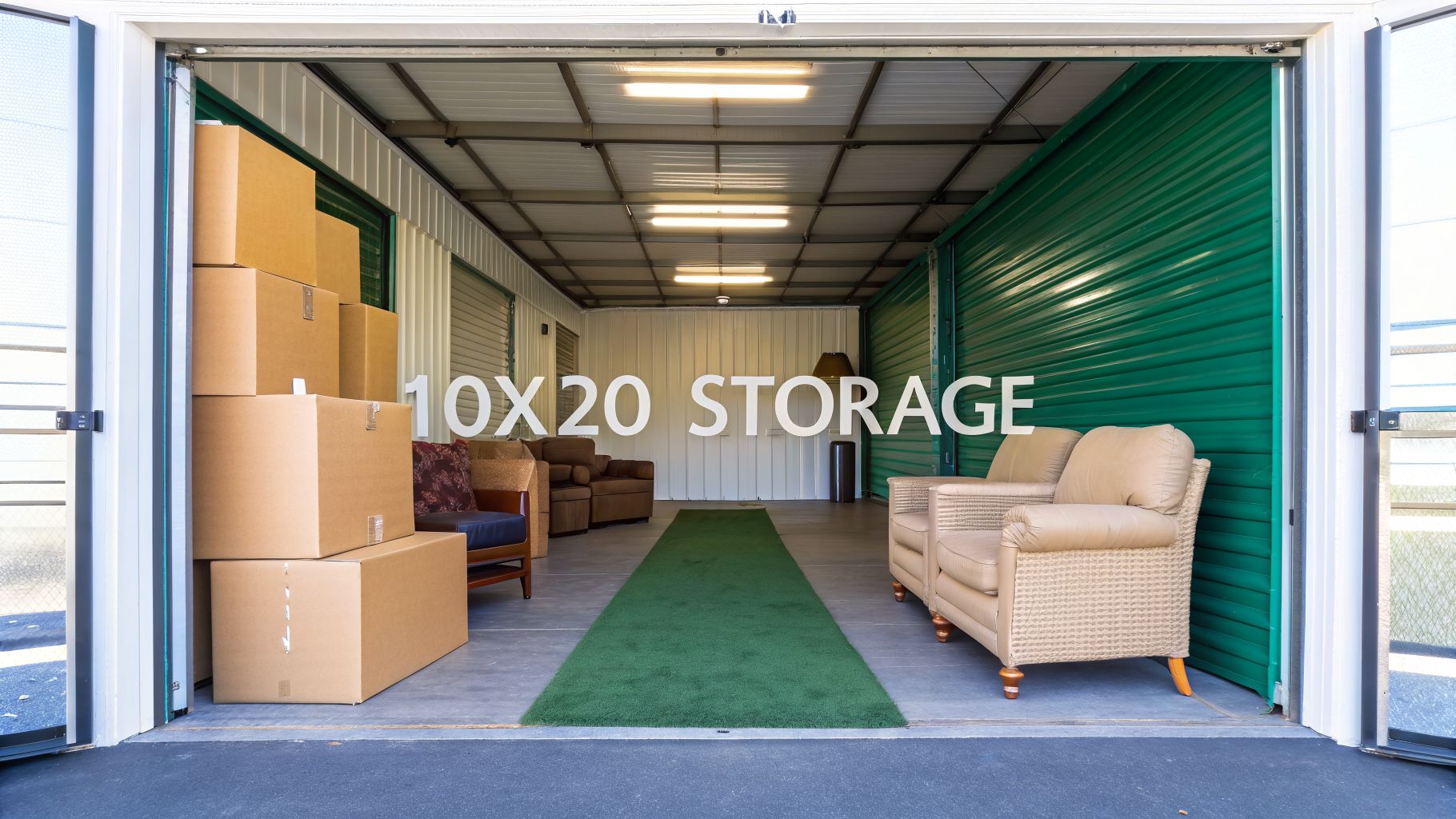
When you’re tackling a major move or a big decluttering project, the 10x20 storage unit is often the hero of the story. It provides an impressive 200 square feet of space, making it a go-to choice for some of life's biggest transitions. The easiest way to picture it? Think of a standard single-car garage—it’s that kind of roomy.
How Big Is a 10x20 Storage Unit Really?
It’s easy to hear numbers like "10x20" and have them just float in your head without a real-world anchor. So let's ground those dimensions. A 10x20 unit is exactly what it sounds like: 10 feet wide and 20 feet long. That gives you a solid footprint of 200 square feet to work with.
To give you an even clearer picture, here's a quick breakdown of what you're getting.
10x20 Storage Unit at a Glance
This table helps you see the numbers, but the real magic comes from understanding the volume.
That's just the footprint, though. The real game-changer is the vertical space. Most units feature an 8-foot ceiling, which bumps your total storage capacity up to a massive 1,600 cubic feet. This is crucial because it means you can stack boxes high, stand mattresses and couches on their ends, and really get creative with your layout.
Why This Size Is So Popular
The 10x20 is a powerhouse in the storage world for a reason. It hits that perfect sweet spot for major life events, whether you're moving out of a two or three-bedroom home, gutting your house for a big renovation, or need a place to stash business inventory.
It’s one of the most widely available sizes you'll find at storage facilities nationwide, making it a dependable option almost anywhere you look. The numbers back it up, too. Industry data reveals that the 10x20 storage unit captures 22.1% of total revenue across all sizes, second only to the smaller 10x10 unit. It’s clear people rely on this size when they have serious storage needs.
Visualizing the Space
So, what does all that space look like in practice? To really get a feel for whether a 10x20 is right for you, picture packing it with all of the following items:
- The entire contents of a master bedroom, including a king-size bed, dressers, and nightstands.
- Your living room furniture, like sofas, a coffee table, and an entertainment center.
- Major household appliances, such as a refrigerator, washer, and dryer.
- A full dining room set.
- On top of all that, dozens of large moving boxes.
This unit isn't just for movers. It’s also an excellent choice for homeowners who need to get seasonal stuff out of the garage—think patio furniture, holiday decor, and lawn equipment. It’s even big enough for hobbyists to store things like jet skis, motorcycles, or a classic car.
By understanding both the square footage and the crucial vertical volume, you can plan your storage strategy like a pro. If you’re still weighing your options, our comprehensive storage unit size guide is a great resource for comparing all the sizes available.
What Realistically Fits Inside a 10x20 Unit
Knowing a 10x20 storage unit's dimensions is one thing, but actually picturing your own stuff inside is a whole different ballgame. Let's get past the abstract numbers and look at what this 200-square-foot space can truly hold, whether you're moving, running a business, or just clearing out your house.
This simple graphic nails the comparison: a 10x20 unit offers 200 square feet, which is about the same footprint as a standard one-car garage.
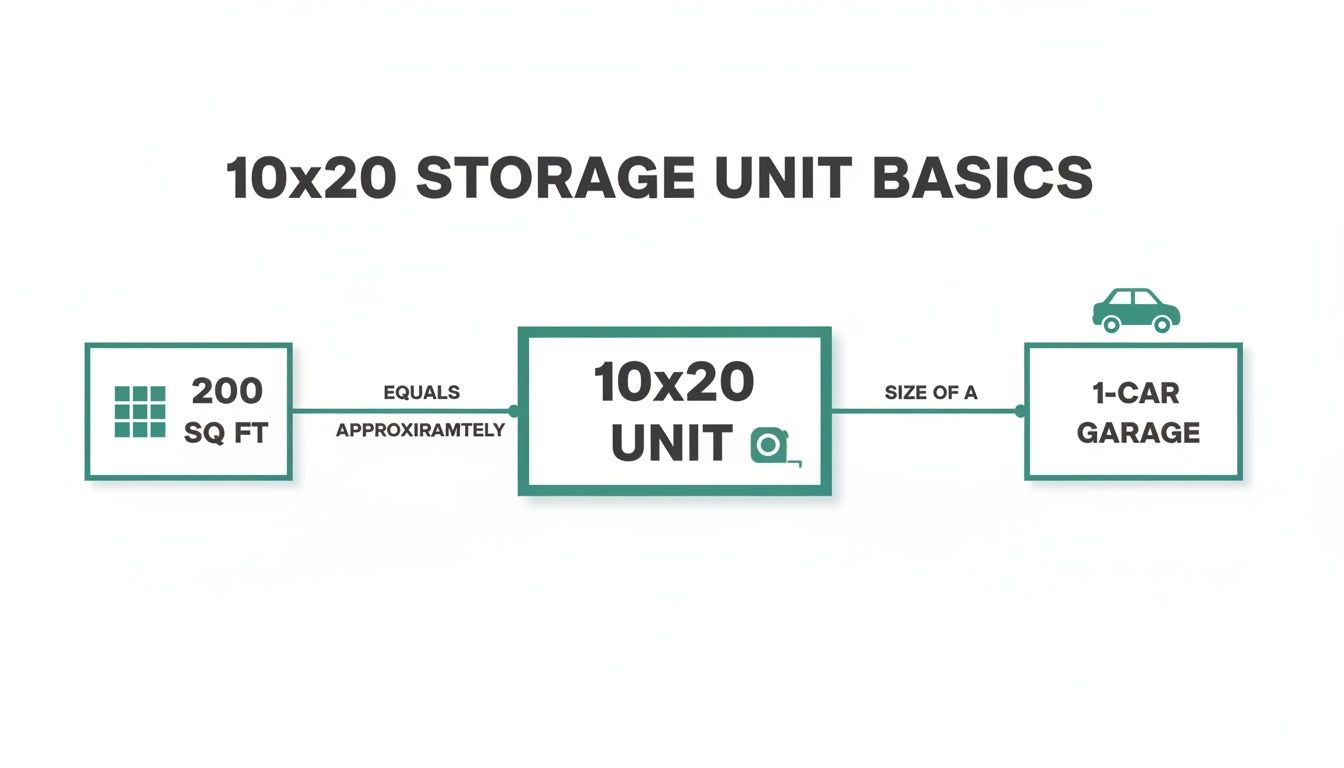
As the picture shows, the old rule of thumb holds true. If you can park a car in it, you’re dealing with a space just like a 10x20 unit.
For Movers Relocating a Home
If you're in the middle of a move from a two or three-bedroom house, a 10x20 storage unit is very often the sweet spot. It's built to hold the contents of an entire multi-room home, giving you a central hub to keep everything protected during the chaos of a move.
With some smart packing, you can typically fit all of this inside:
- Major Living Room Furniture: Think a large sectional sofa, a couple of armchairs, coffee tables, and an entertainment center.
- Complete Bedroom Sets: You can easily store a king-size mattress and box spring, several dressers, nightstands, and headboards.
- Dining Room Contents: A big dining table with six to eight chairs, a buffet, and a china cabinet will fit right in alongside everything else.
- Large Appliances: Your standard-sized refrigerator, washer, dryer, and dishwasher can all be accommodated.
- Dozens of Boxes: Even after all that furniture and the appliances are in, you'll still have plenty of room for 50-75 standard moving boxes filled with clothes, dishes, and other personal items.
The real secret is to think vertically. Stand sofas and mattresses on their ends (just be sure to wrap them in protective covers first!) to open up a ton of floor space. Taking apart bed frames and tables is another non-negotiable step for getting the most out of your unit.
This amount of space makes the 10x20 a go-to choice. But if your needs are a bit smaller, like for a one or two-bedroom apartment, you might want to learn more about a 10x15 storage unit to see if it’s a better match.
For Small Business and Commercial Use
A 10x20 unit isn't just for moving; it’s a flexible and budget-friendly warehouse for countless small businesses. Instead of locking into pricey commercial real estate, entrepreneurs use this space for all kinds of operational needs.
Common Business Use Cases:
- Excess Inventory: E-commerce sellers and retailers can store overstock merchandise, keeping their main shop or office floor clear and organized.
- Archived Documents: Law firms, accountants, and medical practices can securely archive years of files, freeing up expensive office space for people, not paper.
- Tools and Equipment: Contractors, landscapers, and cleaning services often use these units as a home base for tools, machinery, and supplies that won’t fit in a work truck.
- Office Furniture: Businesses that are downsizing, renovating, or in-between leases can store desks, chairs, filing cabinets, and conference room furniture.
For anyone using a unit for business, creating a clear aisle down the middle is essential. This lets you grab a specific box of inventory or a client file without having to unpack the whole thing every time.
For Home Decluttering and Seasonal Storage
Sometimes you just want your garage or basement back. A 10x20 storage unit is a powerful tool for reclaiming your space by stashing bulky items you don't use year-round. It’s basically an off-site garage.
This size is ideal for stowing away all that large seasonal and recreational gear, such as:
- Patio Furniture: Full outdoor dining sets, lounge chairs, umbrellas, and planters.
- Holiday Decorations: Those huge boxes for Christmas, Halloween, and other holidays that clog up your closets for 11 months a year.
- Lawn and Garden Equipment: Riding lawnmowers, snow blowers, wheelbarrows, and other big yard tools.
- Recreational Vehicles: Depending on the facility's rules, you can often store motorcycles, ATVs, jet skis, or kayaks.
By moving these things into a 10x20 unit, you can finally park your car in the garage again or turn that cluttered basement into a family room or home gym. It's a practical way to expand your home's living area without a costly renovation.
How Much Does a 10x20 Storage Unit Cost?
Trying to nail down the exact price of a 10x20 storage unit is a bit like trying to book a hotel room—there’s no single sticker price. The cost swings quite a bit based on a few key factors, so what you pay can be wildly different from what someone pays in another city, or even just across town.
The national average gives you a decent baseline, but think of it as just a starting point. Your actual monthly bill is going to be a unique mix of where you live, what features you need, and even what time of year you rent. Getting a handle on these variables is the real secret to setting a realistic budget and avoiding any nasty surprises down the road.
The Big Three Cost Factors
Three main drivers are responsible for the bulk of your monthly storage fee. The way these elements interact can lead to some major price differences, even for the exact same 200-square-foot space.
Geographic Location: This one’s a biggie. A unit in a dense urban hub like Los Angeles or Chicago will almost always cost more than one in a suburb or rural town. High demand and pricier real estate in major cities naturally push storage rates up. For example, a 10x20 unit might set you back over $380 in L.A. but closer to $130 in a less competitive market like Houston.
Climate Control: Choosing a climate-controlled unit is probably the single biggest price modifier. This feature keeps the temperature and humidity steady, which is crucial for protecting sensitive items like wood furniture, electronics, artwork, and important documents. For that peace of mind, you can expect to pay a premium of 20-30% more.
Seasonal Demand: Storage prices tend to ebb and flow with the seasons. They usually peak in the summer months when everyone is moving. If you can wait to rent until the late fall or winter, you might just snag a better deal. Facilities are often more willing to run promotions to fill up empty units during the slow season.
Uncovering the Full Price Tag
The monthly rent is just one piece of the puzzle. A few other costs can pop up, and being aware of them from the start will help you see the true financial picture before you sign on the dotted line.
Because they can hold the contents of a multi-bedroom home, 10x20 storage units are one of the pricier options out there, often averaging around $229 per month for a standard, non-climate-controlled unit. For comparison, a 10x10 unit is closer to $128 on average. Adding climate control to a 10x20 unit will typically tack on another $25-$40 to your monthly bill.
When evaluating storage options, understanding factors like 10x20 storage unit cost is key, and you can explore various options and their pricing by looking into different storage unit prices in your area. Also, make sure to budget for these common fees:
Potential Added Costs:
- Administrative Fee: This is a one-time charge, usually between $10 and $25, that you pay when you first sign the rental agreement.
- Mandatory Insurance: Nearly all facilities require you to insure your belongings. You can often use your existing homeowner's or renter's policy, but if not, you’ll have to buy a separate plan from the storage company.
- A High-Quality Lock: You’re responsible for securing your own unit. Plan on buying a sturdy lock, like a disc lock, which typically costs $15-$50.
- Late Fees: Just like any other bill, paying your rent late will result in penalties.
By factoring in all these variables, you can look past the advertised rate and get a much clearer picture of the total cost. If you're ready to dive even deeper into all the elements that make up your monthly fee, check out our complete guide on how much storage units cost.
Packing and Organizing Your 10x20 Unit Like a Pro
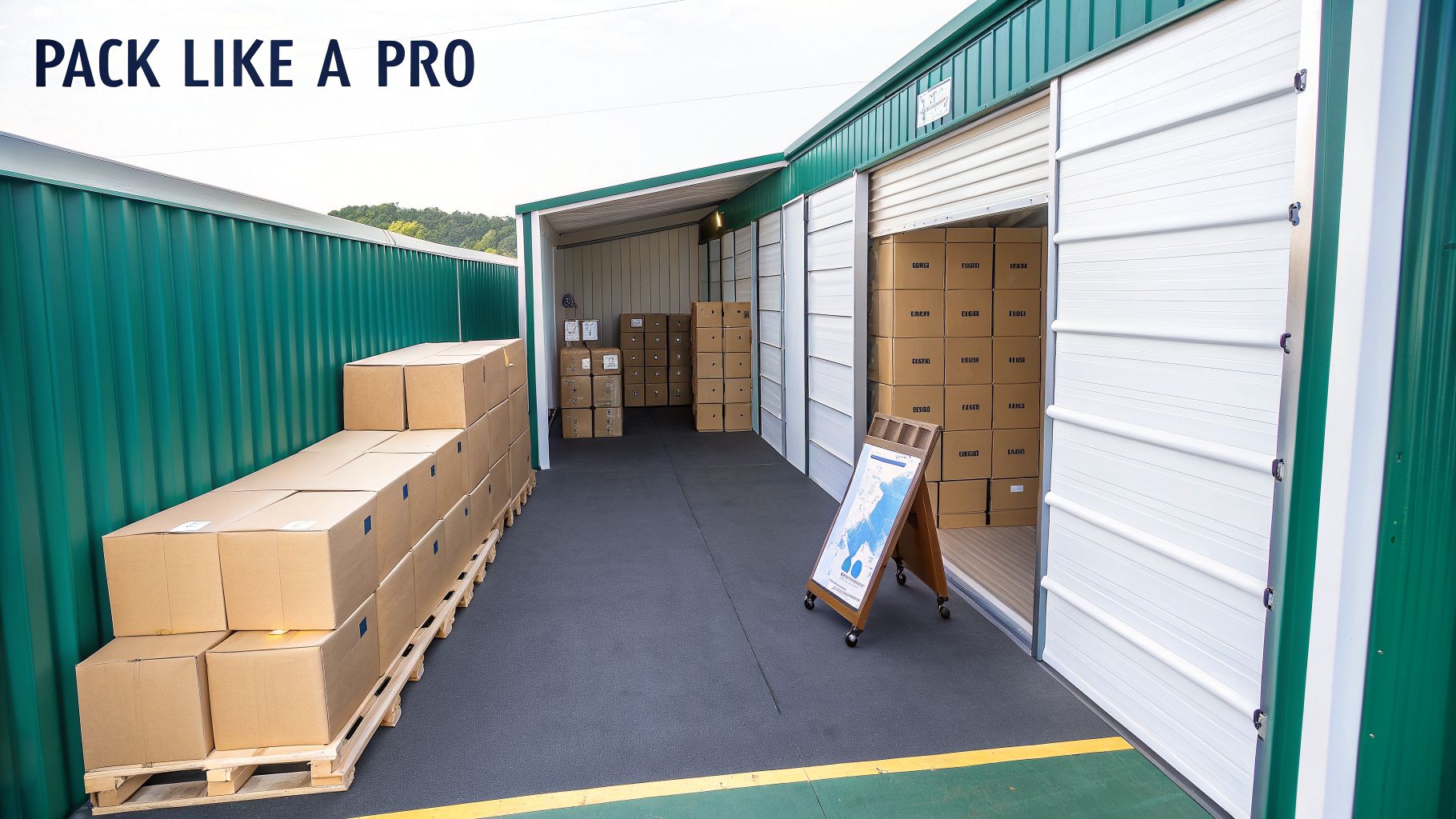
Getting the most out of a 10x20 storage unit is less about brute force and more about smart strategy. A well-organized unit protects your belongings from damage and, more importantly, saves you from future headaches. Think of it like packing for a big trip—you wouldn't just cram everything into a suitcase and cross your fingers.
The real work starts long before you even see the moving truck. Your first move should be creating a detailed list of every single item you plan to store. This inventory helps you visualize the space and makes sure nothing gets left behind. At the same time, do yourself a favor and get some good, uniform moving boxes. It's tempting to grab free ones from the grocery store, but their random sizes create wobbly, unstable stacks just waiting to topple over.
The Foundation: Your Pre-Packing Checklist
A little prep work before you start taping up boxes will make the entire loading process a thousand times easier. This is all about setting yourself up for success. If you need help with the heavy lifting and transport, consulting with local movers can take a huge weight off your shoulders.
Your pre-packing game plan should include:
- Detailed Inventory: Make a list or a spreadsheet of everything going into the unit. It’s a lifesaver for insurance and for finding that one specific box later on.
- Uniform Boxes: Stick to a few standard sizes—small, medium, and large. This makes stacking stable, safe, and way more efficient.
- Essential Packing Supplies: Stock up on quality packing tape, bubble wrap, markers, and packing paper. Don't skimp on furniture covers or mattress bags to shield your items from dust and moisture.
Once you’ve got everything boxed up, this is where the pro-level organization comes in. A non-negotiable rule is to label every box on at least three sides, not just the top. Trust me, this simple trick means you'll always be able to see what's inside, no matter how it’s stacked.
Before you move a single item in, sketch a quick map of your unit. Pencil in where big furniture will go and where different categories of boxes will live. This little map will feel like a treasure guide when you need to grab something down the road.
Loading Your Unit for Easy Access
The way you load your 10x20 storage unit directly impacts how easily you can get to your stuff later. The golden rule? Anything heavy, bulky, or that you know you won't need for a while goes against the back wall. Think dressers, washing machines, and your heaviest boxes.
Next, you'll start building your walls of boxes. Always place the heaviest boxes on the bottom with lighter ones on top to prevent anything from getting crushed. You want to use the unit's full height, but don't stack so high that the towers become unsteady.
Critical Access Tip
The single most important part of your layout is creating a central walkway. Leave a clear path right down the middle, from the door to the back wall. This lets you walk in and grab items from either side without having to play a frustrating game of Tetris every time.
Finally, take furniture apart whenever you can. Removing table legs and disassembling bed frames saves a surprising amount of floor space, as you can store these pieces vertically against the walls. For an even deeper dive into mastering your space, our guide on organizing a storage unit has more advanced techniques. Follow these steps, and your 10x20 unit will feel less like a cluttered garage and more like a perfectly organized extension of your home.
Is a Traditional 10x20 Unit Always the Right Choice?
A 10x20 storage unit gives you a massive 200 square feet of space, but what happens when you don't actually need that much room? For many people, especially city dwellers with just a few dozen boxes, renting a huge unit feels like overkill. Plus, who really looks forward to renting a truck and hauling everything across town?
The old-school self-storage model just doesn't work for everyone. Thankfully, the industry has changed, and there are now some really smart, flexible options out there.
To see what I mean, let's walk through two very different storage experiences.
The Traditional Renter Experience
Let’s imagine Jane, who’s moving out of her two-bedroom apartment. She goes with a 10x20 unit because it seems like the standard thing to do. Her weekend is spent renting a moving truck, loading heavy furniture, and driving it all to the facility. She's paying for the full 200 square feet, even though about a third of it is just empty space.
A few months go by, and she needs her winter coats. The problem? That box is buried somewhere at the very back, behind a couch and a tower of other boxes. Getting to it means spending a Saturday afternoon playing a frustrating game of storage unit Tetris. It's a hassle she never saw coming.
The Modern Storage Experience
Now, meet John. He lives in a city apartment and just needs to free up some space. Instead of a big unit, he chooses a per-box storage service like Endless Storage. He doesn't rent a truck or do any heavy lifting. The service ships durable, empty bins right to his doorstep. He packs on his own schedule, and when he’s done, they come and pick everything up.
His items are kept in a secure, climate-controlled facility—a premium feature that’s usually standard with these services. When the weather turns cold, John just logs into his online account, clicks on the box with his winter gear, and has it delivered right back to him. He only pays for the exact space his boxes use, and not a single square foot more.
This shift really changes how we should think about storage. It’s no longer about renting real estate; it's about paying for a service that gives you convenience and flexibility.
What Makes Per-Box Storage a Smarter Choice?
Comparing Jane and John’s stories, it’s easy to see why per-box services are becoming so popular, especially for people in cities or anyone whose storage needs might change over time. The entire model is built to eliminate the common headaches of traditional storage.
The convenience is a huge draw. With flexible month-to-month terms and no long-term commitments, you're not locked into anything. Imagine storing 20 boxes at $7.99 each—that comes out to less than $160 per month, with insurance often included. When you compare that to the $229 average for a standard 10x20 unit, the savings are clear, and you manage it all online without ever leaving your home.
Here’s a quick breakdown of the main advantages:
- Door-to-Door Service: No trucks, no driving. Empty boxes are delivered to you, and your packed boxes are picked up when you're ready.
- Pay for What You Use: You’re billed per box or item, so you never pay for empty space you don't need. This is way more cost-effective if you don't have enough to fill a large unit.
- On-Demand Retrieval: Need something back? Just request the specific box you need online, and it’s shipped right to your door, often within 48 hours.
- Climate Control is Standard: Most per-box services include climate control at no extra charge, giving you peace of mind that your sensitive items are protected.
To help you decide what's best for your situation, here’s a direct comparison of the two approaches.
Traditional 10x20 Unit vs. Per-Box Storage Service
Ultimately, the choice depends on what you’re storing and how much convenience you value.
If you’re facing a mountain of boxes and the thought of a traditional storage unit feels like too much, it’s definitely worth looking into a more modern approach. For a deeper dive, check out our guide on finding the right alternative to a traditional storage unit. It’s a practical, hassle-free solution built for the way we live today.
Frequently Asked Questions About 10x20 Units
So, you've decided a 10x20 storage unit seems like the right fit. That’s a big decision, but the smaller questions that pop up right before you sign the lease can be just as important. It's totally normal to have a few last-minute things to figure out.
Think of this as your final Q&A before committing. We'll run through the most common questions renters have, from climate control to making sure your car will actually fit, so you can move forward with total confidence.
Do I Really Need a Climate-Controlled 10x20 Unit?
This really comes down to what you’re putting inside the unit. Climate control is a must-have if you’re storing anything sensitive to big swings in temperature or humidity. It keeps the environment steady, usually somewhere between 55 and 80 degrees, protecting your belongings from damage.
You’ll want to spring for climate control if you’re storing things like:
- Wooden or Leather Furniture: This prevents the wood from warping and cracking or the leather from splitting.
- Electronics: It protects delicate internal parts from moisture that can cause rust and corrosion.
- Artwork and Photographs: This is your best defense against fading, discoloration, and mold.
- Important Documents or Books: Keeps paper from turning yellow, brittle, or getting mildewed.
- Musical Instruments: Protects the integrity of wood, strings, and other sensitive components.
Think of climate control less as a luxury and more as an insurance policy. If your items have real monetary or sentimental value, the extra 20-30% a month is a small price to pay to avoid irreversible damage from rust, mold, and mildew.
But if you’re just stashing sturdy things like garden equipment, patio furniture, or plastic tubs full of clothes you don't mind getting a little musty, you can probably save the money and stick with a standard drive-up unit.
Can I Store a Car in a 10x20 Storage Unit?
Yes, you absolutely can! A 10x20 storage unit is the go-to size for vehicle storage. It’s basically the same size as a standard one-car garage, so it’s a perfect home for most cars, sedans, and even some smaller SUVs. You’ll have enough room to park and still open the doors without squeezing.
Before you get too excited, though, you have to check the facility's specific rules. Most places have a few requirements you'll need to meet.
Common Vehicle Storage Requirements:
- Proof of Ownership: You'll need to show the vehicle's title or registration.
- Proof of Insurance: The car must be insured while it’s being stored.
- Vehicle Condition: The car typically has to be in running condition. You can't just park a non-operational vehicle in there.
- Fluid Leaks: Your car can't be leaking any fluids like oil or gas.
It’s an incredibly popular option for storing a classic car over the winter, keeping a spare vehicle safe, or just freeing up some much-needed driveway space.
What Size Moving Truck Do I Need for a 10x20 Unit?
To haul enough stuff to properly fill a 10x20 storage unit, you're going to want a 17 to 20-foot moving truck. That size is built to handle everything from a two or three-bedroom home, which lines up perfectly with a 200-square-foot space.
One of the most common moving day mistakes is renting a truck that’s too small. You end up making multiple trips, which burns through time, gas, and money. A 17 or 20-foot truck should give you plenty of room for your big furniture, appliances, and all those boxes in one go.
When you're mapping out your moving budget, remember to factor in the full cost of the truck rental—that means the daily rate, per-mile charges, gas, and any insurance you add on. Getting this part right makes for a much smoother day.
How Do I Know if a 10x20 Unit Is Too Big?
A 10x20 storage unit offers a serious amount of space, and paying for square footage you don’t use is just throwing money away. This size is really meant for someone moving the contents of a whole 2-3 bedroom house. If you’re just storing a few things, it's almost certainly overkill.
Run through this quick mental checklist to see if you should look for something smaller:
- Are you only clearing out a single room, like a spare bedroom or home office?
- Do you live in an apartment and just need to store seasonal decor and a few extra boxes?
- Is your pile of stuff mostly boxes, without much bulky furniture?
If you said "yes" to any of those, you should definitely consider downsizing. A 10x10 or even a 5x10 unit would probably be a much better fit and could save you a good chunk of change every month.
The trick is to be honest about how much stuff you actually have. Don't pay for 200 square feet if you only need 100. Overestimating is one of the easiest ways to overspend on self-storage.
And for anyone storing mostly boxes and smaller items, there might be an even smarter, more modern way to handle it. This brings us back to services that store your things by the box, offering a flexible alternative for those who find a whole unit to be too much.
Feeling overwhelmed by the idea of a huge unit and all the heavy lifting? Endless Storage offers a smarter, more convenient solution. We send storage kits to your door, pick up your packed boxes, and store them in our secure, climate-controlled facilities. You only pay for the space you use, starting as low as $7.99 per box. Skip the truck rental and the hassle—discover a better way to store at https://www.endless-storage.com.
Frequently Asked Questions
Unveiling the Secrets to Effortless Storage
Endless Storage is available nationwide. You pick a plan, tell us where to pickup, and we'll send a UPS van to collect, whichever state you're in.
Your shipping label will be sent to your email within a few minutes, if not instantaneously. It can also be accessed through your customer profile.
Your box will be shipped to one of our climate controlled self storage facilities in our closest self storage facility. Our manager will accept your package, notify you that your box has been received, and securely stored. Only our managers will have access to Endless Storage boxes.
Email us at admin@endless-storage.com click to live chat with us, or send us a message below.
Never! We're committed to transparent pricing with no surprises. You'll lock in your rate with no hidden fees and no long-term contracts.
Fast access guaranteed! Your boxes will arrive at your doorstep within 48 hours of requesting them back. Need to check on delivery? We provide tracking information for complete peace of mind.
Totally flexible! Store month-to-month with no long-term commitment and cancel anytime.
Everything's online! Use your account dashboard to:
• Set up automatic monthly payments
• Request box returns
• Update your address
• Order additional boxes
• Track shipments
Your boxes are insured up to $100 each. Our customer service team will help you file any necessary claims and resolve issues quickly.
Don't worry – we'll email you right away if there's a payment issue. Your items stay safe, though you may have temporary service interruption or late fees until payment is resolved.
When you request our free storage kits, you'll have 30 days to send in your boxes to activate your 3 months of free storage. Think of it like starting a gym membership – your activation window begins when you receive your kits, and your full free trial begins once you send in your first box. During your free months, you'll experience our complete storage service at no cost.
Your 30-day activation window begins when you receive your storage kits. We'll send you an email confirmation when your kits are delivered, marking the start of your activation period.
If you haven't sent any boxes for storage within your 30-day activation window, your free trial will expire and we'll begin charging the regular monthly rate of $9.99 per box. This helps ensure our storage kits go to customers who are ready to use our service.
A box costs $9.99 per month to store (plus sales tax). This price includes free shipping for standard boxes under 50 lbs. and smaller than 16"x16"x16"
Log into your Endless Storage account, locate the box you would like returned, and simply click Return My Box.
Yes, each box stored with us is insured for up to $100 throughout transit as well as the duration of storage within our facilities.
Your box will be at your doorstep within 48 hours of you requesting it back.
Store 10+ boxes? We'll pick them up for free! After your purchase, we'll contact you to schedule a convenient pickup time and arrange UPS collection.
We trust UPS with all shipments, and every box includes $100 insurance coverage. You'll receive tracking information to monitor your items' journey.
Yes! Visit any of our locations by appointment. Just bring a photo ID matching your customer profile.
For everyone's safety, we can't store hazardous materials, firearms, or perishables. All items must fit within our standard boxes.
It's easy! Order your storage kit online, and we'll ship it to you within 1-2 business days. Your shipping labels will be emailed instantly and available in your account.
We're here to help! Email us at admin@endless-storage.com, use our live chat, or send us a message through your account.
To cancel your storage service with Endless Storage, please email your cancellation request to admin@endless-storage.com. Our team will process your request within 2 business days and confirm your cancellation via email.
We understand packing takes time. However, to maintain your free trial benefits, you'll need to send at least one box within the 30-day activation window. If you need more time, you can always start with one box to activate your trial and send the rest later. You can always reach out to admin@endless-storage.com if you have any issues or concerns.
When you request our free storage kits, you're starting a 30-day window to begin using our storage service.
Important: To activate your free trial, send at least one box for storage within 30 days. If no boxes are sent within this 30-day window, a one-time $50 fee applies to cover materials and shipping costs. This fee is clearly disclosed before you sign up.
Think of it like reserving a hotel room – we're setting aside space and sending specialized packing materials for your use. The fee only applies if you request materials but don't begin storage, similar to a hotel's no-show charge.