You're probably reading this while standing in the middle of a half-packed apartment, staring at things you definitely own but don't currently have room for. Extra kitchen gear. Off-season clothes. Holiday bins. A bike you swear you'll use more when the weather settles down. In Kansas City, that situation is normal, especially if you're moving between leases, downsizing, or just trying to make a smaller place feel livable.
The hard part isn't deciding whether you need storage. It's figuring out which kind of storage fits your life, your budget, and your tolerance for hauling boxes across town.
Navigating Your Storage Needs in Kansas City
A lot of people treat storage like a last resort, as if needing it means you bought too much stuff or failed at organizing. That's not how it works in real life. Storage usually shows up during transitions. You move, combine households, inherit furniture, start working from home, or realize your apartment closet was never designed for actual human life.
That's why I like to frame storage as a logistics problem, not a personal one. You've got belongings with different timelines. Some items need to stay close. Some can disappear for months. Some are too bulky for your current place, and some are just taking up space because there isn't a better system yet.

Why this is more common than it feels
Storage is already part of everyday life for a lot of renters. Nationally, 11.1% of renting households use self-storage, and the typical rental lasts about 14 months, according to Neighbor's self-storage industry statistics. That matters because it shows storage isn't just for major downsizers or businesses. It's a mainstream solution for ordinary space constraints and life transitions.
Practical rule: If your home is doing double duty as bedroom, office, gym, and seasonal closet, you don't have a clutter problem. You have a storage allocation problem.
In Kansas City, individuals often choose between two paths:
- Traditional self-storage, where you rent a unit and move everything yourself
- By-the-box storage, where you store a smaller volume and avoid renting an entire room you don't need
If you're still sorting out which category you fall into, browsing storage service areas and availability can help you see what kinds of pickup-based options exist alongside standard facility rentals.
Start with the volume, not the habit
Self-storage is often the default choice because it's familiar. You picture a garage-style unit, a lock, and a monthly bill. That works well when you have furniture, large equipment, or the contents of a whole room.
But if what you really need is space for a few bins, archived paperwork, dorm items, or the boxes that are crowding your hallway, a full unit may be more than you need. That distinction is where most Kansas City storage decisions get easier.
The Traditional Choice Self-Storage Units in KC
Kansas City has a real self-storage market. It isn't a thin, limited category with only a few scattered facilities. One industry report says the Kansas City metro has 152 institutional-quality storage properties totaling about 9.9 million net rentable square feet, and a 2026 pricing snapshot shows 5x5 units averaging $33 per month and climate-controlled units averaging $82 per month, according to Inside Self-Storage's Kansas City market report.
That scale is useful for shoppers because it means you'll usually find multiple facility types, not just one format. In practice, that means more chances to compare access style, location, climate control, and whether a unit is designed for household goods or something larger.
What a traditional storage unit is really buying you
A self-storage unit is rented space. That sounds obvious, but it's the main thing to remember. You're not paying for the exact amount you store. You're paying for a fixed-size room whether it's full, half-full, or mostly air.
Common choices in Kansas City usually follow a familiar pattern:
- Small units for boxes, seasonal items, and overflow from closets
- Mid-size units for furniture, apartment contents, or renovation staging
- Large units for full moves, business inventory, or vehicle-sized storage use cases
Most facilities market around size bands like 5x5 through 10x30. Those labels matter less than your actual mix of items. A person storing lamps, framed art, winter clothing, and records has a different need from someone storing a sectional, dining set, and appliances.
Features that matter more than the brochure
When people shop for storage Kansas City options, they often focus on headline price first. That's understandable, but the monthly rate is only part of the decision. The daily experience matters too.
Look closely at these trade-offs:
- Climate control: Good for paper records, electronics, fabrics, photos, instruments, and anything sensitive to heat or humidity.
- Drive-up access: Convenient when you're moving bulky items yourself, less important if you're storing mostly boxes.
- Elevator and hallway layouts: These can make move-in day either manageable or miserable.
- Access hours: Useful if you expect frequent visits.
- Location relative to home: A cheaper facility across town can become expensive in time and hassle.
A low monthly rate stops feeling low when every retrieval takes an hour, a car trip, and a full afternoon of motivation.
If you're trying to benchmark facilities, it helps to review a broader comparison of storage unit pricing models so you're not looking at sticker price in isolation.
What works well with self-storage
Traditional units are usually the right choice when the items are physically large, oddly shaped, or needed on your own schedule. They also make sense when you already have a truck, strong move help, and a clear inventory.
Self-storage tends to work best for:
| Use case | Why it fits traditional units |
|---|---|
| Full apartment move | You can store furniture and boxes together |
| Home renovation | Bulky items need a single staging space |
| Business inventory | Shelving and repeated access are easier in a unit |
| Vehicle or outdoor gear | Larger spaces handle awkward dimensions better |
Where self-storage starts to break down
The model gets less efficient when your volume is small. Renting a room for a few boxes can be practical in the short term, but it often feels disproportionate. You still have to pack, load, transport, unload, and repeat the process whenever you want something back.
That's the hidden friction in the traditional model. It solves square footage, but it often leaves convenience entirely on you.
A Modern Alternative How By-the-Box Storage Works
By-the-box storage, resembling cloud storage for physical belongings, offers a more sensible approach. You don't rent a room and then figure out how to fill it. You store only what you need to get out of your home.
That difference matters in Kansas City because much of the local storage marketing still centers on larger units, climate control, and vehicle storage. As Extra Space Storage's Kansas City facility listings make clear, the dominant comparison set is built around unit sizes, which leaves a gap for people who only need to store a few boxes rather than a couch or an entire room.
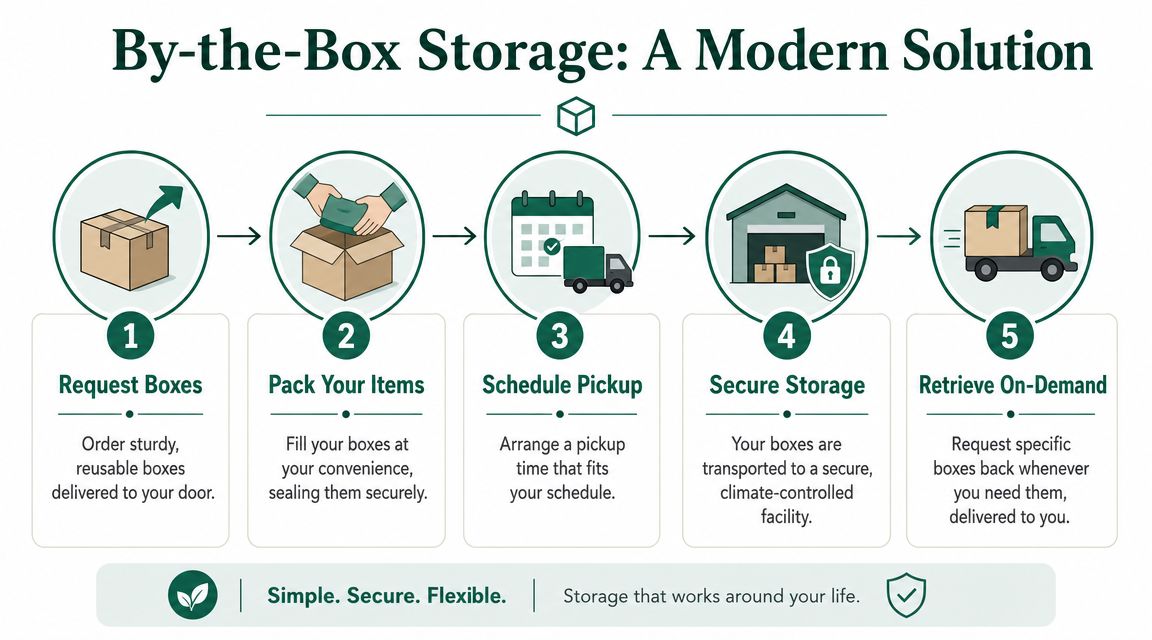
The process in plain terms
Most by-the-box services follow a simple flow:
You get boxes or a storage kit
The service sends durable boxes to you. That removes the first annoying step, which is hunting for matching boxes and packing supplies.
You pack on your own timeline
This is usually better than trying to load a storage unit in one rushed day. You can sort carefully, label clearly, and decide what's worth storing.
Pickup happens from your home
That's the biggest shift from self-storage. You don't drive to the facility. The boxes leave from your doorstep or building pickup point.
Your items go into secure storage
Instead of managing a unit yourself, you're storing tracked boxes in a managed facility.
You request returns when needed
- No need for a large vehicle
- No wasted unit space
- No repeated facility trips
- No pressure to finish in one move day
- Soft goods and seasonal items: coats, boots, decor, extra bedding
- Paper and archives: tax files, keepsakes, old notebooks, records
- Slow-use household items: serving ware, occasional kitchen gear, spare electronics
- Mostly furniture and full-room contents: traditional self-storage
- Mostly labeled boxes and personal items: by-the-box can be cleaner and less chaotic
- Whole-home temporary staging: a larger unit or container can be easier to manage
- Need to store furniture or large gear? Start with traditional units.
- Need to store boxes, bins, and apartment overflow? Start with by-the-box.
- Need frequent in-person access? A facility may fit better.
- Need convenience more than square footage? Pickup-based storage is usually the cleaner option.
If you need one box back, you ask for one box back. You don't open a whole unit just to dig through the back corner.
For a concrete example of the model, box-and-go storage services show how pickup-based storage is structured around smaller, manageable inventories.
Why apartment renters notice the difference fast
This model is especially good for city living because it removes the parts that are hardest in an apartment setup:
That makes it well suited for closet overflow, decor bins, extra linens, archived files, college items, and the in-between category of stuff you want to keep but don't want in sight.
A quick walkthrough helps if this format is new to you:
What by-the-box storage does not solve
It isn't the answer for everything. If you need to store a sofa, heavy gym equipment, or the contents of an entire home, a box-based model may not be the cleanest fit. It's strongest when the problem is compact volume and high inconvenience, not massive furniture storage.
That's why the best use case is usually simple: you don't need a room. You need your space back.
Comparing Your Kansas City Storage Options Head-to-Head
The biggest mistake people make with storage Kansas City choices is comparing only the monthly advertised rate. That's too narrow. The key comparison is structure. Are you paying for a room, or are you paying for the amount you store?
Kansas City pricing gives a good example of why this gets confusing. Extra Space Storage's Kansas City pricing analysis shows that the cost per square foot drops from about $1.31 for a 5x5 unit to about $0.70 for a 10x30 unit. On paper, that makes larger units look more efficient. In real life, it can push people into renting more space than they need.
Traditional Self-Storage vs. By-the-Box Storage
| Feature | Traditional Self-Storage | By-the-Box Service |
|---|---|---|
| Pricing structure | Pay for a fixed-size unit | Pay for the amount you store |
| Best for | Furniture, full-room contents, bulky gear | Boxes, seasonal items, documents, apartment overflow |
| Move-in effort | You pack, load, drive, unload | You pack, then schedule pickup |
| Access style | Visit the facility yourself | Request specific items back |
| Space efficiency | Can leave you paying for unused room | Better fit for small-volume storage |
| Vehicle needed | Usually yes, especially for larger loads | Often no |
| Ideal user | Home mover, contractor, inventory-heavy business | Renter, student, declutterer, small-space household |
Where the “cheaper” option can cost more
A larger unit can have a better per-square-foot rate and still be the wrong choice. That's because most households don't think in square feet. They think in actual objects. Six boxes of winter clothes, two totes of holiday decor, archived papers, and spare bedding don't naturally fill a room-sized unit.
Decision shortcut: If your first storage list is mostly boxes and bins, start by evaluating by-the-box service before renting a full unit.
People often confuse value with scale. Storage facilities reward higher space consumption. Box-based services reward precision. Neither model is wrong. They're built for different inventories.
If you want another framework for judging the true cost, this storage unit cost comparison guide is useful because it shifts the question from “what's the posted monthly price?” to “what I am paying to store what I own?”
Convenience is the dividing line
For many renters, convenience ends up being the deciding factor. A self-storage unit gives direct physical access, which is useful if you expect frequent visits or need to swap large items often. But if access is occasional, the drive, elevator, cart, gate code, and unloading process can be more work than the stored item is worth.
By-the-box storage changes the workflow. You lose spontaneous walk-in access, but you gain a model that doesn't require your Saturday to revolve around a storage run.
That same trade-off shows up in other cities too. If you're comparing how different markets think about compact storage and household overflow, this guide to best storage solutions in Perth is a useful outside example of how convenience and storage type shape the decision.
The cleanest way to choose
Choose traditional storage when you need physical room. Choose box storage when you need friction removed. Most bad storage decisions come from using a room-based product to solve a small-volume problem.
How to Choose the Right Storage for Your Life
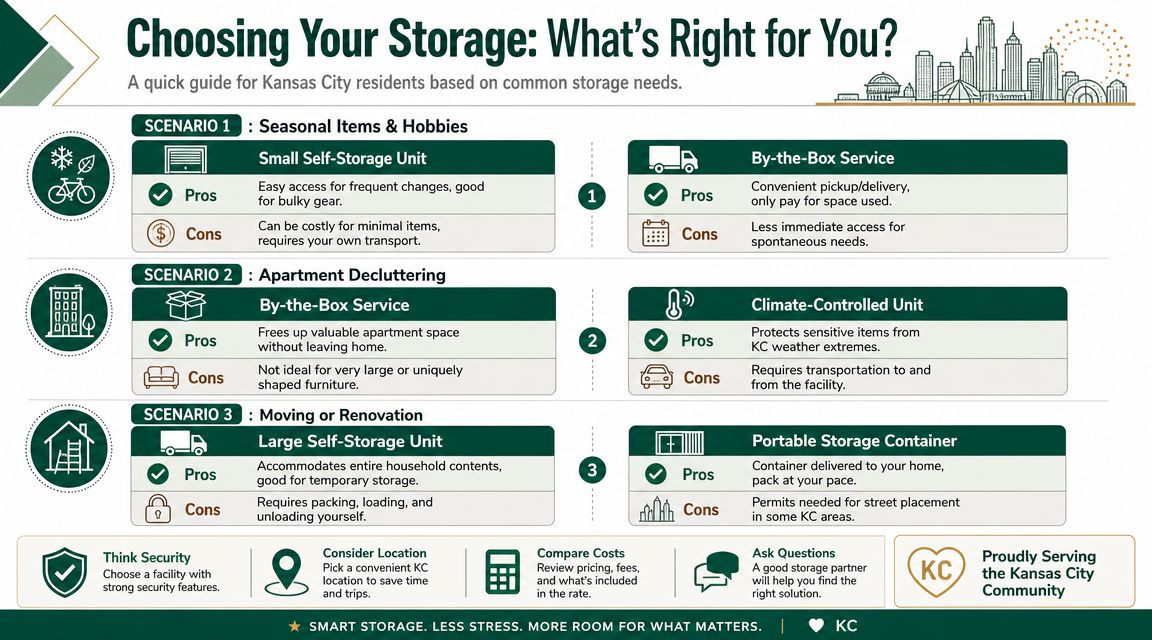
The right storage choice usually becomes obvious once you stop thinking in abstract categories and start thinking in scenarios. What are you storing, how often will you need it, and how much effort are you willing to spend moving it around?
If you're freeing up apartment space
This is the classic Kansas City renter problem. You don't need to store a whole household. You need the hallway clear, the closet usable, and the guest room to stop being a pile of “I'll deal with it later.”
For that situation, by-the-box storage usually makes the most sense. It handles the stuff that creates visual and practical clutter without forcing you into a full storage unit.
Store this way if your list looks like:
A climate-controlled unit can also work if you have more volume or more delicate items, but the effort level is higher because you're still handling transport yourself.
If you're between leases or moving soon
Moving creates a different kind of storage need. Timing gets messy. One lease ends before the next starts, or you need a buffer while repairs happen, a roommate situation changes, or closing dates slip.
In that case, the best option depends on your inventory:
If you're unsure how much room your move really requires, this storage unit sizing guide helps you sanity-check whether you're solving for a few stored categories or an actual roomful of belongings.
Store based on retrieval pattern, not emotion. If you won't need it for months, optimize for convenience. If you'll be in and out every week, optimize for access.
If you're storing business or project materials
Kansas City small businesses, freelancers, and side hustlers often need storage too. Samples, records, pop-up event materials, and light inventory can take over a living space fast.
The key question is whether you need active workspace or just off-site holding. If you need shelves, regular visits, and room to sort inventory, self-storage is usually better. If you just need archive-style storage for boxed materials, a by-the-box model is much less wasteful.
If you're attached to “just in case” items
People often overspend on storage. They rent more space than they need because parting with things feels harder during a move or life change. A smaller, item-based storage option can help because it forces better sorting. You keep what matters without paying for a room full of indecision.
That's often the most practical answer for apartment living. Not maximal storage. Just enough.
Your Next Step Evaluate a Smarter Storage Solution
If your storage problem looks like “I have too many boxes and not enough apartment,” a full self-storage unit is often more commitment than you need. It can still be the right answer for furniture, large moves, or business inventory. But for compact household overflow, it's common to pay for empty space and do all the hauling yourself.
That's where a by-the-box service becomes the smarter fit. You match the storage method to the actual problem. Small volume. Limited time. No interest in driving across town to manage a room-sized unit.
One example is Endless Storage, which offers storage-by-the-box with shipped kits, pickup, climate-controlled storage, and returns on request. That kind of setup is practical for seasonal items, closet overflow, documents, and the packed-but-not-needed category that shows up in so many Kansas City apartments.
Before you choose anything, do one quick filter:
Storage should make your life lighter, not add another recurring errand. The best choice is the one that fits your actual belongings and your actual routine.
If you're ready to compare a simpler option, visit Endless Storage to see how box-based storage works, check pricing, and decide whether a smaller, pickup-based setup fits your Kansas City move or decluttering plan better than a traditional unit.
Frequently Asked Questions
Unveiling the Secrets to Effortless Storage
Endless Storage is available nationwide. You pick a plan, tell us where to pickup, and we'll send a UPS van to collect, whichever state you're in.
Your shipping label will be sent to your email within a few minutes, if not instantaneously. It can also be accessed through your customer profile.
Your box will be shipped to one of our climate controlled self storage facilities in our closest self storage facility. Our manager will accept your package, notify you that your box has been received, and securely stored. Only our managers will have access to Endless Storage boxes.
Email us at admin@endless-storage.com click to live chat with us, or send us a message below.
Never! We're committed to transparent pricing with no surprises. You'll lock in your rate with no hidden fees and no long-term contracts.
Fast access guaranteed! Your boxes will arrive at your doorstep within 48 hours of requesting them back. Need to check on delivery? We provide tracking information for complete peace of mind.
Totally flexible! Store month-to-month with no long-term commitment and cancel anytime.
Everything's online! Use your account dashboard to:
• Set up automatic monthly payments
• Request box returns
• Update your address
• Order additional boxes
• Track shipments
Your boxes are insured up to $100 each. Our customer service team will help you file any necessary claims and resolve issues quickly.
Don't worry – we'll email you right away if there's a payment issue. Your items stay safe, though you may have temporary service interruption or late fees until payment is resolved.
When you request our free storage kits, you'll have 30 days to send in your boxes to activate your 3 months of free storage. Think of it like starting a gym membership – your activation window begins when you receive your kits, and your full free trial begins once you send in your first box. During your free months, you'll experience our complete storage service at no cost.
Your 30-day activation window begins when you receive your storage kits. We'll send you an email confirmation when your kits are delivered, marking the start of your activation period.
If you haven't sent any boxes for storage within your 30-day activation window, your free trial will expire and we'll begin charging the regular monthly rate of $9.99 per box. This helps ensure our storage kits go to customers who are ready to use our service.
A box costs $9.99 per month to store (plus sales tax). This price includes free shipping for standard boxes under 50 lbs. and smaller than 16"x16"x16"
Log into your Endless Storage account, locate the box you would like returned, and simply click Return My Box.
Yes, each box stored with us is insured for up to $100 throughout transit as well as the duration of storage within our facilities.
Your box will be at your doorstep within 48 hours of you requesting it back.
Store 10+ boxes? We'll pick them up for free! After your purchase, we'll contact you to schedule a convenient pickup time and arrange UPS collection.
We trust UPS with all shipments, and every box includes $100 insurance coverage. You'll receive tracking information to monitor your items' journey.
Yes! Visit any of our locations by appointment. Just bring a photo ID matching your customer profile.
For everyone's safety, we can't store hazardous materials, firearms, or perishables. All items must fit within our standard boxes.
It's easy! Order your storage kit online, and we'll ship it to you within 1-2 business days. Your shipping labels will be emailed instantly and available in your account.
We're here to help! Email us at admin@endless-storage.com, use our live chat, or send us a message through your account.
To cancel your storage service with Endless Storage, please email your cancellation request to admin@endless-storage.com. Our team will process your request within 2 business days and confirm your cancellation via email.
We understand packing takes time. However, to maintain your free trial benefits, you'll need to send at least one box within the 30-day activation window. If you need more time, you can always start with one box to activate your trial and send the rest later. You can always reach out to admin@endless-storage.com if you have any issues or concerns.
When you request our free storage kits, you're starting a 30-day window to begin using our storage service.
Important: To activate your free trial, send at least one box for storage within 30 days. If no boxes are sent within this 30-day window, a one-time $50 fee applies to cover materials and shipping costs. This fee is clearly disclosed before you sign up.
Think of it like reserving a hotel room – we're setting aside space and sending specialized packing materials for your use. The fee only applies if you request materials but don't begin storage, similar to a hotel's no-show charge.