Feeling overwhelmed by clutter or staring down a big move? Finding the right self storage solution can make all the difference, turning a stressful situation into a manageable one. This guide is here to cut through the noise and give you a clear, practical look at today's storage landscape.
Navigating Your Modern Self Storage Options
At its core, "self storage" is just an extension of your home—think of it as a closet or garage you rent to hold things you don't currently have room for. For years, this meant one thing: driving out to a facility lined with rows of identical metal doors.
But things have changed. The world of self storage has grown way beyond that classic model, with options designed for different needs, budgets, and lifestyles. Understanding the key differences is the first step to picking the right one and saving yourself time and money in the process.
For anyone living in a smaller space, the right storage can be a game-changer. You can even find some great small apartment organization ideas to maximize space that pair perfectly with an off-site solution.
The Three Core Storage Models
We'll dive into each of these in more detail, but let's start with a quick overview. Your main choices boil down to three distinct approaches:
- Traditional Drive-Up Units: This is the classic model. You rent a unit at a facility and are responsible for moving all your items there yourself.
- Portable Storage Containers: A big container gets dropped off at your home. You fill it up on your own schedule, and a company hauls it away to a storage center or directly to your new address.
- Valet or By-the-Box Storage: This is the full-service, convenience-focused option. A company provides boxes, picks them up when they're packed, stores everything for you, and delivers items back whenever you need them—often managed through an app.
Each of these self storage solutions tackles the same basic problem—a lack of space—but they do it with completely different levels of convenience, access, and cost. The trick is matching the right model to your specific situation.
Ultimately, your choice will hinge on a few key factors: how much stuff you have, how often you’ll need to get to it, and how much of the heavy lifting you want to do yourself. If you’re trying to coordinate a move at the same time, our complete guide to moving and storage solutions can help you plan everything out.
The Traditional Self Storage Unit Explained
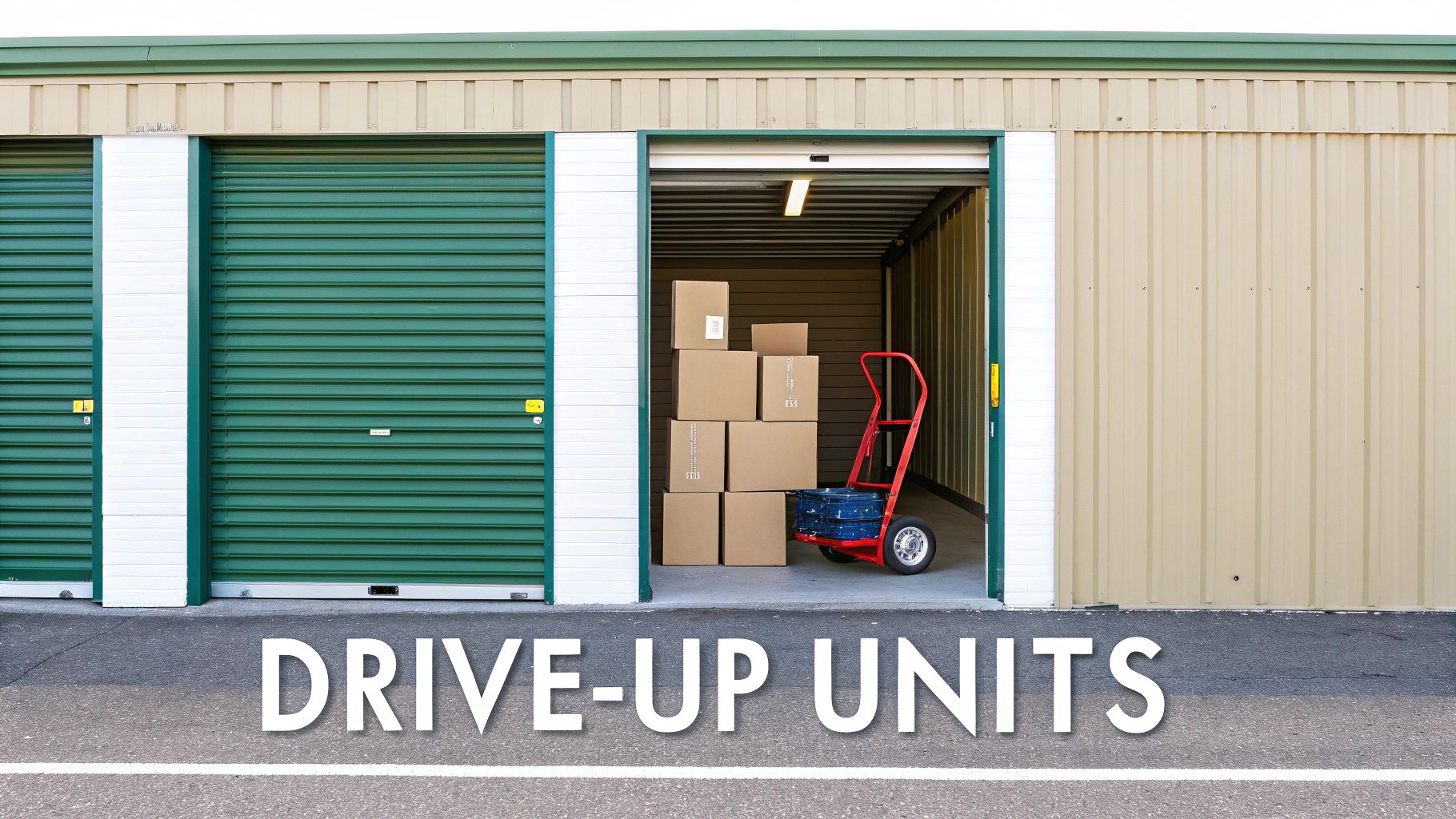
When you hear "self-storage," you probably picture it right away: long rows of roll-up garage doors, a keypad at the gate, and cars pulling right up to their units. That’s the classic self-storage model, and for good reason—it’s been the industry standard for decades. The idea is simple: you rent a secure, private space and handle getting your stuff in and out yourself.
The biggest draw here is direct control and unfiltered access. It’s your unit, your lock, and your key. Most facilities let you come and go as you please during access hours, which are often 24/7. This hands-on, DIY approach is exactly what many people are looking for.
Just how popular is it? The U.S. self-storage market is massive, with industry stats pointing to roughly 2.6–2.8 billion square feet of rentable space across more than 67,000 facilities. Occupancy rates often hover in the mid-90s, which tells you just how much people rely on this solution. For a deeper dive, check out the state of self storage in 2025 at Stortrack.com.
Finding Your Perfect Fit
Traditional storage facilities offer a whole menu of unit sizes, kind of like picking out an apartment. Getting the size right is the key to not paying for air.
- Small Units (5x5 or 5x10 feet): Think of these as an extra walk-in closet. They’re perfect for stashing holiday decorations, a few boxes of files, or small furniture like a desk chair and a bookshelf.
- Medium Units (10x10 or 10x15 feet): This is about half the size of a standard one-car garage. You can comfortably fit the contents of a one- or two-bedroom apartment in here, including big appliances, couches, and plenty of boxes.
- Large Units (10x20 feet or larger): Now we're talking about the size of a full one-car garage. These are built to hold the contents of an entire multi-bedroom house, from large furniture sets and appliances to, in some cases, even a car.
At its core, traditional storage is all about autonomy. You get a dedicated physical space that you manage completely on your own terms, giving you total control over your belongings.
Weighing the Pros and Cons
While having direct access is a huge plus, the traditional model isn’t without its trade-offs. It’s a very hands-on approach that demands a fair bit of work on your part.
Key Considerations:
- You're the moving crew. It’s on you to get a truck or a van large enough to haul your belongings. This usually means renting a moving truck, which adds another layer of cost and coordination to your day.
- All the heavy lifting is yours. Loading up the truck, driving to the facility, and unloading everything into the unit—it's all on you. This can be a serious physical workout, especially with heavy furniture or dozens of boxes.
- You might pay for space you don't use. If your stuff doesn't quite fill up that 10x10 unit you rented, you’re still paying for every square foot of it. This can feel wasteful if you just have a few bulky items that don't fit a smaller unit.
This model is a fantastic fit for anyone who needs to get to their things often and doesn't mind handling the logistics. Think of a small business owner storing inventory they need to access daily, or a family that needs to store furniture during a quick home renovation. For them, the control and access are worth the effort.
How Portable Storage Containers Work
Portable storage containers completely flip the old model on its head. Instead of you schlepping everything across town to a storage unit, the unit comes directly to you. A big, weather-resistant container gets dropped right in your driveway, giving you the space of a traditional unit with unbelievable door-to-door convenience.
Think of it as your own temporary garage that pops up exactly when and where you need it. This simple shift has been a lifesaver for anyone tackling a home renovation, staging a house to sell, or just making a local move. It completely cuts out all those frantic, stressful trips to and from a storage facility.
The Step-by-Step Process
The beauty of this system is its simplicity. Everything works around your schedule, not the tight deadline of a rental truck. You get to load your things at your own pace—whether that's cramming it all into one weekend or chipping away at it over a full week.
- Delivery to Your Door: It all starts when the storage company drops off a container at your home. You pick the size you need, and they place it right where you want it, usually in the driveway or on the lawn.
- You Load on Your Time: This is where the magic happens. You pack up your belongings and load the container whenever you feel like it. No pressure, no rush.
- Pickup and Storage: Once you’re all packed up, you just schedule a pickup. The company swings by, grabs the entire container, and drives it off to a secure, centralized storage facility.
- Final Destination: When you’re ready for your stuff, you can have the container delivered to your new house for unloading. Or, if you were renovating, they’ll just bring it right back to your original address.
The whole model is built to take the logistical nightmare out of moving and storing a large amount of stuff.
The real value of a portable container is simple: it drastically cuts down on the physical labor and planning you have to do. By bringing the storage to your doorstep, it eliminates the entire transportation headache.
Practical Considerations Before You Order
While these containers are incredibly convenient, they aren't the perfect solution for every single situation. The biggest hurdle? Space. You need a place to actually put the container, which can be a huge issue in packed urban neighborhoods. Before you pull the trigger, take a hard look at your property and the local rules.
Key Questions to Answer:
- Do I have the physical space? You’ll need a flat, easy-to-access spot like a driveway, a solid patch of your yard, or a dedicated parking space.
- Are there local restrictions? Some cities or Homeowner Associations (HOAs) have strict rules about how long you can leave a container on your property. You might even need a permit, so it’s always smart to check with your local government first.
- How does the cost compare? Pricing is often pretty competitive with traditional units, especially when you remember you're not paying for a moving truck. But the final bill will depend on the container size, how long you rent it for, and how many times it needs to be moved.
For a deeper dive, check out our guide to using portable storage containers, which covers everything from picking a size to finding a great provider. It’s a powerful mix of convenience and capacity, making it a fantastic choice for anyone who has the space to make it work. It just simplifies complex projects by bringing the solution right to you.
The Convenience of Valet Storage Services
Think of cloud storage, but for your actual, physical stuff. That’s the brilliant idea behind valet storage, a modern take on storing your things that’s often called by-the-box storage. It’s a model built from the ground up for convenience, especially if you’re navigating city life, a small apartment, or frequent moves. It pretty much erases all the classic hassles of self-storage.
The whole process is refreshingly straightforward. Forget renting a truck and hauling boxes yourself. Instead, you just request durable, standard-sized storage bins, and they show up at your door. You pack on your own time, and when you’re done, you schedule a pickup. A team swings by, grabs your stuff, and whisks it away to a secure, often climate-controlled, warehouse.
A Digital Approach to Physical Items
What really makes valet storage a game-changer is the digital inventory. Every single box or item you store gets photographed and cataloged in your online account. So when you need something back—whether it's your winter parka or that vinyl collection—you just log in, click on the item you want, and set up a delivery. It's storage that behaves like an on-demand service.
This approach is a perfect match for a few key situations:
- Urban Dwellers: No car? No problem. Valet storage completely solves the logistical nightmare of getting your belongings to a storage facility.
- Small Space Living: It lets you declutter without having to part with things you love. Think seasonal items like holiday decorations or bulky ski gear.
- Busy Professionals: The entire experience is managed from your phone or laptop, saving you precious time and energy that would otherwise be burned on trips to a storage unit.
Valet storage shifts your role from manual laborer to logistics manager. You direct the entire operation from your screen while someone else handles all the heavy lifting and driving.
This new wave of tech-savvy, door-to-door storage is a huge reason the industry is booming. The global self-storage market, which recently hit around USD 59.08 billion, is expected to soar to USD 83.20 billion by 2030. A lot of that growth is fueled by city dwellers who’d much rather have pickup and delivery than drive out to a facility. You can dig into the market trends and structural demand over on GrandViewResearch.com.
Pay for What You Use, Not for Empty Air
One of the best parts is the way pricing works. With a traditional storage unit, you’re stuck paying a flat monthly rate for a fixed amount of space, whether it’s full or half-empty. Valet services, on the other hand, usually charge you per box or per item. That means you only pay for the exact amount of space your stuff takes up.
This item-by-item approach can lead to some serious cost savings, especially if you don't need a whole 5x5 unit. Let's say you just need to store ten boxes of books and off-season clothes. You pay for those ten boxes, and that’s it. This efficiency is a big reason why valet storage is becoming the go-to for people looking to declutter without overpaying.
Now, this model isn't really built for storing all the furniture from a three-bedroom house. Its real strength is in handling smaller, boxed items and individual pieces like your bike or a piece of art. If most of what you need to store fits in a box or is a single, manageable item, the convenience is pretty tough to top. To get a better feel for the whole process, you can learn more about how a storage pickup service operates and what you can expect.
At the end of the day, valet storage is a fundamental change in how we think about our belongings. It gives you a fluid, flexible extension of your own closet, accessible with just a few clicks. It’s a smarter, more efficient solution made for a modern lifestyle where convenience and clever use of space are everything.
Choosing Your Ideal Self Storage Solution
Now that we’ve walked through the different types of self storage solutions, how do you actually make the right call for your situation? The secret isn’t finding the universally “best” option—it’s about finding the one that lines up perfectly with your life right now.
Think of it like choosing a vehicle. You wouldn't buy a zippy sports car to haul lumber, and you wouldn't use a massive moving truck for your daily commute. Each storage model is a specialized tool. Matching the right tool to the job saves you time, money, and a whole lot of headaches.
The Four Big Decision Factors
Your perfect storage solution sits at the crossroads of four key variables. Just by thinking through each one, you can pretty quickly narrow the field from three options down to one clear winner.
- How Much Stuff Are You Storing? Is it the entire contents of a house, or just a few boxes of seasonal clothes? The sheer volume of your items is the first and most important filter.
- How Often Do You Need Access? Will you need to get to your things frequently, or are you packing them away for the long haul? This is huge, as some solutions are built for instant, anytime access while others prioritize convenience over frequency.
- How Much Work Do You Want to Do? Let’s be honest—how much of the heavy lifting are you willing to do yourself? Consider the packing, driving, loading, and overall effort required for each option.
- What's Your Budget? How much are you prepared to spend each month? Your budget will shape not only the type of storage you pick but also extra features like climate control and insurance.
Getting an accurate read on how much space you need is the foundation of a good decision. If you're scratching your head on this one, our guide can help you figure out how much storage do I need before you commit to anything.
Matching the Solution to Real Life
Let’s put this into practice with a couple of real-world scenarios. A family moving the contents of their three-bedroom house will find a portable container to be a lifesaver. It completely eliminates the need for endless back-and-forth trips and lets them pack at their own pace.
On the other hand, picture a recent college grad living in a tight city apartment who just needs to stash winter gear and a few boxes of books. For them, a valet service like Endless Storage is a perfect fit. They skip the cost of a full unit they don't need and avoid all the hassle of moving everything themselves, paying only for the exact items they store.
The most effective way to choose is to score each storage type against your personal priorities. Don’t just look at the monthly price—consider the total cost in terms of your time, effort, and convenience.
This simple flowchart shows just how straightforward a valet storage process can be.
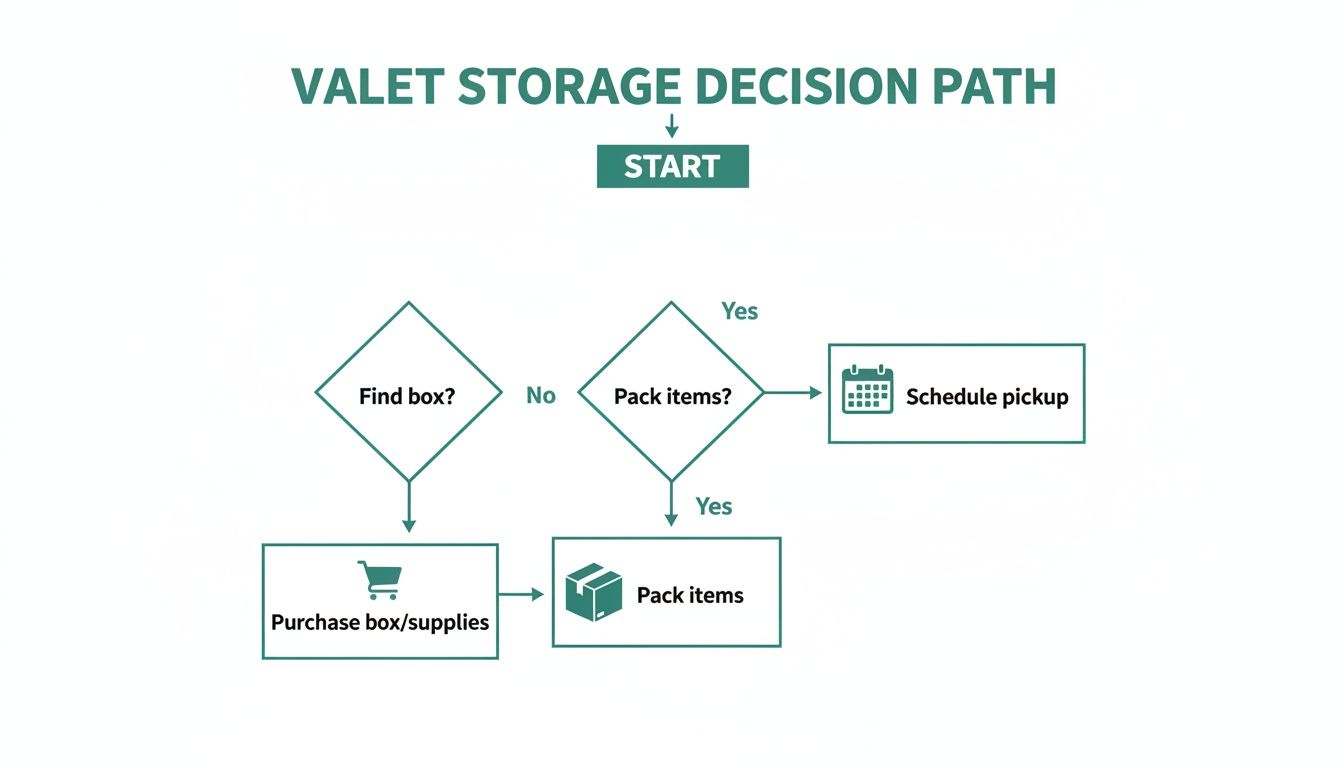
As you can see, the whole thing boils down to a few simple steps: packing your things and scheduling a pickup. All the logistical headaches of traditional storage are just… gone.
Decision Matrix: Which Storage Is Best for You?
To make it even clearer, here’s a breakdown of how each solution stacks up against our key decision factors. Use this as a quick guide to see which option scores highest for what matters most to you.
At the end of the day, choosing the right self-storage solution means being honest about your needs. By really thinking through these factors, you can move beyond a simple price comparison and pick the option that genuinely makes your life easier.
Smart Packing Strategies for Any Storage Type
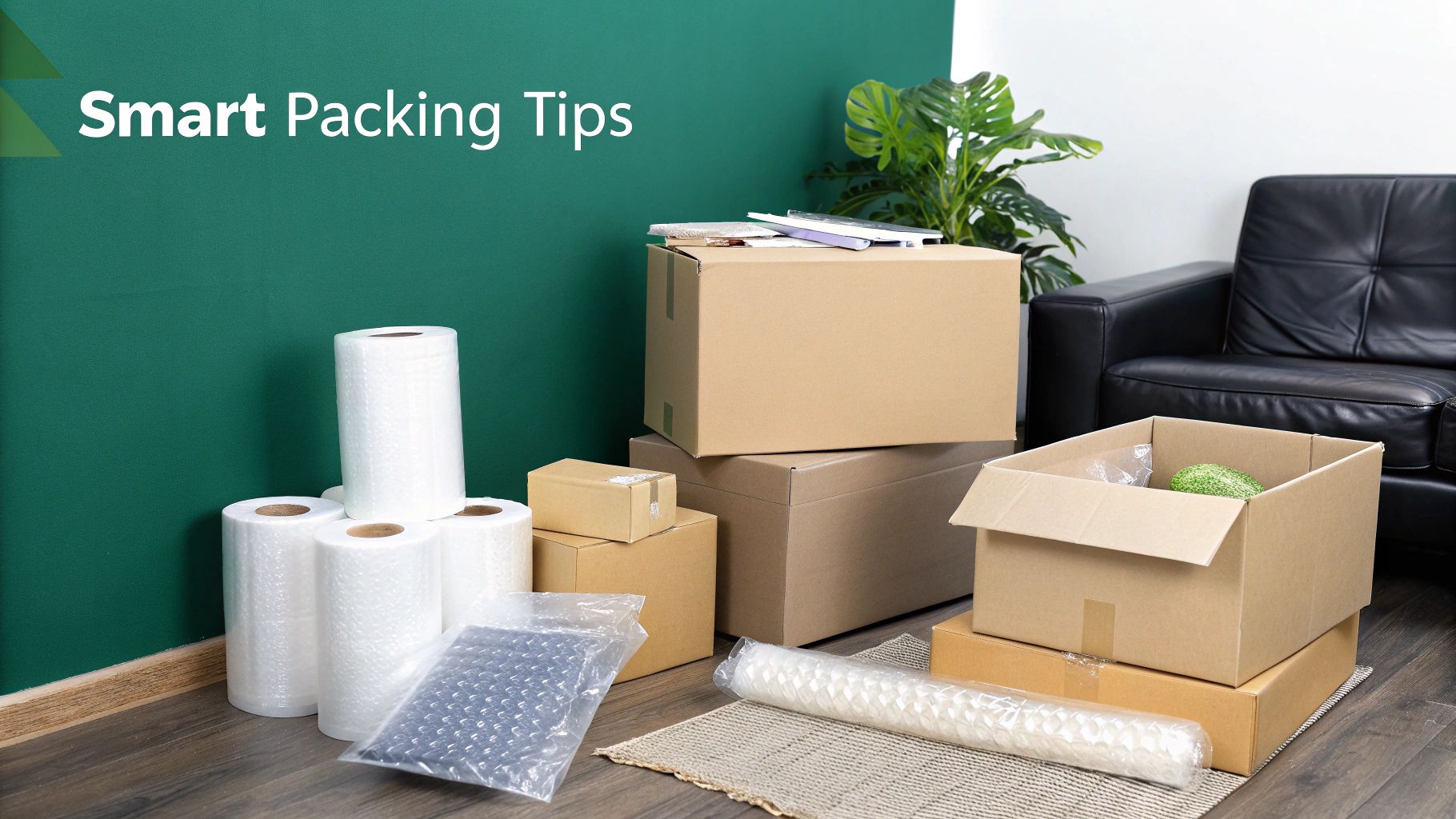
Picking the right self-storage solution is a great first step, but the job is far from over. How you pack is just as important—it protects your things, saves space, and prevents a massive headache when you need to grab something later. Smart packing is the real difference between a smooth storage experience and a chaotic mess.
Think of your storage unit like a library. Every box is a book, placed on a shelf with care so it's easy to find and stays in perfect shape. A messy unit? That’s like a pile of books just tossed in a corner. You'll have to dig through everything to find what you need, and some things will probably get damaged along the way.
This methodical approach is more important than ever. The self-storage industry has seen a massive influx of nearly USD 50 billion in investor capital recently, all thanks to its reliable performance and high demand. Facility operators have shown they can command higher prices because people are willing to pay for well-run, secure places to keep their belongings. It's a clear sign that quality matters.
Build a Strong Foundation With the Right Supplies
Your packing success starts long before you even tape up the first box. Using the right materials isn't just a suggestion; it’s a must for keeping your items safe.
- Use Uniform Boxes: It's tempting to reuse old grocery boxes, but trust me, investing in new, sturdy moving boxes of similar sizes is a game-changer. They stack better, are far more stable, and won't buckle under the weight of what's above them.
- Gather Essential Protection: Don't skimp here. Get plenty of bubble wrap for fragile items, packing paper to fill in gaps, and furniture covers to guard against dust and moisture. And never underestimate the power of good packing tape.
The Art of Packing the Box
With your supplies ready, it's time to pack each box with a strategy. This isn’t just about cramming things in; it’s a balancing act of protection and future access. For a deep dive, our guide on how to pack efficiently for a move is packed with actionable tips.
Here’s a quick-start guide to get you going:
- Distribute Weight Evenly: Always put heavier items on the bottom and lighter ones on top. This simple rule prevents your delicate belongings from getting crushed.
- Fill Empty Spaces: Use packing paper, old towels, or linens to fill every gap. This stops items from shifting around and breaking during transit.
- Don’t Overpack: If a box is too heavy to lift comfortably, it's a risk to your back and the box itself. It’s better to use two boxes than to have one burst open.
Key Takeaway: The goal for every box is simple: create a dense, stable cube with zero internal movement. This gives you maximum protection and makes stacking inside your storage space a breeze.
Master Your Inventory and Labeling System
Finally, the step that will save your sanity later: creating a system to track what you've stored. When you urgently need your winter coats, a well-labeled box is your best friend.
Your labeling system doesn't have to be complex, just consistent. On at least two sides of every single box, clearly write:
- The general contents (e.g., "Kitchen - Mugs & Glasses," "Office - Files").
- The room it belongs to.
- A big, bold "FRAGILE" warning if necessary.
For next-level organization, create a master inventory list in a notebook or on your phone. Number each box and jot down its main contents. This list will be priceless, turning a frustrating hunt into a simple two-minute lookup.
Common Questions About Self Storage
Even after you've looked at the different storage options out there, a few practical questions usually come up. Getting these details straight is the last step before you can feel confident you’re protecting your stuff without overpaying.
Think of this as your final checklist. Answering these questions now will save you from headaches down the road and make sure the solution you pick is the right fit.
Do I Need Climate-Controlled Storage?
This is easily one of the most important questions, and the answer really comes down to what you’re storing. Climate control is basically an insurance policy against the weather—it keeps the temperature and humidity inside your space stable, no matter what’s happening outside.
For sturdy things like garden tools, patio furniture, or basic household goods you’d keep in a garage, a standard unit is probably fine. But for anything sensitive, climate control is a must-have.
Consider it non-negotiable for:
- Wooden Furniture: Prevents warping, cracking, and splitting that can happen when temperatures fluctuate.
- Electronics and Media: Protects delicate circuits in your TV or computer and stops moisture from ruining DVDs, vinyl records, and old photos.
- Artwork and Antiques: Shields valuable pieces from humidity that causes mildew and permanent damage.
- Important Documents: Keeps paper from getting brittle or yellowed over time.
Choosing climate control is like buying insurance against the elements. It’s a small extra cost that provides crucial protection for items that are either financially or sentimentally irreplaceable.
What Kind of Insurance Do I Need?
Most storage places will require you to have insurance, and for good reason. It’s your safety net against the unexpected, like a fire, theft, or water damage. You usually have a couple of options here.
First, give your current homeowner's or renter's insurance provider a call. A lot of policies actually extend coverage to items stored off-site, but you need to confirm the details and coverage limits. If your policy doesn’t cover it or isn't enough, the storage facility will offer its own insurance plan. Always ensure your belongings are covered—it’s just a fundamental part of storing smart.
How Much Storage Space Do I Actually Need?
Figuring out the right size unit can feel like guesswork, but you don't want to pay for a bunch of empty air. Most companies have online size guides, but here are a few real-world comparisons to help you visualize what you need:
- 5x5 Unit (25 sq. ft.): Think of a small walk-in closet. This is perfect for a few boxes, a small dresser, and seasonal gear like holiday decorations or a couple of bikes.
- 10x10 Unit (100 sq. ft.): This is about half the size of a standard one-car garage. It can usually hold everything from a one-bedroom apartment, including a couch, a mattress set, and major appliances.
- 10x20 Unit (200 sq. ft.): Now you're at the size of a full one-car garage. This is what you’d need for the contents of a two or three-bedroom house, including bulky furniture, lots of boxes, and all your appliances.
Ready to skip the guesswork and find a solution that fits your life perfectly? With Endless Storage, you only pay for the exact space you use. We provide the boxes, pick them up, and deliver your items back on demand, making storage simpler than ever. Get started with Endless Storage today!
Frequently Asked Questions
Unveiling the Secrets to Effortless Storage
Endless Storage is available nationwide. You pick a plan, tell us where to pickup, and we'll send a UPS van to collect, whichever state you're in.
Your shipping label will be sent to your email within a few minutes, if not instantaneously. It can also be accessed through your customer profile.
Your box will be shipped to one of our climate controlled self storage facilities in our closest self storage facility. Our manager will accept your package, notify you that your box has been received, and securely stored. Only our managers will have access to Endless Storage boxes.
Email us at admin@endless-storage.com click to live chat with us, or send us a message below.
Never! We're committed to transparent pricing with no surprises. You'll lock in your rate with no hidden fees and no long-term contracts.
Fast access guaranteed! Your boxes will arrive at your doorstep within 48 hours of requesting them back. Need to check on delivery? We provide tracking information for complete peace of mind.
Totally flexible! Store month-to-month with no long-term commitment and cancel anytime.
Everything's online! Use your account dashboard to:
• Set up automatic monthly payments
• Request box returns
• Update your address
• Order additional boxes
• Track shipments
Your boxes are insured up to $100 each. Our customer service team will help you file any necessary claims and resolve issues quickly.
Don't worry – we'll email you right away if there's a payment issue. Your items stay safe, though you may have temporary service interruption or late fees until payment is resolved.
When you request our free storage kits, you'll have 30 days to send in your boxes to activate your 3 months of free storage. Think of it like starting a gym membership – your activation window begins when you receive your kits, and your full free trial begins once you send in your first box. During your free months, you'll experience our complete storage service at no cost.
Your 30-day activation window begins when you receive your storage kits. We'll send you an email confirmation when your kits are delivered, marking the start of your activation period.
If you haven't sent any boxes for storage within your 30-day activation window, your free trial will expire and we'll begin charging the regular monthly rate of $9.99 per box. This helps ensure our storage kits go to customers who are ready to use our service.
A box costs $9.99 per month to store (plus sales tax). This price includes free shipping for standard boxes under 50 lbs. and smaller than 16"x16"x16"
Log into your Endless Storage account, locate the box you would like returned, and simply click Return My Box.
Yes, each box stored with us is insured for up to $100 throughout transit as well as the duration of storage within our facilities.
Your box will be at your doorstep within 48 hours of you requesting it back.
Store 10+ boxes? We'll pick them up for free! After your purchase, we'll contact you to schedule a convenient pickup time and arrange UPS collection.
We trust UPS with all shipments, and every box includes $100 insurance coverage. You'll receive tracking information to monitor your items' journey.
Yes! Visit any of our locations by appointment. Just bring a photo ID matching your customer profile.
For everyone's safety, we can't store hazardous materials, firearms, or perishables. All items must fit within our standard boxes.
It's easy! Order your storage kit online, and we'll ship it to you within 1-2 business days. Your shipping labels will be emailed instantly and available in your account.
We're here to help! Email us at admin@endless-storage.com, use our live chat, or send us a message through your account.
To cancel your storage service with Endless Storage, please email your cancellation request to admin@endless-storage.com. Our team will process your request within 2 business days and confirm your cancellation via email.
We understand packing takes time. However, to maintain your free trial benefits, you'll need to send at least one box within the 30-day activation window. If you need more time, you can always start with one box to activate your trial and send the rest later. You can always reach out to admin@endless-storage.com if you have any issues or concerns.
When you request our free storage kits, you're starting a 30-day window to begin using our storage service.
Important: To activate your free trial, send at least one box for storage within 30 days. If no boxes are sent within this 30-day window, a one-time $50 fee applies to cover materials and shipping costs. This fee is clearly disclosed before you sign up.
Think of it like reserving a hotel room – we're setting aside space and sending specialized packing materials for your use. The fee only applies if you request materials but don't begin storage, similar to a hotel's no-show charge.