
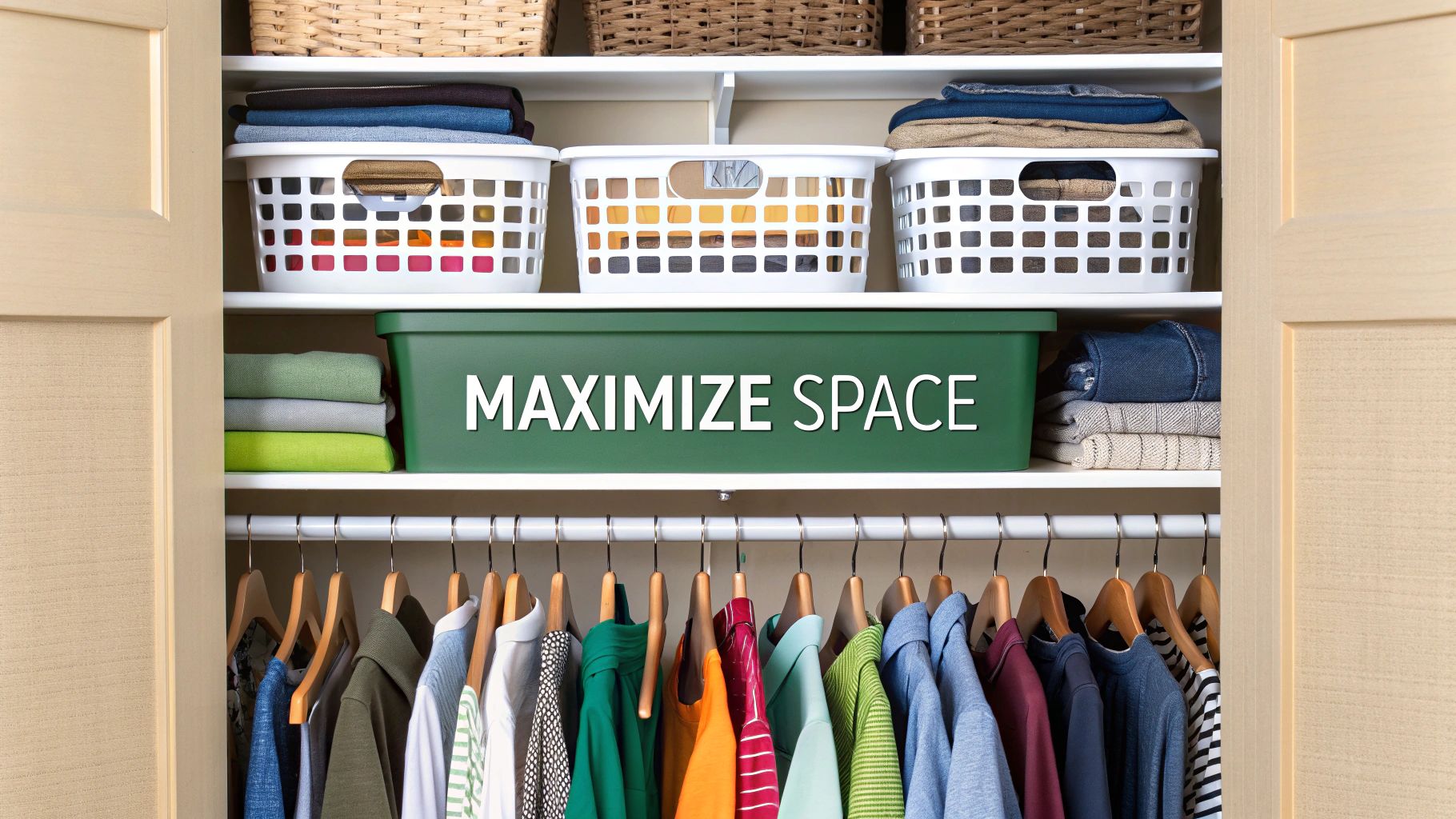
If you want to truly maximize small closet space, it’s not about finding one magic bullet. It’s about following a clear, four-part game plan: ruthlessly declutter, measure and map out your space, use every vertical inch, and rotate your seasonal items. This is the framework that will take a closet from cramped and chaotic to calm and functional—no major renovation required.
Conquering Closet Chaos: A Realistic Starting Point
Let’s be honest: staring into a cramped, overflowing closet can feel completely overwhelming. It's a daily frustration for so many of us dealing with limited storage, where just finding the right shirt feels like an archaeological dig.
This guide isn't about just tidying up. It’s a proven system for creating a functional, stress-free space you’ll actually enjoy using. The whole philosophy boils down to a simple progression: figure out what you have, get rid of what you don’t need, organize what’s left, and then optimize every single inch of the space.
And this isn’t just a personal pet peeve—it’s a massive modern need. The closet organizer market is a huge part of the home organization industry, with a global market valued at USD 7.64 billion. That number tells a story: people are getting serious about smart space management, especially in places where every square foot counts.
Your Roadmap to a Better Closet
Before you start pulling everything out and making a mess, it helps to see the road ahead. I like to think of this process in four distinct phases. Each one builds on the last, setting you up for a closet that actually stays organized for good.
To give you a bird's-eye view, here's a quick breakdown of the journey we're about to take.
Your Quick-Start Closet Optimization Framework
This structured approach ensures you’re creating a sustainable system, not just shuffling clutter around.
The most impactful change you can make doesn't start with buying new organizers. It starts with deciding what truly deserves to take up valuable space in your life. That mindset is the foundation of a permanently organized closet.
The first phase—the purge—is without a doubt the most critical. Before you get started, it helps to get in the right headspace. Our guide on how to start decluttering is the perfect place to prepare for this foundational step in your closet transformation.
The Great Closet Cleanout: A Realistic Purging Strategy
Before you can even think about new hangers or fancy bins, you have to edit. A good, honest purge is the single most important step to reclaiming a small closet. It’s the only way to create the blank canvas you need for any real change.
I know, it sounds awful. But the goal isn’t to stare into a sad, empty space. It's about curating a closet filled only with things you actually wear, love, and feel great in. Putting in the work now makes every other organizing step so much easier.
The Four-Bin Method
Okay, let's get tactical. Grab four bins, boxes, or just make four distinct piles on your floor. Label them: Keep, Donate/Sell, Store, and Toss. Everything—and I mean everything—that comes out of your closet has to land in one of these four spots. No cheating.
Physically sorting each piece forces you to make a real decision. You can no longer just shuffle things from one side of the rod to the other and call it progress. You'll get a shocking visual of what you own versus what you actually use.
- Keep: These are the items you've worn in the last year that still fit your life and your body.
- Donate/Sell: Anything in good shape that you just don't wear anymore.
- Store: Think off-season gear or sentimental pieces you love but don't need access to every day.
- Toss: Be real. If it's stained, stretched, or beyond repair, it's time to let it go.
Trying to conquer the entire closet at once is a recipe for burnout. Trust me. Break it down into smaller, bite-sized tasks—just do shirts today, then tackle pants tomorrow. This approach keeps you from getting overwhelmed and giving up halfway through.
Asking the Hard Questions
As you pick up each item, you have to be brutally honest. Sentimental value is a real thing, but your tiny closet can't double as a museum for clothes you'll never wear again. The trick is to separate that emotional tug from practical, everyday use.
Stuck on a piece? Run it through this quick checklist:
- Have I worn this in the last 12 months? If the answer is no, the odds of you wearing it again are pretty slim.
- If I saw this in a store right now, would I buy it? This little question is great for cutting through the "but I already own it" bias.
- Does this make me feel confident today? Stop saving things for a "someday" version of yourself. Your closet should serve you now.
- Is this item truly worth the precious real estate it's taking up?
Facing the reality of your wardrobe can be tough, but it’s an absolutely essential part of the process. For anyone who feels this is just the tip of the iceberg, our guide on how to get rid of almost everything offers a much deeper strategy. It’s perfect for learning how to let go of things that no longer serve you, freeing up both physical and mental space.
Once you've got your "Keep" pile, you’re ready for the fun part: planning the layout.
Strategic Space Planning: Unlocking Your Closet's Potential
With the hard part of decluttering behind you, it's time to shift from editor to architect. This is where the real magic happens. This planning stage is your secret weapon to truly maximize small closet space, making sure every organizer you buy has a specific, high-impact purpose. It's the difference between buying a bunch of random bins and creating a thoughtful, functional system that actually works for you.
First thing's first: grab a tape measure. Get the real dimensions of your closet—height, width, and depth. Don't just eyeball it. Knowing you have exactly 28 inches of width instead of "about two feet" makes a world of difference when you're trying to squeeze in a shelving unit. The goal is to see your closet not just as it is, but for what it could be.
Before you start planning the layout, you need a clear visual inventory of what's left. The four-step sorting process is perfect for this.
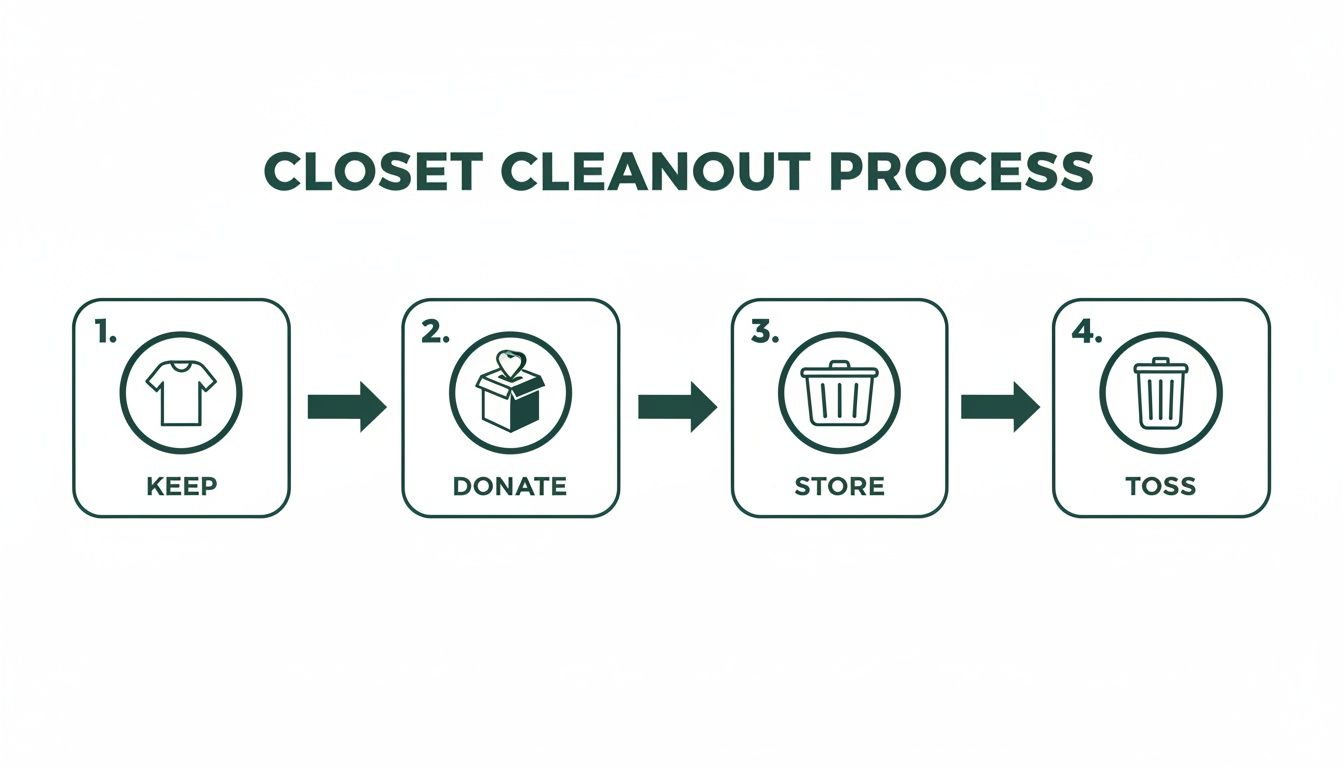
This simple but effective method forces a decision for every single item you own, which is the key to preventing that clutter from creeping right back in.
Mapping Out Your Zones
With your measurements in hand, sketch a quick diagram of your closet. It doesn’t need to be a masterpiece—a simple box will do. The whole point is to visualize a new layout and create logical zones for different categories of your stuff.
Think in terms of activity and accessibility.
- Prime Real Estate: The area between your eyes and your knees is the easiest to get to. This is where your most frequently worn items, like work shirts and everyday jeans, should live. No more bending or stretching for the basics.
- High Altitude Storage: That top shelf is perfect for the things you don't need every day. Think bulky sweaters in the summer, formal wear you only pull out a few times a year, or extra bedding.
- Floor Space: Down below is ideal for shoes, a small drawer unit for socks and accessories, or bins for your workout gear.
This zoning approach stops the daily frustration of digging through off-season coats just to find the t-shirt you want to wear today.
A common mistake is treating all closet space as equal. By assigning value to different zones based on how often you need to access them, you can build a layout that works with your daily routine, not against it.
Leveraging Vertical Space
The most underused asset in almost every small closet is its height. Seriously, look at all that empty air above your current hanging rod or top shelf—that’s pure, untapped potential. Adding a second rod to create a double-hang section can instantly double your hanging capacity for shirts, skirts, and folded pants. It's a game-changer.
Similarly, tall, narrow shelving units draw the eye upward and make use of the full vertical plane. For truly optimized space, especially in compact homes, it might be worth exploring your options. You can learn more in Your Practical Guide to a Customised Wardrobe in Singapore for some expert insights.
Planning these vertical solutions will completely transform your space. For more ideas on finding room where you least expect it, check out our guide on the best storage for small spaces.
Choosing the Right Tools for Vertical and Hidden Spaces
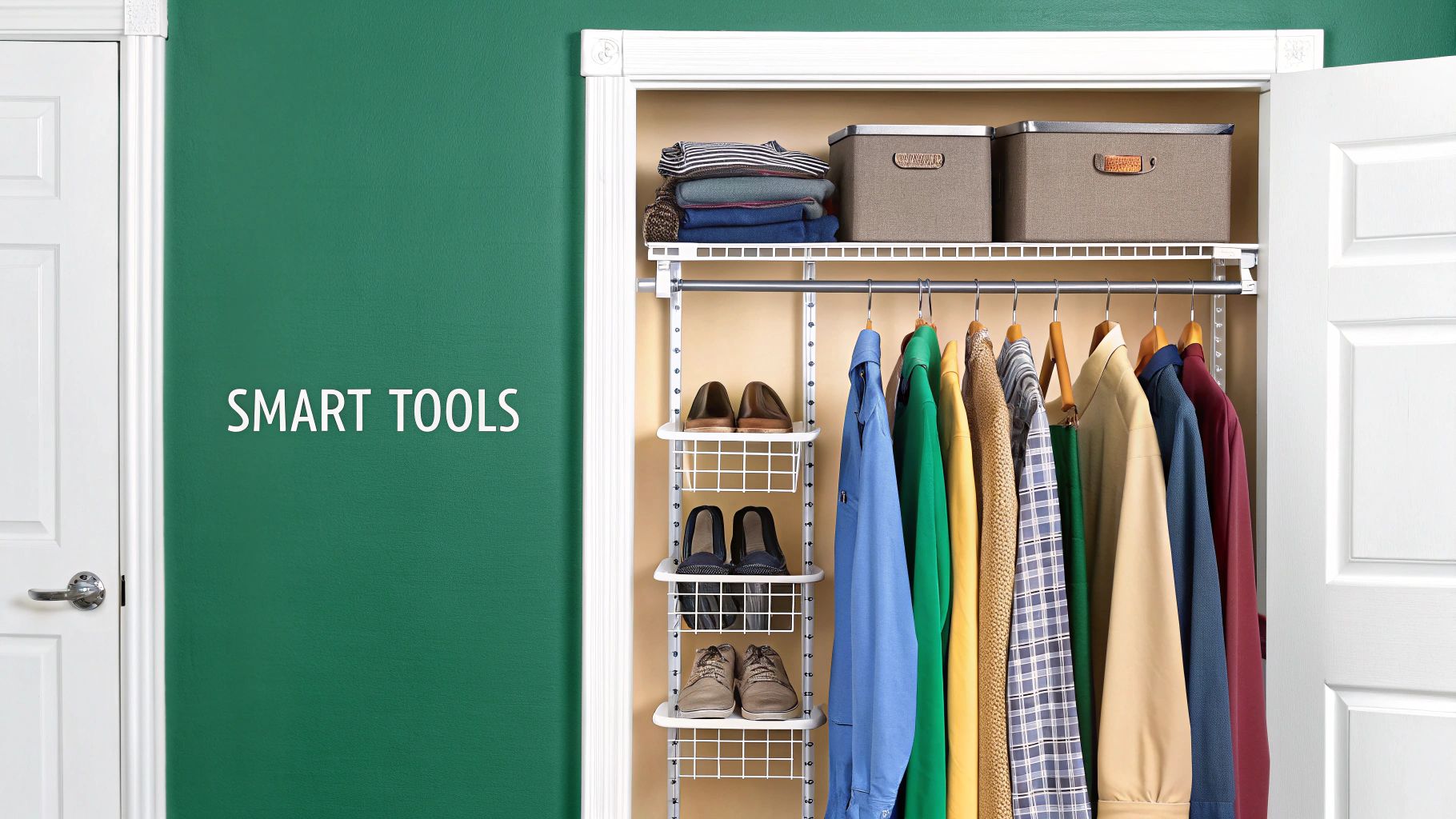
Alright, with a freshly decluttered closet and a clear plan, it’s time for the fun part: bringing it all to life. This is where you get to pick the tools that will turn your clever ideas into a functional reality. Moving past basic bins to smart, hard-working organizers is how you’ll truly reclaim every last inch of space.
And you're not alone in wanting smarter storage. The demand for clever closet solutions is booming, with North America making up a massive 38% of the global market for custom closets. This isn't just a fleeting trend; it’s a real shift driven by our desire to personalize our homes and find better ways to live in smaller, often urban, spaces. It really shows how much we've come to value organizers that are designed with a specific purpose in mind.
Unlocking Your Vertical Potential
One of the biggest mistakes I see people make is forgetting to look up. Your closet's height is its best-kept secret, and ignoring all that vertical real estate is a huge missed opportunity. The good news? It's also one of the easiest fixes.
Here are a couple of my favorite high-impact solutions for going vertical:
- Double-Hang Rods: This is such a simple trick with a massive payoff. Adding a second rod below your main one can literally double your hanging space for things like shirts, skirts, and pants folded over a hanger.
- Hanging Shelf Organizers: If you're not handy with a drill, these fabric or canvas shelves are your best friend. They create instant, structured storage out of thin air, perfect for stacking sweaters, t-shirts, and jeans.
Which one is right for you? It really just depends on your wardrobe. If you have tons of blouses and slacks, go for the double rod. If you’re more of a sweater-and-jeans person, a hanging organizer will be a game-changer.
Reclaiming Awkward and Hidden Spaces
Every closet has them—those weird, underused spots you don't know what to do with. I'm talking about the back of the door or that dead zone right under your main shelf. With the right gear, these forgotten areas can become some of your most valuable storage spots.
One of the most satisfying moments in any closet makeover is transforming a completely useless area—like the back of the door—into a functional, organized zone. It feels like you've discovered free real estate right inside your own home.
Look for tools specifically made for these little nooks. A good over-the-door shoe rack can hold so much more than shoes—it's fantastic for scarves, belts, and sunglasses. Likewise, simple under-shelf baskets clip right onto your existing shelves to create a bonus layer for smaller items like clutches or socks. Browsing through various closet organizers and tools can give you a ton of ideas for tackling every last corner.
The Game-Changing Power of Slim Hangers
If I could recommend just one single purchase that makes an immediate, visible difference, it would be switching to slim velvet hangers. Seriously. Those bulky plastic and wooden hangers are space vampires, sucking up precious rod length with their wide shoulders.
Making the switch can instantly free up 20-30% more hanging space. Plus, the uniform, streamlined look just makes everything feel calmer and more organized, letting you see what you actually own. It’s a small investment with a huge return. For more ways to find storage in unexpected places, check out our guide to hidden storage ideas.
Smart Storage Beyond the Closet: The Role of Offsite Solutions
Let's be real. Even after you’ve decluttered and organized like a pro, you might hit a wall. Sometimes, your small closet just can't physically hold everything you want to keep. This isn't a failure—it's just a matter of square footage. The next logical step is to maximize small closet space by thinking outside the closet.
This is where you have to get honest about what you truly need access to every day or week. The goal is a closet that feels functional and calm, filled only with what’s relevant right now. Everything else is just eating up prime real estate and contributing to that feeling of being overwhelmed.
Embrace the Rotational Wardrobe
The idea of a rotational wardrobe is a total game-changer for anyone struggling with a small closet. It’s a simple but brilliant practice: separate your things into what you need now versus what you'll need later. This lets your closet breathe and makes getting ready in the morning so much faster and less stressful.
What kind of items get rotated out?
- Seasonal Clothing: Those heavy winter coats and chunky sweaters have no reason to take up precious hanger space in July.
- Special Occasion Wear: That tuxedo or formal gown you wear maybe once a year? It doesn't need to be front and center.
- Bulky Sporting Gear: Ski boots, camping equipment, and other hobby gear can absolutely take over a small closet.
- Sentimental Keepsakes: Things like heirlooms or baby clothes are important to keep, but they don't belong in your everyday functional space.
By moving these items out, your closet transforms from a stuffed storage locker into a curated, accessible wardrobe.
The most liberating feeling is opening your closet and seeing only relevant, wearable options. A rotational system isn't about getting rid of things; it's about giving yourself the gift of clarity and simplicity every single day.
Finding a Home for Your Overflow
Okay, so you've identified what can be rotated out. Now, where does it all go? Shoving everything under the bed or into a dusty attic can lead to damage from pests, moisture, or extreme temperatures. This is the perfect moment to consider a modern offsite solution that acts as a secure, clean extension of your home.
Unlike old-school self-storage, by-the-box services offer a much smarter approach. You can store just a few bins of off-season clothes or sentimental items in a climate-controlled facility without paying for a big, half-empty unit. This keeps your belongings protected and gives you back valuable living space. It's all about living a less cluttered life, knowing your stuff is safe, sound, and just a click away when you need it.
If you're looking into options beyond the typical storage locker, our guide to storage unit alternatives can point you in the right direction.
Maintaining Your Newly Organized Closet
You've done it. You’ve purged, sorted, and wrestled your closet into a state of beautiful order. But let’s be honest, the real battle isn’t the initial overhaul—it’s keeping it that way.
The great news is that you don’t need another weekend-long project. Staying organized is all about building a few simple, sustainable habits into your routine. Think of it as light upkeep, not another round of decluttering chaos.
Adopt the One-In, One-Out Rule
This is probably the single most powerful habit you can adopt to prevent your closet from backsliding into clutter. The "one-in, one-out" rule is exactly what it sounds like: for every new shirt, pair of jeans, or jacket that comes into your home, an old one has to go.
This simple principle forces you to be more intentional with your shopping and constantly evaluate what really deserves a spot in your prime real estate. It's a game-changer that stops the slow, creeping accumulation of stuff that buried your closet in the first place.
Schedule a Weekly Reset
Find just 10 minutes once a week—maybe on a Sunday evening as you wind down—for a quick closet tidy-up. This isn’t a deep clean. It’s a fast reset to get everything back in its proper place before the new week begins.
A weekly 10-minute reset is the organizational equivalent of making your bed every morning. It's a small, high-impact habit that prevents minor messes from snowballing into a major project.
Here's what that lightning-fast session looks like:
- Finally hang up the clothes that have been living on "the chair."
- Put your shoes back on their rack or shelf.
- Quickly straighten any stacks of folded sweaters and return accessories to their homes.
Make Seasonal Swaps Seamless
When it's time to swap your seasonal clothes, don't just dump one bin out and stuff another one in. Treat this transition as a mini-decluttering opportunity.
As you pack away your chunky winter sweaters, give them a quick once-over. Are there any you didn’t wear at all last season? Be ruthless. Those can go straight into a donation bag instead of taking up valuable storage space. This little trick ensures you're only storing items you'll actually be excited to see again next year.
Common Questions About Maximizing Closet Space
Even with the best game plan, a few tricky questions always seem to pop up during a closet makeover. Nailing these final details is the secret to making your new, organized system actually last. Here are some straight-up, practical answers to the questions we hear all the time.
What Should I Do If I Don't Have a Closet at All?
This is a super common problem, especially in older homes and studio apartments, but don't worry—the same organizing principles still work. Your mission is to create a "closet zone" using other pieces of furniture. A freestanding wardrobe or a simple open clothing rack can immediately define a dedicated space for your clothes, giving you a functional (and often stylish) stand-in for a traditional closet.
Get creative here. A sturdy bookshelf can be perfect for folded sweaters and jeans, or you can use a dresser as the anchor for your clothing storage area. The point is to gather your wardrobe into one central spot, even if that spot doesn't have a door.
Are Expensive Organizers Really Worth the Money?
Honestly? Not always. The best organizer is the one that solves your specific storage headache, and that definitely doesn't always mean the one with the biggest price tag. Before you splurge on a fancy, complicated system, make sure you’ve covered the low-cost, high-impact basics first.
- Slim Hangers: This is the single best, cheapest investment you can make for immediate space-saving results. Trust me on this one.
- Shelf Dividers: These are inexpensive and absolutely perfect for stopping those neat stacks of sweaters from tumbling over.
- Over-the-Door Racks: A brilliant way to add a ton of storage without drilling a single hole.
Always think about function first. A simple tension rod that costs a few bucks can create a game-changing double-hang section, which is often far more useful than an expensive container that doesn't quite fit your stuff.
Don’t fall into the trap of thinking a perfect closet requires a huge budget. The smartest solutions are often the simplest. Master the fundamentals—purging, zoning, and using vertical space—before spending a lot on specialized gear.
How Do I Handle Sentimental Items That I Can't Part With?
We all have them. Those treasured items are important, but your everyday closet is the wrong place for them. A small closet has to be all about function and easy access to what you actually wear. If you have an item that isn't in your regular rotation but you can't imagine tossing it, it's the perfect candidate for long-term storage.
This is where you need to think beyond the four walls of your home. Storing sentimental pieces like a wedding dress, old baby clothes, or family heirlooms offsite keeps them safe and sound without cluttering up your prime real estate. It's a strategy that honors their value while giving you the clutter-free space you need for your daily life. After all, when you maximize small closet space, you're really just making room for your current self to thrive.
When your closet can’t hold it all, let Endless Storage be your second closet. We offer secure, by-the-box storage that’s perfect for your seasonal wardrobe, bulky gear, and precious keepsakes. Learn more about how we can help you reclaim your space at https://www.endless-storage.com.
Frequently Asked Questions
Unveiling the Secrets to Effortless Storage
Endless Storage is available nationwide. You pick a plan, tell us where to pickup, and we'll send a UPS van to collect, whichever state you're in.
Your shipping label will be sent to your email within a few minutes, if not instantaneously. It can also be accessed through your customer profile.
Your box will be shipped to one of our climate controlled self storage facilities in our closest self storage facility. Our manager will accept your package, notify you that your box has been received, and securely stored. Only our managers will have access to Endless Storage boxes.
Email us at admin@endless-storage.com click to live chat with us, or send us a message below.
Never! We're committed to transparent pricing with no surprises. You'll lock in your rate with no hidden fees and no long-term contracts.
Fast access guaranteed! Your boxes will arrive at your doorstep within 48 hours of requesting them back. Need to check on delivery? We provide tracking information for complete peace of mind.
Totally flexible! Store month-to-month with no long-term commitment and cancel anytime.
Everything's online! Use your account dashboard to:
• Set up automatic monthly payments
• Request box returns
• Update your address
• Order additional boxes
• Track shipments
Your boxes are insured up to $100 each. Our customer service team will help you file any necessary claims and resolve issues quickly.
Don't worry – we'll email you right away if there's a payment issue. Your items stay safe, though you may have temporary service interruption or late fees until payment is resolved.
When you request our free storage kits, you'll have 30 days to send in your boxes to activate your 3 months of free storage. Think of it like starting a gym membership – your activation window begins when you receive your kits, and your full free trial begins once you send in your first box. During your free months, you'll experience our complete storage service at no cost.
Your 30-day activation window begins when you receive your storage kits. We'll send you an email confirmation when your kits are delivered, marking the start of your activation period.
If you haven't sent any boxes for storage within your 30-day activation window, your free trial will expire and we'll begin charging the regular monthly rate of $9.99 per box. This helps ensure our storage kits go to customers who are ready to use our service.
A box costs $9.99 per month to store (plus sales tax). This price includes free shipping for standard boxes under 50 lbs. and smaller than 16"x16"x16"
Log into your Endless Storage account, locate the box you would like returned, and simply click Return My Box.
Yes, each box stored with us is insured for up to $100 throughout transit as well as the duration of storage within our facilities.
Your box will be at your doorstep within 48 hours of you requesting it back.
Store 10+ boxes? We'll pick them up for free! After your purchase, we'll contact you to schedule a convenient pickup time and arrange UPS collection.
We trust UPS with all shipments, and every box includes $100 insurance coverage. You'll receive tracking information to monitor your items' journey.
Yes! Visit any of our locations by appointment. Just bring a photo ID matching your customer profile.
For everyone's safety, we can't store hazardous materials, firearms, or perishables. All items must fit within our standard boxes.
It's easy! Order your storage kit online, and we'll ship it to you within 1-2 business days. Your shipping labels will be emailed instantly and available in your account.
We're here to help! Email us at admin@endless-storage.com, use our live chat, or send us a message through your account.
To cancel your storage service with Endless Storage, please email your cancellation request to admin@endless-storage.com. Our team will process your request within 2 business days and confirm your cancellation via email.
We understand packing takes time. However, to maintain your free trial benefits, you'll need to send at least one box within the 30-day activation window. If you need more time, you can always start with one box to activate your trial and send the rest later. You can always reach out to admin@endless-storage.com if you have any issues or concerns.
When you request our free storage kits, you're starting a 30-day window to begin using our storage service.
Important: To activate your free trial, send at least one box for storage within 30 days. If no boxes are sent within this 30-day window, a one-time $50 fee applies to cover materials and shipping costs. This fee is clearly disclosed before you sign up.
Think of it like reserving a hotel room – we're setting aside space and sending specialized packing materials for your use. The fee only applies if you request materials but don't begin storage, similar to a hotel's no-show charge.