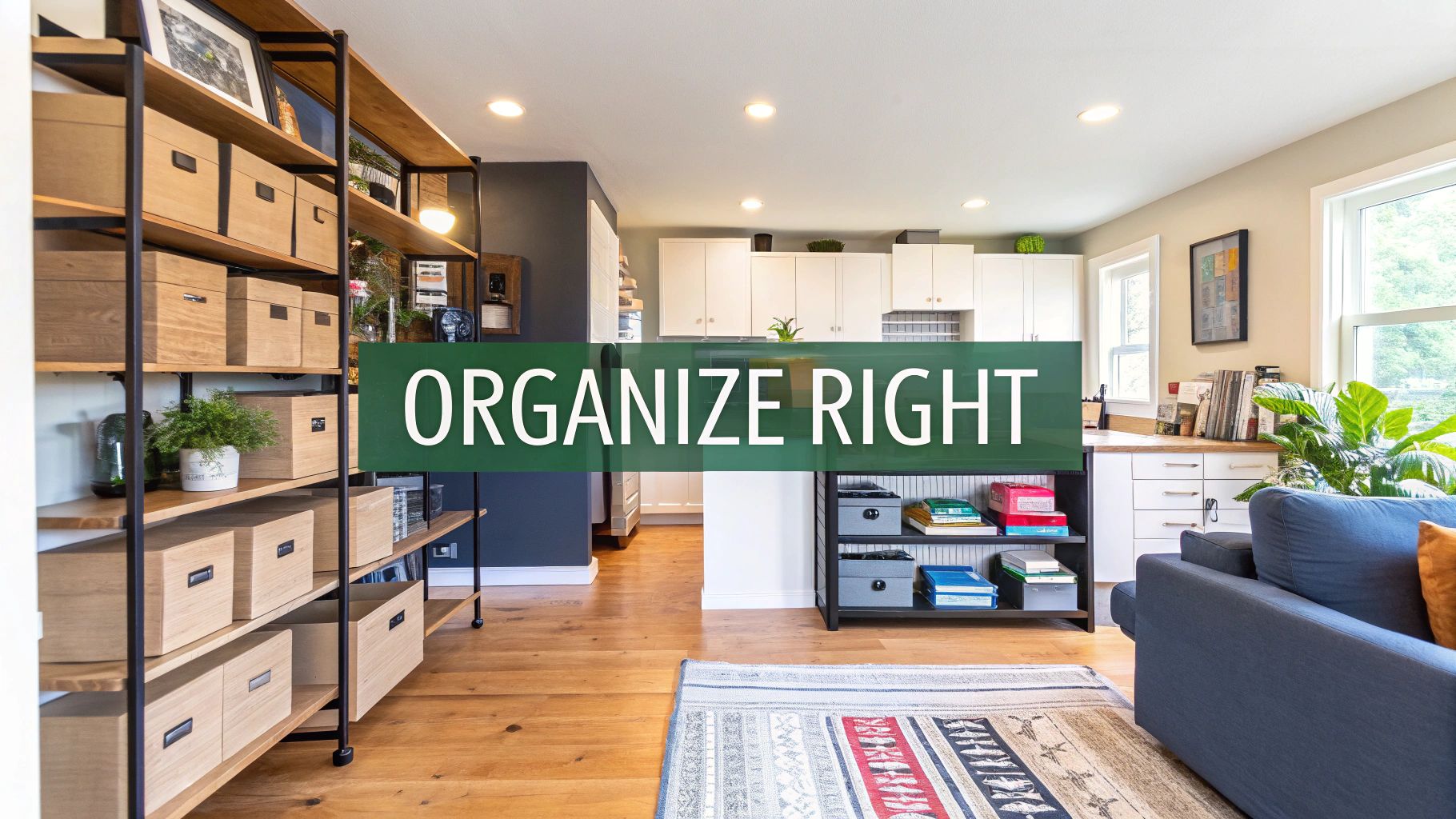
To really organize a house for good, you have to start with a solid plan and get your head in the right space. The whole process really boils down to four key parts: figuring out your goals, intentional decluttering, organizing room-by-room, and then actually sticking with it through maintenance routines. Success isn’t about hitting some impossible standard of perfection overnight. It’s about building sustainable habits that create a space that feels calm and actually works for you.
Building Your Foundation for an Organized Home
Before you even think about picking up a single item, let’s talk about your most important tool: your mindset. Organizing your home isn't just about cleaning. It’s about intentionally designing a space that supports your life, cuts down on stress, and gives you back precious time. You're creating systems that work for you, not against you.
That feeling of being completely overwhelmed is usually the biggest roadblock. Staring at an entire house can feel like a mountain you’ll never climb, which is exactly why we're going to break it all down into small, satisfying wins. The goal isn’t to create a sterile show-home; it's to build a functional environment that simply feels good to live in.
Define Your Personal Organizing Goals
First, ask yourself why you even want to get organized. Is it to stop feeling so stressed all the time? To find things without tearing the house apart? Or maybe you just want a home you’re proud to have people over to. Your personal "why" is what will keep you going when you hit a messy closet and feel like giving up.
Try to picture some specific outcomes you're aiming for:
- Reduce morning chaos: "I want to get ready in the morning without that frantic, last-minute search for my keys or wallet."
- Create a relaxing evening routine: "I want to actually unwind on the couch at night without staring at piles of clutter."
- Enjoy hobbies more easily: "I want my craft supplies to be easy to get to so I can finally use them again."
The real objective here is to shift your perspective from, "Ugh, I have to clean this mess," to "I am creating a space that serves me better." This simple change in thinking turns a dreaded chore into an empowering project.
The Power of a Proven System
Following a structured approach is what keeps you from burning out and makes sure all your hard work actually lasts. In fact, behavioral studies show that households using dedicated decluttering sessions and designated ‘zones’ for items can get back between 30 to 70 hours per year. That’s time you’re currently losing just by looking for things or making the same small decisions over and over.
A great way to build a strong foundation for managing all the paper and schedules that create clutter is to explore some practical family command center ideas. It gives you one central spot for mail, calendars, and reminders, which tackles a huge source of surface clutter right from the start. Getting that initial setup in place is a key first step before you dive into the deeper work. You can learn more about getting started in our guide on how to start decluttering with a clear, effective plan.
The Art of Intentional Decluttering
Okay, with your plan and goals in place, it’s time to roll up your sleeves for the most satisfying part of this whole process: decluttering. This is where you physically handle every single item and decide if it truly has a place in your life. Think of it less as "getting rid of stuff" and more as curating a home filled only with things you genuinely need, use, or absolutely love.
This doesn't have to be some paralyzing, monumental task. The secret is to keep it simple. I’ve always relied on a straightforward four-category sorting system that has never let me down. All you need are four boxes, bins, or even just designated corners of the room.
- Keep: These are the no-brainers—the items you use regularly, truly love, and that add real value to your daily life. They earn their spot in the room you’re tackling.
- Donate/Sell: Good stuff, just not your stuff anymore. These are items in great condition that someone else could get a ton of use out of.
- Store: Think seasonal decor, important documents, or sentimental items you can't part with but don't need to see every day. These are the things you need, just not right now.
- Discard: Anything broken, expired, or just plain unusable. This pile is destined for the trash or recycling bin—no second thoughts.
Feeling stuck on where to even begin? I get it. This decision tree can help you pick a starting point that builds momentum instead of stress.
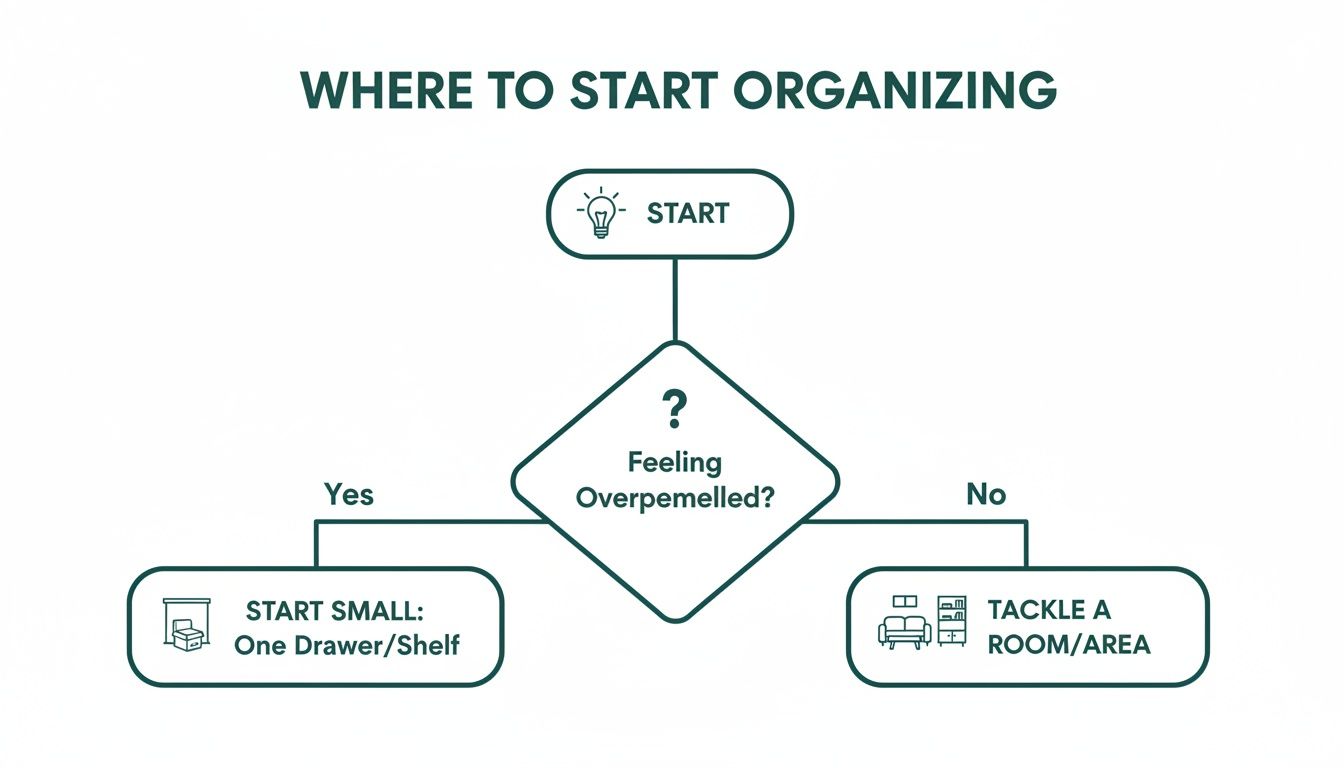
As the chart shows, the best approach is to check in with yourself. If you’re feeling overwhelmed, start small. A single drawer, one shelf—that’s a win.
Making Those Tough Decluttering Decisions
Sorting obvious trash or your daily-use items is easy. The real work happens in the gray areas—the sentimental trinkets, the "just in case" gadgets, and the clothes you swear you’ll fit into again someday. When you find yourself on the fence, ask a few direct questions to get unstuck.
- When did I last actually use this? If it’s been over a year, that’s a pretty big red flag. Be brutally honest here.
- Does this support the life I have now? We all hold onto things tied to past hobbies or versions of ourselves. It’s liberating to let them go and make space for who you are today.
- If I were shopping right now, would I buy this again? This question is magic. It cuts right through the noise and reveals how much you truly value something in the present moment.
If you want to go deeper on this, our complete guide can help you declutter your home and finally reclaim your space for good.
Handling Sentimental Clutter
This is the final boss of decluttering for most people. Sentimental items are tough, but they can also create the most physical and emotional clutter. Remember, the memory is what's important, not always the object itself. You don't need to save every single one of your child's drawings to cherish their creativity.
My go-to trick: Create one beautiful "memory box" for your absolute most-cherished keepsakes. For everything else? Take a high-quality photo. This digitizes the memory, letting you keep the sentiment without sacrificing precious space.
This approach honors your past while making your home work for your present. You get the meaningful connection without the physical weight.
What to Do with Your Sorted Piles
Once your bins are full, you have to act fast. Don’t let those "Donate/Sell" boxes become a new form of clutter in the corner of your room.
- Discard: Get the trash and recycling out of the house immediately. It’s an instant win that provides a satisfying sense of accomplishment.
- Donate/Sell: List items on Facebook Marketplace or Poshmark today. Don't wait. For donations, schedule a pickup or plan a trip to your local charity within the next few days. Put it on the calendar!
- Store: Pack your "Store" items into clearly labeled, sturdy bins. This is where an off-site solution can be a total game-changer, especially for bulky seasonal gear or sentimental boxes that are hogging closet space.
By working through your home with this intentional framework, you’re doing more than just cleaning up. You're making conscious choices about the environment you want to live in every single day.
Your Room-by-Room Organization Blueprint
Alright, you’ve done the hard work of decluttering. Now for the fun part: bringing a smart, functional order back into your home. This is where we stop subtracting and start adding—adding systems, adding efficiency, and most importantly, adding a sense of calm. Think of this as the detailed blueprint for reclaiming each space with a clear mission. We’ll work our way through the house logically, starting where the action is and moving into the more personal zones.
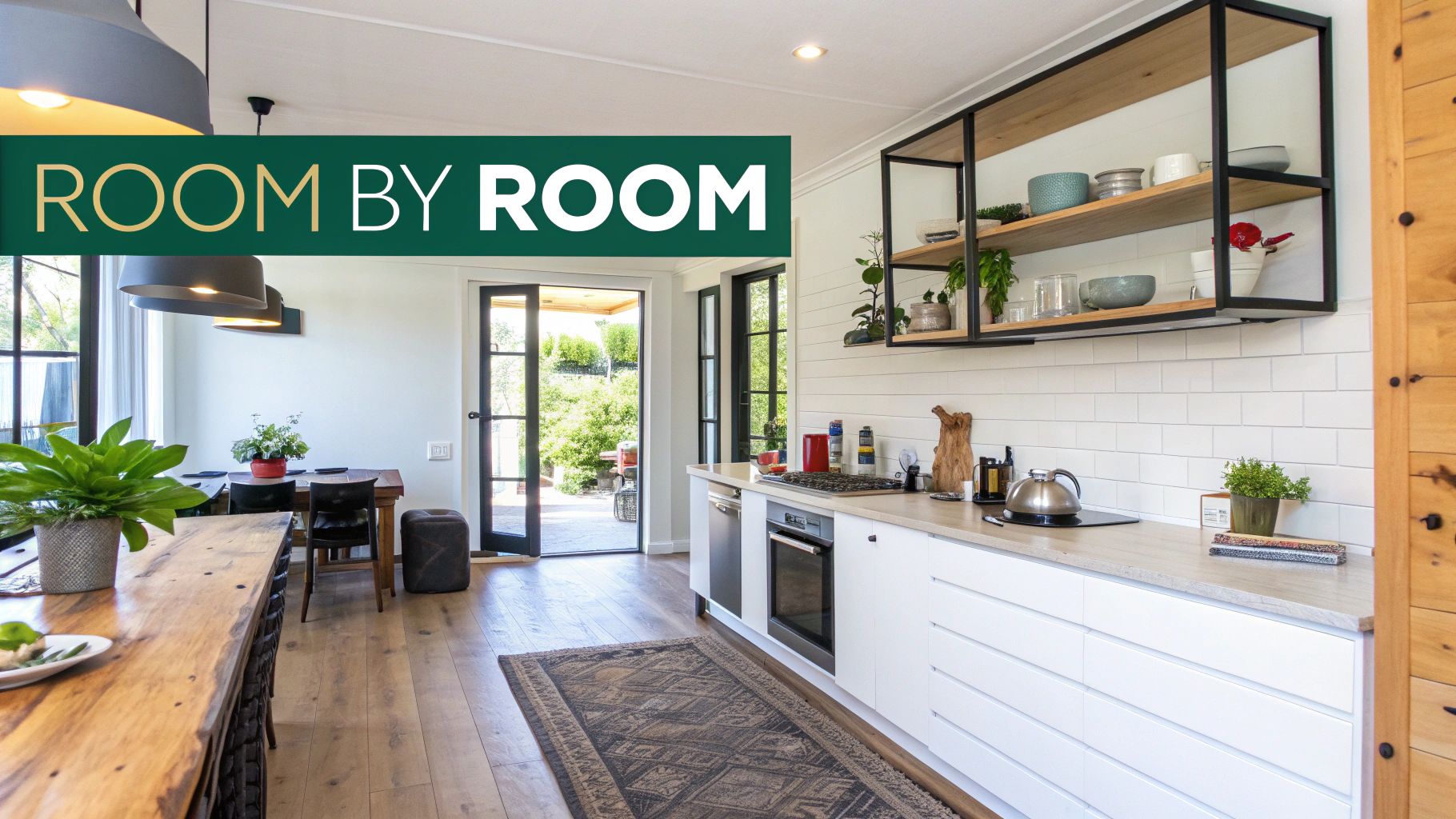
The secret to making organization stick is simple: give every single thing a designated "home." When an item has a logical place to live, putting it away becomes a quick, automatic habit instead of a huge, draining chore. This is how you organize a house in a way that actually lasts.
Conquering the Kitchen Command Center
The kitchen is the heart of the home, which means it’s also a magnet for clutter. Our goal here is to carve out efficient "work zones." When you do this right, everything from cooking a meal to unloading the groceries just flows.
Start by pulling everything out. Empty every cabinet and drawer, and group like items together on your counters. Put all the spices in one spot, all the baking dishes in another, and so on. This visual inventory is a real eye-opener—you'll immediately spot the three can openers you didn't know you had and the mountain of mismatched food container lids.
Now, think in zones:
- Prep Zone: This should be near a clear stretch of counter. Keep mixing bowls, cutting boards, knives, and measuring cups here.
- Cooking Zone: Arrange pots, pans, cooking utensils, and spices within arm’s reach of the stove and oven.
- Pantry Zone: Group food by category (grains, canned goods, snacks). I'm a big fan of using clear containers for bulk items like flour and pasta so you can see what you have at a glance.
- Dish Zone: Store plates, bowls, and glasses right next to the dishwasher. It makes unloading so much faster.
This zoning strategy cuts down on the steps you take while you cook, turning kitchen chaos into a smooth, enjoyable process. Once your zones are mapped out, you can put everything back with intention.
Creating a Tranquil Living Room
Your living room should be for relaxing and connecting, not a holding pen for random stuff. The usual suspects creating clutter here are media, books, and all the little things from our daily routines.
First, let's tackle the media. Go through your DVDs, video games, and CDs and consolidate. Ask yourself if you really need the physical copy or if a digital version would do the job. For the keepers, a media console with doors is perfect for hiding the visual noise.
Next up: cables. Nothing makes a room feel messier than a spaghetti-like tangle of wires. Use simple cord organizers, zip ties, or a cable management box to neatly bundle them up behind your electronics. It's a small change that makes a huge visual difference.
Finally, create a home for everyday items.
A "landing basket" is a total lifesaver for living rooms. Find an attractive basket and make it the dedicated spot for things that tend to collect during the day—remotes, a book, your tablet. At the end of the night, a quick 5-minute tidy involves putting everything from the basket back where it belongs.
This simple routine stops that slow, creeping clutter from taking over your relaxation space. It’s all about building small, sustainable habits.
Organizing Your Personal Sanctuaries: The Bedroom and Closet
Your bedroom is supposed to be your ultimate retreat, but a chaotic closet can completely disrupt that sense of peace. When you organize your wardrobe, the goals are efficiency and visibility.
Start by pulling everything out of the closet. Use the same sorting method as before: keep, donate/sell, and store. Be ruthless. If something doesn't fit, feels uncomfortable, or hasn't been worn in a year, it's time for it to go.
For the clothes you're keeping, get strategic with how you put them back:
- Group by Category: Put all shirts together, all pants together, you get the idea.
- Color Code: Within each category, arrange items by color. This isn't just for looks; it makes grabbing a specific piece of clothing incredibly fast.
- Use Matching Hangers: This is a small investment with a big payoff. Switching to slim, uniform hangers instantly creates a clean, streamlined look and frees up a surprising amount of rod space.
For your drawers, file-folding is a game-changer. Instead of stacking shirts on top of each other, fold them into neat little rectangles and "file" them vertically. This lets you see every single item at once—no more digging through piles. For a complete guide, you can check out our detailed home organization checklist to ensure you cover every base.
Tackling the Home Office and Paper Clutter
A disorganized office can be a major roadblock to productivity, and the number one offender is almost always paper. Piles of mail, bills, and random documents create both physical and mental clutter.
The best long-term fix is to go digital. It might sound like a big project, but creating a paperless system is easier than ever. Use a scanning app on your phone to instantly digitize important documents like bills, receipts, and records. Once it's scanned and saved, you can shred the physical copy and reclaim your space.
Set up a simple digital filing system on your computer or a cloud service with folders for different categories:
- Taxes
- Medical Records
- Household Bills
- Important Receipts
For the handful of physical papers you have to keep (like birth certificates or social security cards), dedicate one small, clearly labeled file box. This gets rid of the need for bulky filing cabinets. The demand for smarter storage is growing—the home storage and organization market was valued at around USD 46 billion in 2023 and is expected to keep expanding. It's a clear sign that people are looking for better ways to maximize their space, and investing in good systems is a smart move.
Conquering the Toughest Utility Spaces
Last but not least, we face the final frontiers: the garage, basement, and attic. These are the zones where forgotten items go to hide. The keys to success here are durable solutions and thinking vertically.
First, you have to clear everything out. And I mean everything. It’s the only way to really see what you're working with. Be prepared for some surprises. Sort everything into your four piles, but be extra critical about what really deserves to come back into the space.
Next, invest in sturdy storage built for these tougher environments.
When you put things back, group them by function. Create a dedicated "Gardening Zone," a "Tool Zone," and a "Seasonal Zone." Label every single bin on multiple sides. It might feel a little tedious in the moment, but you’ll thank yourself later when you're not tearing through ten boxes to find the holiday lights. For those sentimental or seasonal items you rarely need, a service like Endless Storage is the perfect way to free up valuable real estate in your home without having to get rid of important belongings.
Unlocking Space With Smart Storage Solutions
You've done the hard work of decluttering, and now it's time for the fun part: putting everything back in a way that makes sense for the long haul. This is where smart storage comes in. The goal isn't just to hide your stuff away; it's about creating systems that make your belongings easy to find and even easier to put back where they belong.
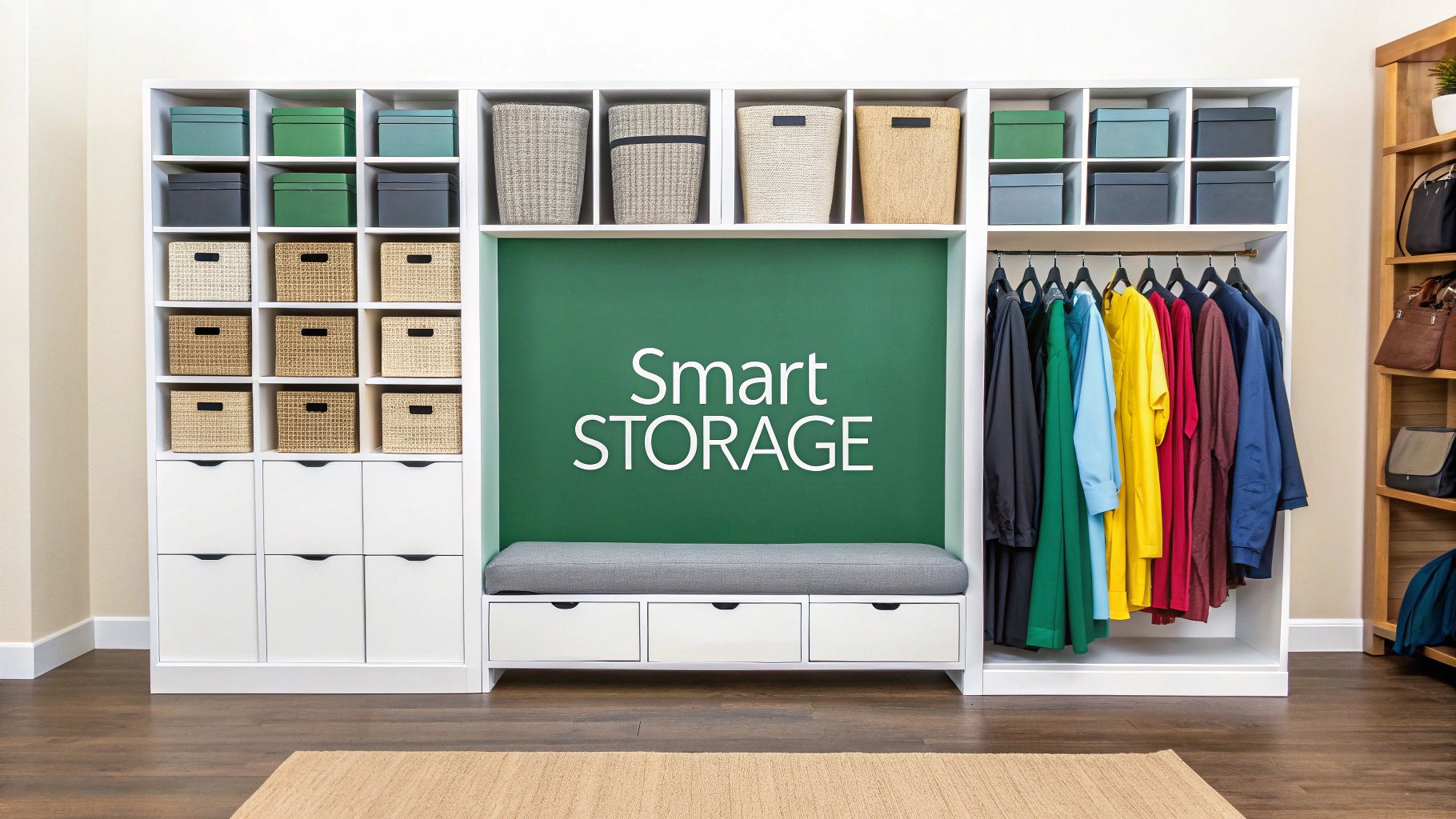
This isn't just a niche interest; it's a huge part of modern living. With homes getting more compact, the global market for home organization products is expected to hit $13.27 billion by 2025. This boom is fueled by clever plastic, wire, and modular systems designed to make every single inch of your home work harder.
Think Vertically to Maximize Your Space
One of the biggest mistakes I see people make is forgetting to look up. Floor space is a finite resource, but your walls offer a massive, often-ignored opportunity to add storage without making a room feel cramped or crowded.
Instead of squeezing in another bulky floor cabinet, look at these alternatives:
- Floating Shelves: These are perfect for books, decor, or bathroom essentials. You get all the storage without the heavy footprint of a traditional bookcase.
- Wall-Mounted Organizers: Think about a magnetic knife strip in the kitchen, a pegboard in the garage or craft room, or hanging file holders in your home office.
- Over-the-Door Hangers: These are absolute game-changers, and not just for shoes. I love using them on the inside of a pantry door for spices and snacks or in a kid's room for corralling small toys.
When you're dealing with truly tight quarters, every technique counts. If you need more ideas, there are some great strategies for organizing small spaces and maximizing your home that can help.
Embrace Modular and Multi-Functional Pieces
Life changes, and your storage should be able to change with it. That’s why I always recommend modular systems and multi-functional furniture as smart, long-term investments. Things like cube organizers or customizable closet systems can be reconfigured, added to, or moved as your needs shift.
Furniture that works double-duty is another secret weapon for saving space:
- An ottoman with hidden storage is perfect for stashing blankets in the living room.
- A lift-top coffee table can pull triple duty as a table, a workspace, and a storage spot.
- A bed frame with built-in drawers underneath is a no-brainer for adding storage.
Choosing furniture that does more than one job is a core principle of efficient small-space living. It allows you to add functionality without adding clutter.
For a deeper dive into this, check out our guide on the best storage for small spaces. It’s packed with solutions that fit just about any layout.
To help you visualize your options, here’s a quick comparison of storage solutions for some of the most common trouble spots in a home.
Storage Solution Comparison for Key Areas
Choosing the right storage often comes down to budget and needs. This table breaks down some popular choices for different areas of the house.
These are just starting points, of course. The best solution is always the one that fits your space and makes your daily routine feel a little bit easier.
Master Your Container and Labeling System
The right containers can turn a chaotic cabinet into a masterpiece of organization, but the real secret is consistency. Whenever you can, go for clear or uniform containers. Being able to see what’s inside at a glance saves you from digging around and prevents you from accidentally buying a third jar of paprika.
Your labeling strategy is the final, crucial piece of the puzzle. It’s what makes a storage system truly functional for everyone in the house. A simple, consistent labeling method ensures anyone can find what they need and—more importantly—put it back in the right place.
A Few Labeling Techniques I Swear By:
- Chalkboard or Dry-Erase Labels: These are fantastic for pantry canisters or any bin where the contents might change.
- Printed Labels: A simple label maker gives you a clean, uniform look that’s perfect for long-term storage in the garage, basement, or office.
- Photo Labels: This is my favorite trick for kids' toy bins. Just tape a picture of the contents on the outside. Cleanup becomes a simple matching game they can actually do themselves.
By combining vertical thinking, adaptable furniture, and a clear container strategy, you’re not just organizing your home for today. You’re building a resilient framework that will help it stay that way.
Creating Habits to Keep Your Home Organized
You’ve put in the hard work. The boxes are gone, everything has a place, and you can finally breathe. But how do you keep it that way? This is where the real magic happens.
An organized home isn't a destination you arrive at once; it's the result of small, consistent habits that hum along quietly in the background of your daily life. The goal is to shift your mindset from "I have to clean" to building simple systems that stop clutter before it even starts. This is about enjoying your home, not constantly tidying it.
Build Simple Daily Routines
The secret to a home that stays tidy is weaving small, easy actions into your everyday schedule. When these habits feel automatic, they stop feeling like chores.
- The 15-Minute Nightly Reset: Before you crash for the night, set a timer for just 15 minutes. It’s incredible what you can get done in that short burst. Put away the remotes, fold the throw blankets, wipe down the kitchen counters, and toss any stray mugs into the dishwasher.
- Make Your Bed Every Morning: It’s a classic for a reason. This two-minute task instantly makes your bedroom feel more pulled together and sets a productive, organized tone for your entire day.
- The One-Touch Rule: This one is a game-changer. When you bring something into your home—like the mail—deal with it immediately. Don't just set it down. Open it, and put bills, important papers, and junk mail in their designated spots right away.
Implement Weekly and Monthly Resets
While daily habits keep the surface-level stuff in check, you'll want to schedule slightly bigger check-ins to prevent deeper clutter from creeping back in. These are crucial for making sure your hard work lasts.
A weekly reset is your chance to tackle things that aren't on the daily tidy list. Think wiping down appliance fronts, vacuuming the high-traffic areas, or doing a quick clean-out of old leftovers in the fridge. It’s all about maintaining the order you've already worked so hard to create.
One of the most powerful principles for lasting organization is the "one in, one out" rule. When a new item comes into your home, a similar one has to go. Buying a new pair of sneakers? An old pair gets donated. It’s a simple but incredibly effective way to keep your home from getting overstuffed again.
If you want to dive deeper into maintaining your space, these clutter-free living tips are packed with great ideas that can truly transform your home.
Schedule Seasonal Tune-Ups
About four times a year, it’s a good idea to schedule a more significant "tune-up." This is your moment to hit those spots that don't need constant attention but can easily become hidden clutter zones over time.
Seasonal Reset Checklist:
- Closet Swap: Pack away the out-of-season clothes and bring the current season's wardrobe to the front. This is the perfect opportunity to part with anything you didn't wear last season.
- Pantry and Medicine Cabinet Edit: Do a quick scan for expired food, spices, or medications and toss them.
- Deep Clean One Zone: Pick one single area—like the garage, the junk drawer, or the space under the sinks—for a more thorough declutter and scrub-down.
By layering these simple daily, weekly, and seasonal habits, you build a sustainable system that works for you. Organization stops feeling like a massive project and just becomes the natural, easy way you live in your home.
Common Questions About Organizing a House
Even the most detailed plan can hit a snag. When you're deep into a massive organizing project, it's completely normal to feel stuck or have questions pop up. Feeling that way is just part of the process.
I've been there, and I've helped countless people push through those same roadblocks. Here are my straight-up answers to the most common challenges you'll likely face. Think of this as your troubleshooting guide to keep the momentum going.
Where Should I Start When I Feel Completely Overwhelmed?
This is the big one. That feeling of being totally overwhelmed is the number one reason people throw in the towel. If this is you, my best advice is to think smaller. No, even smaller than that.
Forget about tackling an entire room right now. Instead, pick one tiny, almost laughably small spot.
- A single junk drawer in your kitchen.
- The top shelf of the linen closet.
- Just the surface of your nightstand.
Set a timer for 15 minutes and go all-in on only that one area. The magic here is the powerful sense of accomplishment you get from finishing even a tiny task. That little win creates the momentum you need to move on to the next small space, turning a gigantic project into a series of satisfying victories.
How Do I Handle Sentimental Items I Can’t Keep?
This is, without a doubt, the most emotionally taxing part of organizing. My approach has always been to honor the memory, not necessarily the physical object tied to it.
Start by asking yourself if holding onto an item brings you genuine joy, or if it feels more like an obligation. Your home should be your sanctuary, not a museum of guilt.
Remember, your memories live inside you, not inside the object. Letting go of the item doesn't mean you're letting go of the precious memory it represents.
For the items you truly love but just don't have room for, create a single, beautifully contained "memory box." Another fantastic method is to digitize them. Take a high-quality photo, and you've preserved the sentiment perfectly without taking up valuable real estate in your home.
What's the Best Way to Stay Motivated on a Big Project?
Motivation is almost always fueled by visible progress. This is why I always tell people to take "before" photos of the spaces they're about to organize. Once you're done, snap an "after" picture.
Seeing that dramatic side-by-side transformation is an incredibly powerful reminder that your hard work is actually paying off. It’s proof you can see and feel.
Another great trick is to bring in some light accountability. Tell a friend or family member what you're up to. Just knowing someone else is aware of your goal can give you that extra nudge to stay on track when you feel like quitting.
Finally, you have to reward yourself for hitting milestones. Did you finally conquer the garage? Treat yourself! Organizing an entire house is a marathon, not a sprint, so celebrating your progress along the way is absolutely essential.
After all that hard work decluttering, you might still have things you need but simply don't have space for. That's where Endless Storage comes in. We offer a simple, by-the-box storage solution that helps you reclaim your home without forcing you to part with important belongings. See how it works at https://www.endless-storage.com.
Frequently Asked Questions
Unveiling the Secrets to Effortless Storage
Endless Storage is available nationwide. You pick a plan, tell us where to pickup, and we'll send a UPS van to collect, whichever state you're in.
Your shipping label will be sent to your email within a few minutes, if not instantaneously. It can also be accessed through your customer profile.
Your box will be shipped to one of our climate controlled self storage facilities in our closest self storage facility. Our manager will accept your package, notify you that your box has been received, and securely stored. Only our managers will have access to Endless Storage boxes.
Email us at admin@endless-storage.com click to live chat with us, or send us a message below.
Never! We're committed to transparent pricing with no surprises. You'll lock in your rate with no hidden fees and no long-term contracts.
Fast access guaranteed! Your boxes will arrive at your doorstep within 48 hours of requesting them back. Need to check on delivery? We provide tracking information for complete peace of mind.
Totally flexible! Store month-to-month with no long-term commitment and cancel anytime.
Everything's online! Use your account dashboard to:
• Set up automatic monthly payments
• Request box returns
• Update your address
• Order additional boxes
• Track shipments
Your boxes are insured up to $100 each. Our customer service team will help you file any necessary claims and resolve issues quickly.
Don't worry – we'll email you right away if there's a payment issue. Your items stay safe, though you may have temporary service interruption or late fees until payment is resolved.
When you request our free storage kits, you'll have 30 days to send in your boxes to activate your 3 months of free storage. Think of it like starting a gym membership – your activation window begins when you receive your kits, and your full free trial begins once you send in your first box. During your free months, you'll experience our complete storage service at no cost.
Your 30-day activation window begins when you receive your storage kits. We'll send you an email confirmation when your kits are delivered, marking the start of your activation period.
If you haven't sent any boxes for storage within your 30-day activation window, your free trial will expire and we'll begin charging the regular monthly rate of $9.99 per box. This helps ensure our storage kits go to customers who are ready to use our service.
A box costs $9.99 per month to store (plus sales tax). This price includes free shipping for standard boxes under 50 lbs. and smaller than 16"x16"x16"
Log into your Endless Storage account, locate the box you would like returned, and simply click Return My Box.
Yes, each box stored with us is insured for up to $100 throughout transit as well as the duration of storage within our facilities.
Your box will be at your doorstep within 48 hours of you requesting it back.
Store 10+ boxes? We'll pick them up for free! After your purchase, we'll contact you to schedule a convenient pickup time and arrange UPS collection.
We trust UPS with all shipments, and every box includes $100 insurance coverage. You'll receive tracking information to monitor your items' journey.
Yes! Visit any of our locations by appointment. Just bring a photo ID matching your customer profile.
For everyone's safety, we can't store hazardous materials, firearms, or perishables. All items must fit within our standard boxes.
It's easy! Order your storage kit online, and we'll ship it to you within 1-2 business days. Your shipping labels will be emailed instantly and available in your account.
We're here to help! Email us at admin@endless-storage.com, use our live chat, or send us a message through your account.
To cancel your storage service with Endless Storage, please email your cancellation request to admin@endless-storage.com. Our team will process your request within 2 business days and confirm your cancellation via email.
We understand packing takes time. However, to maintain your free trial benefits, you'll need to send at least one box within the 30-day activation window. If you need more time, you can always start with one box to activate your trial and send the rest later. You can always reach out to admin@endless-storage.com if you have any issues or concerns.
When you request our free storage kits, you're starting a 30-day window to begin using our storage service.
Important: To activate your free trial, send at least one box for storage within 30 days. If no boxes are sent within this 30-day window, a one-time $50 fee applies to cover materials and shipping costs. This fee is clearly disclosed before you sign up.
Think of it like reserving a hotel room – we're setting aside space and sending specialized packing materials for your use. The fee only applies if you request materials but don't begin storage, similar to a hotel's no-show charge.