

Staring into a cluttered bedroom can feel completely paralyzing. You stand in the doorway, look at the chaos, and your brain just shuts down. If you've ever felt that way, you're not alone.
The reality is that 54% of Americans feel overwhelmed by their clutter, and a staggering 78% have no idea where to even begin. It's a common struggle, especially when you consider the average home now contains around 300,000 items. That's a lot of stuff to manage.
This is exactly why the "start small" approach works so well. Your goal isn't to get a magazine-perfect room in one afternoon—that's just a recipe for burnout. Instead, you're aiming to create one small island of calm that proves you can make progress. Start with your nightstand or the top of your dresser. That quick win builds momentum and makes the bigger project feel way less daunting.
Set a Realistic Pace for Your Project
The best plan is the one you can actually stick with. Don't feel pressured to block out an entire weekend if you don't have one to spare. Your timeline should fit your life.
- The Weekend Warrior: If you do have a couple of free days, you can make a huge dent. Spend Saturday sorting and decluttering, then use Sunday for organizing and putting everything back in its new home.
- The Daily Fifteen: For super busy schedules, just 15 minutes a day is surprisingly effective. This method keeps overwhelm at bay and helps you build a consistent habit. You'll be amazed at what a week of focused 15-minute bursts can accomplish.
- The One-Zone-a-Day Method: Break the room down into mini-projects. Monday is for the nightstand. Tuesday is for one dresser drawer. Wednesday is for that pile of books in the corner. You get the idea.
The key is turning a vague, intimidating goal ("organize my bedroom") into a series of clear, achievable tasks. This mental shift is what will carry you through to the finish line. For more strategies on getting past that initial inertia, check out our guide on how to declutter when overwhelmed.
Prepare Your Mindset and Your Toolkit
Before you even move a single thing, get your head in the game. Acknowledge that this process takes time and you're going to have to make some decisions. Remind yourself why you're doing this: to create a space that feels like a peaceful sanctuary, not just a storage unit.
The most effective approach isn't about getting rid of all your things; it's about making deliberate choices to keep what truly adds value to your life and creating a system where those items can be easily found and enjoyed.
You also don't need to rush out and buy a bunch of fancy containers right away. Your initial toolkit is all about sorting, not storing.
Grab a few simple things:
- Sorting Bins or Boxes: Label four containers clearly: Keep, Donate/Sell, Store, and Trash.
- Cleaning Supplies: A few microfiber cloths and a multi-surface cleaner will come in handy as you clear off surfaces.
- Trash Bags: Have plenty on hand for anything that's broken or unusable.
With a clear plan, a realistic timeline, and the right mindset, you're ready to start making real, lasting change. And since the closet is often the biggest beast in any bedroom project, understanding how to organize a closet can give you a fantastic framework for success.
A Simple Sorting Strategy That Actually Works
Alright, you've carved out a small starting zone and have your supplies ready. Now for the main event: the sorting. This is where the wheels fall off for most people. It's so easy to just move piles from the floor to the bed and back again without actually deciding anything.
To sidestep that common trap, you need a dead-simple system. Forget complicated flowcharts and get ready to embrace the Four-Box Method. This is my go-to strategy for a reason—it works.
You’ll set up four distinct zones—using actual boxes, laundry baskets, or even just labeled tarps on the floor. Every single thing you pick up goes into one of these four categories immediately. No exceptions. The "maybe" pile is officially banned; it's just a way to put off a decision.
The Four-Box Method
The real power of this approach is its simplicity. It forces a choice, and making choices is the engine that drives decluttering forward. By limiting your options, you cut through the decision fatigue that can bring any organizing project to a screeching halt.
To help you visualize how each category functions, here's a simple table breaking down the Four-Box Method. It’s designed to make your sorting process as quick and painless as possible.
The Four-Box Decluttering Method
With these clear destinations, every item has a place to go, which keeps you moving and prevents those overwhelming piles from forming.
This simple decision tree is perfect for when you’re staring at the mess and don't know where to begin.
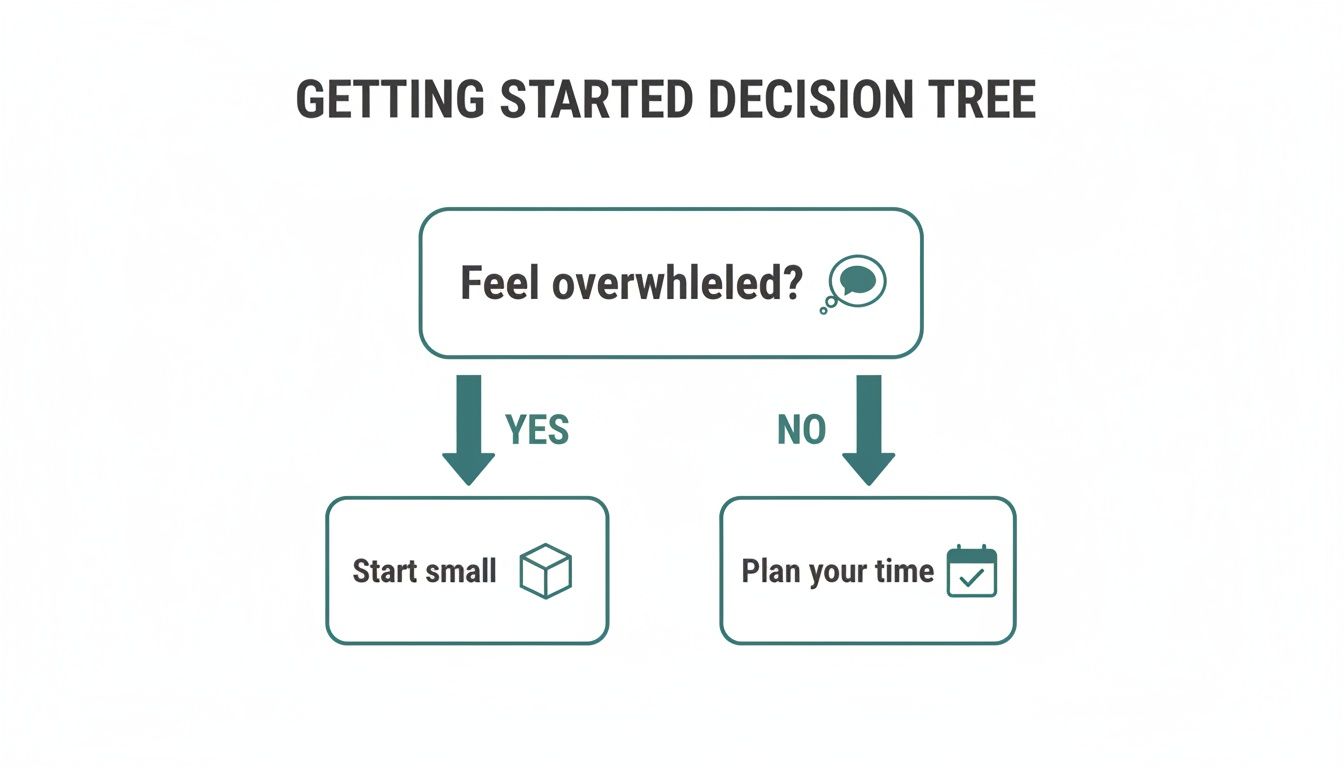
Sometimes, just giving yourself permission to start with one small drawer is all it takes to build momentum.
Making Confident Decisions
Knowing the categories is one thing, but actually putting things in them can feel tough. The goal is to touch each item just once and decide its fate. This prevents you from second-guessing and keeps the energy high.
So, how do you decide what to keep? A great guideline I always recommend is the one-year rule. If you haven't used it, worn it, or even thought about it in the last 12 months (and it’s not a precious sentimental item), it's probably time for it to go. This simple rule helps you break free from the "but I might need it someday" cycle that keeps our rooms full of clutter.
The most freeing realization in organizing a cluttered bedroom is that you are not just getting rid of things. You are making room for peace, clarity, and the life you want to live in that space.
Let's talk about a classic example: the clothes you hope to fit into again someday. This is an emotional one for a lot of us. Keeping them in your main closet, where you see them every morning, can feel like a daily reminder of what doesn't fit. A much better approach? Put them in the "Store" box. They're out of sight but not gone forever.
Handling Guilt and Sentimental Items
Sorting through your stuff is a trip down memory lane, and it can bring up a lot of feelings. You’ll find gifts you never really liked but felt guilty getting rid of, or ticket stubs from a concert ten years ago. It’s okay to feel that pang of emotion. Acknowledge it, and then let the item go.
For unwanted gifts, remember this: the gift-giver’s kind intention was fulfilled the moment you received it. You aren’t obligated to keep it in your home forever. Pass it along to the "Donate/Sell" box so it can find a new home with someone who will truly love it. For more ideas on what to tackle, our complete decluttering checklist can help keep you on track.
When you get to sentimental items, be a curator, not an archivist. You don't need to keep every single birthday card to remember you are loved. Pick a few representative items that spark a genuinely happy memory and place them in the "Store" box. Your memories live in you, not in the objects. Digitizing old photos and letters is another fantastic way to preserve the memory without the physical footprint. You’ve got this.
Conquering Your Closet and Dresser
Let's be honest, for most of us, the closet and dresser are the real epicenters of bedroom chaos. These spaces get stuffed so full that just finding a matching pair of socks can feel like an archaeological dig. If that sounds a little too familiar, it’s time for a new battle plan.
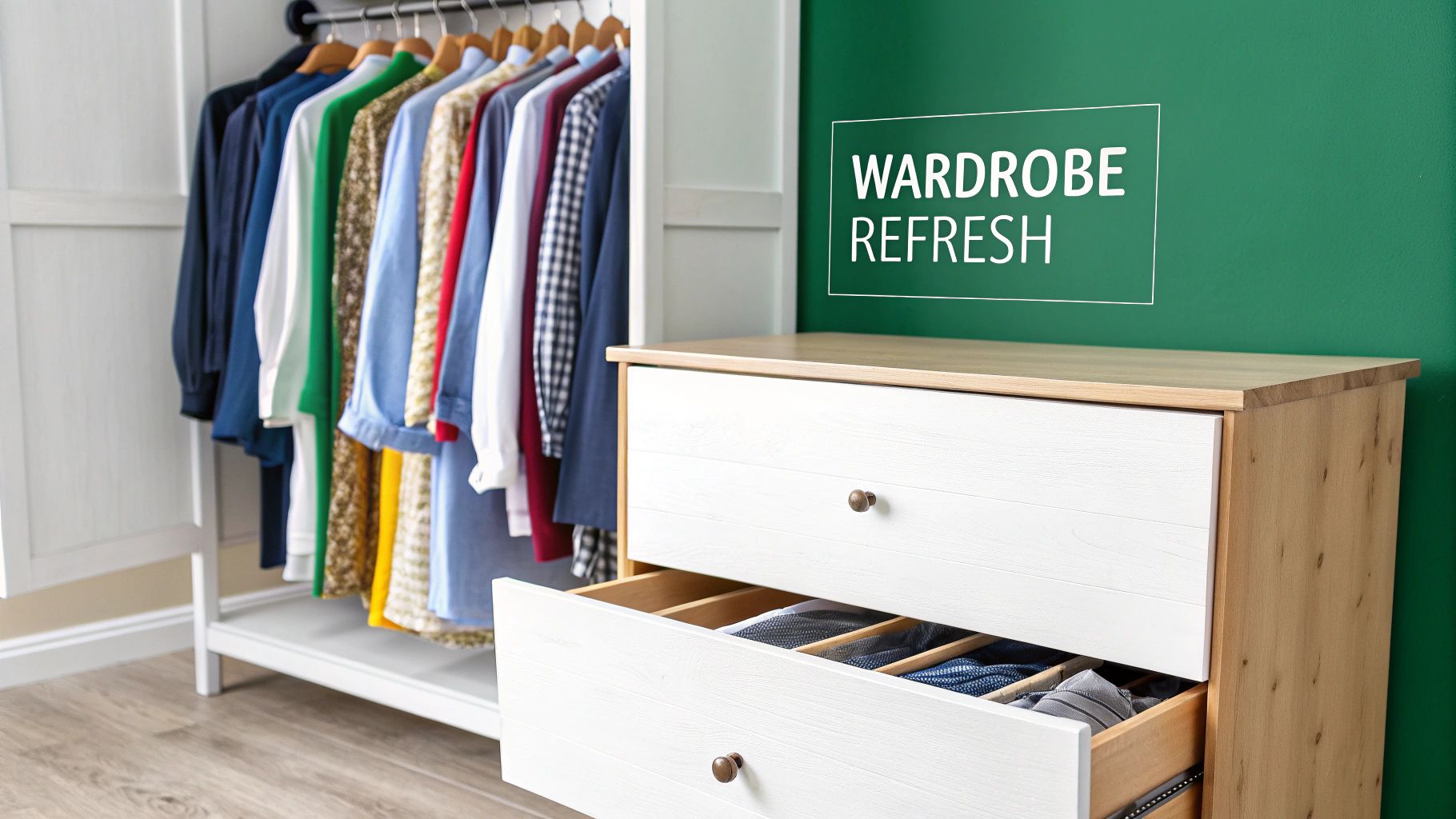
The trick is to stop thinking about what you should keep and start focusing on what you actually love to wear. Your wardrobe should be a curated collection of pieces that make you feel confident and comfortable right now, not a museum of clothes you might wear someday. That simple mindset shift makes the tough decisions a whole lot easier.
Applying the 80/20 Rule to Your Wardrobe
A fantastic place to start is with the Pareto Principle, better known as the 80/20 rule. When you apply it to your clothes, it suggests that you wear about 20% of your wardrobe 80% of the time. Think about it—you have those few favorite pairs of jeans, cozy sweaters, and go-to shirts that are constantly in rotation. The rest? It’s mostly just taking up space.
This isn't just some abstract theory; it's a practical filter for decluttering. As you go through each piece of clothing, ask yourself if it’s part of that hardworking 20%. If it’s not, it's a perfect candidate for your "Donate/Sell" or "Store" box. This one concept can give you the push you need to finally part with items you’ve been hanging onto for years. You can find more eye-opening stats about our relationship with clutter on BecomingMinimalist.com.
Master the Art of the Vertical Fold
Once you’ve whittled down your collection, how you put things back is just as crucial as what you decided to keep. This is especially true for dresser drawers, which have a bad habit of becoming a jumbled mess. The solution is simple: stop stacking and start filing.
The vertical folding technique, made famous by Marie Kondo, is a total game-changer. Instead of laying folded clothes flat on top of each other, you fold them into small, compact rectangles that can stand up on their own.
- You can see everything at a glance. No more digging through piles to find that one t-shirt.
- It creates a surprising amount of space. You will be shocked at how much more you can fit into a drawer this way.
- Things stay much neater. When you pull one item out, the others stay perfectly in place.
By changing how you fold, you transform your drawers from chaotic pits into a tidy library of your clothing. Every item is visible, accessible, and easy to grab.
Sort and Categorize for Your Real Life
Now that you have a streamlined collection, it’s time to organize it in a way that actually makes sense for your daily routine. Grouping "like with like" is the single most effective strategy you can use.
Carve out distinct zones in your closet and dresser that reflect your lifestyle:
- Work Attire: Keep all your office-appropriate clothes together.
- Workout Gear: Dedicate one drawer or section just for athletic wear.
- Casual & Weekend Wear: This is home for your everyday jeans, t-shirts, and sweaters.
- Formal or Occasion Wear: Items you don’t wear often can be tucked away in a less accessible spot.
This system saves you so much mental energy in the morning. When it’s time to head to the gym, you know exactly which drawer to open. It eliminates that frantic searching and makes your entire routine feel smoother. For an even deeper dive into this, check out our dedicated closet organization tips.
Embrace the Seasonal Wardrobe Swap
If you live anywhere with changing seasons, you know the pain of having bulky winter coats hogging precious closet space in the middle of July. The answer is a seasonal wardrobe swap. This is one of the most impactful things you can do to organize a cluttered bedroom, particularly if you're short on space.
At the end of each season, set aside an hour to pack away the clothes you won’t need for the next few months.
- Wash Everything First: Make sure every item is clean before storing it to prevent stains from setting in.
- Use Proper Containers: Opt for weathertight bins or vacuum-sealed bags to protect your clothes from dust, moisture, and pests.
- Label Clearly: Slap a label on each bin describing the contents (e.g., "Winter Sweaters & Coats") so you can find what you need when the seasons change again.
This simple routine frees up a massive amount of space and gives you a natural opportunity to reassess your wardrobe twice a year. It’s a built-in maintenance plan that keeps your closet functional, relevant, and refreshingly clutter-free.
Smart Storage Solutions for Every Space
After all that hard work sorting and purging, you're finally left with only the things you truly need, use, and love. Now for the satisfying part: giving every single one of those items a logical, permanent home. This isn't just about hiding things away; it’s about creating an intuitive system where putting things back is just as easy as taking them out.
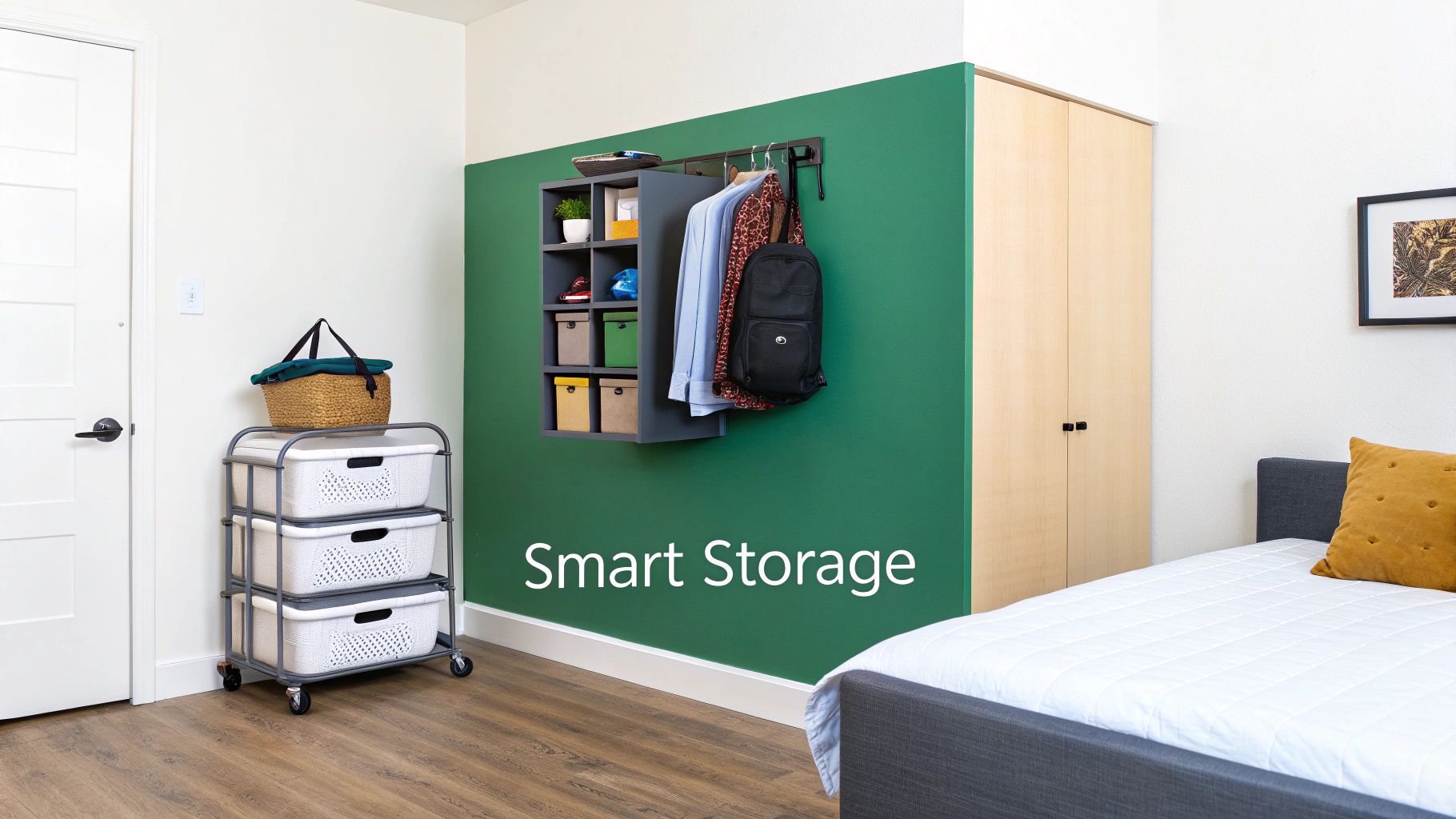
This is especially true in smaller bedrooms where every square inch is prime real estate. The goal is to move beyond just tossing things in bins and start thinking strategically about your space.
Think Vertically to Maximize Space
One of the most common mistakes I see is people forgetting about their walls. When floor space is limited, the only way to go is up. Drawing the eye upward not only creates a sense of spaciousness but also unlocks a huge amount of untapped storage potential.
Here are a few vertical storage power players:
- Wall-Mounted Shelves: Perfect for books, plants, or small baskets holding accessories. They get items off your floor and dresser, instantly cutting down on surface clutter.
- Over-the-Door Organizers: These are no longer just for shoes! Use them on the back of your bedroom or closet door for scarves, belts, makeup, or toiletries.
- Slender Rolling Carts: A slim, three-tiered cart can tuck neatly between your dresser and the wall or serve as a mobile nightstand, holding everything from your current read to your skincare routine.
The demand for these solutions is exploding. The home organization industry has more than doubled to over $8 billion since the early 2000s. A huge driver of that growth is younger generations—nearly 70% of 18-34-year-olds report feeling stressed by disorganization.
Unlock Your Under-Bed Potential
The space under your bed is one of the most underutilized storage areas in the entire home. It’s the perfect spot for items you don't need to access every day but still want to keep close by. Think of it as your bedroom's built-in attic.
This area is ideal for:
- Extra sets of bedding and pillows
- Off-season clothing (like those bulky sweaters)
- Suitcases and travel bags
- Shoes you wear less frequently
To do this right, you need proper containers. Long, shallow bins with wheels make it easy to slide items in and out, while vacuum-sealed bags are fantastic for compressing bulky textiles like duvets. For a deeper dive, check out our guide on how to maximize your space with smart under-bed storage solutions.
Avoid This Common Organizing Mistake
Here's a piece of advice that will save you time, money, and a whole lot of frustration: do not buy a single storage container until after you have finished decluttering. I know it’s tempting to rush out and buy a bunch of beautiful, matching bins, but this is a classic organizing mistake.
You must know exactly what you need to store before you can choose the right storage for it. Buying containers first forces you to fit your belongings to the container, rather than finding the perfect container for your belongings.
Once you know exactly what’s left, you can measure your spaces—your shelves, drawers, and under-bed clearance—and purchase containers that fit perfectly. This intentional approach ensures you create a system that is functional, looks cohesive, and will actually stand the test of time. It can be helpful to see examples of how you can eliminate clutter with 5 bedroom solutions that target these common problem areas.
Building Habits to Stay Organized for Good
You’ve done it. You’ve sorted, purged, and organized your way to a serene, clutter-free bedroom. While the hard part is over, the real victory lies in keeping it that way. This is where you shift from a one-time project to a sustainable lifestyle, building simple habits that keep the chaos from creeping back in.
The key is to create systems that are so easy they feel automatic. This isn't about maintaining perfection; it's about having a simple plan to deal with the natural ebb and flow of daily life. By embedding a few core practices into your routine, you can make sure your bedroom remains a peaceful retreat for good.
Adopt the One-In, One-Out Rule
One of the most powerful habits for maintaining balance is the one-in, one-out rule. The concept is brilliantly simple: every time a new item comes into your bedroom, a similar item must go out. Buy a new pair of jeans? An old pair gets donated. Get a new book for your birthday? An old one comes off the shelf.
This rule acts as your personal gatekeeper, stopping the slow accumulation of stuff that leads back to a cluttered space. It forces you to be a more conscious consumer, making you pause and consider if you truly need something new and what you're willing to part with to make room for it. It’s a simple equation that maintains equilibrium.
Implement a 10-Minute Weekly Reset
Life gets busy, and it's totally normal for small things to get left out of place. A weekly reset is your secret weapon against this slow slide back into disarray. All you need is 10 minutes, once a week, to put your room back in order.
A weekly reset isn't about deep cleaning or reorganizing. It’s a quick, focused burst of tidying to address the small messes before they can combine to form a bigger problem. It's preventative maintenance for your space.
Set a timer and fly through these quick tasks:
- Put away any clothes that have landed on "the chair."
- Clear surfaces like your nightstand and dresser.
- Straighten books, stack mail, and return items to their designated homes.
This small investment of time pays huge dividends, resetting your room to its organized state and making it much easier to manage throughout the week. If you find yourself losing steam, our tips on finding decluttering motivation can help you stay on track.
Create a Designated Clutter Dropbox
Despite our best intentions, random items will find their way into the bedroom—mail, receipts, keys, loose change. Without a system, these things end up scattered on every available surface. This is where a clutter dropbox comes in.
A dropbox is simply one designated container—a stylish basket, a small tray, or a decorative box—where all miscellaneous items go. It's a containment strategy. Instead of having five small piles of clutter, you have one controlled spot.
At the end of each day or during your weekly reset, you can quickly sort through the dropbox. File the important papers, put the change in a jar, and toss the trash. This single habit contains the mess, making it manageable and preventing it from taking over your newly organized bedroom. It’s a simple solution that honors the reality of daily life while protecting your hard-won peace.
We Get These Questions All The Time
Even with a solid plan, decluttering your bedroom can throw you a curveball. Below are some quick answers to the questions we hear most often, designed to get you past those tough spots and back on track.
How Long Does It Really Take to Organize a Very Cluttered Room?
Honestly, there's no single answer. The real timeline depends on the room's size and just how much stuff you're navigating. But the one thing I can tell you for sure is to avoid the all-or-nothing approach—that’s a recipe for burnout.
Some people thrive on a "weekend blitz," dedicating two full, uninterrupted days to knock it out. If you have the stamina and the time, go for it.
But for most of us, the "15-minutes-a-day" strategy is far more sustainable and less terrifying. You’d be amazed at the progress you can make in short, focused bursts over a week or two, without ever feeling like you’ve sacrificed your entire life to the project.
The secret is to stay consistent and focus on one tiny zone at a time. Seeing those small wins will keep you going.
- Day 1: Just clear the top of your nightstand. That's it.
- Day 2: Tackle one, single dresser drawer.
- Day 3: Organize one shelf in your closet.
What Should I Do with Sentimental Items I Can’t Part With?
This is a big one, and let me be clear: the goal is not to force you to throw away things that hold deep personal meaning. The solution is to be intentional about what you keep in your immediate space, curating your collection so it honors your memories instead of creating daily clutter.
First, gather your sentimental items and choose only the most meaningful ones—the things that spark a genuinely happy memory. A great space-saving trick is to digitize old photos, letters, and your kids' artwork. You preserve the memory without the physical bulk.
For the physical keepsakes you truly want to save—family heirlooms, your favorite childhood books, a special piece of clothing—think about archival storage. Using an external service keeps them safe and sound without taking up prime real estate in your bedroom. This way, you can honor your past while fully enjoying a clutter-free present.
How Can I Get My Partner on Board with Organizing?
When you share a space, you have to be on the same page. If your partner is, let’s say, less enthusiastic about tidying up, the key is to make the system almost effortless. You have to remove all the friction.
The goal isn't to change your partner's personality. It's to create a shared environment that functions so smoothly and logically that staying organized becomes the path of least resistance for everyone.
Start by setting up simple, foolproof systems. A laundry hamper with clearly labeled sections for "Lights" and "Darks" is a great start. Another game-changer is the "in-between" bin—a designated spot for clothes that have been worn but aren't dirty enough for the wash. This one simple fix contains the dreaded "chairdrobe" pile.
I Always Get Overwhelmed and Quit Halfway Through. What Can I Do?
Decluttering paralysis is real, and it’s completely normal. To fight it, you need an easy, high-impact win right at the start. So please, don't start with the closet—that's often the most intimidating part of the entire room.
Instead, start by clearing every flat surface you can see.
- Make your bed.
- Clear off the top of your dresser.
- Tidy your nightstand completely.
This strategy gives you an immediate visual reward. That powerful sense of accomplishment is the fuel you need to keep going. Another pro tip: have your exit plan ready before you even start sorting. Know exactly where donations are going and have your trash and recycling bags ready so the clutter you’ve decided to part with leaves your home immediately.
When you need a secure home for your seasonal wardrobe, sentimental keepsakes, or anything else you want to keep but don't need every day, Endless Storage can help. We offer convenient, by-the-box storage with free pickup, so you can reclaim your space without leaving your house. Learn more about how it works at https://www.endless-storage.com.
Frequently Asked Questions
Unveiling the Secrets to Effortless Storage
Endless Storage is available nationwide. You pick a plan, tell us where to pickup, and we'll send a UPS van to collect, whichever state you're in.
Your shipping label will be sent to your email within a few minutes, if not instantaneously. It can also be accessed through your customer profile.
Your box will be shipped to one of our climate controlled self storage facilities in our closest self storage facility. Our manager will accept your package, notify you that your box has been received, and securely stored. Only our managers will have access to Endless Storage boxes.
Email us at admin@endless-storage.com click to live chat with us, or send us a message below.
Never! We're committed to transparent pricing with no surprises. You'll lock in your rate with no hidden fees and no long-term contracts.
Fast access guaranteed! Your boxes will arrive at your doorstep within 48 hours of requesting them back. Need to check on delivery? We provide tracking information for complete peace of mind.
Totally flexible! Store month-to-month with no long-term commitment and cancel anytime.
Everything's online! Use your account dashboard to:
• Set up automatic monthly payments
• Request box returns
• Update your address
• Order additional boxes
• Track shipments
Your boxes are insured up to $100 each. Our customer service team will help you file any necessary claims and resolve issues quickly.
Don't worry – we'll email you right away if there's a payment issue. Your items stay safe, though you may have temporary service interruption or late fees until payment is resolved.
When you request our free storage kits, you'll have 30 days to send in your boxes to activate your 3 months of free storage. Think of it like starting a gym membership – your activation window begins when you receive your kits, and your full free trial begins once you send in your first box. During your free months, you'll experience our complete storage service at no cost.
Your 30-day activation window begins when you receive your storage kits. We'll send you an email confirmation when your kits are delivered, marking the start of your activation period.
If you haven't sent any boxes for storage within your 30-day activation window, your free trial will expire and we'll begin charging the regular monthly rate of $9.99 per box. This helps ensure our storage kits go to customers who are ready to use our service.
A box costs $9.99 per month to store (plus sales tax). This price includes free shipping for standard boxes under 50 lbs. and smaller than 16"x16"x16"
Log into your Endless Storage account, locate the box you would like returned, and simply click Return My Box.
Yes, each box stored with us is insured for up to $100 throughout transit as well as the duration of storage within our facilities.
Your box will be at your doorstep within 48 hours of you requesting it back.
Store 10+ boxes? We'll pick them up for free! After your purchase, we'll contact you to schedule a convenient pickup time and arrange UPS collection.
We trust UPS with all shipments, and every box includes $100 insurance coverage. You'll receive tracking information to monitor your items' journey.
Yes! Visit any of our locations by appointment. Just bring a photo ID matching your customer profile.
For everyone's safety, we can't store hazardous materials, firearms, or perishables. All items must fit within our standard boxes.
It's easy! Order your storage kit online, and we'll ship it to you within 1-2 business days. Your shipping labels will be emailed instantly and available in your account.
We're here to help! Email us at admin@endless-storage.com, use our live chat, or send us a message through your account.
To cancel your storage service with Endless Storage, please email your cancellation request to admin@endless-storage.com. Our team will process your request within 2 business days and confirm your cancellation via email.
We understand packing takes time. However, to maintain your free trial benefits, you'll need to send at least one box within the 30-day activation window. If you need more time, you can always start with one box to activate your trial and send the rest later. You can always reach out to admin@endless-storage.com if you have any issues or concerns.
When you request our free storage kits, you're starting a 30-day window to begin using our storage service.
Important: To activate your free trial, send at least one box for storage within 30 days. If no boxes are sent within this 30-day window, a one-time $50 fee applies to cover materials and shipping costs. This fee is clearly disclosed before you sign up.
Think of it like reserving a hotel room – we're setting aside space and sending specialized packing materials for your use. The fee only applies if you request materials but don't begin storage, similar to a hotel's no-show charge.