
Choosing a moving truck can feel like a guessing game. Pick one that’s too small, and you’re looking at multiple, frustrating trips back and forth. Go too big, and you’re just paying to haul empty air. Getting the box truck dimensions right from the start is the key to a smoother, more affordable move.
This guide is here to help you skip the guesswork by turning abstract numbers into something you can actually use.
Picking the Right Truck Without the Guesswork
A truck's length, width, and height are the foundation of a good moving plan. It's a detail that’s more important than ever, especially with the box truck market booming. The market hit USD 12.9 billion in 2023 and is expected to climb to around USD 19 billion by 2032, thanks to the rise of e-commerce and local deliveries.
What does that mean for you? More options, which is great, but it also makes it even more critical to pick the right vehicle for your move.
To give you a head start, here is a quick guide to some common truck sizes and what they're typically used for.
Quick Guide to Common Box Truck Sizes
| Truck Size | Approx. Interior Dimensions (LxWxH) | Best For |
|---|---|---|
| 10' | 9'11" x 6'4" x 6'2" | Studio apartment or dorm room |
| 16' | 16' x 7'8" x 7'2" | 1-2 bedroom apartment or a small home |
| 26' | 26'5" x 8'1" x 8'3" | 3-4 bedroom house or larger moves |
This table gives you a solid starting point for matching a truck to your move.
Matching Truck Size to Your Move
Now, let's connect those numbers to what you actually own. This quick visual guide does a great job of pairing common truck sizes with the type of home they can handle.
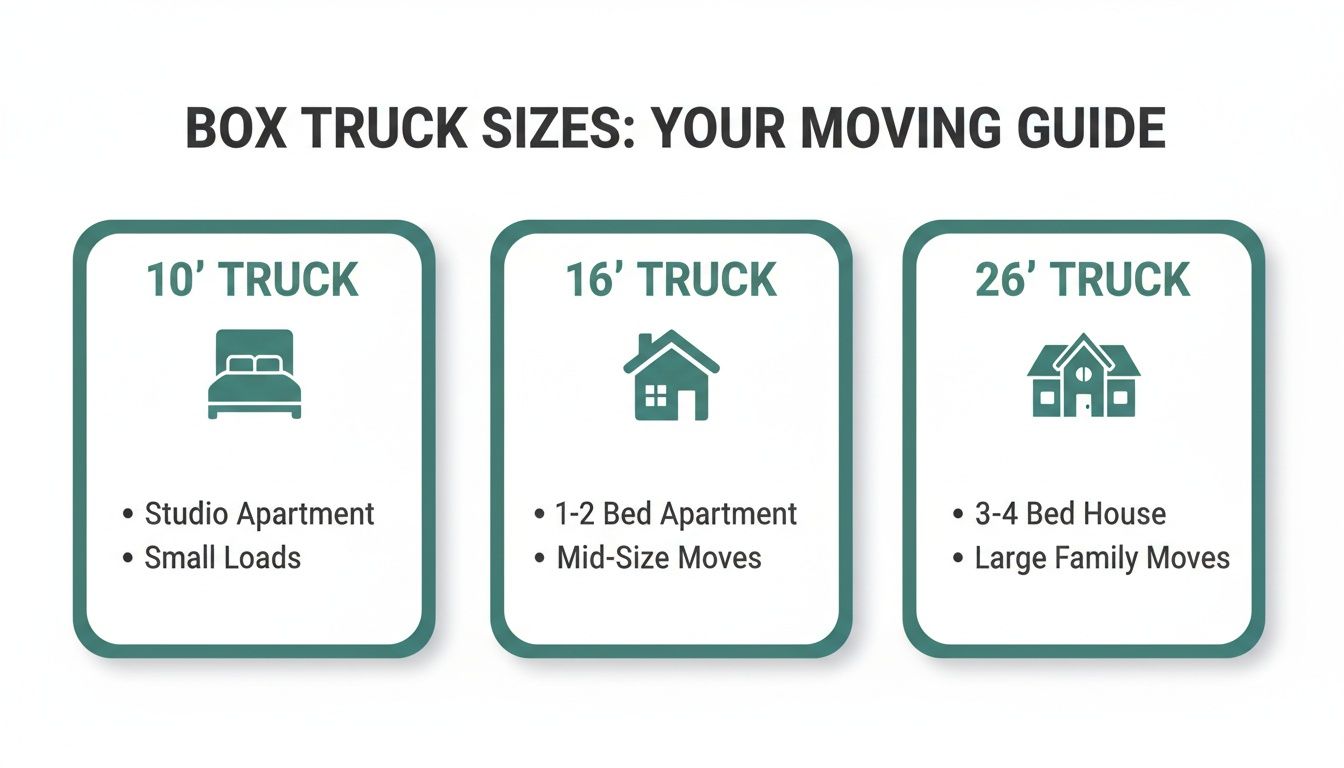
Seeing it laid out like this gives you an immediate feel for scale, helping you narrow down your choices before you get into the nitty-gritty of measurements.
Try to picture your own belongings fitting into these spaces. A 10-foot truck is usually just right for a dorm or studio, but the contents of a multi-bedroom house will easily fill a 26-foot truck. If you're still on the fence, you might want to look into whether you need a self storage truck to help with your move.
The most common mistake people make is underestimating how much room their stuff actually takes up. A sofa, a mattress, and a handful of boxes can fill up a small truck way faster than you’d think.
Decoding Standard Box Truck Dimensions
When you see an ad for a "16-foot truck," that number only tells you part of the story—the length. To really know if your stuff will fit, you need to think in three dimensions: length, width, and height. Multiplying all three gives you the truck’s total volume in cubic feet, which is what truly matters.
But what's a cubic foot? Picture a standard moving box, the kind that’s one foot on every side. A typical 10-foot truck can hold about 400 of those boxes, assuming you stack them perfectly. Thinking about it this way makes it much easier to visualize how much space you’re actually getting.
Over the years, the rental market settled on a few key sizes that just work. The most common options you’ll find—10-12 feet, 14-18 feet, and 20-26 feet—became the standard because they strike the perfect balance between cargo space and being able to navigate city streets without a commercial license.
Small Movers: 10-Foot and 12-Foot Trucks
A 10-foot truck is the go-to for smaller moves, like hauling the contents of a studio apartment or a college dorm room. Their biggest advantage is their compact size. They're a dream to handle on crowded city streets and a whole lot easier to park, which can be a lifesaver in urban areas.
Inside, you’re looking at around 400 cubic feet of space. To put that in perspective, think of it as a large walk-in closet. It’s perfect for a queen-sized bed, a loveseat, a dresser, and a handful of boxes, but you'll run out of room quickly after that. If you're on the fence, a 12-foot truck gives you a little more wiggle room without feeling like you're suddenly driving a bus.
When you're stuck between two sizes, it's almost always better to go with the bigger one. That extra space is a safety net for those last-minute items or awkwardly shaped furniture, saving you from the nightmare of making a second trip.
Mid-Sized Movers: 14-Foot and 16-Foot Trucks
Jumping up to a 14-foot or 16-foot truck opens up a lot more possibilities. This is the sweet spot for most one or two-bedroom apartment moves. These trucks typically give you between 800 and 900 cubic feet of volume, which is roughly the size of a small one-car garage.
That extra room means you can comfortably fit larger furniture like a full dining set, multiple bedroom suites, and even some major appliances. While they are bigger, a 16-foot truck is still surprisingly manageable for most people to drive. If your move is taking you across state lines, it's smart to see what your options are. For those planning a long haul, a good guide to interstate removal truck hire can be a huge help.
Large Movers: 20-Foot to 26-Foot Trucks
When you’re moving an entire house, you need the biggest truck you can get. A 26-foot truck is the largest vehicle most companies will let you rent without a commercial driver's license. It’s an absolute beast, offering a massive 1,700 cubic feet of space or more.
This is the truck you need for a three to four-bedroom home. It can handle everything from large sectional sofas and king-sized beds to refrigerators, washers, and dryers. But keep in mind, loading a truck this big is a serious game of Tetris. To make sure you do it right, check out our guide on the best way to pack a moving truck for some pro tips on using every inch of space safely.
What Actually Fits Inside Each Truck Size
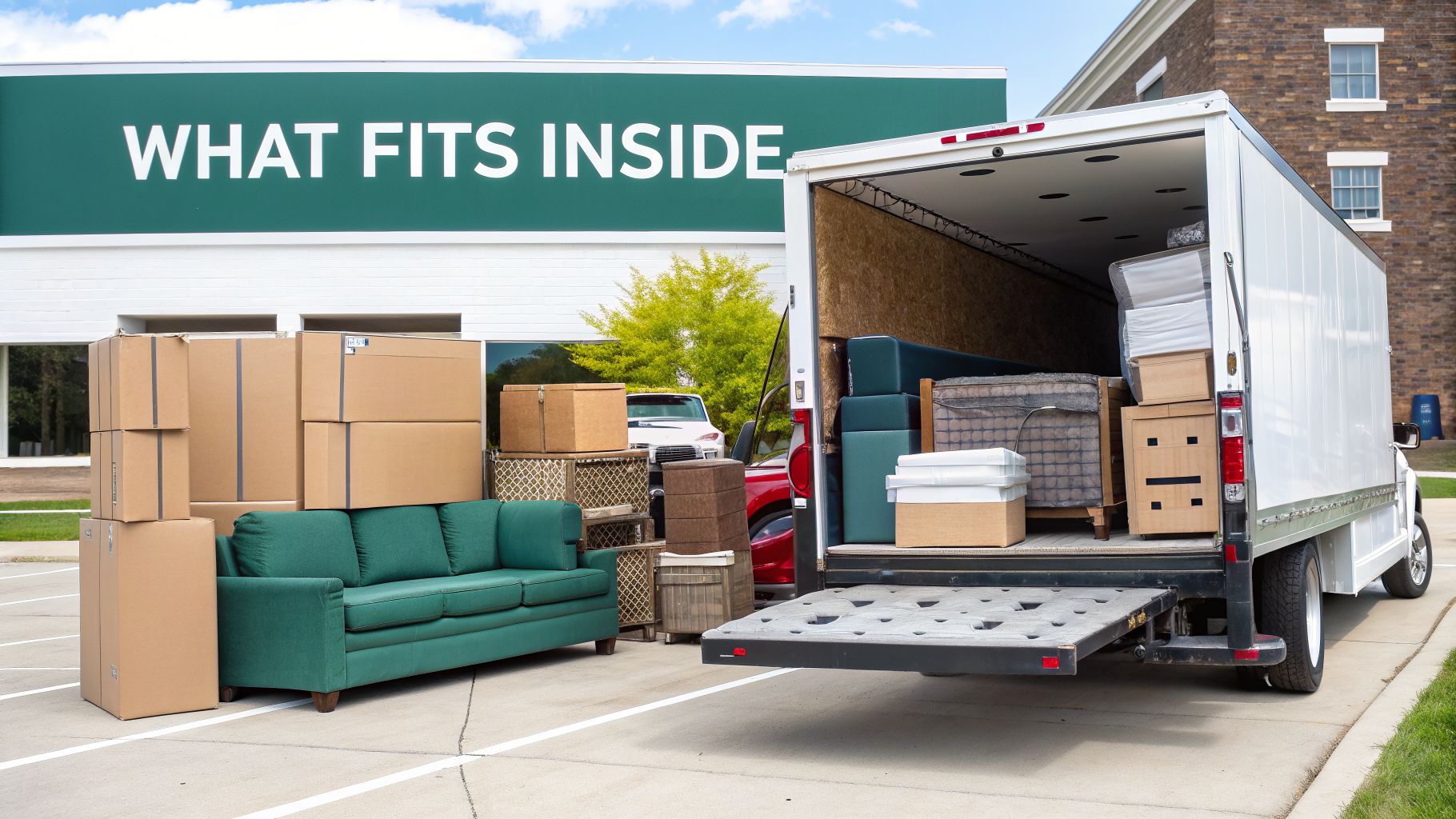
Knowing a truck's cubic footage is one thing, but it doesn't exactly help you picture your sofa, bed, and all those boxes fitting inside. Let's translate those abstract box truck dimensions into real-world items you actually own.
This way, you can mentally pack the truck before you even rent it. It’s the best way to avoid the classic moving day mistake: renting a truck that’s too small or paying for a ton of space you just don't need.
The 10-Foot Truck: A Studio Apartment's Best Friend
Think of a 10-foot truck as the go-to for a really small move. It’s the perfect size for someone moving out of a studio apartment or a college dorm room for the very first time.
You can comfortably fit the absolute essentials, like:
- A queen-sized mattress and box spring.
- A small sofa or loveseat.
- A dresser and a small desk.
- Roughly 15-20 medium-sized boxes.
Just be realistic about its limits. If you have bulky furniture, anything oddly shaped, or more than a single room's worth of stuff, you'll run out of space fast.
The 16-Foot Truck: For Small Apartments and Homes
There's a reason the 16-foot truck is one of the most popular rental sizes—it hits that perfect sweet spot for a lot of moves. This is usually the right call when you're moving a one-bedroom or a smaller two-bedroom apartment.
With this much space, you can typically load:
- The contents of two full bedrooms (beds, dressers, nightstands).
- A complete living room set, including a sofa, chairs, and a coffee table.
- Major appliances like a washer and dryer.
- Up to 50 medium boxes, or even more if you're a Tetris master.
This size gives you a lot more breathing room than a 10-footer, but it isn't so big that it feels intimidating to drive. If you're trying to picture how your items fit in a fixed space, our storage unit size guide can offer another helpful perspective.
Don’t forget about the "Mom's Attic"—that little storage nook over the truck’s cab. It’s the ideal spot for fragile items, bags, or any boxes you want to keep separate and easy to get to.
The 26-Foot Truck: For Moving a Whole House
When you’re packing up a three-to-four-bedroom home, you’ll need the biggest option available for a standard DIY move: the 26-foot truck. This beast is designed to handle the contents of an entire family home, hopefully in a single trip.
A 26-foot truck has room for multiple large furniture sets, all your major appliances, and even outdoor gear like lawnmowers or patio furniture. You can easily pack 100+ boxes along with:
- King-sized beds and large bedroom furniture.
- Sectional sofas and bulky entertainment centers.
- A full dining room table with chairs.
- Garage items and bicycles.
Moving with a truck this big requires some serious planning. You have to be strategic about loading everything to maximize space and distribute the weight evenly for a safe drive. It's a true test of your packing and spatial reasoning skills.
The Hidden Factor of Box Truck Weight Limits
It's a classic moving day scenario that can go wrong fast. You've played a perfect game of Tetris with your belongings, everything is packed tight, and you still have a little room left by the door. But just because there’s space, doesn't mean you're not already overloaded. Weight, not volume, is the sneakiest part of figuring out box truck dimensions.
So many people focus only on cubic feet, but every single truck has a strict weight limit it can safely carry. You’d be surprised how quickly you can hit that limit, especially if you’re moving dense, heavy items. Imagine loading up a truck with boxes of books, a solid oak dining set, and your prized record collection—you could run out of weight capacity long before you run out of physical room.
Understanding GVWR And Payload Capacity
To make sure your move is safe, there are two key terms you’ll want to get familiar with: Gross Vehicle Weight Rating (GVWR) and payload capacity. They might sound technical, but they're actually pretty simple.
Gross Vehicle Weight Rating (GVWR): This is the absolute max a truck can weigh, period. It includes the truck itself, the fuel in the tank, you and your passengers, and all of your cargo. Think of it as the truck’s all-in weight limit.
Payload Capacity: This is the number that really matters for your move. It's the maximum weight of all the stuff you can safely load onto the truck. You get this number by taking the truck's GVWR and subtracting its empty weight (also called curb weight).
Basically, payload capacity is your "stuff" allowance. A truck full of pillows and lampshades will weigh a whole lot less than one filled with appliances and workout equipment, even if they both take up the same amount of space.
Typical Payload Limits For Common Trucks
Weight limits can change a lot depending on the truck size. For instance, the gross vehicle weight rating can go from around 8,000 pounds for smaller trucks to over 33,000 pounds for big commercial ones. This means very different payload capacities—a 10-foot truck might only handle a maximum payload of 2,850 pounds, while a 26-foot truck can often take on 10,000 pounds or more. If you want to dive deeper, you can discover more insights about box truck weight specifications on goloadup.com.
Here’s a quick rundown to keep in your back pocket:
- 10-12 Foot Trucks: Payload capacity is usually around 2,800 - 3,500 lbs. Great for some light furniture, but they can get overloaded quickly with heavy boxes.
- 14-16 Foot Trucks: The payload here jumps to roughly 4,000 - 7,000 lbs. This range is usually enough to handle the contents of a one or two-bedroom apartment.
- 20-26 Foot Trucks: These big movers have a serious payload of 7,000 - 10,000+ lbs, making them a solid choice for moving an entire house.
Ignoring these limits isn't just a bad idea—it's illegal. You could face hefty fines, create dangerous driving conditions, and put a ton of extra wear on the truck's brakes and suspension. Always double-check the specific payload capacity of your rental before you start loading it up.
How to Measure Your Life in Boxes
Ready to move past the guesswork and get a real plan together? While online calculators can give you a starting point, nothing beats a quick 'pen and paper' inventory for figuring out what you actually need. This simple method helps you take control of the planning process, giving you the confidence to pick the right box truck.
Think of it as creating a personalized blueprint for your move. You’ll be able to see exactly what you're working with, which makes matching your items to the correct box truck dimensions a whole lot easier.
Create Your Quick Inventory
Start by walking through your home, room by room, with a notepad or a simple spreadsheet. Don't stress about measuring every little thing just yet. The goal here is to get a solid overview of your belongings.
For each room, jot down two things:
- Large Items: List all your big furniture—beds, couches, dressers, tables, and major appliances.
- Box Estimate: Make a rough count of how many standard moving boxes you think you’ll need for everything else like clothes, books, and kitchenware.
This basic list is your foundation. It helps you visualize the total volume and keeps you from forgetting major pieces, like that bookshelf tucked away in the office corner.
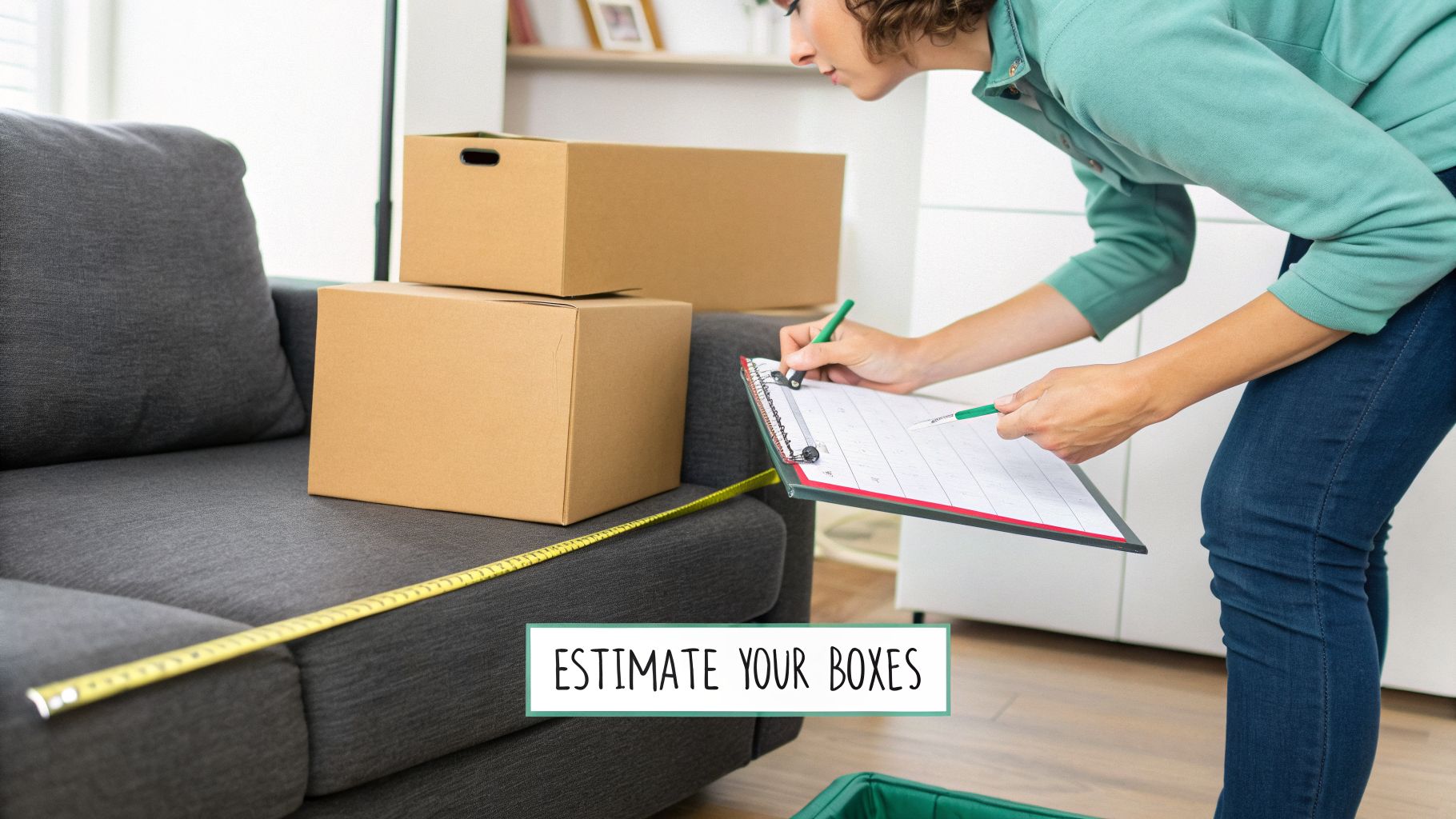
Use a Tape Measure for the Big Stuff
Now, grab a tape measure for your largest and most awkwardly shaped items. Get the length, width, and height of things like your sectional sofa, entertainment center, or that antique armoire that’s been in your family for years.
Having these precise measurements is your secret weapon. It ensures your most important pieces will fit through doorways and, more importantly, into the truck without any last-minute surprises.
For example, knowing your biggest item is 7 feet long instantly tells you a truck with less than 8 feet of interior length won't cut it. This is the kind of practical detail that makes choosing a truck so much simpler.
If you want more specific guidance, our storage space calculator can help you turn those dimensions into a cubic footage estimate. To really 'measure your life in boxes' and pack like a pro, check out this excellent guide to choosing the right moving boxes. This hands-on approach turns abstract planning into concrete, confident action.
When Renting a Truck Isn't the Answer
Knowing your box truck dimensions is a great start, but a DIY move is often more complicated than the numbers suggest. The math might add up on paper, but it doesn't account for the real-world stress of driving a massive truck for the first time.
Suddenly, you're faced with challenges that measurements can't solve. Think about navigating a 26-foot vehicle down narrow city streets, the impossible puzzle of finding legal parking, and the pure physical exhaustion of loading and unloading against a ticking clock. These "hidden costs" of a DIY move go way beyond the rental fee.
You also have to factor in surprise fuel expenses—those big trucks are thirsty—and the very real burnout that can hit before you’re even halfway done. For city dwellers or anyone in a small apartment, renting a huge truck can feel like using a sledgehammer to crack a nut.
A Modern Alternative to the Big Truck
What if there was a better way? A more flexible, less stressful option that doesn't involve wrestling with a giant truck on a high-pressure deadline. This is especially true if your moving or storage needs don't fit neatly into a single day.
A service-based approach offers a much smarter path. It's built to solve the classic DIY moving headaches:
- Navigating Urban Chaos: Driving a large truck in a dense city is a specialized skill most of us don't have.
- Parking Nightmares: Good luck finding a spot for a 26-foot vehicle in a crowded neighborhood.
- The All-or-Nothing Rush: You have one day to get everything packed, loaded, moved, and unloaded. No pressure, right?
- Physical Exhaustion: The labor involved is intense and almost always underestimated.
For situations like these, moving or storing items on a by-the-box basis just makes more sense. You pay only for what you need, without the pressure of driving, parking, and racing against time.
For many people, especially in cities, the biggest challenge isn't space—it's logistics. A full-service solution eliminates the most stressful parts of the moving equation, allowing you to focus on settling in, not on driving a commercial vehicle.
If you're looking for a simpler way to handle your belongings during a move or just need to free up some space at home, you might be interested in how self-storage delivered to your door works. It's an option that completely sidesteps the hassles of a traditional truck rental.
Common Questions About Box Truck Dimensions
You’ve measured your furniture and mapped out your move, but a few nagging questions about the truck itself can still cause some pre-move jitters. Let's clear up some of the most common mix-ups so you can feel confident on moving day.
Do I Need a Special License for a 26-Foot Truck?
This is a big one, and the answer is almost always no. For most moves, your standard driver's license is all you'll need to get behind the wheel of a 26-foot rental truck.
Rental companies like U-Haul and Penske know their customers, so they keep their trucks just under the legal limit that requires a special license. Their fleets are designed with a Gross Vehicle Weight Rating (GVWR) below 26,001 pounds, which is the magic number for needing a Commercial Driver's License (CDL). Still, it never hurts to double-check with the rental agent, just in case local rules have a specific quirk.
What's the Difference Between Payload and Cubic Feet?
Getting this wrong is one of the most common moving day mistakes. It's a classic case of space versus weight.
- Cubic Feet is all about volume. It’s the total amount of open space inside the truck's cargo box.
- Payload Capacity is about weight. This is the maximum total weight the truck can safely handle, which includes every single thing you put in it—plus passengers and fuel.
You can easily max out your payload capacity long before you run out of cubic feet. Think about it: a truck full of heavy book boxes, a solid oak dining set, and old appliances will hit its weight limit far faster than one packed with just clothes and pillows. Always prioritize weight.
Are the Interior Dimensions Accurate?
Not exactly, and this is a detail that can trip up even experienced movers. A "16-foot truck" is more of a size category than a precise measurement.
The actual, usable interior space is often a few inches shorter—maybe around 15 feet and 8 inches. If you're trying to fit a massive sectional sofa that just barely fits those specs, you could be in for a nasty surprise. If an item’s fit is going to be tight, call the rental company and ask for the exact interior dimensions before you commit. A two-minute phone call can save you a world of frustration.
If the thought of measuring, weighing, and driving a huge truck feels like a headache you'd rather avoid, Endless Storage offers a much simpler path. We take care of all the logistics. You just pack. Learn more at https://www.endless-storage.com.
Frequently Asked Questions
Unveiling the Secrets to Effortless Storage
Endless Storage is available nationwide. You pick a plan, tell us where to pickup, and we'll send a UPS van to collect, whichever state you're in.
Your shipping label will be sent to your email within a few minutes, if not instantaneously. It can also be accessed through your customer profile.
Your box will be shipped to one of our climate controlled self storage facilities in our closest self storage facility. Our manager will accept your package, notify you that your box has been received, and securely stored. Only our managers will have access to Endless Storage boxes.
Email us at admin@endless-storage.com click to live chat with us, or send us a message below.
Never! We're committed to transparent pricing with no surprises. You'll lock in your rate with no hidden fees and no long-term contracts.
Fast access guaranteed! Your boxes will arrive at your doorstep within 48 hours of requesting them back. Need to check on delivery? We provide tracking information for complete peace of mind.
Totally flexible! Store month-to-month with no long-term commitment and cancel anytime.
Everything's online! Use your account dashboard to:
• Set up automatic monthly payments
• Request box returns
• Update your address
• Order additional boxes
• Track shipments
Your boxes are insured up to $100 each. Our customer service team will help you file any necessary claims and resolve issues quickly.
Don't worry – we'll email you right away if there's a payment issue. Your items stay safe, though you may have temporary service interruption or late fees until payment is resolved.
When you request our free storage kits, you'll have 30 days to send in your boxes to activate your 3 months of free storage. Think of it like starting a gym membership – your activation window begins when you receive your kits, and your full free trial begins once you send in your first box. During your free months, you'll experience our complete storage service at no cost.
Your 30-day activation window begins when you receive your storage kits. We'll send you an email confirmation when your kits are delivered, marking the start of your activation period.
If you haven't sent any boxes for storage within your 30-day activation window, your free trial will expire and we'll begin charging the regular monthly rate of $9.99 per box. This helps ensure our storage kits go to customers who are ready to use our service.
A box costs $9.99 per month to store (plus sales tax). This price includes free shipping for standard boxes under 50 lbs. and smaller than 16"x16"x16"
Log into your Endless Storage account, locate the box you would like returned, and simply click Return My Box.
Yes, each box stored with us is insured for up to $100 throughout transit as well as the duration of storage within our facilities.
Your box will be at your doorstep within 48 hours of you requesting it back.
Store 10+ boxes? We'll pick them up for free! After your purchase, we'll contact you to schedule a convenient pickup time and arrange UPS collection.
We trust UPS with all shipments, and every box includes $100 insurance coverage. You'll receive tracking information to monitor your items' journey.
Yes! Visit any of our locations by appointment. Just bring a photo ID matching your customer profile.
For everyone's safety, we can't store hazardous materials, firearms, or perishables. All items must fit within our standard boxes.
It's easy! Order your storage kit online, and we'll ship it to you within 1-2 business days. Your shipping labels will be emailed instantly and available in your account.
We're here to help! Email us at admin@endless-storage.com, use our live chat, or send us a message through your account.
To cancel your storage service with Endless Storage, please email your cancellation request to admin@endless-storage.com. Our team will process your request within 2 business days and confirm your cancellation via email.
We understand packing takes time. However, to maintain your free trial benefits, you'll need to send at least one box within the 30-day activation window. If you need more time, you can always start with one box to activate your trial and send the rest later. You can always reach out to admin@endless-storage.com if you have any issues or concerns.
When you request our free storage kits, you're starting a 30-day window to begin using our storage service.
Important: To activate your free trial, send at least one box for storage within 30 days. If no boxes are sent within this 30-day window, a one-time $50 fee applies to cover materials and shipping costs. This fee is clearly disclosed before you sign up.
Think of it like reserving a hotel room – we're setting aside space and sending specialized packing materials for your use. The fee only applies if you request materials but don't begin storage, similar to a hotel's no-show charge.