You open one closet and a suitcase falls out. The hallway has a bike, two delivery boxes you meant to break down last week, and a winter coat you definitely do not need today. That is normal Bay Area living.
Many people here are fitting a full adult life into a small apartment, an in-law unit, or a shared house with very little slack space. Storage ceases to be a luxury, and rapidly becomes essential. It becomes the difference between feeling settled and feeling like your home is one long move-in day.
Your Guide to Bay Area Storage Starts Here
A friend in San Francisco once described her apartment as “comfortable until I try to own anything seasonal.” That is the problem in one sentence. Skis, holiday decor, extra kitchen gear, old files, camping equipment, moving boxes, and sentimental stuff all compete for the same few shelves.

Bay Area storage decisions usually start with one trigger. A move. A roommate change. A baby. A breakup. A lease ending before the next one starts. Or just the slow realization that your apartment works better when every square foot is not doing double duty.
Some people need a traditional storage unit because they have furniture, business inventory, or equipment they want to reach often. Others need a lighter option. A few boxes of books. Off-season clothes. Paperwork. Small valuables they do not want under the bed or stacked behind the couch.
Two storage paths most renters weigh
The practical choice, in most cases, comes down to this:
- Traditional self-storage: You rent a unit, transport your items yourself, and visit the facility when needed.
- By-the-box storage: You store only the boxes or small items you need to remove from your home, without committing to a full unit.
Neither path holds an intrinsic advantage. The right answer depends on what you are storing, how often you need it back, and whether you have a car, spare time, and enough margin in your budget to pay for convenience or space.
If you want a broader look at flexible options before deciding, this overview of https://www.endless-storage.com/blog-posts/your-guide-to-flexible-storage-solutions is a useful starting point.
Tip: In the Bay Area, the wrong storage choice usually hurts in one of two ways. You either pay for a lot of unused space, or you create a retrieval process so annoying that you stop using your stuff altogether.
Why Bay Area Storage Is a Unique Challenge
Bay Area storage is not expensive due to chance. The region has a supply problem, and renters feel it every month.
San Francisco offers only 2.1 square feet of storage space per person, while San Jose offers 3.8 and Sacramento offers 4.9, according to Matthews Real Estate Investment Services’ California self-storage market report. That same report notes San Francisco’s broader city figure at only 2 square feet per capita and nearly 5% population growth over the past five years.
Less room, more pressure
That imbalance changes how people should think about storage. In lower-cost markets, renting “a little extra space” can be a lazy but manageable choice. In the Bay Area, that habit leads to rapid expense.
The same report also highlights nearby differences that matter when people compare cities. Los Angeles averages 1.7 square feet per capita, San Jose sits higher, and Sacramento has more breathing room. Those gaps help explain why Bay Area renters often hit fewer good options close to home, especially in dense neighborhoods.
Nationally, occupancy held near 90% through 2023 in the same Matthews report. That does not mean every facility is full all the time. It does mean operators are not under much pressure to make shopping easy for you.
Why apartment dwellers feel this harder
The Bay Area creates a specific kind of storage pain:
- Small homes magnify clutter: One extra shelving unit can make a studio feel crowded.
- Car-free living changes the math: If you do not drive, every facility visit becomes a trip.
- Moves happen in phases: A lot of renters need temporary overflow, not a permanent room full of stuff.
- Furniture is not always the main problem: Often it is the medium-size category. The things, too useful to toss and too awkward to keep at home.
When I see people struggle with storage here, it is rarely because they own too much in some abstract sense. It is because their homes have no buffer.
Before paying for storage, squeeze your apartment for hidden capacity first. Good furniture-level fixes, including smart space-saving solutions like under bed storage, can sometimes eliminate the need for outside storage altogether. If that still leaves stacks in the living room, then external storage starts to make sense.
Key takeaway: In the Bay Area, storage is not just about finding space. It is about finding the least painful way to buy back usable living space.
Decoding Traditional Self-Storage Units
Traditional self-storage looks simple from the outside. You pick a size, sign, and move in. In practice, facilities price convenience, access, and location within the building almost as much as the unit itself.
At one Bay Area Self Storage location in San Mateo, a standard 10'x10' interior unit rents for $286 web rate and $358 in-store, while a second- or third-floor unit of the same size drops to $261 web rate, and a 10'x10' drive-up rises to $336 web and $420 in-store, according to Bay Area Self Storage’s San Mateo pricing page.
What drives the price
Most renters focus on square footage first. That matters, but it is only one line item in the logic.
Three pricing levers show up again and again:
- Booking channel matters: Web pricing can undercut walk-in pricing by a lot.
- Floor level matters: Upper floors are less convenient, so they can be cheaper.
- Access style matters: Drive-up access costs more because loading is easier.
That means “a 10'x10'” is not one product. It is a family of products with different convenience premiums attached.
What works well with a traditional unit
A regular self-storage unit tends to work best when your storage looks like a mini move.
Use it when you have:
- Large furniture: Beds, couches, dining tables, shelving.
- Bulky household overflow: Mattresses, rugs, strollers, bikes, file cabinets.
- Frequent retrieval needs: Business inventory, event gear, contractor tools.
- A car or van: Self-storage is far easier when loading is not your main obstacle.
For a broad overview of how facilities structure these choices, the Complete Self-Storage Options Handbook is a handy reference.
What catches people off guard
The common mistake is renting more space than your actual item mix requires. A half-full unit feels harmless at move-in. A few months later, you realize much of your payment is for storing air.
Another mistake is overvaluing convenience at signing. Ground floor and drive-up access are useful. But if you are storing long-term items and your visits are infrequent, paying that premium month after month may not be worth it.
A final problem is labor. Traditional self-storage assumes you will do a lot yourself. You source boxes, pack them, haul everything over, unload it, and repeat that process whenever you want something back.
If you are trying to estimate whether a facility unit fits your situation, this explainer on https://www.endless-storage.com/blog-posts/self-storage-unit can help you think through common unit-use scenarios without relying on guesswork.
Tip: If you go the facility route, compare the same unit three ways before signing. Web rate, in-store rate, and upper-floor rate. That quick check tells you how much you are paying for convenience versus capacity.
Exploring Modern By-the-Box Storage
By-the-box storage solves a different problem from self-storage. It is not trying to replace a garage-size unit full of furniture. It is designed for the renter whose apartment is crowded, but whose storage needs are still selective.
Instead of renting a room, you store at the item or box level. That changes the buying logic right away. You stop asking, “What is the smallest unit I can get?” and start asking, “What do I need out of my home?”
Why this model fits urban living
In the Bay Area, that distinction matters. Many people do not need to store a whole apartment. They need to remove a manageable layer of stuff from their current one.
The strongest use cases are familiar:
- Seasonal clothing
- Books you want to keep but not display
- Important paper records
- Holiday items
- Kitchen overflow
- Baby gear between stages
- Dorm or internship transitions
- Short-gap moves
The pricing model is easier to follow too. According to this Bay Area pricing discussion, by-the-box storage starts at $7.99 per box per month. The same source notes that storing four boxes might cost around $32 per month, which can be a more economical choice than renting a $200+/month 5'x15' unit when you are not storing large furniture.
Where by-the-box works best
This model makes the most sense when convenience is part of the value, not an afterthought.
It is a strong fit if you want to avoid:
- Driving across town to a facility
- Paying for empty cubic space
- Carrying boxes down hallways and elevators
- Building your month around access hours
The trade-off is straightforward. You gain simplicity and better fit for small-to-medium storage loads. You give up the “walk in anytime and rummage through a full unit” style of access that some people still want.
If you are considering whether a box-based service matches your item list, this page on https://www.endless-storage.com/blog-posts/rent-storage-box is useful for understanding what kinds of belongings fit the model well.
What does not fit this model
In most cases, this model is the wrong answer for:
- Large furniture
- High-volume move-outs
- People who need very frequent hands-on access
- Messy or unplanned packing habits
It rewards organization. If you label well and know what you are storing, it feels efficient. If you throw random items into unmarked boxes, it becomes a slower version of the same clutter problem you already had.
The practical upside is transparency. The transparency of cost for each additional box is greater than with a facility, where the jump from one unit size to another can feel blunt.
A Side-by-Side Comparison for Your Needs
The most useful Bay Area storage question is not “Which option is best?” It is “Which option wastes less money and less effort for the way I live?”
That answer changes depending on whether you are storing a couch and a bed frame, or four boxes of winter clothes and archived paperwork.
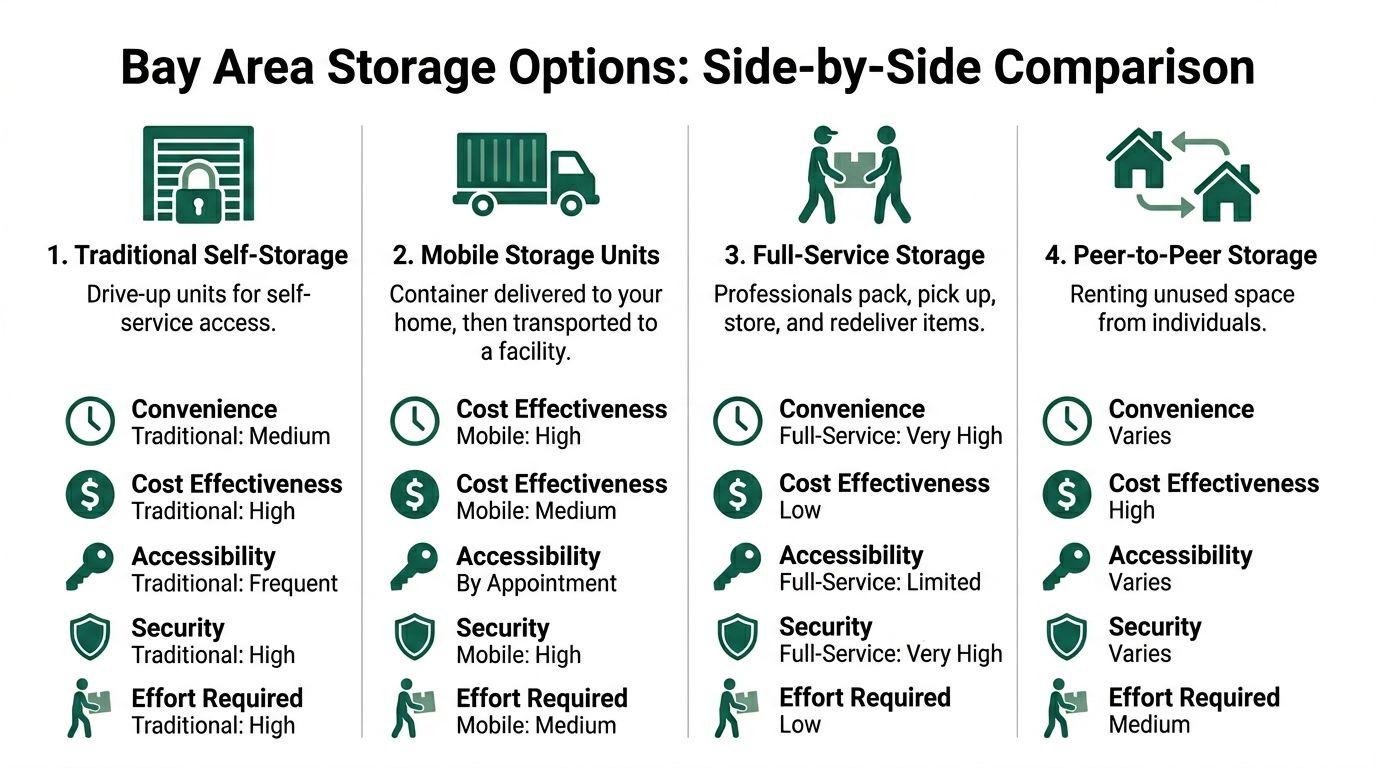
Traditional self-storage vs by-the-box storage
| Factor | Traditional Self-Storage | By-the-Box Storage (e.g., Endless Storage) |
|---|---|---|
| Best for | Furniture, bulky items, large move transitions, business stock | Seasonal items, books, documents, clothing, apartment overflow |
| How you pay | For a whole unit, whether full or not | For the boxes or items you store |
| Access style | You drive to the facility and retrieve items yourself | You request returns rather than visiting a unit |
| Labor required | Higher. Packing, hauling, loading, unloading | Lower. Better for people without a car or with limited time |
| Space efficiency | Can be poor if your unit is partly empty | Usually better for small storage loads |
| Good fit for frequent visits | Yes | Usually not the first choice |
| Good fit for minimalists and small apartments | Sometimes, if items are bulky | Often, if items are compact and well packed |
| Decision risk | Over-renting space | Underestimating how often you want immediate access |
Use cases that make the choice obvious
A few scenarios make the trade-off clearer.
Choose traditional self-storage if you are between apartments and need to hold the contents of a one-bedroom, including furniture. A unit handles volume and awkward item shapes better than a box-based service.
Choose traditional self-storage if you run a side business that needs regular physical retrieval. If you are in and out of storage often, direct facility access is valuable.
Choose by-the-box if your apartment is overrun by medium-size stuff. Coats, files, books, decor, kitchen gear, and sentimental items are exactly where this model shines.
Choose by-the-box if you do not own a car. The hassle of reaching a facility alters the true cost, even when the advertised monthly rate looks reasonable.
Think in usable space, not listed size
Here, people make better decisions. They stop thinking in unit labels and start thinking in actual item mix.
Ask yourself:
- Am I storing furniture or just boxed belongings?
- Do I need access often, or just occasionally?
- Will I use most of the paid space?
- Is transport the hardest part of this project?
- Would I rather pay for flexibility or for unrestricted physical access?
Key takeaway: Traditional units sell space. By-the-box services sell selectivity and convenience. The true value depends on which one you need more.
The monthly bill isn't the sole hidden cost in the Bay Area. Sometimes it is the Saturday you lose to traffic, loading, elevator runs, and unloading a unit that is only half full.
Practical Tips for Packing and Accessing Your Items
A cramped Mission apartment can turn one bad packing choice into months of irritation. If the box with your tax folder ends up under lamps, winter coats, and a kitchen appliance you forgot you owned, the storage price stops being the primary problem.
Packing determines whether your storage plan stays efficient. It also affects your true cost per cubic foot. Sloppy packing wastes paid space in a traditional unit, and it increases retrieval friction if you use a by-the-box service.
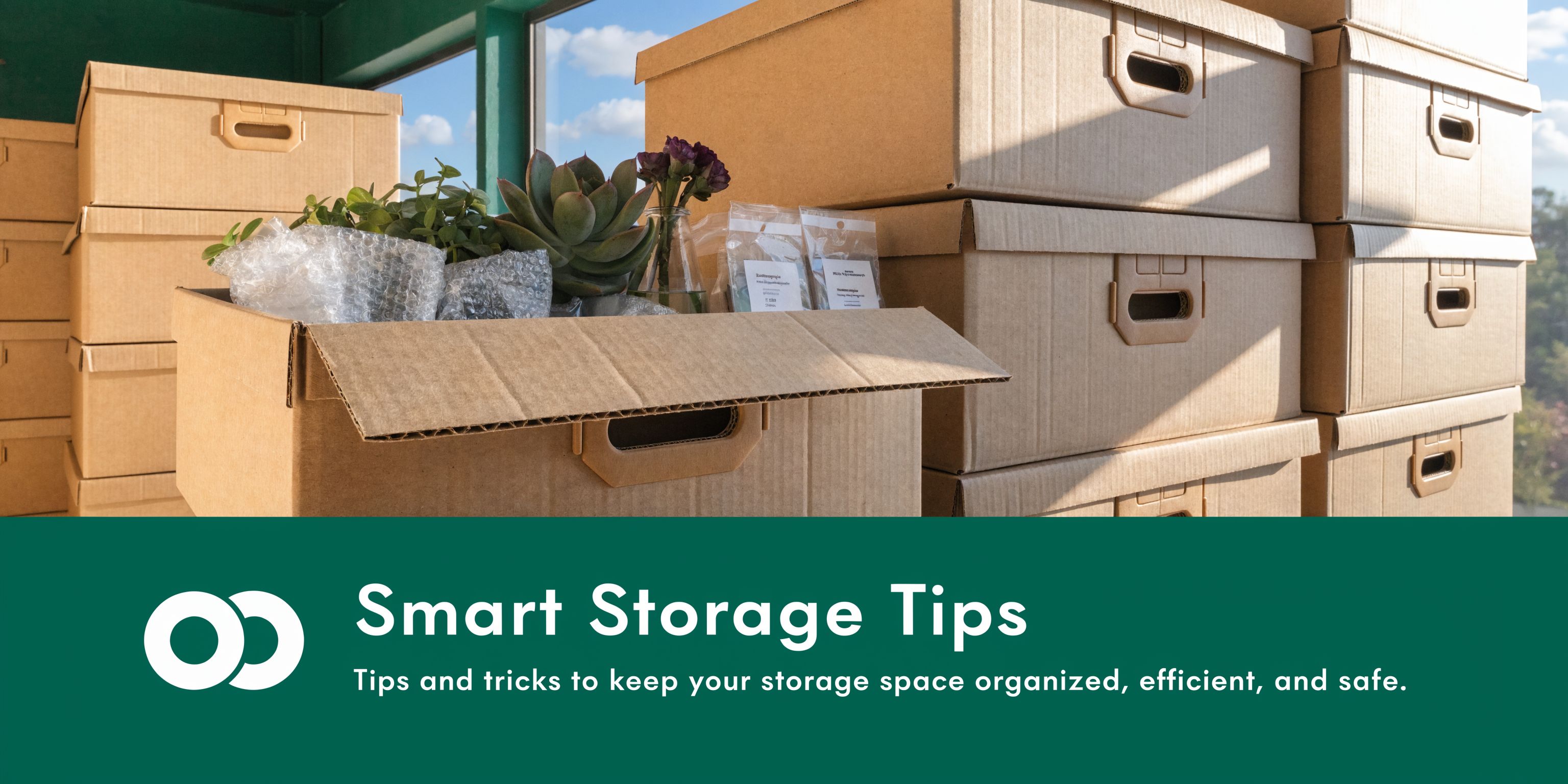
Build a simple system before you tape the first box
Keep the system boring and repeatable. That is what works when you are tired, short on space, and packing after work.
Use this setup:
- Number each box: Box 1, Box 2, Box 3.
- Photograph contents before sealing: One quick overhead photo usually does the job.
- Create a matching list on your phone: Note the box number and broad contents.
- Label two sides, not just the top: You can still identify boxes once they are stacked.
- Group by retrieval timing: Move-out supplies, tax records, winter wear, holiday decor.
If you are unsure how much space your stuff will use, this storage unit size calculator helps you estimate volume before you buy too much unit space or overcommit to box counts.
If you want a practical starter checklist, https://www.endless-storage.com/free-moving-box-packing-guide-checklist is worth bookmarking before you pack.
Pack for retrieval, not just compression
People in small Bay Area apartments often pack to clear floor space fast. That solves today's mess and creates next season's headache.
Dense packing is useful only if you can still get to what matters. A full 5x5 unit with no aisle can be cheaper on paper than a by-the-box plan, but that math falls apart if every retrieval requires unloading half the front row. The same rule applies to box services. If every box is labeled "office" or "misc," convenience disappears.
Better rules:
- Books go in small boxes: Heavy boxes split and are miserable to carry down stairs.
- Linens and clothes can fill larger boxes: They stay light and cushion odd shapes.
- Fragile kitchenware needs padding and separation: Wrap items, then fill gaps so they do not knock together.
- Electronics should travel with cables labeled: Keep cords in a zip bag inside the same box.
- Do not create mystery boxes: Use labels you will understand six months from now.
Leave a little air in each plan. In a storage unit, that means a narrow access path or one clearly marked front zone for items you may need sooner. In a by-the-box service, it means keeping likely retrieval items in their own boxes instead of spreading them across three half-organized ones.
This short video gives a solid visual refresher on packing basics before a move or storage reset:
Frequently Asked Questions
Unveiling the Secrets to Effortless Storage
Endless Storage is available nationwide. You pick a plan, tell us where to pickup, and we'll send a UPS van to collect, whichever state you're in.
Your shipping label will be sent to your email within a few minutes, if not instantaneously. It can also be accessed through your customer profile.
Your box will be shipped to one of our climate controlled self storage facilities in our closest self storage facility. Our manager will accept your package, notify you that your box has been received, and securely stored. Only our managers will have access to Endless Storage boxes.
Email us at admin@endless-storage.com click to live chat with us, or send us a message below.
Never! We're committed to transparent pricing with no surprises. You'll lock in your rate with no hidden fees and no long-term contracts.
Fast access guaranteed! Your boxes will arrive at your doorstep within 48 hours of requesting them back. Need to check on delivery? We provide tracking information for complete peace of mind.
Totally flexible! Store month-to-month with no long-term commitment and cancel anytime.
Everything's online! Use your account dashboard to:
• Set up automatic monthly payments
• Request box returns
• Update your address
• Order additional boxes
• Track shipments
Your boxes are insured up to $100 each. Our customer service team will help you file any necessary claims and resolve issues quickly.
Don't worry – we'll email you right away if there's a payment issue. Your items stay safe, though you may have temporary service interruption or late fees until payment is resolved.
When you request our free storage kits, you'll have 30 days to send in your boxes to activate your 3 months of free storage. Think of it like starting a gym membership – your activation window begins when you receive your kits, and your full free trial begins once you send in your first box. During your free months, you'll experience our complete storage service at no cost.
Your 30-day activation window begins when you receive your storage kits. We'll send you an email confirmation when your kits are delivered, marking the start of your activation period.
If you haven't sent any boxes for storage within your 30-day activation window, your free trial will expire and we'll begin charging the regular monthly rate of $9.99 per box. This helps ensure our storage kits go to customers who are ready to use our service.
A box costs $9.99 per month to store (plus sales tax). This price includes free shipping for standard boxes under 50 lbs. and smaller than 16"x16"x16"
Log into your Endless Storage account, locate the box you would like returned, and simply click Return My Box.
Yes, each box stored with us is insured for up to $100 throughout transit as well as the duration of storage within our facilities.
Your box will be at your doorstep within 48 hours of you requesting it back.
Store 10+ boxes? We'll pick them up for free! After your purchase, we'll contact you to schedule a convenient pickup time and arrange UPS collection.
We trust UPS with all shipments, and every box includes $100 insurance coverage. You'll receive tracking information to monitor your items' journey.
Yes! Visit any of our locations by appointment. Just bring a photo ID matching your customer profile.
For everyone's safety, we can't store hazardous materials, firearms, or perishables. All items must fit within our standard boxes.
It's easy! Order your storage kit online, and we'll ship it to you within 1-2 business days. Your shipping labels will be emailed instantly and available in your account.
We're here to help! Email us at admin@endless-storage.com, use our live chat, or send us a message through your account.
To cancel your storage service with Endless Storage, please email your cancellation request to admin@endless-storage.com. Our team will process your request within 2 business days and confirm your cancellation via email.
We understand packing takes time. However, to maintain your free trial benefits, you'll need to send at least one box within the 30-day activation window. If you need more time, you can always start with one box to activate your trial and send the rest later. You can always reach out to admin@endless-storage.com if you have any issues or concerns.
When you request our free storage kits, you're starting a 30-day window to begin using our storage service.
Important: To activate your free trial, send at least one box for storage within 30 days. If no boxes are sent within this 30-day window, a one-time $50 fee applies to cover materials and shipping costs. This fee is clearly disclosed before you sign up.
Think of it like reserving a hotel room – we're setting aside space and sending specialized packing materials for your use. The fee only applies if you request materials but don't begin storage, similar to a hotel's no-show charge.