You're probably dealing with common basement apartment problems. One room has to do everything. The light feels flat no matter how many lamps you add. The ceiling seems lower after you move furniture in, and once a few storage bins, extra blankets, and laundry baskets pile up, the whole place starts reading more like overflow space than home.
That's the turning point for most successful basement apartment decorating ideas. You stop treating the apartment like a compromised version of an upstairs unit and start designing it for what it is. Basements often have little natural light and low ceilings, so the best results usually come from layered lighting, lighter finishes, mirrors, and clear room zones, as noted in Emily Henderson's basement design guidance. The good news is that modern basement styling has shifted toward making these spaces feel like a true extension of the home, not just a place to stash leftovers from the rest of the house.
That shift matters because decorating works best when it's tied to comfort, storage, and daily function. If you're trying to make your place feel better without overspending, this affordable living room makeover guide is a helpful companion.
Here are eight practical, budget-aware ways to make a basement apartment feel brighter, calmer, and far more intentional.
1. Minimalist Organization and Decluttering Methodology
Most basement apartments don't look bad because of the decor. They look crowded because too many things are competing for too little visual space. If you want the room to feel taller, cleaner, and more finished, start by removing what doesn't need to live there.
That's especially important in a below-grade apartment where residents often end up storing transition-period belongings, seasonal gear, or moving leftovers. In recent Census estimates, about 13% of households moved in the prior year, and renters move more often than homeowners. In real life, that means clutter isn't always laziness. It's often the result of living in between stages.
Start with visible pressure points
Don't begin with sentimental boxes or packed closets. Start with the surfaces and corners that make the apartment feel busy the second you walk in. Entry piles, open shelving, the top of a dresser, and the floor around the bed usually give you the fastest visual payoff.
I like a three-way sort: keep, remove, and maybe. The maybe box is useful because it stops decision fatigue from killing momentum. Seal it, date it, and revisit it later.
Practical rule: If an item makes the room harder to clean, harder to use, or harder to relax in, it needs a stronger reason to stay.
Use storage as part of decorating
Good basement apartment decorating ideas always include subtraction. A room can't feel styled if it's doing the job of a backup garage. Keep daily-use items inside the apartment and move low-use items out of the visual field, or off-site entirely.
A step-by-step small apartment decluttering guide can help you build that process without trying to purge everything in a weekend.
A few tactics work especially well:
- Limit duplicates: Keep one favorite version when possible, especially for mugs, throw blankets, workout gear, and miscellaneous baskets.
- Use clear bins selectively: They're helpful in closets and utility areas, but too many visible clear bins make a living area feel like storage.
- Set a re-entry rule: For every new decorative item that comes in, remove or rotate something else out.
Minimalism in a basement apartment shouldn't feel severe. It should feel breathable.
2. Light and Brightness Enhancement Through Strategic Lighting
Lighting changes a basement faster than paint, art, or furniture ever will. If the apartment feels gloomy at noon, a single ceiling fixture won't fix it. You need layers that spread light across the room, not just downward.
The practical benchmark I use comes from residential lighting guidance. Typical living spaces are often designed around roughly 100 to 300 lux for general ambient use, with higher task lighting where needed. In a basement, reaching that feel usually takes more than one source.
Build the room in layers
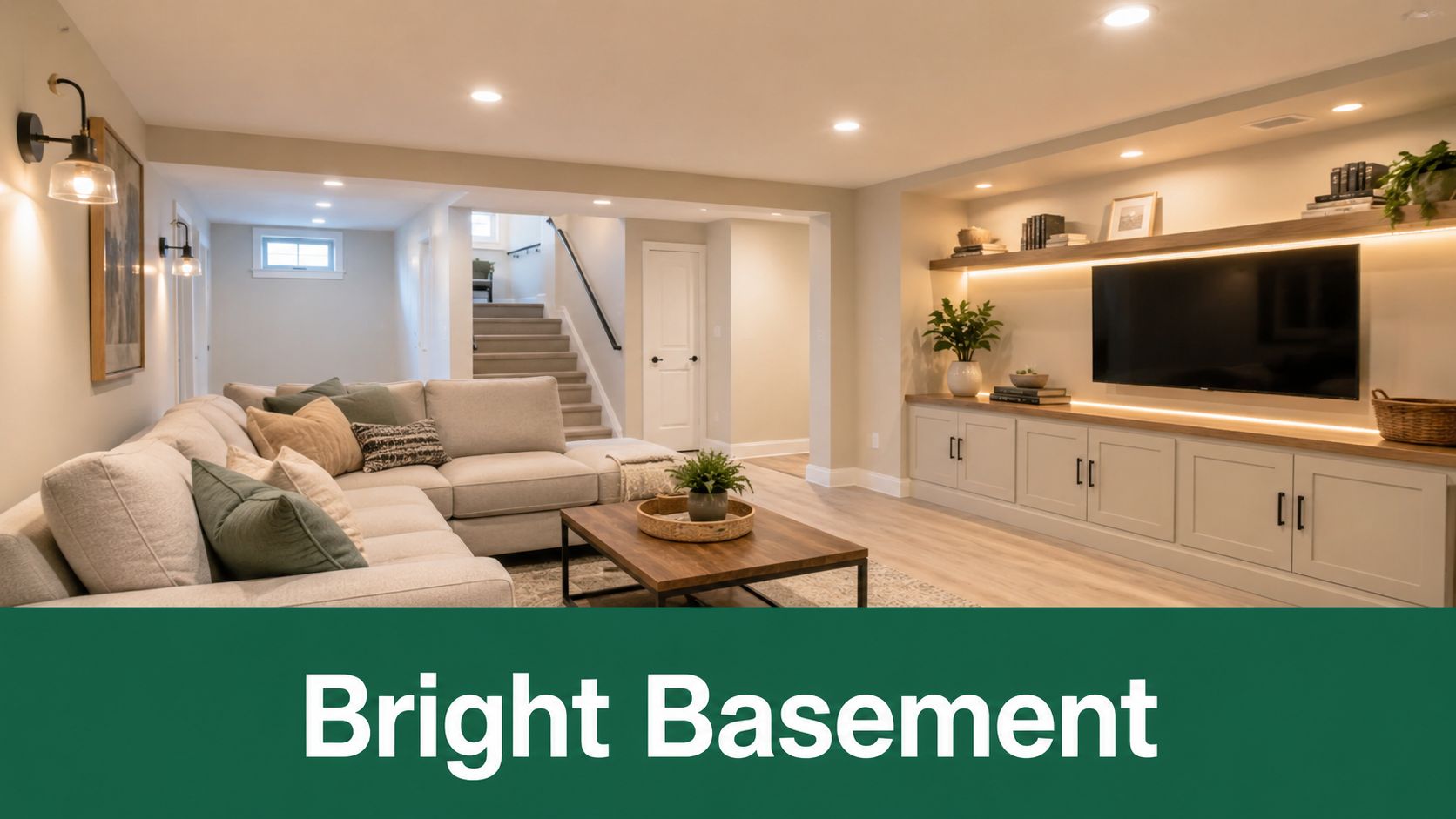
Start overhead, then move outward. A flush-mount LED ceiling fixture or recessed lights handle ambient light. After that, add a floor lamp near seating, a table lamp at a side table or dresser, and task lighting anywhere you read or work.
Warm white bulbs around 3000K usually make a basement feel more welcoming than cooler tones. Cool white can make concrete tones, gray flooring, and builder-white walls feel harsher.
Here's what tends to work best:
- Ambient light first: Use a broad, diffused ceiling fixture instead of a spotlight-style center light.
- Task light second: Add a focused lamp at a desk, bedside table, or reading chair.
- Accent light third: Use LED strips on shelves or behind a headboard for depth and softness.
A solid basement lighting guide from Northpoint Construction is useful if you're comparing fixture types and placement ideas.
What doesn't work
More wattage isn't the same as better lighting. Overly bright bulbs in one fixture often create glare and deep shadows, which makes a low-ceiling room feel smaller. The fix is spread, not intensity.
Light the edges of the room, not just the center. Basements feel larger when the perimeter is bright.
Mirrors help here too, but only if they reflect a light source or a clean view. A mirror pointed at clutter doubles clutter.
3. Color Psychology and Paint Selection for Depth and Mood
Paint in a basement has one job above all else. It needs to help the room hold light. That doesn't mean every wall has to be stark white. In fact, overly cold white can make a basement feel flatter and more institutional.
Warmer light neutrals, soft greiges, muted taupes, and gentle off-whites usually perform better. Emily Henderson's guidance also leans toward warmer wall colors for basements because they help soften the darkness these spaces naturally have. That tracks with what I see in real rooms. A warm white with a little body feels friendlier than a blue-white with too much contrast.
Pick colors that cooperate with basement light
Test paint on at least two walls, not just a sample card. Basement lighting changes dramatically depending on lamp temperature, flooring tone, and how much natural light reaches the room. A color that looks airy under store lighting can go muddy once it's below grade.
A few reliable approaches:
- Warm white walls: Good for small apartments with mixed-use furniture and limited window light.
- Soft beige-greige: Better if the basement has gray flooring or exposed concrete tones that need warming up.
- Muted color accents: Dusty blue, sage, clay, or mushroom work better than saturated jewel tones in tight spaces.
For finish, eggshell often gives the best balance in living areas. It reflects a bit of light but won't emphasize every wall imperfection the way glossier paint can.
Don't ignore the ceiling
If the ceiling is low, paint it a slightly lighter shade than the walls. That subtle shift can make the upper plane recede. Painting everything the same dark color might look dramatic online, but in a basement apartment it usually closes the room in unless the space already has strong lighting and generous ceiling height.
If you want a second opinion on how paint affects perceived size, Newline Painting's guide to making rooms look bigger with wall paint offers practical visual cues.
The biggest mistake is choosing paint before fixing the lighting plan. In basements, those two decisions belong together.
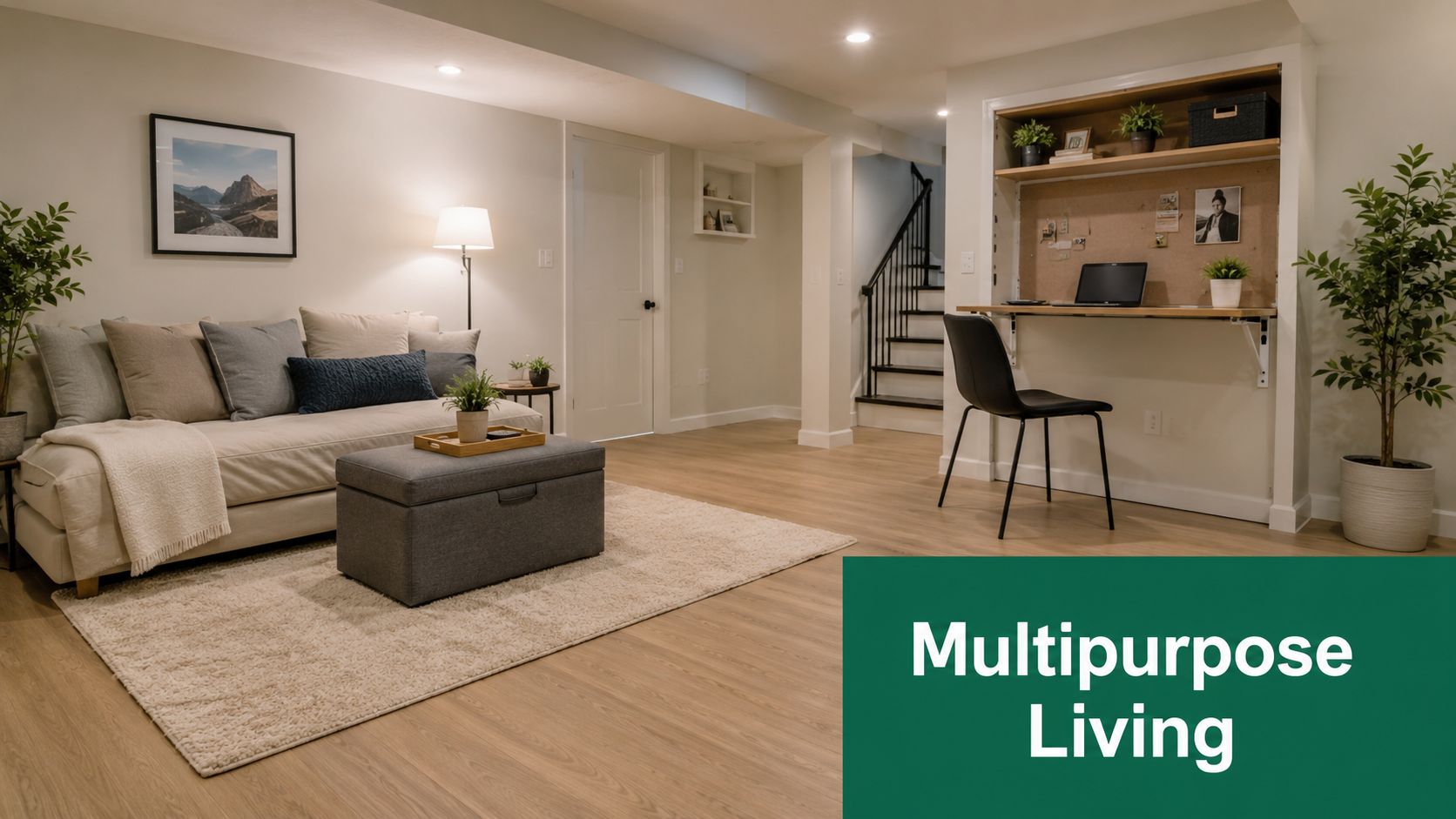
4. Multipurpose Furniture and Clever Spatial Zoning
A basement apartment works better when furniture does double duty. Not because that sounds efficient, but because every large piece takes up visual and physical territory. If one item can handle two jobs well, you buy back breathing room.
Many basement apartment decorating ideas succeed or fail based on how furniture is chosen. People often choose furniture based on style first, then realize the sofa blocks circulation, the desk takes over the sleeping area, or the bed leaves no room for guests. The smarter move is to assign zones before you shop.
Create zones without building walls
In open basement layouts, I usually define three things first: where you sleep, where you lounge, and where you work or eat. Then I use furniture placement, lighting, and rugs to separate them.
A loveseat with a narrow profile often works better than a bulky sectional. A storage ottoman can function as a coffee table, hidden storage, and extra seating. A wall-mounted drop-leaf desk is often a better basement choice than a full freestanding desk.
These moves help:
- Float furniture when possible: Pulling the sofa slightly off the wall can create a more intentional living zone.
- Use rugs as boundaries: One rug under the bed area and another in the seating zone creates structure without adding clutter.
- Choose leggy furniture: Pieces with visible space underneath tend to feel lighter than blocky, skirted forms.
Flexibility matters more than perfection
If your apartment has to shift between workday, movie night, overnight guest space, and laundry overflow, rigid furniture plans don't last. Pieces on casters, nesting tables, fold-out dining surfaces, and modular shelving earn their keep.
For compact layouts, space-saving furniture ideas can help you find pieces that solve multiple problems at once.
The room should be able to change without looking like you're constantly rearranging your life.
What doesn't work is stuffing every wall with furniture. A basement feels better when at least one path through the room stays visually open.
5. Vertical Storage and Wall-Mounted Solutions
When floor space is tight, the wall becomes part of the floor plan. That's the basic rule. If your storage is spreading outward instead of upward, the apartment will keep feeling smaller no matter how nice the decor is.
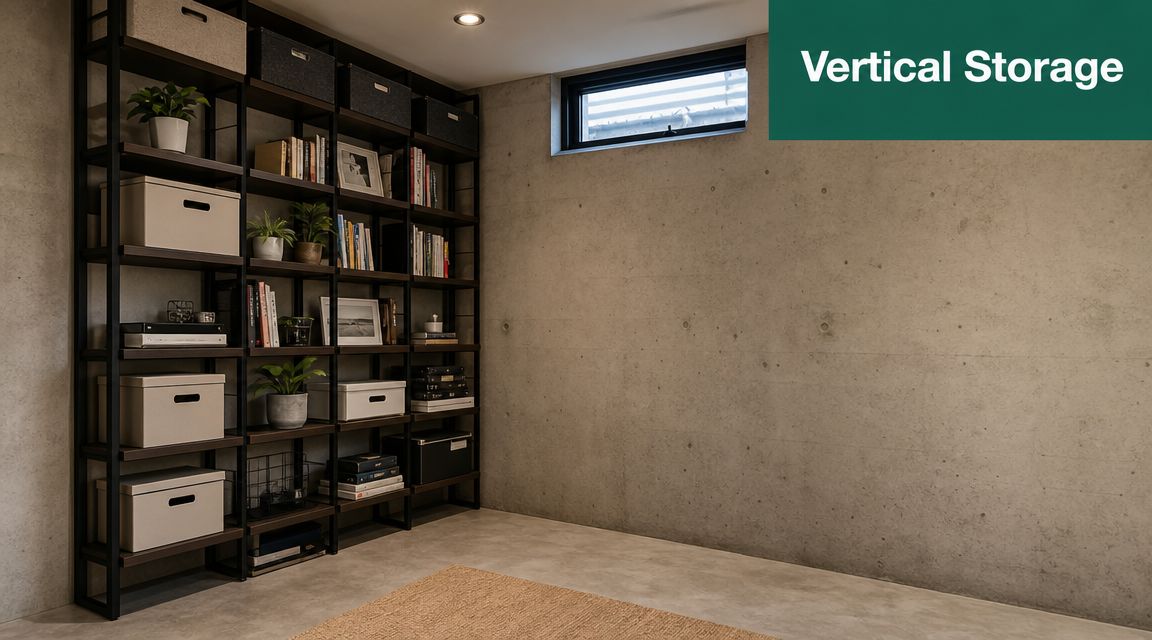
Vertical storage is also one of the best ways to make a basement apartment look intentional. Freestanding piles look temporary. Mounted shelves, consistent containers, and defined storage bands look designed.

Think in bands, not scattered shelves
Instead of adding one random shelf wherever clutter appears, create a clear storage zone. A row of floating shelves above a desk, matching wall hooks at the entry, or a tall bookcase anchored in one corner reads cleaner than lots of small interruptions around the room.
Keep shelf styling simple. In a basement apartment, shelves should carry mostly useful items, with a few decorative pieces mixed in. Too many tiny objects create visual static.
A good wall-storage mix usually looks like this:
- Closed storage up high: Matching boxes or baskets for paperwork, cords, and seasonal extras.
- Open storage at eye level: Books, a plant, framed art, or attractive daily-use pieces.
- Utility storage low: Hooks, bins, or cabinets for bags, shoes, and heavy-use items.
Store less on-site
Many individuals often overlook the larger organizational system. Wall storage helps, but it shouldn't become an excuse to keep every backup item in the apartment. Seasonal decor, extra linens, old files, off-season clothes, and rarely used keepsakes don't need prime wall real estate.
If you want shelves that look polished instead of overloaded, these DIY floating shelf ideas are a good starting point.
One more trade-off worth mentioning: open shelving looks great when you're disciplined. If you know you're not going to edit it regularly, a slim cabinet with doors may serve you better than another set of display shelves.
6. Strategic Use of Mirrors to Expand Visual Space
Mirrors are one of the oldest basement fixes because they still work. Design guidance for basement spaces consistently recommends mirrors to reflect light and help darker rooms feel more open, especially when natural light is limited, as noted in DesignThusiasm's basement decorating advice.
The mistake is using them casually. A mirror only improves the room if it reflects something worth seeing.
Put mirrors where they multiply light
The best location is usually opposite or adjacent to a strong light source. That might be a lamp cluster, a window, or the brightest open wall in the apartment. A large floor mirror leaned behind a seating area can bounce light across the room. A tall mirror near the entry can make a narrow circulation path feel less compressed.
Try these placements:
- Across from a lamp grouping: This spreads brightness deeper into the room.
- Near a dining or desk nook: It helps break up dead wall space and adds depth.
- At the end of a short hallway: It can make a tight basement transition zone feel less boxed in.
What to avoid
Don't place mirrors directly across from open storage, laundry clutter, or a tangle of cords behind the TV. They double visual noise. Also be careful with too many small mirrors unless you're creating an intentional gallery composition. Random reflective pieces can feel fussy in a low-light room.
A larger single mirror often does more than a cluster of decorative ones. Thin black, wood, or brass frames usually blend easily with most basement styles, from modern to transitional.
A mirror should solve a problem. More light, more depth, or a better focal point. If it does none of those, it's just another object on the wall.
If you want the room to feel calmer, one strong mirror beats three mediocre ones almost every time.
7. Soft Furnishings, Textiles, Cozy Layering, and Natural Elements
You can feel the difference the moment a basement apartment gets its soft layers right. The room stops reading as leftover square footage and starts feeling like a home. The catch is that every rug, curtain, and throw also becomes one more surface that can trap dampness, dust, and odor.
Start with the room conditions before you buy anything decorative. If the apartment still feels humid, fix that first with ventilation or a dehumidifier, then add textiles. Soft finishes work best as the final layer of a system, not the solution to a comfort problem.
Pick fabrics and fibers that match basement conditions
In below-grade spaces, easy care usually beats delicate beauty. I often steer clients away from thick shag rugs, puddled curtains, and absorbent padding unless the basement is consistently dry year-round. A low-pile washable rug, a flatweave, or an indoor-outdoor style often looks cleaner longer and is much easier to maintain.
A few reliable choices:
- Washable low-pile rugs: Easier to clean after tracked-in moisture, pet messes, or that faint musty smell basements can develop.
- Performance upholstery fabrics: A smart choice for sofas, dining chairs, and headboards in rooms with less airflow.
- Moisture-resistant rug pads: Better than felt-style pads that hold onto dampness.
- Lined curtains with a light drape: Enough softness for comfort, without the bulk of heavy panels.
This is also the point where decluttering supports design. If extra blankets, hobby supplies, or display pieces are overflowing into baskets and corners, the room will feel heavy no matter how nice the textiles are. Keeping only the pieces you use weekly gives the apartment more breathing room, and storing delicate keepsakes properly helps preserve them. This guide on how to store collectibles safely and neatly is useful if decorative items are competing with everyday comfort.
Layer texture with restraint
Basements usually need softness, but they do not need volume everywhere. One rug, one throw, and two or three well-chosen pillows often do more than a sofa buried under layers. Mix texture instead of quantity. Linen, cotton knit, boucle, woven grasscloth accents, cane, light wood, and matte ceramics all warm up the room without adding visual bulk.
Natural elements help, too. A wood side table, a woven tray, or a ceramic lamp base can offset the harder surfaces common in basement apartments. If you use baskets, choose them for edited storage, not overflow storage. Once baskets become catch-alls, the room starts sliding back into clutter.
Plants are worth using, but be realistic about the light. Pothos, ZZ plant, and snake plant tend to handle basement conditions better than fussier varieties. If natural light is limited, add a simple grow light and treat it like part of the lighting plan, not an afterthought.
8. Art, Decor, and Personal Expression Through Curated Collections
A basement apartment can be clean, bright, and organized and still feel generic. That usually happens when everything functional is in place, but nothing tells you who lives there. Art fixes that faster than almost any other finishing layer.
The key word is curated. You don't need to fill every wall. In a basement, too many small decorative decisions can make the room feel crowded again.
Make the walls feel intentional
Start with one anchor area. That might be above the sofa, above the bed, along a stair wall, or in the dining nook. Build around a small set of meaningful pieces rather than buying filler art just to occupy space.
A strong mix might include:
- Personal photography: Black-and-white prints, travel photos, or family images in matching frames.
- Textural art: Fabric hangings, framed textiles, or simple relief pieces that add softness.
- Graphic prints: Abstracts, line drawings, or vintage posters that give the room a focal point.
Keep the frame finish consistent if you want calm. Mix styles more freely if you want the room to feel layered and collected.
Display collections with discipline
Collectibles and sentimental objects can absolutely belong in a basement apartment. They just need boundaries. One shelf, one cabinet top, or one picture ledge usually reads far better than spreading keepsakes across every surface.
That matters even more in small spaces, where every decorative item also competes with storage needs. If you have collections that matter to you but don't need to be out all year, rotate them. The apartment stays personal without getting visually overloaded.
For delicate or seasonal display pieces, this guide on how to store collectibles can help you protect what you're not actively displaying.
The best art choices in basements usually do one of two things. They add energy to a room that lacks architectural character, or they add warmth to a room that already feels spare and functional. Either way, they finish the story.
8-Point Basement Apartment Decor Comparison
| Strategy | Implementation Complexity 🔄 | Resource Requirements ⚡ | Expected Outcomes 📊 / Quality ⭐ | Ideal Use Cases 💡 | Key Advantages ⭐ |
|---|---|---|---|---|---|
| Minimalist Organization & Decluttering | High, deep, iterative process 🔄 | Low financial cost; high time/emotional investment ⚡ | Dramatically increased perceived space; sustained clarity 📊 ⭐⭐⭐⭐ | Small basements needing space optimization and habit change 💡 | Maximizes space, reduces stress, easier maintenance |
| Light & Brightness Enhancement | Medium, layered planning & wiring 🔄 | Moderate cost; may require professional installation ⚡ | Significant brightness and mood improvement 📊 ⭐⭐⭐⭐ | Windowless or dim basements needing atmosphere boost 💡 | Transforms ambiance; energy-efficient LED options |
| Color Psychology & Paint Selection | Low–Medium, prep and testing 🔄 | Affordable materials; may need moisture-resistant primer ⚡ | Improved light reflection and cohesive base 📊 ⭐⭐⭐ | Small spaces where visual expansion is desired 💡 | High ROI; amplifies light; customizable accents |
| Multipurpose Furniture & Spatial Zoning | Medium, measurement and layout planning 🔄 | Moderate–high cost for quality pieces; planning time ⚡ | Maximized functionality; clear zoned areas 📊 ⭐⭐⭐⭐ | Studio/open-plan basements requiring multi-use solutions 💡 | Saves floor space; flexible arrangements |
| Vertical Storage & Wall-Mounted Solutions | Medium, anchoring and configuration 🔄 | Moderate materials; possible pro install for concrete walls ⚡ | Greatly increased storage capacity without floor loss 📊 ⭐⭐⭐⭐ | Limited floor area needing visible organization 💡 | Maximizes storage; keeps items accessible and visible |
| Strategic Use of Mirrors | Low, placement or simple mounting 🔄 | Low–moderate cost; secure mounting for large mirrors ⚡ | Instant sense of space and brightness boost 📊 ⭐⭐⭐ | Narrow or windowless rooms needing depth and light 💡 | Affordable, quick visual expansion; versatile styles |
| Soft Furnishings, Textiles & Natural Elements | Low, styling and upkeep 🔄 | Low–moderate ongoing cost; maintenance required ⚡ | Warmer, cozier environment; improved acoustics 📊 ⭐⭐⭐ | Cold or sterile basements needing comfort and texture 💡 | Adds warmth, sound absorption, seasonal flexibility |
| Art, Decor & Curated Personal Expression | Low–Medium, curation and hanging 🔄 | Variable cost (prints to originals); time for selection ⚡ | Personalized, engaging space with focal points 📊 ⭐⭐⭐ | Tenants wanting identity without major renovation 💡 | Adds personality; easy to rotate and update |
Creating a Home You Love, Below Ground
Decorating a basement apartment goes better when you stop treating each decision like a separate fix. The room doesn't improve because you bought a nicer lamp, found a better rug, or added one mirror. It improves when lighting, layout, storage, paint, and daily habits start working together.
That system-based approach matters more in a basement than almost anywhere else. Below-grade apartments ask more from every choice. Light has to be layered because daylight is limited. Storage has to be edited because square footage disappears quickly. Soft furnishings have to feel cozy without creating a damp, overloaded environment. Even wall color has to cooperate with the lighting plan if you want the room to feel open.
That's why the best basement apartment decorating ideas usually start with subtraction. Clear the clutter. Move low-use items out. Decide what the apartment needs to do every day before you start styling it. Once the room is carrying only the things you use and love, every decorative decision gets easier.
From there, focus on the highest-impact upgrades first. Improve brightness with layered lighting. Choose paint that adds warmth instead of flattening the room. Use furniture to create zones, not barriers. Take storage vertical so the floor can breathe. Add mirrors with purpose. Then layer in textiles, natural elements, and art once the practical issues are under control.
There are real trade-offs in basement decorating, and it helps to be honest about them. Open shelving looks great, but only if you're willing to edit it. Plush textiles feel cozy, but only if the room is dry enough to support them. Oversized furniture may be comfortable, but it can make a low-ceiling apartment feel compressed. Good design in a basement isn't about ignoring those trade-offs. It's about choosing the version that supports how you live.
The encouraging part is that basement apartments respond quickly to smart changes. A cleaner layout, better light spread, fewer visible belongings, and more deliberate color can shift the entire mood of the space without a full renovation. The room starts feeling less temporary, less apologetic, and much more like home.
If your apartment has felt dark, cramped, or hard to pull together, that doesn't mean it lacks potential. It usually means the space needs a better system. Build that first, and the style follows.
If your basement apartment feels crowded because you're trying to live and store everything in the same footprint, Endless Storage is a practical way to fix that. Their storage-by-the-box model works especially well for city renters, people between moves, and anyone rotating seasonal items, extra blankets, decor, or collectibles out of a small apartment. Instead of cramming seldom-used belongings into closets and corners, you can keep your space lighter, cleaner, and easier to decorate while still having access to the things you want to keep.
Frequently Asked Questions
Unveiling the Secrets to Effortless Storage
Endless Storage is available nationwide. You pick a plan, tell us where to pickup, and we'll send a UPS van to collect, whichever state you're in.
Your shipping label will be sent to your email within a few minutes, if not instantaneously. It can also be accessed through your customer profile.
Your box will be shipped to one of our climate controlled self storage facilities in our closest self storage facility. Our manager will accept your package, notify you that your box has been received, and securely stored. Only our managers will have access to Endless Storage boxes.
Email us at admin@endless-storage.com click to live chat with us, or send us a message below.
Never! We're committed to transparent pricing with no surprises. You'll lock in your rate with no hidden fees and no long-term contracts.
Fast access guaranteed! Your boxes will arrive at your doorstep within 48 hours of requesting them back. Need to check on delivery? We provide tracking information for complete peace of mind.
Totally flexible! Store month-to-month with no long-term commitment and cancel anytime.
Everything's online! Use your account dashboard to:
• Set up automatic monthly payments
• Request box returns
• Update your address
• Order additional boxes
• Track shipments
Your boxes are insured up to $100 each. Our customer service team will help you file any necessary claims and resolve issues quickly.
Don't worry – we'll email you right away if there's a payment issue. Your items stay safe, though you may have temporary service interruption or late fees until payment is resolved.
When you request our free storage kits, you'll have 30 days to send in your boxes to activate your 3 months of free storage. Think of it like starting a gym membership – your activation window begins when you receive your kits, and your full free trial begins once you send in your first box. During your free months, you'll experience our complete storage service at no cost.
Your 30-day activation window begins when you receive your storage kits. We'll send you an email confirmation when your kits are delivered, marking the start of your activation period.
If you haven't sent any boxes for storage within your 30-day activation window, your free trial will expire and we'll begin charging the regular monthly rate of $9.99 per box. This helps ensure our storage kits go to customers who are ready to use our service.
A box costs $9.99 per month to store (plus sales tax). This price includes free shipping for standard boxes under 50 lbs. and smaller than 16"x16"x16"
Log into your Endless Storage account, locate the box you would like returned, and simply click Return My Box.
Yes, each box stored with us is insured for up to $100 throughout transit as well as the duration of storage within our facilities.
Your box will be at your doorstep within 48 hours of you requesting it back.
Store 10+ boxes? We'll pick them up for free! After your purchase, we'll contact you to schedule a convenient pickup time and arrange UPS collection.
We trust UPS with all shipments, and every box includes $100 insurance coverage. You'll receive tracking information to monitor your items' journey.
Yes! Visit any of our locations by appointment. Just bring a photo ID matching your customer profile.
For everyone's safety, we can't store hazardous materials, firearms, or perishables. All items must fit within our standard boxes.
It's easy! Order your storage kit online, and we'll ship it to you within 1-2 business days. Your shipping labels will be emailed instantly and available in your account.
We're here to help! Email us at admin@endless-storage.com, use our live chat, or send us a message through your account.
To cancel your storage service with Endless Storage, please email your cancellation request to admin@endless-storage.com. Our team will process your request within 2 business days and confirm your cancellation via email.
We understand packing takes time. However, to maintain your free trial benefits, you'll need to send at least one box within the 30-day activation window. If you need more time, you can always start with one box to activate your trial and send the rest later. You can always reach out to admin@endless-storage.com if you have any issues or concerns.
When you request our free storage kits, you're starting a 30-day window to begin using our storage service.
Important: To activate your free trial, send at least one box for storage within 30 days. If no boxes are sent within this 30-day window, a one-time $50 fee applies to cover materials and shipping costs. This fee is clearly disclosed before you sign up.
Think of it like reserving a hotel room – we're setting aside space and sending specialized packing materials for your use. The fee only applies if you request materials but don't begin storage, similar to a hotel's no-show charge.