Sooner or later, it happens to almost everyone: you run out of room. Whether it's a slow creep of clutter or a sudden life change, that feeling of being squeezed out of your own home is universal. The good news is, finding additional self storage is easier than ever, but your options have grown. This guide will walk you through everything from traditional units to newer, by-the-box services.
Why You Might Need Additional Self Storage

The hunt for more space rarely comes out of nowhere. It usually starts with a specific life event or just the slow-and-steady accumulation of things we love. As our lives evolve, our belongings can quickly outgrow the closets, basements, and corners we have to work with.
This is especially true if you live in a city. Apartments seem to be getting smaller while the cost per square foot skyrockets, making every inch of space precious. Finding a home for seasonal gear, hobby equipment, or family heirlooms often means looking for a solution outside your four walls.
Common Triggers for Needing More Space
The reasons people look for storage are as varied as the items they put in it. Still, a few common situations pop up time and time again:
- Downsizing: Moving into a smaller home is probably the number one reason people suddenly need to store furniture, appliances, and boxes of memories—either for a little while or for the long haul.
- Urban Living: City dwellers know the struggle. Limited square footage makes it nearly impossible to keep bulky items like winter sports gear, holiday decorations, or an extra bike at home.
- Life Transitions: Big life events—getting married, welcoming a baby, or moving in with a partner—often mean you end up with two of everything. A storage solution gives you a place to put the duplicates.
- Decluttering Projects: Sometimes, you just want to create a more minimalist, organized home. Storage lets you do that without having to part with meaningful possessions for good.
The sheer scale of this need is mind-boggling. The U.S. self-storage industry has ballooned into a powerhouse, pulling in an estimated $39.5 billion in annual revenue. With over 51,000 facilities across the country—more than all Starbucks, McDonald's, and Subway locations combined—it's obvious that needing extra room is a fundamental part of modern life. You can explore more surprising self-storage statistics to see just how essential this service has become.
For city dwellers, the problem isn't just about space—it's about logistics. Finding additional self storage without owning a car or navigating a large, out-of-the-way facility is a major hurdle that modern solutions aim to solve.
Comparing Your Additional Storage Options
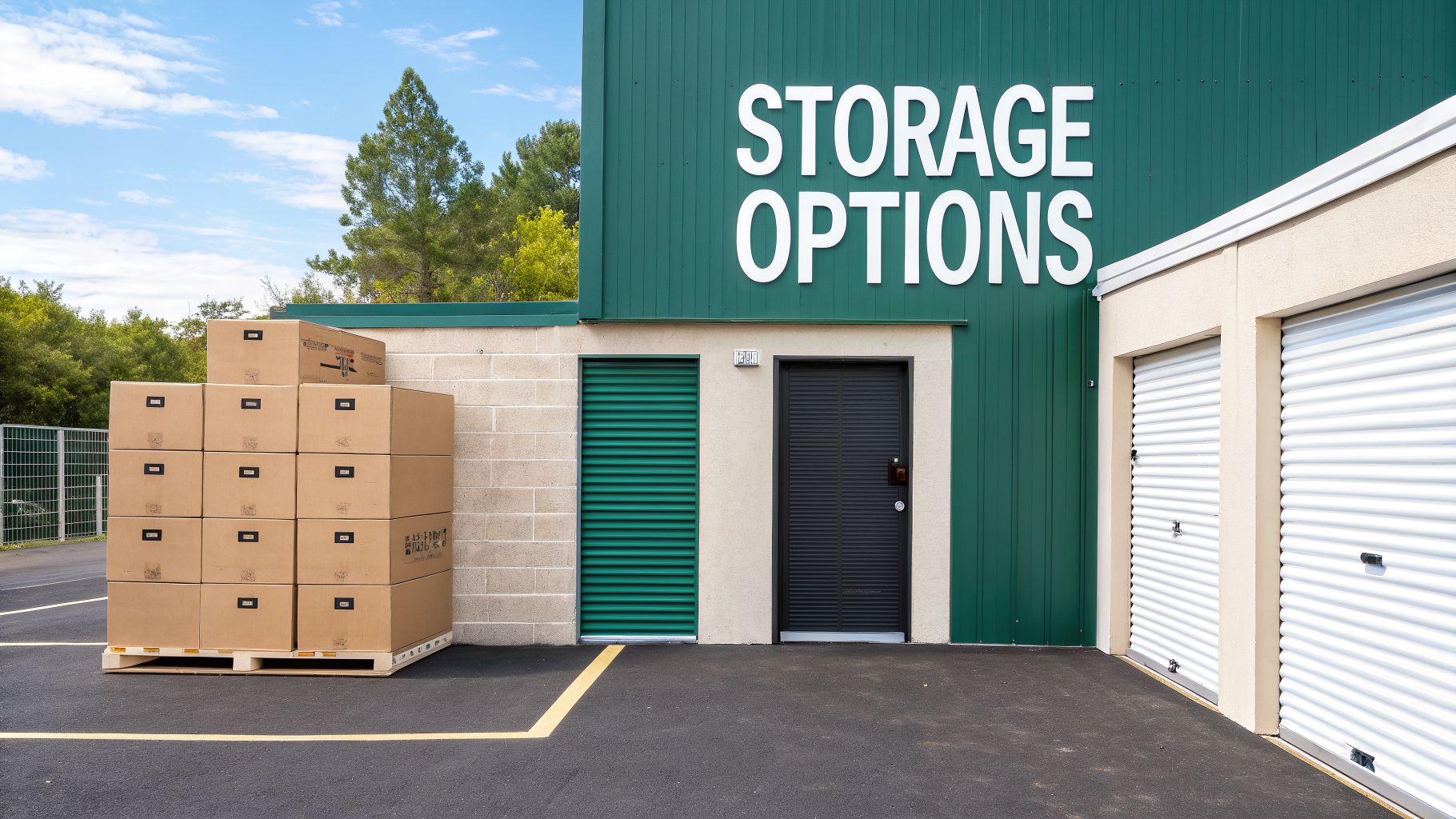
So you've run out of space. It happens to the best of us. When you need a little more room to breathe, figuring out the right kind of additional self storage can feel overwhelming. The truth is, each option is built for a different kind of need, budget, and lifestyle.
Picking the wrong one can mean paying for a huge, half-empty unit or dealing with a logistical nightmare just to get back one box. You’ve basically got three main paths you can go down: per-box storage, a traditional self-storage unit, or a portable container. For a deep dive into every possible scenario, the Complete Self-Storage Options Handbook is an excellent resource.
A Quick Look at the Contenders
Let's break down what each of these really means before we get into the nitty-gritty. Understanding the core concept of each will make your decision a whole lot easier.
Per-Box Storage: Think of it as storage that comes to you. Companies like Endless Storage send you heavy-duty boxes, you pack them up, and they're picked up and whisked away to a secure facility. You only pay for the exact items you store, and they’re brought back whenever you need them.
Traditional Self-Storage: This is the classic drive-up or hallway unit you see everywhere—basically, renting a private garage at a big facility. You’re in charge of getting everything there, packing the unit yourself, and making the trip back anytime you need to grab something.
Portable Storage Containers: You’ve probably seen these containers from brands like PODS sitting in driveways. A large container is dropped off at your house, you fill it on your own schedule, and then it’s either kept on your property or hauled off to a central warehouse.
Quick Guide to Additional Self Storage Options
To make sense of it all at a glance, it helps to see how these options compare side-by-side. This table gives you a quick snapshot to point you in the right direction.
| Storage Type | Best For | Cost Structure | Convenience Level |
|---|---|---|---|
| Per-Box Storage | Small-to-medium volume, seasonal items, city living | Pay per item (box, bulky item, etc.) | High |
| Traditional Self-Storage | Large volume, furniture, frequent direct access | Flat monthly fee for a fixed unit size | Low to Medium |
| Portable Containers | Moving, home renovations, on-site access needs | Flat monthly fee plus delivery fees | Medium |
If you're trying to figure out the budget side of things, our guide on cost-effective storage solutions can help you weigh the financial pros and cons even further.
This high-level overview makes one thing clear: the best additional self storage solution depends entirely on how much you have and how you want to manage it. Paying for a half-empty 5'x10' unit makes little financial sense if you only need to store a few boxes of winter clothes and documents.
Deep Dive Per-Box Storage vs Traditional Units
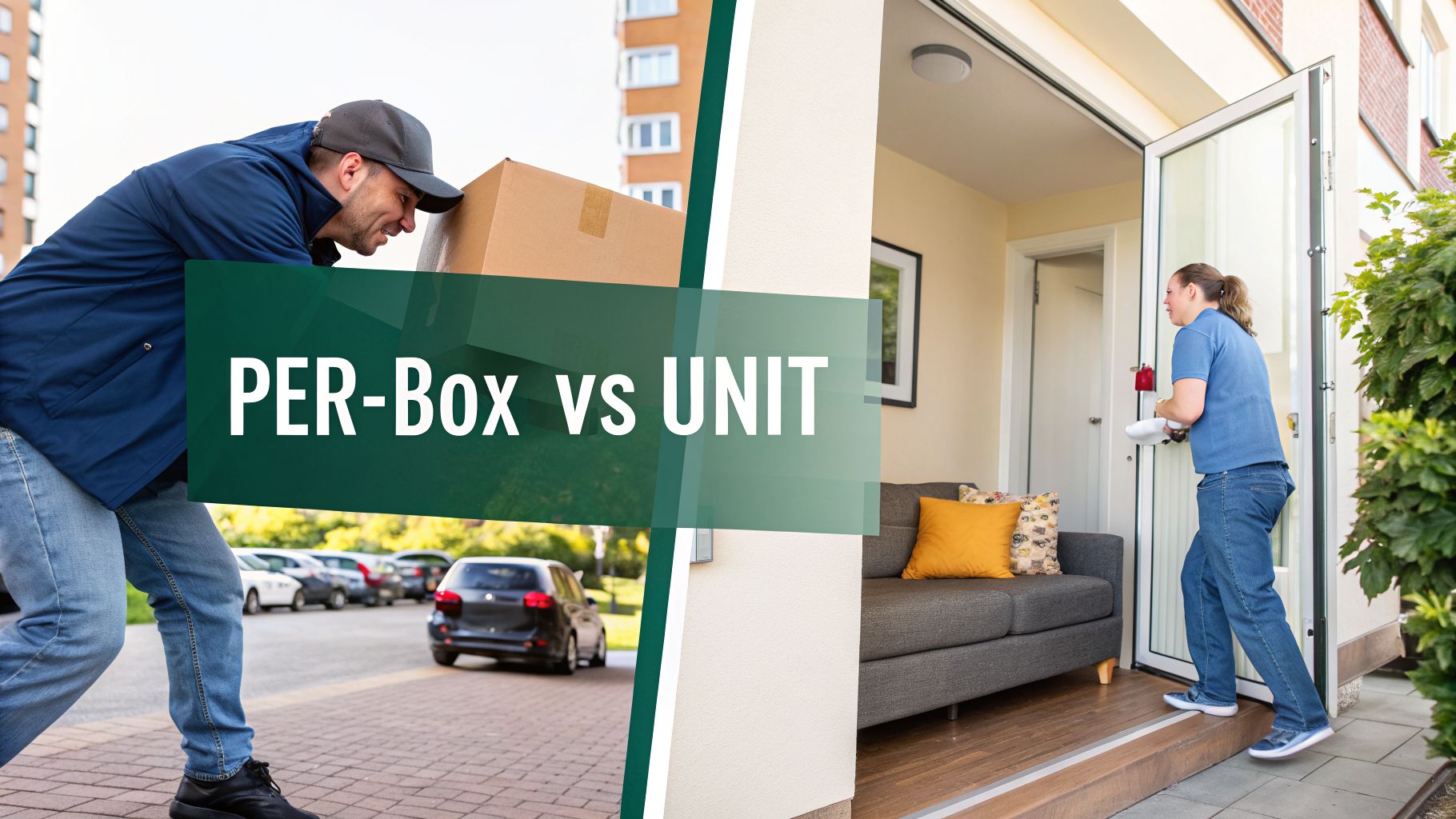
When you need additional self storage, you’ll find yourself choosing between two main paths: modern per-box services and a traditional storage unit. The right answer isn’t about which one is better, but which one fits your life right now. Simply listing pros and cons doesn't really get to the heart of the matter, so let's look at it through a real-world lens.
Think about the difference between stashing seasonal clothes versus an entire living room set. These two jobs have completely different needs, and they perfectly illustrate why one storage model might work for you over the other. It really comes down to a classic choice: paying only for what you use, or paying for a chunk of space you might not completely fill.
Cost Effectiveness: A Tale of Two Scenarios
The biggest difference you'll notice is the price tag. With a traditional unit, you rent a fixed amount of space—like a 5'x5' or 10'x10' locker—for a flat monthly fee, regardless of how full it is. On the other hand, per-box services, like Endless Storage, bill you only for the specific items you’re storing.
Scenario 1: Storing Seasonal Items: You need a home for three boxes of winter coats, one box of holiday decor, and a snowboard. A per-box service would charge a small monthly fee for just those five items. Renting even the smallest traditional unit would mean paying for a lot of empty air.
Scenario 2: Storing Furniture: You're downsizing and need to store a couch, a mattress, and several large boxes. In this case, the flat monthly rate of a 10'x10' traditional unit is usually more cost-effective than paying a per-item fee for that many bulky things.
The math is pretty clear. For smaller, itemized storage, paying per piece saves a ton of money. If you're looking to store the contents of a whole room, a traditional unit's bulk pricing just makes more sense.
Convenience and Access: Urban vs. Suburban Needs
This is where the two models really split, especially for city dwellers. Hauling your things to a traditional storage facility takes time, effort, and a car—a major pain if you don’t have one.
Per-box services were created to solve this exact problem. They deliver boxes right to your door, pick them up once packed, and bring them back whenever you ask. This "valet" model is a lifesaver for people in dense cities like New York or Chicago, where driving and parking are a nightmare. You can learn more about how these services work in our guide to storage box rentals.
"As someone living in a 600-square-foot apartment in the city, the idea of renting a car to haul my things to a storage unit on the outskirts of town was a non-starter. Per-box storage meant I could declutter my entire closet without leaving my building. They picked it all up from my lobby—it felt like magic."
However, if you need to grab your belongings often and on short notice, a traditional unit has the edge. You can drive to the facility and get your items yourself, many of which offer 24/7 access. Per-box services are just as accessible but typically require 24-48 hours' notice to schedule a return delivery.
Security and Item Care
Both options take security seriously, just in different ways. Traditional facilities have on-site security features like gates, cameras, and sometimes guards. You use your own lock, so you have the only key to your unit.
Per-box services handle security at a centralized, climate-controlled warehouse. These locations aren't open to the public, which means access is highly restricted. It also means your things are kept in a stable environment, protecting them from damage caused by extreme temperature swings. For sensitive items like electronics, wooden furniture, or important documents, that climate stability is a huge plus.
When to Choose Portable Storage Containers
Beyond traditional units and per-box services, there's another option you've probably seen in your neighborhood: portable storage containers. We're talking about those big, box-like containers, often from brands like PODS, that pop up in driveways during a move or renovation. Their entire appeal is built around short-term, on-site access.
Unlike any other storage option, a portable container brings the unit right to your doorstep. The company drops it off on your property, and you can take your time loading it over days or even weeks. This makes them a fantastic solution when you need constant access to your stuff while it’s temporarily out of the house.
Ideal Scenarios for Portable Containers
Portable storage really excels in a few specific situations where logistics are the biggest headache:
- Home Renovations: Tearing up a kitchen or finishing a basement means you need to get furniture and boxes out of the way but keep them close. A container sitting in the driveway is the perfect on-site staging area.
- Local Moves: Imagine loading up a container over a week instead of cramming it all into one chaotic moving day. Once you're ready, the company picks it up, drives it to your new home, and you can unload at your own pace.
- Temporary On-Site Storage: Businesses often grab these to handle seasonal inventory overflow or to store equipment securely on a construction site.
Logistical Hurdles and Limitations
That on-site convenience comes with some major trade-offs, which is why portable containers aren't a great fit for long-term needs or just storing a few things. The biggest issue is simply space and local rules. You absolutely need a private driveway or yard to place one, which rules out most apartment dwellers and a lot of city residents.
Trying to put one on a public street is a whole other story, often requiring special permits and a trip through city regulations. If you're looking for more details, our complete guide on portable storage containers breaks down all the pros and cons.
The key takeaway is that portable containers are a specialized solution for short-term, high-volume needs where on-site access is paramount. They are not a practical choice for storing a few boxes or for anyone without a dedicated, private space to place one.
This is especially true for the majority of renters. Interestingly, Gen Xers are the top users of self-storage, with 54% of them renting a unit. At the same time, 52% of all storage facilities are in the suburbs, where driveway space is far more common. You can discover more about self-storage market trends and demographics to see how these patterns line up. For the typical apartment resident just needing to clear out some seasonal gear, the cost and hassle make this option a non-starter compared to a simple per-box service.
Packing and Protecting Your Stored Items
Once you've decided on the right kind of additional self storage, the next step is just as important: making sure everything is packed securely for its time away. It's not just about preventing dings and scratches—good packing makes finding and retrieving your stuff a thousand times easier.
Think about it. Using sturdy, uniform boxes makes stacking them a breeze and keeps things from toppling over. Meticulous labeling saves you from the future headache of guessing what's where. This is especially true for services like Endless Storage, where a detailed inventory is your best friend for managing individual items.
The Critical Role of Climate Control
Not all storage spaces are created equal. You have to consider the environment, because things like intense heat, cold, and humidity can absolutely wreck sensitive items. Wood furniture, electronics, artwork, and even important documents don't stand a chance in extreme conditions.
That’s where climate control becomes a non-negotiable for certain belongings. It’s no surprise that demand for these specialized units is growing. In fact, roughly 1 in 5 people using self-storage now opt for climate-controlled spaces to protect their valuables from weather damage.
It’s a smart move, especially if you live somewhere with harsh seasons. While these units cost a bit more, it’s a small price to pay for peace of mind. For a closer look at this trend, you can review recent self-storage industry statistics.
Practical Packing and Insurance Tips
Keeping your items safe involves more than just a good environment. It all comes down to smart packing habits and making sure you have the right insurance coverage in place.
Use the Right Materials: Your packing materials are your first line of defense. Invest in new, sturdy boxes, and skip the used ones from the grocery store—they can have hidden weaknesses or even pests. Load up on packing paper and bubble wrap. For extra guidance, check out our guide on how to pack fragile items for some expert tips.
Label Everything Meticulously: Don't be shy with the marker. Label each box on multiple sides with its contents and the room it came from. If you're using a per-box service, take a minute to create a digital inventory with photos so you know exactly what’s in each box without having to open it.
Understand Your Insurance Options: A common mistake is assuming your homeowner's or renter's insurance automatically covers items in storage. Many policies have surprising limitations. Services like Endless Storage often include a baseline insurance plan with every order, which gives you built-in protection. Always ask and clarify the coverage details before you store anything.
The screenshot below shows just how simple it is to manage your stored items with a modern service.
This kind of digital interface lets you see all your stored boxes at a glance and request a return with just a few clicks. It’s a seamless process, and a well-organized digital inventory is what makes this incredible convenience possible.
Making the Right Choice: Your Decision Checklist
Figuring out what kind of additional self storage you need really comes down to asking the right questions. We've compared the options, and now this final checklist will help you land on the perfect solution by looking at what truly matters for your situation: convenience, cost, and access.
Take a minute to answer these questions honestly. It’s the best way to steer yourself toward the service that genuinely fits your life. There’s no single “best” option here—just the one that’s right for you.
Key Questions to Ask Yourself
Before you pull the trigger on a storage solution, run through this simple framework. Your answers will point you down the right path.
How much stuff are you actually storing? If it’s just a handful of boxes, seasonal gear, or some documents, per-box storage is almost always the most cost-effective way to go. But if you’re looking to store the entire contents of a room or a few large pieces of furniture, a traditional unit will give you more bang for your buck.
How often will you need to get to your things? For items you can plan for and only need back with 24-48 hours' notice, a per-box service that offers scheduled delivery is perfect. If you need immediate, 24/7 walk-in access to grab something on a whim, a traditional unit is really your only option.
What’s your budget look like? Do you prefer paying a small fee for each item and only for the exact space you use? That’s the per-box model. Or does a predictable, fixed monthly rate for a larger, defined space feel safer for your budget? That points directly to a traditional unit.
Do you have a way to transport everything? If you don’t have a car or just want to skip the hassle of renting a truck and driving to a facility, the pickup and delivery model of per-box storage is a lifesaver. If you have a vehicle and don't mind making the trip, a traditional unit is completely manageable.
The decision tree below gives you a great visual for how the amount of stuff you have is the first big fork in the road.
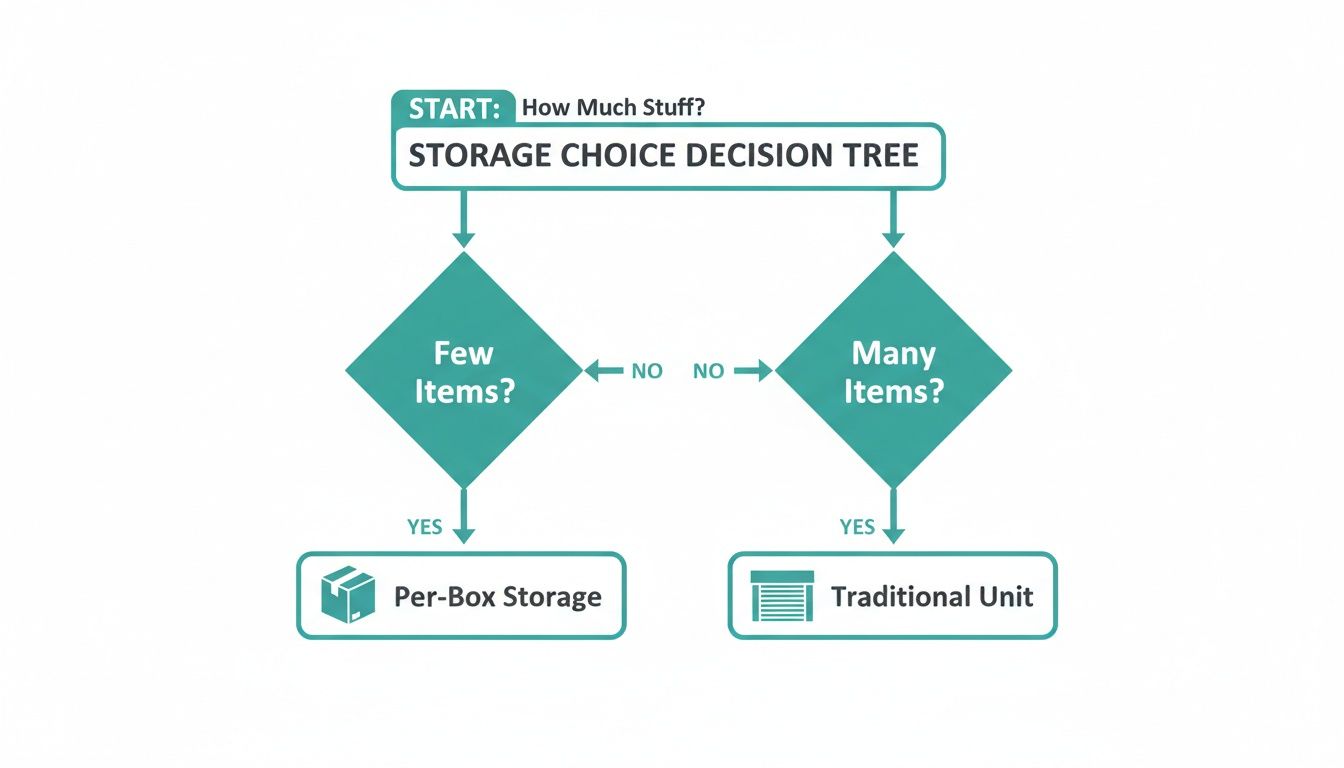
This flowchart really simplifies that first decision, showing that for a small number of items, per-box storage is the most logical starting point. For a more precise estimate of your needs, our storage space calculator can help you dial it in.
For urban residents with fewer items, a desire for convenience, and no easy access to a car, per-box storage like Endless Storage emerges as the clear, modern solution. It's built for your lifestyle.
FAQ
Deciding on the right kind of additional self storage can bring up a lot of questions. We’ve been there. Here are some quick, practical answers to the questions we hear most often to help you feel confident in your choice.
How Quickly Can I Get My Items Back?
With a traditional self-storage unit, you can get your things whenever you want, just by driving over. For per-box services like Endless Storage, the process is just as simple but needs a little bit of planning ahead.
You just log into your online account, request a return, and your items are typically shipped right back to your door within 24-48 hours.
What If I Don't Know How Much Storage I Need?
This is a really common spot to be in. The great thing about per-box storage is that you don’t have to guess. You pack what you want to store, and you only pay for those specific boxes or bulky items.
This flexibility completely removes the risk of paying for a traditional unit that ends up being half-empty.
With modern per-box storage, you're not locked into a fixed space. You can add or get back items one by one, letting your storage grow or shrink with your needs without ever having to sign a new contract or move to a different unit.
Can I Store Large or Awkwardly Shaped Items?
Yes, many per-box services are set up to handle more than just standard boxes. Things like skis, snowboards, golf clubs, and even some small furniture can usually be stored.
You’ll just want to double-check the service’s specific rules for oversized items before you schedule a pickup.
Is Per-Box Storage Cheaper Than a Traditional Unit?
It really depends on how much you’re storing. For a small number of boxes or a few seasonal items, per-box storage is almost always the more budget-friendly option.
However, if you need to store the contents of an entire room or several large pieces of furniture, the flat monthly rate of a traditional storage unit will likely be the more economical choice.
Ready to clear the clutter without leaving your home? With Endless Storage, you get convenient, per-item storage that comes to you. Get started today and reclaim your space. Learn more about how it works.
Frequently Asked Questions
Unveiling the Secrets to Effortless Storage
Endless Storage is available nationwide. You pick a plan, tell us where to pickup, and we'll send a UPS van to collect, whichever state you're in.
Your shipping label will be sent to your email within a few minutes, if not instantaneously. It can also be accessed through your customer profile.
Your box will be shipped to one of our climate controlled self storage facilities in our closest self storage facility. Our manager will accept your package, notify you that your box has been received, and securely stored. Only our managers will have access to Endless Storage boxes.
Email us at admin@endless-storage.com click to live chat with us, or send us a message below.
Never! We're committed to transparent pricing with no surprises. You'll lock in your rate with no hidden fees and no long-term contracts.
Fast access guaranteed! Your boxes will arrive at your doorstep within 48 hours of requesting them back. Need to check on delivery? We provide tracking information for complete peace of mind.
Totally flexible! Store month-to-month with no long-term commitment and cancel anytime.
Everything's online! Use your account dashboard to:
• Set up automatic monthly payments
• Request box returns
• Update your address
• Order additional boxes
• Track shipments
Your boxes are insured up to $100 each. Our customer service team will help you file any necessary claims and resolve issues quickly.
Don't worry – we'll email you right away if there's a payment issue. Your items stay safe, though you may have temporary service interruption or late fees until payment is resolved.
When you request our free storage kits, you'll have 30 days to send in your boxes to activate your 3 months of free storage. Think of it like starting a gym membership – your activation window begins when you receive your kits, and your full free trial begins once you send in your first box. During your free months, you'll experience our complete storage service at no cost.
Your 30-day activation window begins when you receive your storage kits. We'll send you an email confirmation when your kits are delivered, marking the start of your activation period.
If you haven't sent any boxes for storage within your 30-day activation window, your free trial will expire and we'll begin charging the regular monthly rate of $9.99 per box. This helps ensure our storage kits go to customers who are ready to use our service.
A box costs $9.99 per month to store (plus sales tax). This price includes free shipping for standard boxes under 50 lbs. and smaller than 16"x16"x16"
Log into your Endless Storage account, locate the box you would like returned, and simply click Return My Box.
Yes, each box stored with us is insured for up to $100 throughout transit as well as the duration of storage within our facilities.
Your box will be at your doorstep within 48 hours of you requesting it back.
Store 10+ boxes? We'll pick them up for free! After your purchase, we'll contact you to schedule a convenient pickup time and arrange UPS collection.
We trust UPS with all shipments, and every box includes $100 insurance coverage. You'll receive tracking information to monitor your items' journey.
Yes! Visit any of our locations by appointment. Just bring a photo ID matching your customer profile.
For everyone's safety, we can't store hazardous materials, firearms, or perishables. All items must fit within our standard boxes.
It's easy! Order your storage kit online, and we'll ship it to you within 1-2 business days. Your shipping labels will be emailed instantly and available in your account.
We're here to help! Email us at admin@endless-storage.com, use our live chat, or send us a message through your account.
To cancel your storage service with Endless Storage, please email your cancellation request to admin@endless-storage.com. Our team will process your request within 2 business days and confirm your cancellation via email.
We understand packing takes time. However, to maintain your free trial benefits, you'll need to send at least one box within the 30-day activation window. If you need more time, you can always start with one box to activate your trial and send the rest later. You can always reach out to admin@endless-storage.com if you have any issues or concerns.
When you request our free storage kits, you're starting a 30-day window to begin using our storage service.
Important: To activate your free trial, send at least one box for storage within 30 days. If no boxes are sent within this 30-day window, a one-time $50 fee applies to cover materials and shipping costs. This fee is clearly disclosed before you sign up.
Think of it like reserving a hotel room – we're setting aside space and sending specialized packing materials for your use. The fee only applies if you request materials but don't begin storage, similar to a hotel's no-show charge.